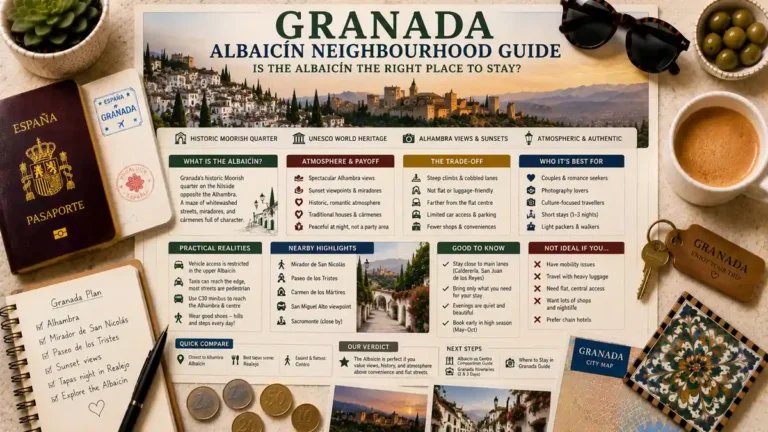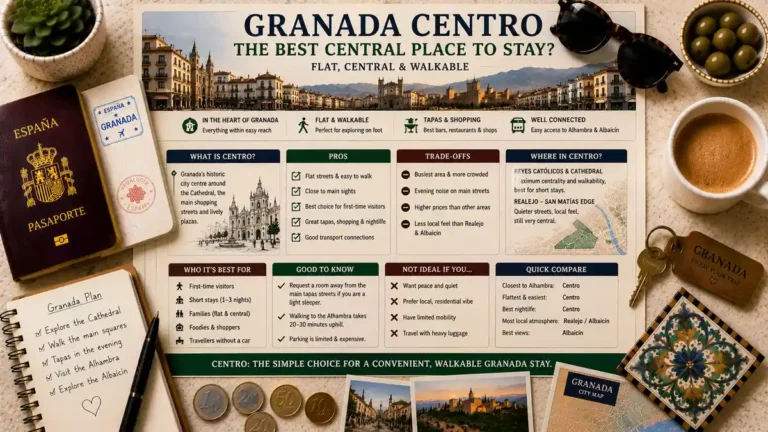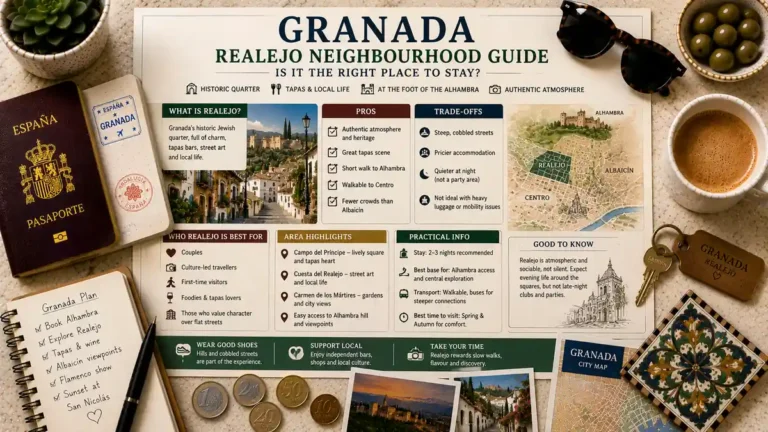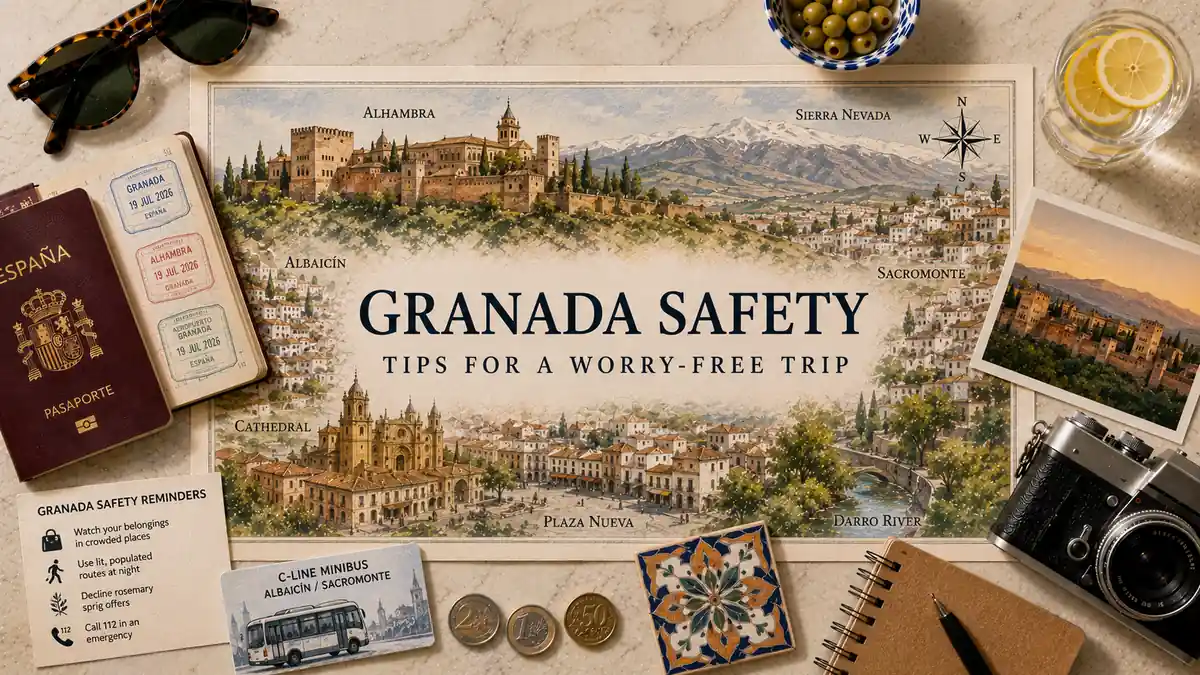
You have chosen Granada, and now the practical question is how safe it actually is and what you should watch for. That instinct is sensible, and the answer is reassuring: Granada is a genuinely safe city where serious crime against visitors is rare. Walking the Albaicín at dusk, queuing for the Alhambra, or riding a crowded minibus uphill, you are far more likely to lose a phone to a pickpocket than to face any real danger. Petty theft is the one variable that separates an easy trip from an annoying one, and it concentrates in a handful of predictable places. This guide gives you the honest verdict, names exactly where and when risk gathers, explains the local rosemary-sprig scam, and turns it all into a short precaution checklist you can actually use.
Quick Answer
Yes, Granada is one of Spain’s safer cities, and violent crime against visitors is rare. The real risk is petty theft — pickpocketing and bag-snatching in crowded tourist spots. Stay alert in Alhambra ticket queues, on packed minibuses, and on unlit Albaicín and Sacromonte lanes after dark; elsewhere, relax and enjoy the city.
Trust Layer
Tripstou planning guide for travelers resolving one travel decision. Covers the main variable, traveler context, and practical tradeoffs.
Produced with AI assistance and reviewed by Alex Perrut, working in tourism since 2015, for the Tripstou editorial team. See our editorial process for details.
Last factual review: July 19, 2026.
Official sources consulted: spain.info, tourspain.es.
Key Takeaways
- Granada is one of Spain’s safer cities, so serious crime is unlikely and the real concern is opportunistic petty theft.
- Pickpockets concentrate in Alhambra ticket queues, packed C-line minibuses, and the crowds around the cathedral and central squares.
- The Albaicín and Sacromonte are safe and beautiful by day; after dark, stick to lit, populated main routes.
- Decline the rosemary sprig offered near the cathedral, since accepting it triggers a payment demand and a distraction theft.
- Solo and female travellers can explore Granada comfortably by applying the same crowd-awareness and night-route habits.
- Carrying your bag crossbody and in front, and keeping your phone off café tables, prevents nearly every incident.
Table of Contents
Is Granada safe for tourists?
Yes, Granada is a very safe city for tourists, and serious crime is uncommon. It ranks consistently among Spain’s safer destinations, and most visits pass without incident. The one genuine concern is petty theft, which targets distraction rather than confrontation. Treat pickpocketing as the main risk and Granada feels reassuringly easy.
The reassurance holds because the crime you are most likely to meet is opportunistic, not aggressive. Thieves in Granada want a quiet win — an unzipped bag, a phone left on a table — and they melt away the moment you notice them. Confrontational street crime against tourists is genuinely unusual, which is why the city feels relaxed even late in the evening.
National-level questions — countrywide scam patterns, the legal system, and full emergency-contact detail — sit outside this page. For that broader picture, see our Spain safety guide; here the focus stays tightly on Granada itself.
Is Granada safe at night?
Yes, Granada is comfortable at night across its central, well-lit areas, where evening life stays busy and relaxed. Tapas bars fill the center late, and streets stay populated well past midnight. Caution applies mainly to narrow, unlit lanes on the hillsides. Keep to main routes after dark and the city stays welcoming.
The nightlife itself is part of what makes Granada feel secure after dark: the free-tapas tradition keeps the center full of people until late, and busy streets are safe streets. Around the cathedral, Plaza Nueva, and the Realejo, you can walk comfortably in the evening.
The picture changes only where the crowds thin. The Albaicín and Sacromonte are built on steep, twisting lanes that empty out and dim after nightfall, so an isolated shortcut there is worth skipping in favor of the lit, populated way down. The rule is about lighting and footfall, not about any single neighborhood being dangerous.
Where do pickpockets operate in Granada?
Pickpockets in Granada work the busiest, most distracted crowds, not quiet residential streets. The reliable hotspots are the Alhambra ticket queues, packed C-line minibuses climbing to the Albaicín, and the tight crowds around the cathedral and central squares. Anywhere tourists bunch together and slow down, opportunists follow.
The pattern is consistent enough to plan around. Risk clusters where three things overlap: dense crowds, distracted visitors, and easy exits for the thief.
- Alhambra ticket queues and entry points — people stand still, juggle phones and tickets, and stop watching their bags.
- Crowded minibuses — the little uphill buses to the Albaicín and Sacromonte pack passengers standing shoulder to shoulder.
- Cathedral, Plaza Bib-Rambla, and central squares — busy pedestrian crowds and outdoor café tables.
- Alcaicería lanes — the narrow market streets funnel visitors into slow-moving, easily jostled queues.
The little C-line minibuses to the Alhambra and Albaicín are the single most reliable pickpocket spot in the city — everyone is wedged in standing, watching the view instead of the bag on their hip. Board with your bag zipped and held in front, and the ride is a non-event. The route mechanics themselves, timetables, and late-night options belong on our Granada transport guide.
Are the Albaicín and Sacromonte safe?
Yes, both the Albaicín and Sacromonte are safe and rewarding by day, and their lanes are among Granada’s highlights. The difference is nightfall. After dark, these hillside neighborhoods turn quiet, steep, and poorly lit, so stick to the main, populated routes. Wander freely by day; choose your path deliberately at night.
By daylight these are two of the most memorable places in the city — the Albaicín’s whitewashed maze and viewpoints, Sacromonte’s cave houses and flamenco. Explore them fully. The only real adjustment is the return journey once the sun is down, when the same picturesque lanes lose their crowds and their lighting.
If you go up to Sacromonte for an evening flamenco show, arrange your way back before you climb — the walk down the unlit lanes after the zambra is exactly where the day-versus-night line starts to matter. A short taxi or a stick-to-the-main-road route removes the problem entirely.
This page frames these areas through safety only. If you are weighing where to base yourself and want the safe-area-versus-avoid-at-night breakdown for choosing a hotel, that lives on our Granada where-to-stay guide.
What is the rosemary-sprig scam in Granada?
The rosemary-sprig scam is Granada’s signature tourist hustle, most common near the cathedral and the approaches to the Alhambra. A friendly woman presses a sprig of rosemary into your hand, offers to read your palm or your fortune, then demands payment — while an accomplice may go for your bag. Decline and keep walking.
The sprig is offered as a gift, and that is the whole trap: once it is in your hand, the demand for money feels awkward to refuse, and the fuss of the “reading” is cover for a second person working your pockets. The fix is to never accept it. A firm “no, gracias” without breaking stride ends it every time — keep your hands to yourself and your bag closed.
Is Granada safe for solo and female travellers?
Yes, Granada is a comfortable, welcoming city for solo and female travellers. It is a popular stop on independent trips, and the safety picture is the same as for anyone — petty theft is the concern, not personal threat. Apply normal night-route awareness on the hillsides and you can explore with confidence.
Granada draws a steady flow of solo travellers, students, and independent visitors, and the compact, walkable center makes it easy to get around alone. Daytime exploring, tapas-hopping in the evening, and the main viewpoints are all comfortable solo. The precautions are the ordinary ones: keep to lit, busy routes late at night, stay aware in crowds, and trust your instinct to leave any situation that feels off.
What precautions should you take in Granada?
The best precautions in Granada are simple anti-theft habits, since distraction is how nearly every incident happens. Carry your bag crossbody and in front in crowds, keep your phone off café tables, and raise your guard in queues and on packed buses. Decline the rosemary sprig. Do this and the risk drops sharply.
None of this requires anxiety — it is a short set of reflexes that becomes automatic within a day:
- Bag to the front in crowds — crossbody, zipped, and swung around to your chest in queues and on buses.
- Phone off the table — pocket it while eating outdoors rather than leaving it beside your plate.
- Split your valuables — keep a card and some cash separate from your main wallet.
- Heighten awareness at the hotspots — Alhambra queues, minibuses, and the cathedral crowds deserve extra attention.
- Decline the rosemary sprig — do not take anything pressed into your hand near the cathedral.
- Stick to lit routes after dark — especially returning from the Albaicín or Sacromonte.
The habit that pays off most is the one that costs nothing: a hand resting on your bag whenever you stop moving, because thieves need you distracted and stationary to work. For everyday etiquette and practical pointers beyond safety, see our Granada travel tips.
Frequently Asked Questions
Which areas of Granada should you avoid after dark?
Granada has no genuinely dangerous districts to avoid outright. The only areas that warrant caution after dark are the isolated, unlit lanes high in the Albaicín and Sacromonte, where footfall thins and shortcuts feel lonely. Stay on the main, populated, well-lit routes and you can move around comfortably at night.
Is Granada safe for families with kids?
Yes, Granada is an easy, welcoming city for families. The compact center, relaxed tapas culture, and busy plazas suit children well, and there is no personal-safety concern beyond ordinary crowd awareness. The same petty-theft precautions apply: keep bags zipped and to the front in queues and on packed minibuses.
Are Granada’s taxis and minibuses safe?
Yes, Granada’s taxis and little C-line minibuses are safe to use. Licensed taxis are reliable, and the minibuses climbing to the Albaicín and Sacromonte are a normal, convenient way up. The only catch is pickpocketing on the packed buses: board with your bag zipped and held in front.
What number do you call in an emergency in Granada?
Dial 112 for any emergency in Granada — it is the free number for police, ambulance, and fire across Spain and the EU, and operators can assist in English. For non-urgent issues like reporting a theft for insurance, ask your accommodation to point you to the nearest police station.
Is it safe to visit the Alhambra?
Yes, visiting the Alhambra is completely safe. It is Granada’s most-visited monument, well-managed and heavily frequented all day. The only real risk sits outside the walls: the ticket queues and entry points are prime pickpocket ground. Keep your bag zipped and to the front while you wait, and stay relaxed inside.
Is tap water safe to drink in Granada?
Yes, tap water in Granada is safe to drink. The city’s supply is treated to Spanish and EU standards, and locals drink it routinely; Granada’s mountain-fed water is often praised for its taste. Carry a refillable bottle to save money and cut plastic, and drink freely from public fountains marked potable.
Related Guides
Keep planning your trip with the next logical guides in the Granada cluster:
- Granada travel guide — the full hub for planning your visit.
- Granada 2-day itinerary — a focused plan for a short stay.
- Granada 3-day itinerary — a fuller route with time beyond the Alhambra.
- Granada trip cost — what to budget for your visit.
- Granada transport guide — getting around, including the minibuses to the Albaicín.
- Granada travel tips — practical pointers for a smoother trip.
Did this guide save you time or money? Tripstou is independent and reader-funded — if you'd like to give something back, you can support the site with a crypto contribution of any size.