Granada, Spain is worth a dedicated stop on a first trip to Spain, and two nights is the floor. The Alhambra is both the reason to come and the constraint that shapes the visit: your Nasrid Palaces time slot decides which day you spend on the hill, and everything else fits around it.
Most long-haul visitors reach Granada through Madrid or Málaga, often as one stop on a wider Andalusia route. This guide settles the planning calls in the order you make them: whether the city suits you, how to secure the Alhambra, how long to stay, when to go, where to base, how to arrive, what it costs and which day trips are worth the effort.
Quick Answer
Granada deserves its own stop: the Alhambra, the Albaicín and a tapas culture where a drink still comes with a free tapa. Book your Nasrid Palaces slot first, then build around it: two days is the minimum, three adds Sacromonte, Realejo or a day trip. It suits first-timers also visiting Seville and Córdoba, couples and culture-led travelers.
Granada Is Worth the Detour, and Here Is Who It Suits
Granada is worth the detour for almost any first-time visitor to southern Spain. The Alhambra is one of the country’s most visited monuments, and the city around it is compact, hilly and unusually cheap to eat in. It suits culture-led first-timers, couples and anyone already pairing Seville and Córdoba on the same trip.
The city rewards travelers who like to walk and look. Moorish palaces, whitewashed hill lanes and an evening bar circuit sit within a short distance of each other. You can see the essentials without a car, a guide or a packed schedule.
The honest drawbacks are physical and seasonal. The Albaicín and the Alhambra both sit on steep hills, the palace complex is crowded at peak times, and winter nights turn cold. Granada is also no beach town and no all-night party city. If those are the priorities, it works better as a two-night cultural break inside a longer trip.
What Granada Is Known For: the Alhambra, the Albaicín and Free Tapas
Granada is known for the Alhambra, with its Nasrid Palaces, Generalife gardens and Alcazaba fortress; for the Albaicín, the old Moorish quarter, and its Mirador de San Nicolás viewpoint; for the Sacromonte caves and their flamenco; for the Cathedral and Royal Chapel; for the riverside Carrera del Darro; and for the free tapa that arrives with every drink.
The Alhambra crowns the hill above the city centre and takes most of a day. The Nasrid Palaces are the timed, most sought-after part; the Alcazaba is the fortress at the western tip, and the Generalife is the garden estate higher up the slope. Planning starts here because this is the one sight with a fixed entry time.
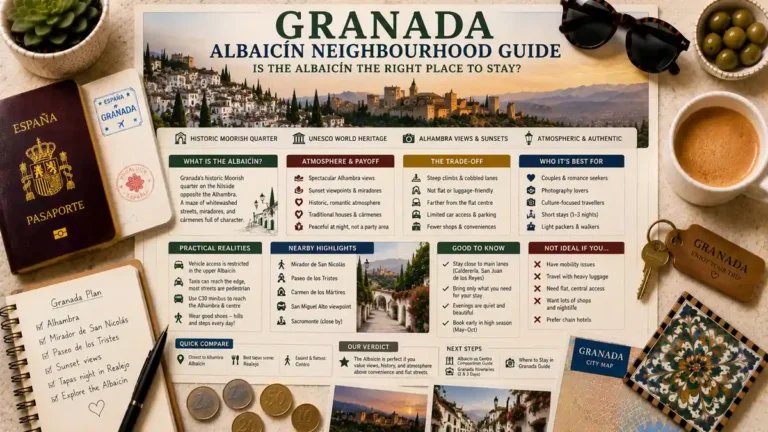
The Albaicín climbs the hill facing the Alhambra across the Darro valley. Its lanes lead up to the Mirador de San Nicolás, where the palace walls line up against the Sierra Nevada, and the view at dusk is the reason many visitors save the quarter for late afternoon. A guided route through the lanes is one way to see it without getting lost: you can join a sunset walk that continues into Sacromonte.
Sacromonte runs further along the same hillside, past the edge of the Albaicín. Its homes and venues are dug into the slope, and the cave flamenco performances held there are the evening most visitors plan around. Seats are limited in a cave, so it pays to reserve a cave show for the night you want.
Down in the flat centre, the Cathedral and the Royal Chapel stand side by side; the chapel holds the tombs of the Catholic Monarchs, Isabella and Ferdinand. From Plaza Nueva, the Carrera del Darro follows the river beneath the Alhambra walls and is the easiest way to walk between the centre and the Albaicín.
The free tapa shapes how Granada eats. Order a drink in a traditional bar and a small plate usually comes with it, so an evening of two or three bars can replace a sit-down dinner. The Spain food guide explains how tapas culture works across the country, and the full selection of sights, with what each one needs, sits in our guide to things to do in Granada.
Tours and activities
Book skip-the-line tickets, day trips and local tours with free cancellation on most activities.
You can also browse everything on getyourguide.com.
Tripstou may earn a commission if you book through this link, at no extra cost to you.
Book the Alhambra Before You Fix Your Dates
Book your Alhambra ticket before anything else in Granada. The Nasrid Palaces can be visited only in the time slot printed on the ticket, online sales close at 23:59 the day before the visit, and the official site advises buying in advance because demand is high.
Tickets are nominative. Bring the original ID you used to book, and if you need to collect a ticket, do it at least one hour before your slot.
Only the palaces are timed. The Alcazaba, the Partal and the Generalife can be visited at any time within the day on your ticket, so the slot fixes one hour of your day and the rest of the complex moves around it.
Pick the slot first and the hotel second. A morning Nasrid slot leaves the afternoon free for the Albaicín and its sunset viewpoint, while a late slot pushes the Albaicín to another day, which is often what turns a two-day trip into three. Ticket types, prices and guided visits are compared in the Alhambra guide.
How Many Days Do You Need in Granada?
Two full days is the minimum for Granada: one for the Alhambra, one for the Albaicín and the centre. Three days is the relaxed number, adding Sacromonte, Realejo or a day trip without rushing the essentials.
| Trip length | What fits | Who it suits |
|---|---|---|
| 1 day | The Alhambra and a short evening in the centre | Travelers passing through on a tight route |
| 2 days | The Alhambra on one day, the Albaicín, Cathedral and centre on the other | Most first-timers on a multi-city Spain trip |
| 3 days | Adds Sacromonte, Realejo evenings or one day trip | Couples and slower-paced travelers |
| 4+ days | Adds the Sierra Nevada, the Alpujarras or a rail day trip | Hikers, skiers and travelers using Granada as a base |
One day fails because the Alhambra alone takes half of it once you add the climb, the queue for your slot and the gardens. That leaves no daylight for the Albaicín, which is the other half of why you came.
The third day buys slack. It absorbs a badly timed Alhambra slot, a hot afternoon or a long tapas night, and it opens a flamenco evening in Sacromonte. Four days only make sense when you add the mountains or a rail day trip. Day-by-day plans are in the 2-day Granada itinerary and the 3-day Granada itinerary.
Spring and Autumn Beat Summer in Granada
April to June and September to October are the best months to visit Granada. Summer is hot enough to make the Alhambra and the Albaicín climbs hard work, while winter brings cold nights, clear skies and snow on the Sierra Nevada.
Granada sits inland at altitude below the mountains, and that shapes every season. Days can be warm while evenings turn cool, even in spring and autumn, so the right bag carries a layer in every month. Our Spain packing list covers what each season means for your luggage.
Spring brings the gardens of the Generalife at their best, and also the busiest Alhambra demand. Holy Week and other national holidays fill hotels and slots fastest, so book early if your dates fall around them. Autumn keeps the light and the warmth with slightly thinner crowds.
Winter is the underrated season. The Alhambra is quieter, the Sierra Nevada is white behind the Mirador de San Nicolás view, and the city stays sunny by day even when nights are cold. If you are weighing Granada against the rest of the country, the best time to visit Spain guide sets out the season logic region by region.
Where to Base Yourself in Granada
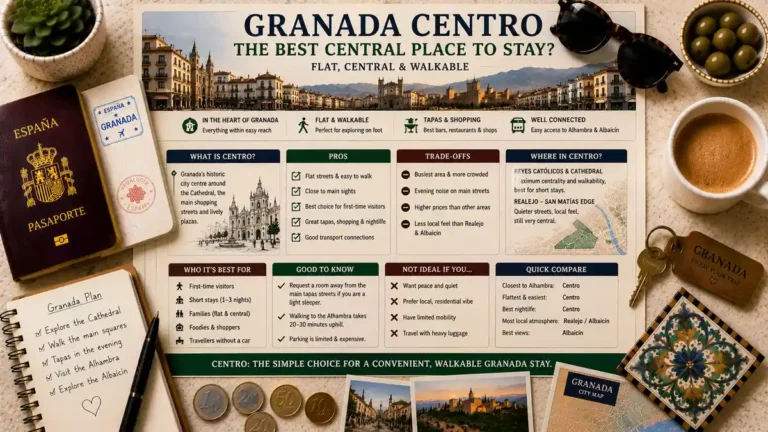
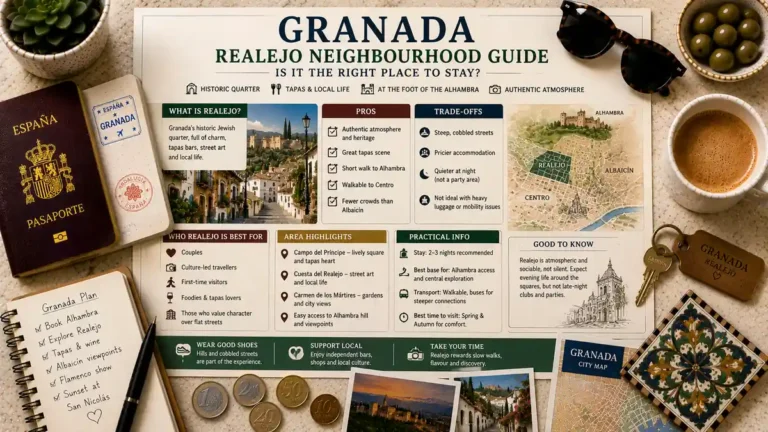
Base yourself in Centro for a flat, practical first visit. Choose the Albaicín for views and atmosphere, at the cost of hills and dragging luggage up cobbles; Realejo for tapas bars and lively evenings; and Sacromonte only if the cave-and-flamenco experience is the point of the stay.
- First-time visitors are best placed near the Cathedral and Plaza Nueva, with taxis, buses and both hills within walking reach: see where to stay in Granada for a first visit.
- Budget travelers keep the bill down by sleeping in the flat centre and walking everywhere, with hostels and simple guesthouses covered in budget places to stay in Granada.
- Couples tend to trade convenience for a terrace facing the Alhambra in the Albaicín, the angle taken by romantic stays in Granada.
- Families need flat streets, space and easy car-free access, which is why the centre usually wins in family stays in Granada.
- Travelers with a bigger budget weigh restored palaces in the old town against hotels close to the Alhambra, compared in luxury stays in Granada.
- Night owls want Realejo or the streets around the centre’s bars, mapped in where to stay in Granada for nightlife.
- Design-led travelers looking for small, characterful hotels in old houses will find them in our boutique hotels in Granada guide.
The full neighbourhood comparison, with the tradeoffs of each area, is in our guide to where to stay in Granada.
Hotels and places to stay
Compare hotels, apartments and stays for your dates in one search.
Search hotels and stays on hotels.com →
Tripstou may earn a commission if you book through this link, at no extra cost to you.
How to Get to Granada and Get Around Once You Arrive
Most long-haul visitors reach Granada through Madrid or Málaga and finish the journey by train or a short connecting flight. Granada’s own airport is small and sits about 15 km from the centre. Once in the city, you walk.
Arriving by air: GRX and the Alsa 245 bus
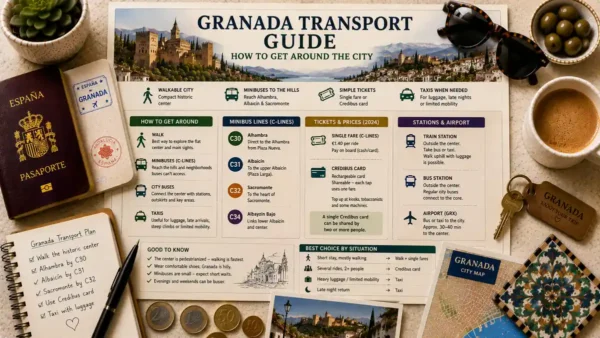
Alsa Line 245 is the public link between Federico García Lorca Granada-Jaén Airport (GRX) and the city centre. It stops at the Palacio de Congresos, Gran Vía by the Cathedral, Avenida de la Constitución and the bus station, and the ride takes about 45 minutes depending on traffic.
Schedules are timed to flight arrivals, and tickets are sold on board or at sale points. Timetables, taxis and the other options are in our Granada airport transport guide.
Arriving by rail via Antequera, Córdoba or Madrid
The train is the default way to reach Granada from Madrid or Málaga. Granada joins Spain’s high-speed network through Antequera, and Córdoba sits on the Madrid high-speed line, which is why the two cities pair so easily on one route.
There are no direct flights from the United States to Granada. Long-haul travelers usually connect via Madrid, with Málaga as the other common gateway, then continue by rail or a domestic hop. Journey times, stations and the bus alternatives are covered in getting around Granada. If Granada is one stop on a longer rail trip, the Spain train itinerary shows how it links up.
Getting around: walk, minibuses, no car
Granada’s centre is walkable, and walking is how you will see most of it. The Albaicín and the Alhambra climbs are steep and cobbled, so small city minibuses run up both hills for anyone who would rather ride; routes and tickets are on the transport page linked above.
A car is a liability inside Granada’s restricted, narrow centre. If the city is one stop on a Spain road trip, park outside the centre and leave the car there until you move on.
What a Granada Trip Costs by Spend Style
Granada is one of the cheaper major Spanish cities to eat in, thanks largely to its free tapas. The bands below are what a day costs per person, flights excluded.
| Spend style | Per person per day | What it buys |
|---|---|---|
| Budget | ~€50–€70 | Hostel dorm, free tapas, walking |
| Mid-range | ~€90–€150 | Private double, sit-down meals |
| Luxury | ~€200 and up | Top hotel, guided experiences |
The budget style works unusually well here. A dorm bed, a few rounds in tapas bars and a city you cross on foot cover most of a day, and the Alhambra ticket is the one cost you cannot shrink.
Mid-range travelers get the most for their money in Granada: a private double in the centre, a proper lunch or dinner, and tapas evenings on top. Luxury spending goes mainly on the room, especially in the restored houses of the Albaicín and the hotels nearest the Alhambra, and on guided visits. Peak spring weeks push every style towards the top of its band.
The category-by-category breakdown is in our Granada trip cost guide, and the Spain travel budget puts Granada beside the rest of the country.
Which Day Trips From Granada Are Real Day Trips?
The genuine day trips from Granada are the Sierra Nevada and the Alpujarras by road, and Córdoba or Málaga by rail. Seville is a long day out that works far better as your next base.
- By road: the Sierra Nevada, the white villages of the Alpujarras, the cave town of Guadix and the Costa Tropical coast south of the city.
- By rail: Antequera as the junction town, Córdoba and Málaga.
The mountain trips are the easiest to justify because they show a side of Granada the city cannot. The Sierra Nevada rises straight behind the Alhambra, with skiing in winter and high walking in summer, and travelers without a car can book this day trip into the range. The Alpujarras and Guadix reward a rented car for the day, with mountain roads and village stops that public transport handles poorly.
Córdoba and Málaga are rail days, and they cost a day of Granada for a single big sight or a coastal break. Córdoba is the stronger choice if you will not sleep there, while Málaga often makes more sense as an arrival or departure point. The Costa Tropical gives the beach that Granada lacks; see our best beaches in Spain for how that coast compares.
Seville deserves nights of its own. Done as a day trip, it eats most of your waking hours in transit and leaves its own major sights rushed, which is why the region’s multi-base routes in the Andalusia guide treat it as a stop, not an outing.
Fitting Granada Into a Wider Andalusia or Spain Route
Granada works as the third point of the Seville–Córdoba–Granada triangle on a one-week route, or as the Andalusian anchor of a 10- or 14-day Spain trip. Its rail link through Antequera and Córdoba makes it the natural eastern end of the region.
A one-week trip usually gives Granada two nights at the end of the triangle, as laid out in the 7-day Spain itinerary. Ten days leave room for Madrid or Barcelona plus three Andalusian cities; the 10-day Spain itinerary shows that balance. Two weeks let Granada keep three nights and a mountain day, the pacing used in the 14-day Spain itinerary.
The choice between rail and road decides the shape. Rail-first routes run Madrid, Córdoba and Granada in a line and suit travelers without a licence or a wish to drive; road-first routes add the Alpujarras and the coast but cost you parking headaches in every old town.
For the country-level picture, start with the Spain travel guide, compare route options in the Spain itinerary planner, and see where Granada ranks among the best places to visit in Spain.
Decide These Before You Book
- Secure your Nasrid Palaces slot before flights and hotels, because it is the only timed entry in Granada and online sales close at 23:59 the day before.
- Two full days covers the Alhambra plus the Albaicín and the centre, and a third day adds Sacromonte, Realejo or a day trip while absorbing a badly timed slot.
- April to June and September to October are the comfortable months, while winter trades cold nights for a quieter Alhambra and snow on the Sierra Nevada.
- Centro is the flat, practical first base, the Albaicín trades hills and cobbles for Alhambra views, and Realejo suits travelers who want tapas evenings on the doorstep.
- Long-haul visitors usually connect through Madrid or Málaga, ride Alsa Line 245 in from Granada’s airport and then cover the city on foot, with no need for a car.
Granada Questions First-Timers Ask
Is Granada hot in summer?
Yes: July and August regularly pass 35°C (95°F), and the uphill walks to the Alhambra and through the Albaicín feel it most. Take the earliest Nasrid Palaces slot you can get, keep the middle of the day for the shaded centre or a long lunch, and leave the Albaicín for the evening, when the Mirador de San Nicolás view is at its best anyway.
Do you need a car in Granada?
No. Inside the city a car only costs you parking and stress, because the sights are reached on foot or by the hill minibuses. It earns its place for the Alpujarras or Guadix, and the simplest way to handle that is to rent one for that day alone, or to pick it up on the morning you leave Granada.
Are tapas really free in Granada?
Yes, in most traditional bars a tapa is included with each drink, so you pay only for what you drink. The bar usually chooses the plate, and each new round tends to bring something different; if you want a specific dish or a larger portion, order it from the menu and it is charged like any other food.
How This Guide Was Checked
This page plans a first trip to Granada (how long to stay, when to go, where to base, how to arrive, what it costs and which day trips work); it is not a list of sights, an area-by-area stay guide, an itinerary, an Alhambra ticket guide or a transport timetable.
Alex Perrut, working in tourism since 2015, checked the booking rule, arrival details and cost bands for the Tripstou editorial team, and the guide was written with AI assistance. How that works is set out in our editorial process.
Official sources consulted: Patronato de la Alhambra y Generalife, Alsa, Spain’s official tourism portal (Turespaña).
Keep Planning Your Granada Trip
- Andalusia travel guide: the regional plan Granada belongs to.
- Granada travel tips: practical habits, from tapas etiquette to the rosemary and carnation sellers and siesta hours.
- Is Granada safe?: how safe the city is and where pickpockets work.
- Common scams in Spain: the country-wide tourist traps to recognise.
- Solo female travel safety in Spain: the solo-female angle for the whole trip.
- Spain’s islands: if your Spain trip continues offshore.
Did this guide save you time or money? Tripstou is independent and reader-funded — if you'd like to give something back, you can support the site with a crypto contribution of any size.