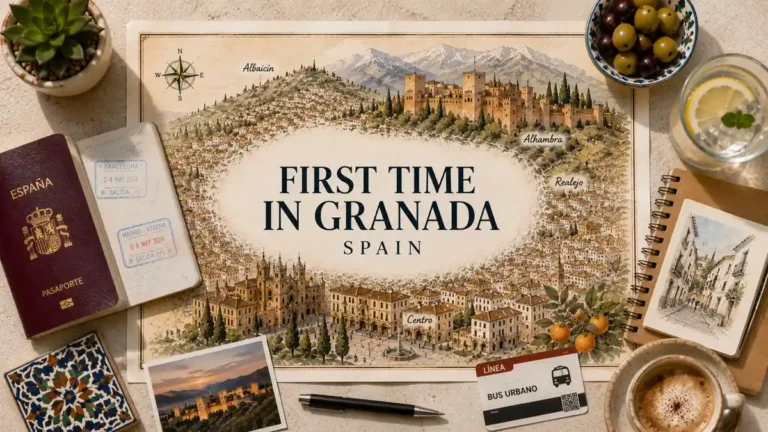

A first visit to Granada rewards a little preparation, and a handful of decisions shape whether the trip runs smoothly. The Alhambra sells out, the streets climb, dinner starts late, and a drink quietly buys you lunch — none of it obvious until you are standing on a cobbled hill wondering why your shoes hurt. Get the big calls right early and the rest falls into place. This guide covers the practical know-before-you-go choices that prevent the common first-timer mistakes: when to book the Alhambra, what to pack for the hills, how the free-tapas custom works, where to base yourself, and how to handle late mealtimes, transport, and money. Each section gives a fast, Granada-specific answer and points to a deeper guide when you want the full detail.
Quick Answer
Book the Alhambra well ahead, wear sturdy shoes for steep streets, and lean into Granada’s free-tapas custom. The Alhambra is timed-entry and sells out, so securing tickets early is the single biggest trip-shaper. Base centrally, eat on late Andalusian time, and carry some cash for small bars.
Trust Layer
Tripstou planning guide for travelers resolving one travel decision. Covers the main variable, traveler context, and practical tradeoffs.
Produced with AI assistance and reviewed by Alex Perrut, working in tourism since 2015, for the Tripstou editorial team. See our editorial process for details.
Last factual review: June 19, 2026.
Official sources consulted: travel-europe.europa.eu, european-union.europa.eu.
Key Takeaways
- Book the Alhambra the moment your dates are set, because timed-entry tickets and the Nasrid Palaces sell out fast.
- Pack broken-in, grippy walking shoes, since Granada’s historic centre is steep, cobbled, and explored almost entirely on foot.
- Order a drink at traditional bars and a free tapa arrives, so a few rounds become a low-cost dinner.
- Walk the compact centre, take city buses for the hilltop climbs, and skip the car in the restricted lanes.
- Eat on late Andalusian time and lead with simple Spanish courtesy to smooth nearly every local interaction.
- Base in the historic centre and carry some cash for small bars, even though cards work in most places.
Table of Contents
When should you book the Alhambra?
Book the Alhambra the moment your travel dates are set. Entry is timed and capacity-limited, and tickets sell out, often weeks ahead in busy periods. Securing a slot early is the single biggest factor in a smooth Granada trip, since the Nasrid Palaces in particular fill fast.
The Alhambra is not a turn-up-and-enter sight. Each ticket carries a fixed time window, the number of daily visitors is capped, and the most popular slots disappear first. Treat the booking as the first thing you lock in, before flights or hotels if necessary.
- Book as soon as dates are firm. Earlier is always safer; popular dates can be gone well in advance.
- Mind the timed Nasrid Palaces slot. Your entry window for the palaces is fixed and enforced — arrive ahead of it.
- Have a fallback. If general tickets are sold out, an official guided tour can be the only remaining way in.
Prices, release windows, and the official booking platform shift over time, so always confirm the current details on the official channel rather than relying on a date or figure. For wider context on the Alhambra and the rest of the city, see our Granada travel guide.
Tours and activities
Book skip-the-line tickets, day trips and local tours with free cancellation on most activities.
You can also browse everything on getyourguide.com.
Tripstou may earn a commission if you book through this link, at no extra cost to you.
How does Granada’s free tapas tradition work?
A drink in Granada usually comes with a free small plate. Order a beer, wine, or soft drink at most traditional bars, and a tapa arrives at no extra cost. The selection is the bar’s choice, and successive rounds often bring different plates, so the custom doubles as a casual, low-cost meal.
This free-tapas tradition is Granada’s strongest local food signal and one of the easiest first-timer wins. You do not order the tapa separately — it simply appears with the drink. The more rounds you stay for, the more varied the plates tend to get.
- Order the drink, not the tapa. The plate comes automatically at traditional bars.
- Stay for a few rounds. Different drinks often bring different tapas, building into a light dinner.
- Bar-hop rather than settle. Moving between bars samples a wider range of plates than parking at one.
Treat it as a custom, not a guarantee: a small number of modern or upscale venues opt out, and what arrives is always the kitchen’s pick rather than a menu choice. Going with the flow is the whole point.
What should you pack for Granada’s steep streets?
Bring sturdy, grippy walking shoes for Granada’s cobbled, steep streets. The historic centre is hilly and largely explored on foot, and smooth-soled shoes slip on worn stone. Comfortable footwear matters more than anything else you pack, because most of what you came to see sits uphill from the flat city core.
The climb to the hilltop neighbourhoods and the Alhambra approach is where flimsy shoes fail. Polished soles and brand-new footwear are the usual culprits behind a sore, slippery first day.
- Broken-in walking shoes or trainers with grippy soles for cobbles and inclines.
- A light layer for cooler evenings and shaded lanes, even after warm afternoons.
- A refillable water bottle for the uphill stretches between sights.
Style-forward footwear is fine for a tapas evening on the flat, but keep it off the hills. If your shoes are right, the rest of the packing list is forgiving.
How do you get around Granada?
Walk the centre, take buses for the hills, and skip the car. Granada’s historic core is compact and pedestrian-friendly, so most sights are within walking distance. City buses handle the steep climbs to hilltop neighbourhoods, while a car is more hassle than help amid narrow lanes and restricted zones.
For a first visit, your own two feet cover most of the trip. The buses earn their place on the gradients — the routes up to the highest neighbourhoods spare your legs when the cobbles get steep. Driving into the historic centre, by contrast, runs into tight streets and access limits that frustrate more than they help.
- Walk by default. The core sights and tapas bars cluster within an easy radius.
- Bus the steep climbs. Small city buses serve the hilltop areas the centre cannot reach on foot.
- Leave the car parked. Restricted zones and narrow lanes make a vehicle a liability in the centre.
Fares, routes, and the specifics of the local bus system change, so check current details on our getting around Granada guide rather than relying on a fixed figure.
How many days do you need in Granada?
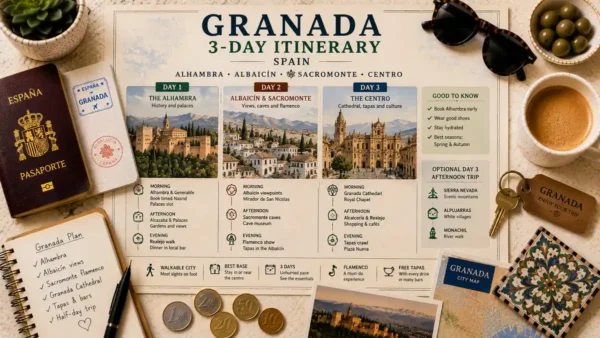
A short, focused stay covers Granada’s must-sees. Two full days are enough to pair the Alhambra with the historic centre and a tapas evening, while a little longer adds breathing room for the surrounding hills and a slower pace. The right length depends on how much you want beyond the headline sights.
Most first-timers find a compact stay does the job: one day built around the Alhambra, another for the old quarters and the city’s food scene. Adding a day mainly buys a slower rhythm and room to wander rather than a longer must-see list.
- Tight on time? See our 2 days in Granada plan for a focused route.
- Want more breathing room? Our 3 days in Granada plan adds a slower day.
The tradeoff is pace, not coverage: the core sights fit comfortably into a short visit, so extra days are about depth and downtime rather than ticking off more headline attractions.
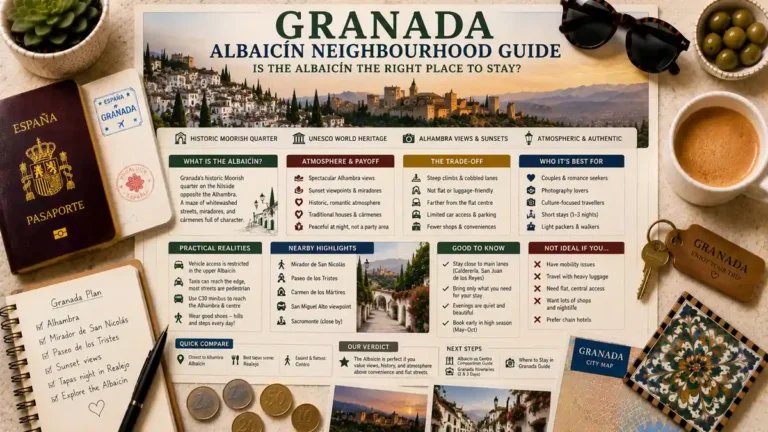
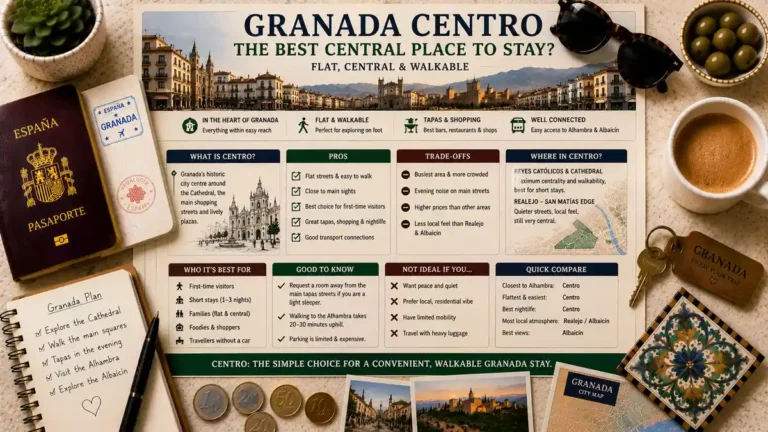
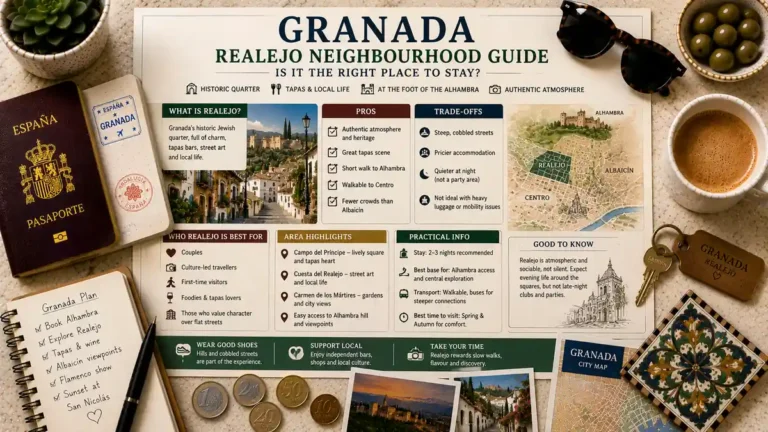
Where should you base yourself in Granada?
Base yourself in the historic centre for easy walkability. Staying central keeps you within strolling distance of the Alhambra approach, the main tapas bars, and the cathedral, so you waste no time commuting. It is the simplest choice for a first visit focused on the headline sights and evening dining.
A central base trades a quieter setting for time saved and steps spared — a worthwhile swap on a short first trip where the goal is to see the essentials without daily transport. Different neighbourhoods suit different priorities, from atmospheric old quarters to flatter, more convenient streets.
For a full breakdown of neighbourhoods and which area fits your trip, see our guide to where to stay in Granada.
Hotels and places to stay
Compare hotels, apartments and stays for your dates in one search.
Search hotels and stays on hotels.com →
Tripstou may earn a commission if you book through this link, at no extra cost to you.
When is the best time to visit Granada?
Shoulder seasons are the most comfortable time to walk Granada. Spring and autumn bring mild temperatures ideal for the hilly streets, while summer turns hot and winter runs cooler with shorter days. For sightseeing on foot, the milder months balance pleasant weather against thinner crowds at the Alhambra.
Because so much of Granada is experienced outdoors and uphill, weather shapes the trip more than it does in flatter cities. The milder months make the climbs pleasant and keep the Alhambra queues more manageable than at peak times.
- Spring and autumn: mild walking weather and a gentler pace at the main sights.
- Summer: hot and busy — plan early starts and shaded breaks if you visit.
- Winter: cooler and quieter, with shorter days and the Sierra Nevada nearby.
Whenever you go, the Alhambra booking rule still applies: even quieter seasons see timed slots fill, so reserve ahead regardless of the month.
How do mealtimes, language, and etiquette work in Granada?
Locals eat late, and basic Spanish courtesy goes a long way. Lunch and dinner both run later than many visitors expect, so kitchens fill in the evening rather than early. A few polite Spanish words, patience with the Andalusian accent, and an unhurried pace will smooth nearly every interaction.
The biggest adjustment for first-timers is the clock. Show up for dinner at an early hour and you may find a quiet room; arrive on local time and the bars come alive. The Andalusian accent is locally distinct, so do not worry if your textbook Spanish takes a moment to land.
- Shift your meals later. Lunch and dinner run on Andalusian time, not early-evening habits.
- Lead with courtesy. A simple greeting and a “gracias” set a warm tone.
- Relax the pace. Meals and service are unhurried by design — settle in.
For country-wide etiquette, customs, and practical norms that apply beyond Granada, see our Spain travel tips.
What money and connectivity should you sort before you go?
Carry some cash for small bars; cards work most places. Many tapas spots, markets, and small cafés still prefer coins and notes, even though shops and restaurants widely accept cards. Sorting a working data plan before you arrive makes maps, tickets, and bus times far easier to manage on the move.
The practical rule is simple: cards for most spending, a modest cash buffer for the smallest, most traditional venues where a tapa and a drink cost little. Keeping some change on hand saves awkward moments at the counter.
- Keep small cash handy for tapas bars, markets, and tips at casual spots.
- Use cards for larger payments at hotels, restaurants, and shops.
- Set up data before arrival so navigation and bookings work from the moment you land.
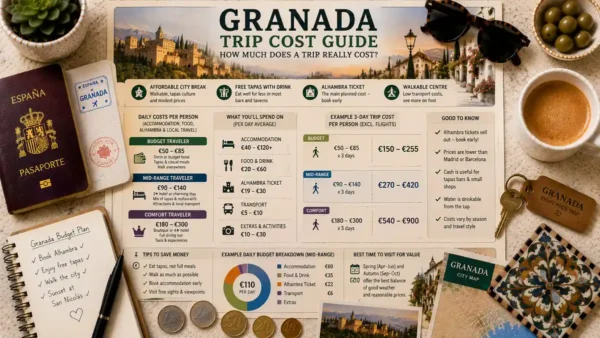
For a full breakdown of spending, see our Granada trip cost guide, and to stay connected, compare options in our guide to the best eSIM for Spain.
Get online the moment you land
An eSIM installs before you fly — no SIM swap, no roaming bill, no queue at an airport kiosk. Two options, depending on how you travel:
Holafly — unlimited-data plans, so nothing counts against a
cap. Best for longer stays, remote work, and heavy map and video use.
Code TRIPSTOU applies automatically: 5% off any travel eSIM,
reusable on every order, or 10% off Holafly Plans.
Get a Holafly eSIM →
Airalo — pay for the data you need, across 200+ destinations,
trusted by 20M+ travelers. Best for short trips and light use.
Use code NEWTOAIRALO15 for 15% off your first order:
Get an Airalo eSIM →
Tripstou may earn a commission if you purchase through these links, at no extra cost to you.
Frequently Asked Questions
Can you visit the Alhambra without booking tickets in advance?
Rarely, and you should not count on it. A small number of same-day tickets can appear, but they vanish quickly and offer no guarantee of entry. For any fixed travel date, reserve online ahead of time; an official guided tour is the most reliable fallback when general tickets are gone.
Are tapas really free everywhere in Granada?
Not everywhere, but the custom is widespread. Most traditional bars include a free tapa with each drink you order, while some modern or upscale venues opt out and charge separately. You never choose the plate — the kitchen decides — so treat free tapas as a happy norm rather than a guaranteed rule.
Is Granada a good destination for travelers with limited mobility?
Granada is manageable but demanding, because its historic core is steep, cobbled, and often climbed on foot. The hilltop neighbourhoods and the Alhambra approach involve significant inclines and uneven surfaces. Travelers with limited mobility should base on flatter central streets, use city buses for the climbs, and plan unhurried days with rest stops.
Do you need to speak Spanish to visit Granada?
No, but a few polite phrases help. Granada is a well-visited city where you can manage with English in most tourist-facing settings. Learning simple greetings and a “gracias” earns warmth, and a little patience helps with the distinctive Andalusian accent. Courtesy and an unhurried manner smooth almost every interaction you will have.
Is one day enough to see Granada?
One day works only if you focus tightly. You can pair a timed Alhambra visit with a short wander through the historic centre and an evening of tapas, but little else fits. A second day adds the old quarters and a slower pace, which most first-timers find far more rewarding.
What mistakes do first-time visitors to Granada make most often?
The biggest mistake is arriving without Alhambra tickets and finding entry sold out. Close behind are wearing smooth-soled shoes on steep cobbles, showing up for dinner too early, and carrying no cash for small bars. Underestimating the hills and over-packing the schedule round out the most common first-timer missteps.
Related Guides
- Granada travel guide — the full destination overview, from the Alhambra to the city’s neighbourhoods.
- Where to stay in Granada — a neighbourhood-by-neighbourhood breakdown to pick your base.
- 2 days in Granada — a focused route for a short, essentials-first visit.
- 3 days in Granada — a slower plan with room to wander beyond the headline sights.
- Granada trip cost — how to budget your visit across stays, food, and sights.
- Getting around Granada — buses, walking, and transport details for the city.
- Best eSIM for Spain — sort mobile data before you arrive.
- Spain travel tips — country-wide practicalities that apply beyond Granada.
- How to Visit the Alhambra
Did this guide save you time or money? Tripstou is independent and reader-funded — if you'd like to give something back, you can support the site with a crypto contribution of any size.