Getting around Granada comes down to one question: when do you walk, and when do you ride? The answer is unusually simple here. Granada’s historic center is small, flat in stretches, and largely pedestrianized, so most sightseeing happens on foot. The complication is elevation. The Alhambra, the Albaicín, and Sacromonte sit on steep hills threaded with narrow lanes that full-size buses cannot reach, which is where Granada’s small minibuses come in. Add the handoff from the bus or train station to the center, the occasional taxi, and a single ticket choice, and you have the whole picture. This guide resolves that decision clearly: walk versus minibus versus city bus versus taxi, which minibus line climbs to which neighborhood, and how tickets and the Credibus card work. No day-by-day routes and no broad city overview, just how to move.
Quick Answer
Granada’s historic center is walkable; ride the small C-line minibuses to reach the Alhambra, Albaicín, and Sacromonte hills. The deciding factor is elevation and luggage: uphill streets are minibus-only, while the flat center is faster on foot. Most short-stay visitors walk the center and buy single rides or a Credibus card for the climb.
Trust Layer
Tripstou planning guide for travelers resolving one travel decision. Covers the main variable, traveler context, and practical tradeoffs.
Produced with AI assistance and reviewed by Alex Perrut, working in tourism since 2015, for the Tripstou editorial team. See our editorial process for details.
Last factual review: June 14, 2026.
Official sources consulted: European Union and Travel Europe.
Key Takeaways
- Granada’s historic center is compact and pedestrianized, so you can explore most sights comfortably on foot.
- The small C30, C31, C32, and C34 minibuses are the only buses reaching the Alhambra, Albaicín, and Sacromonte.
- Pay a single fare on board, or use a rechargeable Credibus card if you ride frequently or stay longer.
- For a short two-day visit spent mostly walking, single fares usually beat the Credibus card on simplicity and value.
- Take a taxi for heavy luggage, late arrivals, limited mobility, or to skip a steep uphill climb.
- Both stations sit outside the center, so bridge the gap with a short city bus ride or taxi.
Table of Contents
Do You Need Public Transport in Granada?
Most visitors barely need public transport in Granada. The historic center is compact and pedestrianized, so you cover it on foot. Public transport matters mainly for the uphill Alhambra, Albaicín, and Sacromonte, plus the handoff from the bus or train station to the center.
The walkable core is the reason. Granada’s main sights, tapas streets, and plazas cluster within a tight area where streets are flat to gently rolling, and walking is almost always the fastest way between two central points. For a short stay based in or near the center, you can go days without boarding a bus at all.
Two situations change the math. The first is the hills: the Alhambra, the Albaicín’s upper lanes, and Sacromonte all involve a real climb, so a minibus often beats the effort. The second is staying outside walking range, which makes a city bus or taxi part of your daily routine. Where you base yourself largely sets how much you ride, so it is worth reading where to stay in Granada before booking.
Walkability is the tradeoff to weigh against comfort. Cobblestones, steps, and gradients make the center tiring with heavy luggage, limited mobility, or in peak summer heat, and in those cases a bus or taxi earns its place. For everything beyond moving around the city, the broader Granada travel guide covers planning, sights, and timing.
Which Minibus Line Reaches the Alhambra, Albaicín, and Sacromonte?
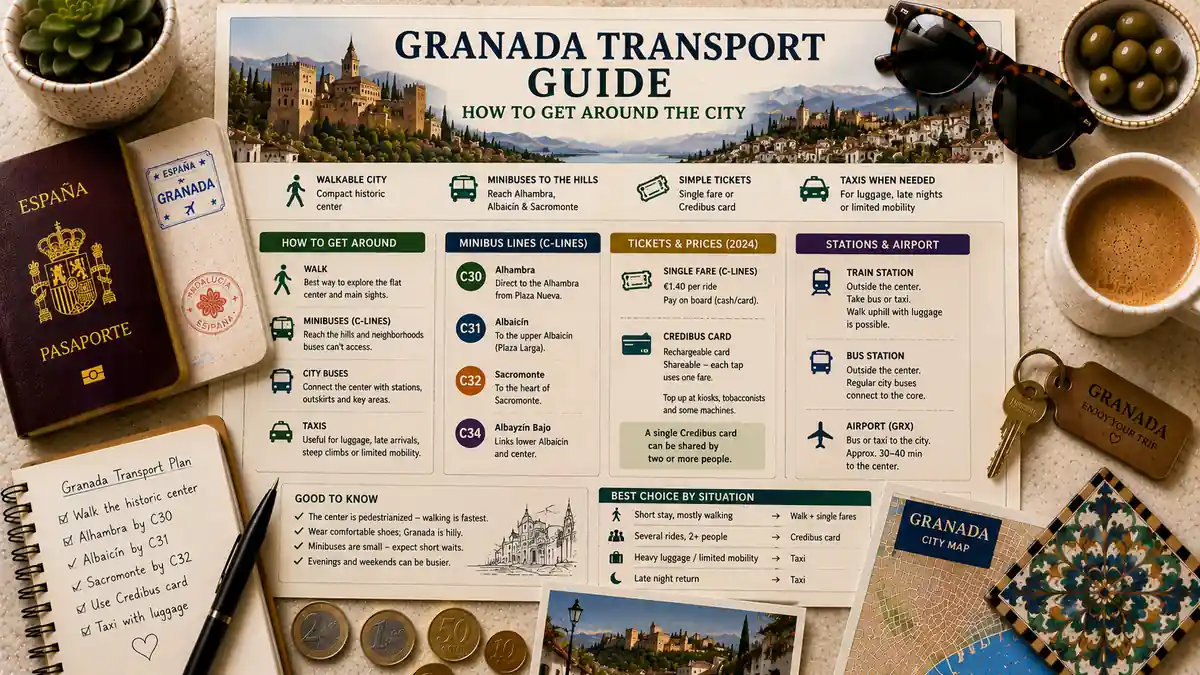
The small red C-line minibuses are the only buses that reach the Alhambra, Albaicín, and Sacromonte. They are narrow enough for the steep, tight streets that full-size buses cannot enter. Four lines cover these hills: C30, C31, C32, and C34, each serving a specific neighborhood.
Each line maps to a clear job. The C30 is the direct climb to the Alhambra, the C31 loops through the Albaicín, the C32 links the Albaicín with the Alhambra, and the C34 heads up to Sacromonte. They share central stops around Plaza Nueva and Plaza Isabel la Católica, which makes them easy to catch from the heart of the center.
| Neighborhood | Minibus line | What the line connects |
|---|---|---|
| Alhambra hill | Line C30 | Runs from the center up to the Alhambra |
| The Albaicín | Line C31 | Loops through the old Moorish quarter’s lanes |
| Albaicín and Alhambra | Line C32 | Links the Albaicín directly with the Alhambra |
| Sacromonte caves | Line C34 | Climbs to the cave-house Sacromonte district |
The minibus is worth it whenever the climb outweighs the short ride, especially in heat, with tired legs, or late in the day. Going up to the Alhambra or the Albaicín’s miradors on foot is rewarding but steep, so many travelers ride up and walk down. Because these neighborhoods anchor most visits, the order you tackle them shapes your days; the 2-day Granada itinerary and the 3-day Granada itinerary handle that sequencing.
Granada’s Main City Bus Lines
Granada’s main red city buses connect the wider city and feed into the historic center. They are most useful when you stay outside comfortable walking range, in the newer districts or near the stations. The LAC line is the central high-frequency route that links the key hubs travelers pass through.
The network splits into a few simple roles:
- LAC (the core line): a frequent route through the central spine, connecting major squares and transfer points.
- Numbered city lines: standard buses linking outer neighborhoods, residential districts, and the station areas to the center.
- C-line minibuses: the small hill buses covered above, which feed off the central stops the red buses also use.
For a center-based short stay, these red buses are an occasional tool rather than a daily one. They matter most when your hotel sits beyond walking distance or you are crossing the city rather than wandering the old town. Frequencies and operating hours shift by line and season, so check the posted times at the stop or the operator’s live information rather than relying on a fixed schedule.
How Do Bus Tickets and the Credibus Card Work?
You pay a single fare in cash on board, or tap a rechargeable Credibus card for a lower per-ride price. The card pulls each fare from a stored balance you top up in advance. For most short stays, the single fare is simpler unless you ride often.
The choice comes down to how many rides you expect:
- Single fare: pay the driver per trip. Best when you only ride a handful of times, mainly up to the Alhambra or the hills.
- Credibus card: a rechargeable card that charges a reduced fare per ride and can be shared between travelers. Best when you ride daily or stay longer.
For a typical two-day visit spent mostly on foot, the single fare usually wins on simplicity, since the card’s per-ride saving needs several trips to offset buying and loading it. If you are based outside the center or plan to lean on the minibuses repeatedly, the card starts to pay off. Fares are modest either way and form only a small slice of your spending; for the full picture, see the Granada trip cost guide rather than budgeting transport in isolation.
When Is a Taxi Worth It in Granada?
A taxi is worth it in Granada for convenience, not everyday travel. It earns its cost when you have heavy luggage, arrive late at night, have limited mobility, or want to skip the steep uphill walk. In a compact, walkable center, you rarely need one otherwise.
The clearest cases are practical, not routine:
- Arrivals and departures: reaching your hotel from the station with bags, or making an early train or flight.
- Late hours: after buses thin out, when walking back uphill feels long.
- Mobility and heat: when steps, cobbles, or summer temperatures make the climb to the Alhambra or Albaicín impractical.
The tradeoff is cost against effort. For two people sharing, a short taxi to bypass a steep climb can feel fair; for solo travelers on a budget, the minibus does the same job for far less. Note that taxis cannot enter the narrowest Albaicín and Sacromonte lanes, so even a taxi may drop you at the edge and leave a short walk to your door.
Getting From the Bus or Train Station to the Center
Granada’s bus and train stations both sit outside the historic core, a short ride from the center. You bridge the gap with a city bus or a taxi, depending on luggage and timing. The walk is doable but uphill in stretches and longer than most arriving travelers want.
Each option suits a different arrival. A city bus connects both stations toward the central area and is the cheapest bridge, fine if you travel light and are not in a rush. A taxi is the simplest with luggage or a late arrival, dropping you as close to your accommodation as the streets allow. Walking works only if you are staying near the edge of the center and carrying little.
Keep this as a quick handoff rather than a full arrival plan. Confirm the current bus connection and stop names locally, since exact lines and timings vary, and let your accommodation’s location decide between bus and taxi. For broader on-the-ground advice beyond transport, see the Granada travel tips.
Frequently Asked Questions
Is Granada a walkable city for tourists?
Yes, Granada is highly walkable for tourists, with most major sights, plazas, and tapas streets clustered in a compact, largely pedestrianized center. The main challenge is not distance but gradient, since the Alhambra and Albaicín sit on steep hills. Comfortable shoes matter more than transport for exploring the flat core.
Do you need a car to get around Granada?
No, you do not need a car to get around Granada, and one is often a liability. The historic center is pedestrianized with restricted traffic zones, limited parking, and narrow lanes. Walking plus the occasional minibus or taxi covers nearly every visitor need, so most travelers arrive by train or bus instead.
How do you get up to the Alhambra without walking?
To reach the Alhambra without the uphill walk, take the C30 minibus, which climbs directly from the center near Plaza Nueva. A taxi is the faster alternative if you have limited mobility or little time. Both spare you the steep climb, though many visitors ride up and walk back down.
Can two people share one Credibus card in Granada?
Yes, a single Credibus card can be shared between two or more travelers, with each tap deducting one fare from the stored balance. This makes it more practical for couples or small groups taking several minibus rides together. For a single rider taking few trips, the standard single fare stays simpler.
How far is Granada’s train station from the city center?
Granada’s train station sits just outside the historic center, close enough for a short city bus ride or taxi rather than a long journey. Walking is possible but involves an uphill stretch with luggage. Most arriving travelers take a quick bus or taxi to reach central accommodation comfortably.
Are taxis expensive in Granada?
Taxis in Granada are reasonably priced for short city trips, especially when two or more people split the fare. They are most cost-effective for airport or station transfers, late nights, or skipping a steep climb. For solo budget travelers, the minibus does the same uphill job for considerably less.
Related Guides
- Granada travel guide — the full hub for planning your visit beyond transport.
- Where to stay in Granada — pick the area that sets how much you walk or ride.
- 2-day Granada itinerary — a route and pacing plan for a short stay.
- 3-day Granada itinerary — a slower sequence that adds the Albaicín and Sacromonte.
- Granada trip cost — where transport fits in the overall budget.
- Granada travel tips — practical advice for your first time in the city.
Did this guide save you time or money? Tripstou is independent and reader-funded — if you'd like to give something back, you can support the site with a crypto contribution of any size.