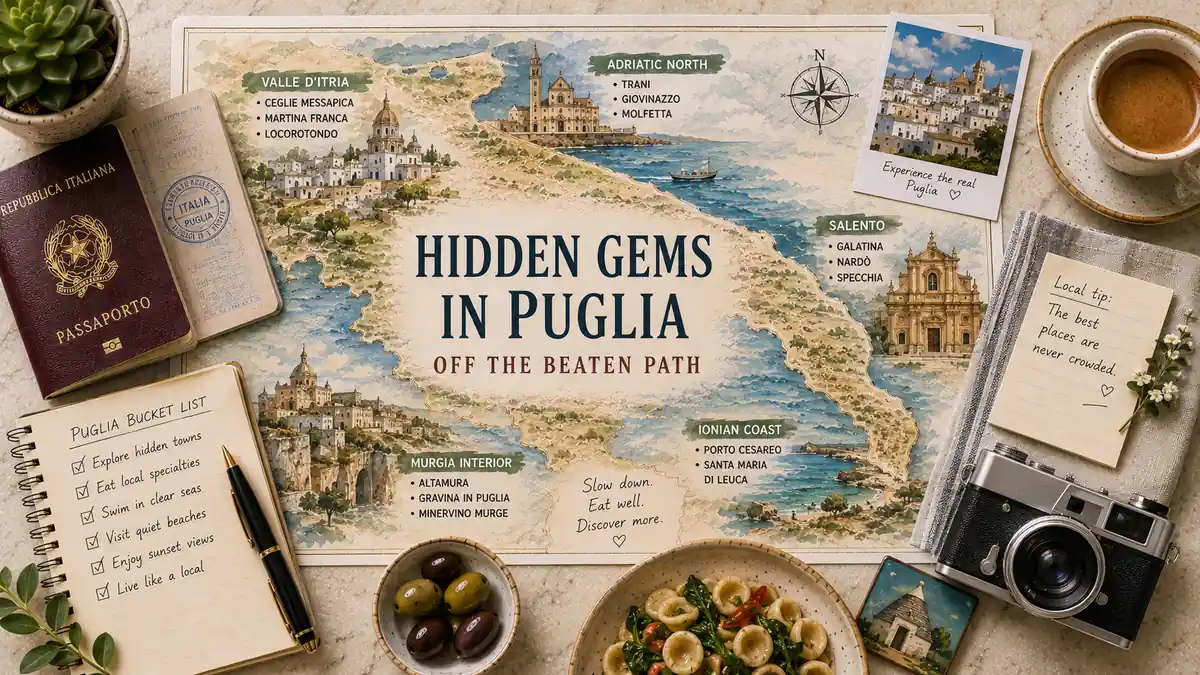
Most Puglia trips run the same loop: Alberobello for the trulli, Ostuni for the white streets, Polignano a Mare for the cliff-diving photo. That circuit is genuinely beautiful, and it is also thoroughly discovered — coach parks, queues, and souvenir stalls included. This page routes you off it. Below are the towns, villages, and coastal spots that stay quiet because the tour buses never reach them, grouped by sub-area so you can pick a zone instead of a scattered list. The stance is simple: a place only earns a spot here if local life still outnumbers visitors. Famous towns are named for contrast, then handed off to where they belong. The list serves travelers who want the real texture of Puglia — the food, the stone, the empty piazzas — over the version that already fills everyone else’s feed.
Quick Answer
Puglia’s most underrated picks are inland towns like Ceglie Messapica, Galatina, and Trani — not the saturated Alberobello circuit. The list groups by sub-area: the Valle d’Itria interior, overlooked Salento, the Adriatic north, and the wild Murgia. Head inland for authentic towns and the Ionian coast for quieter swimming.
Trust Layer
Tripstou selection guide for travelers choosing between multiple places. Covers selection criteria, traveler fit, and trip value.
Produced with AI assistance and reviewed by Alex Perrut, working in tourism since 2015, for the Tripstou editorial team. See our editorial process for details.
Last factual review: July 12, 2026.
Official sources consulted: italia.it, enit.it.
Key Takeaways
- Puglia’s real hidden gems sit inland and on the Ionian coast, not the saturated Alberobello–Ostuni–Polignano circuit everyone already photographs.
- For food, drive to Ceglie Messapica; for frescoes and art, choose Galatina; for a seafront monument without crowds, pick Trani.
- The Murgia interior around Altamura is Puglia’s least touristy zone, trading restaurants and easy transport for space and near-total quiet.
- The quieter the zone, the more self-reliant you must be — coastal Salento is easy, the interior rewards planning.
- On the Ionian coast, quiet is a matter of weeks not places — visit Porto Cesareo outside peak August.
Table of Contents
What actually counts as a hidden gem in Puglia
A hidden gem in Puglia is a town the tour buses skip, not a famous one relabeled as a secret. Alberobello, Ostuni, and Polignano are beautiful but saturated, so they don’t qualify. The genuinely underrated picks sit inland and along the quieter coast, where local life still outnumbers visitors.
The test we use is honest crowd density, not obscurity for its own sake. A qualifying pick has a checkable reason to exist — a specific cathedral, a courtyard layout, a food tradition — plus streets where you hear Italian spoken by residents rather than read on a menu board in four languages. Charm alone doesn’t make the list; every town here carries a distinct hook you can name.
The moment a place shows up in the same three-stop reel everyone posts, it stops being hidden. Polignano crossed that line years ago, and Ostuni is close behind. Those towns are still worth seeing — they simply belong in a different guide. For a profile of Puglia’s headline destinations and the rest of the country’s icons, see our roundup of the best places to visit in Italy, and if your search runs wider than one region, our guide to underrated destinations across Italy covers the picks beyond Puglia.
One caution keeps this list honest: a formerly-quiet town can tip famous fast. When it does, it moves to the contrast side and off the shortlist. That is why the picks below lean on durable features — architecture, geography, food heritage — instead of fragile secrecy.
Valle d’Itria beyond Alberobello
The Valle d’Itria rewards you the moment you leave Alberobello’s trulli crowds behind. Its smaller inland towns keep the same whitewashed-and-stone landscape without the coach parks, souvenir stalls, and queues. Noci, Ceglie Messapica, and Putignano deliver working Puglian life — courtyards, food, and festivals locals actually attend.
These three sit close enough to string together, yet each pulls a different traveler. Base yourself anywhere in the valley and you can reach all of them without doubling back. The reason they stay quiet is structural: they lack a single postcard monument, so day-trippers speed past to the trulli and miss the towns that locals never left.
Noci
Noci made the list for its gnostre — the small covered courtyards where clusters of houses share a communal open-air room. This layout is unusual even by Puglian standards and turns the old town into a maze of intimate stone pockets rather than a single show street. In autumn Noci hosts Bacco nelle Gnostre, a food-and-wine walk through those same courtyards; treat the timing as seasonal and check locally before planning around it.
Pick this if: you want to wander a lived-in historic center where the architecture itself is the attraction, not a specific sight.
Ceglie Messapica
Ceglie Messapica earns its place on two counts: deep Messapian roots that predate Roman Puglia, and a food reputation that draws Italians specifically to eat here. The hilltop old town wraps around a castle keep, quiet most of the year. Ceglie earns its detour on the plate, not the postcard — it is one of the few Puglian towns people drive to for dinner and stay for the streets.
Pick this if: you plan trips around meals and want an authentic gastronomic town far from the coastal crowds.
Putignano
Putignano belongs here for one of Italy’s oldest carnival traditions, staged with towering papier-mâché floats built by local workshops. Outside the festival the town is unhurried and genuinely local, with a compact medieval core few visitors bother to walk. The carnival runs through the winter months into the pre-Lenten season, so confirm dates before building a visit around it.
Pick this if: you’re curious about living folk traditions and want interior authenticity without a tourist scene.
Salento’s overlooked towns
Salento’s best hidden towns lie just inland from Lecce and Gallipoli, where the crowds thin fast. Day-trippers pour into the baroque capital and the party beaches, then leave the surrounding towns almost untouched. Galatina and Oria reward the short detour with frescoes, a castle, and streets where you hear only Salentino.
Salento carries a reputation as one big beach party, which is exactly why its inland towns stay overlooked. The peninsula is small, so both picks sit within an easy drive of the coast — you can swim in the morning and have a whole historic town almost to yourself by afternoon.
Galatina
Galatina made the list for the Basilica di Santa Caterina d’Alessandria, whose interior is covered in vivid medieval frescoes rare for the region. The town is also the historic heart of the tarantism and pizzica tradition, giving it a cultural depth its quiet streets don’t advertise. Away from the basilica, the centro storico stays calm even in high summer.
Pick this if: you travel for art and history and want a fresco cycle without the queues of a headline church.
Oria
Oria earns its spot for a hilltop Swabian castle and a network of atmospheric crypts beneath the old town. Its stacked medieval streets and the summer Palio give it a strong sense of place that few outsiders witness. The castle is privately held and access can be seasonal or limited — check current opening arrangements before you arrive rather than assuming a walk-up visit.
Pick this if: you like fortress towns with a medieval core and don’t mind a place that rewards a little planning.
The Adriatic north almost no one stops for
Northern Puglia’s Adriatic towns get skipped because most itineraries dive straight south to the trulli and Salento. That leaves Trani and Bitonto refreshingly local, despite holding some of the region’s finest Romanesque architecture. Trani’s cathedral sits right on the water; Bitonto guards a quiet medieval core few tourists ever reach.
This is the stretch of Puglia travelers cross rather than stop in, which is precisely its advantage. Both towns are architectural heavyweights that would be mobbed further south. Here they come with room to breathe.
Trani
Trani made the list for a Romanesque cathedral built almost at the water’s edge — pale stone against the Adriatic, unlike almost any church setting in Italy. A Swabian castle, an old fishing harbor, and a historic former Jewish quarter round out a town that punches far above its visitor count. It feels polished yet unhurried, the rare hidden gem that is also genuinely handsome.
Pick this if: you want a seafront town with a knockout monument but none of Polignano’s crush.
Bitonto
Bitonto belongs here for its Romanesque cathedral and a dense, well-preserved medieval center wrapped in olive country. It sits close to Bari yet sees a fraction of the attention, so its old-town lanes stay local and lived-in. This is a town for slow walking and church-spotting, not a checklist stop.
Pick this if: you like Romanesque architecture and quiet historic centers, and you’re passing near Bari anyway.
Wild Puglia: the interior most visitors skip
Inland Puglia’s Murgia plateau is the region’s emptiest corner, and most visitors never see it. Here the landscape turns to dry-stone walls, sheep tracks, and wide rocky steppe instead of coastline. Altamura anchors it with a proud historic center and famous bread; Alta Murgia National Park surrounds it with genuine wilderness.
This zone suits travelers who read emptiness as a feature. There is no marquee coastline and no trulli photo op, which is exactly why the crowds never form. What you get instead is space, big skies, and a slower kind of Puglia.
Altamura
Altamura made the list for a handsome Frederick II-era cathedral and a bread heritage recognized well beyond the region — Pane di Altamura is a protected specialty baked in the town’s traditional ovens. The compact historic center rewards an unhurried morning, and the surrounding Murgia adds prehistoric depth, from ancient caves to fossil sites. It is substance over spectacle.
Pick this if: you want an authentic Murgian town with real food heritage and almost no other tourists.
Alta Murgia National Park
Alta Murgia National Park earns its place as the wild counterweight to Puglia’s coast: a high, rocky plateau of grazing land, stone shelters, and open horizon. It shelters notable sights, including the octagonal Castel del Monte on its edge. Facilities are sparse and access is best planned around your own transport and daylight — treat opening details and trail conditions as things to confirm locally rather than assume.
Pick this if: you want landscape and solitude, and you’re comfortable exploring a park with minimal infrastructure.
Where to find Puglia’s quiet coast
Puglia’s quietest coast is the Ionian side of Salento, not the busy Adriatic beaches near Polignano and Monopoli. Porto Cesareo and the shoreline around it stay calmer outside peak weeks, with shallow, clear water. The Adriatic north has quiet stretches too, but the Ionian is your best bet for uncrowded swimming.
Porto Cesareo works as a low-key coastal base — a small town fronting a marine protected area with pale, shallow water. Keep it in mind as a place to settle rather than a beach to tick off. For which coves to swim, what to do on the water, and experiences along this coast, see our guide to things to do in Puglia.
Quiet on the Ionian is a matter of weeks, not places. The same Porto Cesareo shoreline that feels near-private in early June turns shoulder-to-shoulder in August, so the timing of your visit shifts the crowd far more than the exact spot you choose. Aim for the shoulder edges of the season and the quiet coast reveals itself.
Hotels and places to stay
Compare hotels, apartments and stays for your dates in one search.
Search hotels and stays on hotels.com →
Tripstou may earn a commission if you book through this link, at no extra cost to you.
Which part of Puglia is least touristy?
The Murgia interior is the least touristy part of Puglia, followed closely by the northern Adriatic towns. These zones trade convenience for authenticity: fewer restaurants, patchier transport, and shorter opening hours, but almost no crowds. Choose them if seeing real Puglian life matters more to you than easy logistics and beach access.
The pattern across this whole list is a single tradeoff — the quieter the zone, the more self-reliant you need to be. Coastal Salento is easy and lively; the interior is empty and rewarding but asks more of you. The least-touristy zones stay that way precisely because they lack a world-famous sight; the day an empty Puglian town gets a marquee monument, it won’t stay empty. Here is the quick zone chooser:
- Murgia interior (Altamura, Alta Murgia): best for travelers who want emptiness, landscape, and food heritage over comfort.
- Adriatic north (Trani, Bitonto): best for architecture lovers who want a handsome town without the southern crush.
- Valle d’Itria interior (Noci, Ceglie, Putignano): best for slow authenticity, courtyards, and eating where locals eat.
- Inland Salento (Galatina, Oria): best for art and history within reach of a swim.
- Ionian coast (Porto Cesareo): best for quiet swimming outside the peak weeks.
This page stays deliberately on the where. For when to go, how many days each zone needs, where to base yourself, and whether to rent a car, our full Puglia travel guide handles the planning — this list simply tells you which quiet corners are worth the drive.
Frequently Asked Questions
What’s the best hidden gem in Puglia for food?
Ceglie Messapica is Puglia’s standout hidden gem for food, a hilltop town Italians actually drive to for dinner. Its cucina is built on local produce, orecchiette, and slow-cooked meats, not tourist menus. Book a table, then stay to walk the quiet old town afterward.
Are Alberobello and Ostuni too touristy?
Yes, Alberobello and Ostuni are among Puglia’s most crowded towns, drawing coach tours, queues, and souvenir stalls in season. They are still worth seeing for their trulli and white streets, but they no longer count as hidden. Treat them as headline stops and read our famous Puglia and Italy destinations for those.
Do you need a car to see hidden Puglia?
For most of the hidden inland towns, a car is the practical choice. Trains and buses reach larger centers like Trani and Altamura, but the Valle d’Itria interior, the Murgia, and the quiet coast are far easier with your own wheels. Our Puglia travel guide covers transport in depth.
How do you reach the lesser-known Puglia towns?
Start from Bari or Brindisi airports, then branch out by car. Bari anchors the north and the Murgia, while Brindisi and Lecce open up Salento. Regional trains link the bigger towns, but the smallest villages have sparse timetables, so hiring a car keeps your options open across every zone.
Which hidden Puglia town is best for a first visit?
Trani is the easiest hidden gem for a first visit, pairing a knockout seaside cathedral with an easy train connection and a handsome, walkable center. It delivers the underrated payoff without demanding a car or careful planning. Save the empty Murgia and inland Salento for a return trip.
Can you see Puglia’s hidden gems as day trips from a famous base?
Yes, most hidden towns sit within an hour or so of the popular bases. From Ostuni or Alberobello you can reach the Valle d’Itria interior easily; from Lecce, inland Salento; from Bari, Trani and Bitonto. The quiet coast and deep Murgia reward an overnight, but the rest work as day trips.
Related Guides
Use these guides to turn this shortlist into a full trip — plan the logistics, add the experiences, place the famous stops, and look beyond the region.
- Puglia travel guide — when to go, how many days, where to base yourself, and getting around.
- Things to do in Puglia — experiences, beaches, and activities near these towns.
- Best places to visit in Italy — the famous Puglia and Italy destinations this list deliberately skips.
- Hidden gems in Italy — underrated destinations beyond Puglia.
- Best time to visit Italy — national seasonality, and where the south sits inside it.
- Italy itinerary — how to build a southern leg into a wider route.
Did this guide save you time or money? Tripstou is independent and reader-funded — if you'd like to give something back, you can support the site with a crypto contribution of any size.