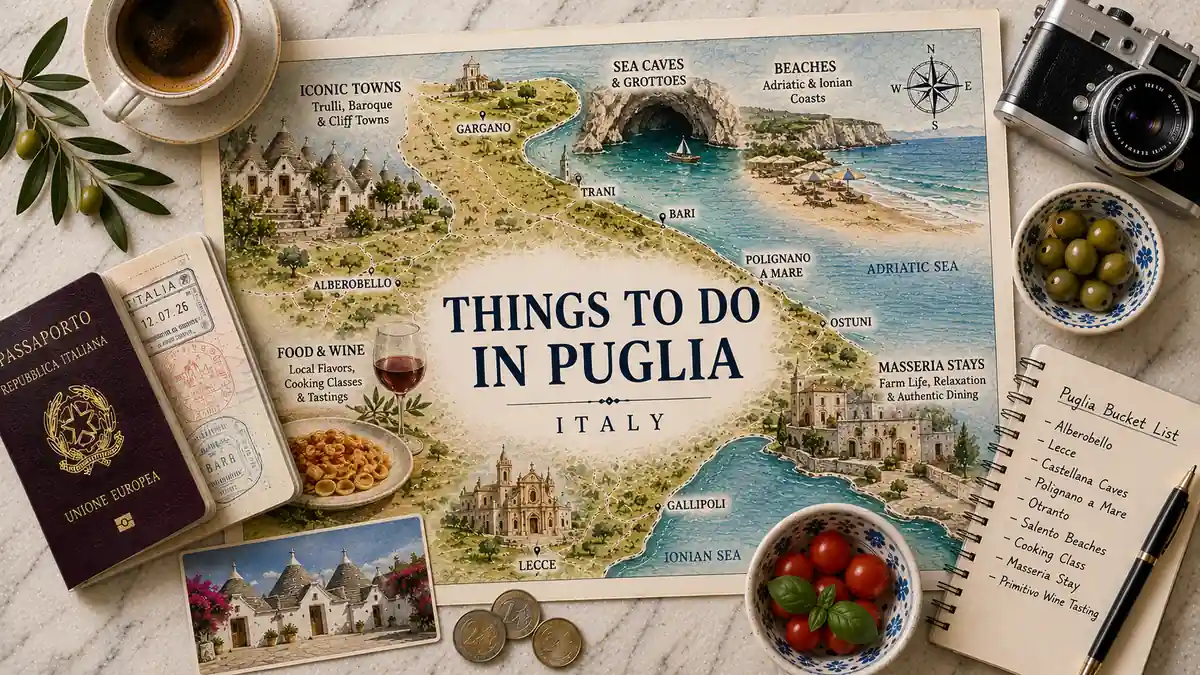
Puglia offers far more experiences than one trip can hold. The heel of Italy packs cone-roofed trulli towns, honey-colored Baroque cities, a limestone cave system, two coastlines of beaches, and some of the country’s best food and wine into a single region — which makes the real challenge deciding what to actually do. This guide solves that with a curated shortlist grouped by experience type: iconic towns, underground caves and grottoes, beaches, food and wine, and the masseria stay. Each pick comes with a clear reason to do it and the kind of traveler it suits, so you can build a trip around your style instead of a generic bucket list. Whether you travel for architecture, sea, or the table, the strongest Puglia experiences are here, sorted so you can choose fast.
Quick Answer
The best things to do in Puglia span iconic towns, sea caves, beaches, food and wine, and masseria stays. Wander Alberobello’s trulli, explore Baroque Lecce and Polignano’s cliffs, tour the Castellana Caves, and relax on Salento’s beaches. Group them by type and choose by style — foodies and culture lovers gain most, while beach-first visitors should lean summer and Salento.
Trust Layer
Tripstou selection guide for travelers choosing between multiple places. Covers selection criteria, traveler fit, and trip value.
Produced with AI assistance and reviewed by Alex Perrut, working in tourism since 2015, for the Tripstou editorial team. See our editorial process for details.
Last factual review: July 11, 2026.
Official sources consulted: Italia.it, ENIT.
Key Takeaways
- Puglia’s strongest experiences group into five types — iconic towns, sea caves, beaches, food and wine, and masseria stays.
- Culture travelers gravitate to Alberobello, Lecce, and Polignano, while foodies should anchor the trip on cooking classes and Primitivo tastings.
- Beach days reward committing to one coast — calm Ionian shallows for families, rugged Adriatic scenery for swimmers and photographers.
- Summer delivers full beach services but heat and crowds; shoulder season trades facilities for quieter towns and easier food experiences.
- A masseria stay is an experience in itself, folding farm-to-table dinners and on-site tastings into where you sleep.
Table of Contents
What Are the Best Things to Do in Puglia?
The best things to do in Puglia fall into five experience types. They span iconic towns, underground caves, beaches, food and wine, and masseria stays — covering architecture, nature, sea, and the table, so most travelers can build a full trip from this shortlist without missing Puglia’s defining highlights.
Grouping the experiences by type makes the trip easier to plan than a flat ranking. Culture travelers gravitate to the towns — Alberobello, Lecce, and Polignano. Nature and adventure travelers head underground into the Castellana Caves. Beach travelers build days around Salento and the Adriatic. Food lovers anchor the trip on cooking classes, cheese farms, and Primitivo tastings. Most visitors mix two or three groups rather than trying to do everything. Few do all five.
The one grouping most people underrate is the masseria stay, which quietly upgrades every other experience by turning where you sleep into a destination in its own right.
For when to go, where to base yourself, and how Puglia fits a wider trip, see our Puglia travel guide. If you’re still weighing Puglia against other regions, our guide to the best places to visit in Italy compares them by travel style.
Wander Puglia’s Trulli and Baroque Towns
Puglia’s towns are among its best experiences precisely because no two look alike. Alberobello’s trulli, Lecce’s Baroque stone, and Polignano’s cliff-top old town each deliver a different kind of wander. Culture travelers and photographers get the most, but all three reward anyone who enjoys walking a beautiful place slowly.
These three towns sit within easy reach of each other, so most trips fold in at least two. To sequence them into a wider route without backtracking, see how we structure an Italy itinerary.
See the Trulli of Alberobello
Alberobello is the one town built almost entirely from trulli — the conical drystone houses that earned it UNESCO World Heritage status. Walking the Rione Monti and Aia Piccola districts, where hundreds of whitewashed cones climb the hillside, feels unlike anywhere else in Italy. Go early or late to dodge the tour-bus crush in the narrow lanes.
Pick this if: you want Puglia’s most iconic, photograph-ready townscape and don’t mind that it draws crowds.
Explore Baroque Lecce and Its Old Town
Lecce rewards slow wandering through the finest Baroque architecture in southern Italy, carved from soft local limestone that glows gold at sunset. Its old town layers a Roman amphitheatre, ornate church facades, and lively piazzas into a compact, walkable center. Unlike Alberobello, Lecce is a living city, so cafes and artisan workshops keep it humming after the day-trippers leave.
Pick this if: you love architecture, history, and an evening passeggiata over a quick photo stop.
Stand Above the Cliffs at Polignano a Mare
Polignano a Mare delivers coastal drama — a whitewashed old town perched on limestone cliffs straight above the Adriatic. The view down to Lama Monachile, the tiny pebble cove wedged between the cliffs, is the region’s signature sea image. Time it for a swim or an aperitivo at a cliff-edge terrace.
Pick this if: you want cliffs, sea views, and a swim built into your town day.
Go Underground: Castellana Caves and Sea Grottoes
Yes, you can go underground in Puglia. The Castellana Caves are a guided limestone system ending at the luminous Grotta Bianca, and Polignano’s sea grottoes are toured by boat. Both are half-day experiences. Families and nature travelers enjoy the caves most; boat trips suit anyone wanting the coast from sea level.
Two very different underground experiences share the theme, and which you choose depends on how much time and effort you want to give it. Both stay light on logistics.
- Guided Castellana cave tour — the fuller experience. Guided routes run in two lengths: a shorter loop and a longer one that reaches the Grotta Bianca, the system’s brightest chamber. Book a slot ahead in high season, and bring a layer, as it stays cool below ground. Best for travelers who want the headline sight and don’t mind a fixed tour time.
- Polignano sea-grotto boat trip — the lighter option. Short boat tours slip along the cliffs into sea caves you can’t reach on foot, typically running only in calm, warmer-weather conditions. Best for travelers already visiting Polignano who want an hour on the water instead of a scheduled excursion.
The caves stay cool year-round, which flips their appeal in summer: when the coast is baking, an hour underground is the region’s best natural air-conditioning. Expect both experiences to sit in the modest tour range and rarely a splurge; treat any price you see as a starting point and confirm current rates when you book.
Puglia’s Beaches Are Worth Building a Day Around
Puglia’s beaches are worth planning a full day around, and the region gives you two coastlines to choose from. The Ionian side around Salento has the calm, Caribbean-clear shallows; the Adriatic coast trades some of that calm for dramatic, rocky scenery. Families lean Ionian, while scenery-seekers and swimmers lean Adriatic.
Match the coast to the kind of beach day you want:
- Calm, family-friendly swimming: the Ionian beaches of the Salento peninsula, around Porto Cesareo and the “Maldives of Salento” stretch, offer shallow, gentle water ideal for kids and long lazy afternoons.
- Scenic and rugged: the Adriatic coast and the Gargano promontory in the north deliver cliffs, coves, and pine-backed bays, with the Foresta Umbra’s ancient woodland just inland for a cooler change of pace.
- Lively beach-club days: Salento’s organized lidos rent loungers and umbrellas through the warm season, with free public stretches alongside them for a no-cost alternative.
Beach access is strongly seasonal. The warm months bring full services, boat trips, and busy lidos, while shoulder-season visits mean quieter sand but fewer facilities. One tip first-timers miss: pick a base on one coast and treat the other as a day trip — trying to split every day between Ionian and Adriatic just burns hours in the car. The two coasts don’t blend.
Food and Wine Experiences Define a Puglia Trip
Food and wine experiences are the heart of a Puglia trip, not a side activity. The signature bookable ones are an orecchiette-making class, a visit to a burrata or cheese farm, and a tasting of the region’s big reds — Primitivo and Negroamaro. Foodies gain the most, but all three suit anyone curious about how Puglia actually eats.
Choose the experience that matches your appetite for hands-on involvement:
- Orecchiette cooking class — hands-on and social. You shape Puglia’s ear-shaped pasta by hand, usually with a local cook, then eat what you made. Pick this if you want a skill to take home and a long, convivial lunch.
- Burrata and cheese farm visit — relaxed and delicious. A working masseria or dairy shows how the region’s famous burrata and mozzarella are made, tasting included. Pick this if you prefer watching and tasting over cooking.
- Primitivo and Negroamaro tasting — for the wine-minded. The Salento vineyards behind Puglia’s bold reds run cellar visits and tastings. Pick this if you want to understand the region’s signature grapes at the source.
Puglia’s best food value often needs no booking: a plate of orecchiette con cime di rapa at a family trattoria delivers the region’s signature dish for the price of lunch. Costs for classes and tastings sit in a moderate range and vary by group size and what’s included, so treat any figure as a ballpark and confirm when booking. For food and wine experiences beyond the region, our guide to things to do in Italy covers the rest of the country.
Tours and activities
Book skip-the-line tickets, day trips and local tours with free cancellation on most activities.
You can also browse everything on getyourguide.com.
Tripstou may earn a commission if you book through this link, at no extra cost to you.
Stay in a Masseria for the Full Puglia Experience
Staying in a masseria is itself one of the best things to do in Puglia. These fortified farm estates, many centuries old, have been converted into characterful stays with on-site restaurants, olive groves, and pools set in deep countryside quiet. The experience suits travelers who want rural atmosphere, slow mornings, and dinners built around estate-grown produce.
A masseria works as an experience regardless of where you base the rest of your trip. The appeal is the estate itself: farm-to-table dinners of just-pressed olive oil and garden vegetables, mornings without a schedule, and the kind of rural silence a town hotel can’t offer. Many run cooking sessions, wine tastings, and cheese-making on the property, folding several Puglia experiences into one stay.
There’s a real tradeoff. A remote masseria rewards you with atmosphere but usually requires a car, and it swaps walkable-town convenience for isolation. Book a night or two mid-trip as an experience in its own right, and keep town-centre stays for the days you want to step out the door into a piazza. Choosing your overall base — which town or coast to sleep in most nights — is a separate planning decision from picking a masseria for the experience.
Hotels and places to stay
Compare hotels, apartments and stays for your dates in one search.
Search hotels and stays on hotels.com →
Tripstou may earn a commission if you book through this link, at no extra cost to you.
Frequently Asked Questions
How many days do you need in Puglia?
Most travelers need four to six days to enjoy Puglia’s main experiences without rushing. A long weekend covers the trulli towns and one coast; a full week lets you add caves, both coastlines, and a masseria stay. For pacing and where to base each night, see our Puglia guide and Italy itinerary planning.
Is Puglia worth visiting?
Yes, Puglia is well worth visiting, especially for travelers who value food, architecture, and uncrowded coastline over big-name landmarks. You get UNESCO trulli, Baroque cities, clear Ionian beaches, and outstanding regional cooking at gentler prices and pace than Italy’s headline destinations. It rewards slow, experience-led trips more than fast sightseeing checklists.
How much does a cooking class or cave tour in Puglia cost?
Expect cooking classes and guided tastings to sit in a moderate per-person range, while cave and boat tours usually cost less, in the modest excursion range. Prices vary with group size, duration, and what’s included, such as meals or wine. Treat any figure you see as a starting point and confirm current rates when booking.
What is Puglia most famous for?
Puglia is most famous for the cone-roofed trulli of Alberobello, its Baroque city of Lecce, and standout food like orecchiette pasta and creamy burrata. The region is also known for bold Primitivo wine, fortified masseria estates, and long stretches of clear Adriatic and Ionian coastline. Together these define its distinct southern-Italian character.
Do you need to book Puglia’s tours and experiences in advance?
For popular experiences in high season, booking ahead is smart, particularly cooking classes, cave tours, and masseria dinners with limited daily slots. In the shoulder months you can often arrange things a day or two out. Casual pleasures — beaches, trattoria meals, town wandering — never need reservations, so keep some plans loose.
What are the top experiences to prioritize on a first, short Puglia trip?
On a short first trip, prioritize the Alberobello trulli, one Baroque or cliff town like Lecce or Polignano, and a single food experience such as a cooking class or burrata tasting. Add one beach half-day if the season fits. This mix captures Puglia’s character without spreading a brief visit too thin.
Related Guides
- Puglia travel guide — when to go, where to base yourself, and how Puglia fits a wider Italy trip.
- Italy itinerary — build these experiences into a route without backtracking.
- Things to do in Italy — the best experiences across the rest of the country.
- Best places to visit in Italy — choose which Italian regions match your travel style.
- Hidden gems in Puglia — the underrated towns to pair with these experiences.
- Best time to visit Italy — national seasonality, and where a southern summer sits inside it.
Did this guide save you time or money? Tripstou is independent and reader-funded — if you'd like to give something back, you can support the site with a crypto contribution of any size.