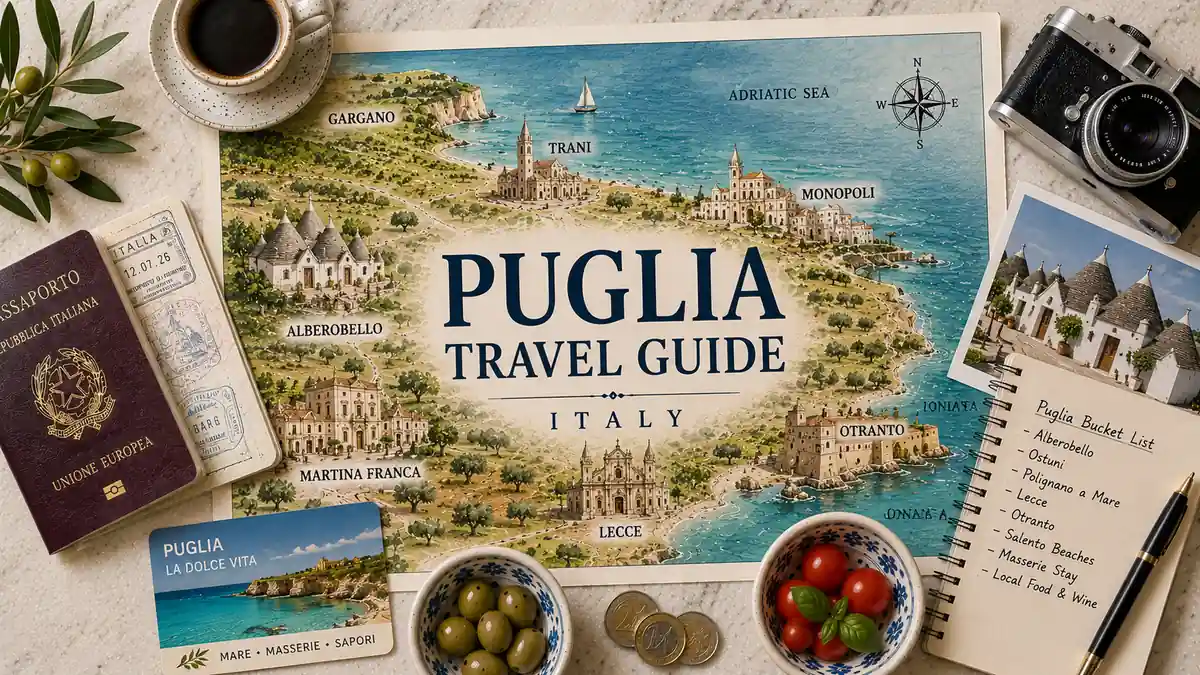
Puglia is the heel of Italy’s boot and the country’s longest region, a long ribbon of Adriatic and Ionian coast wrapped around trulli-dotted countryside. Here you swap crowded northern hotspots for whitewashed hill towns, fortified masseria farmhouses, slow lunches, and beaches that run for kilometres. It is one of Italy’s most rewarding regions to plan around a car and a relaxed pace. This guide covers the decisions that actually shape a Puglia trip: when to go, how many days you need, which airport to use, whether you need a car, where to base yourself, and how the region fits into a wider Italy itinerary. The aim is a plan, not a wish list.
Quick Answer
Yes, Puglia rewards travelers wanting coast, food, and trulli-and-masseria countryside at a slower pace than northern Italy. You need roughly a week and a car, and most visitors base once or twice — Valle d’Itria plus a coast or Salento base. It suits a slower, driving, food-and-coast trip, worth doing as a standalone week or a southern add-on.
Trust Layer
Tripstou region guide for travelers planning a regional trip. Covers sub-areas, trip shape, base strategy, timing, and mobility tradeoffs.
Produced with AI assistance and reviewed by Alex Perrut, working in tourism since 2015, for the Tripstou editorial team. See our editorial process for details.
Last factual review: July 11, 2026.
Official sources consulted: italia.it, enit.it.
Key Takeaways
- Give Puglia a full week to pair Valle d’Itria countryside with a coast or Salento base without rushing.
- Rent a car — trains and buses link the main towns but skip the masserie, coves, and rural stays.
- Base first in the central Valle d’Itria, then add a Lecce or Salento stay for the deep south.
- Travel in the May–June or September–October shoulder for warm sea, open beach clubs, and thinner crowds than peak summer.
- Treat Puglia as a standalone week or a deliberate southern add-on, pairing overland with Matera or Naples.
- Choose Puglia if you value coast, food, and slow driving days over blockbuster art cities and monuments.
Table of Contents
Where Puglia Is and What It’s Known For
Puglia is the heel of Italy’s boot, the country’s longest region, stretching down the southeast Adriatic coast. It is known for the conical trulli houses of the Valle d’Itria, fortified masseria farmhouses, whitewashed hilltop towns, hundreds of kilometres of coastline, and the flat Salento tip at its southern end.
Geographically, the region is a long, narrow strip pinned between two seas — the Adriatic to the east and the Ionian around the Salento peninsula. Bari, the port capital, anchors the centre and north. Below it sits the Valle d’Itria, the limestone plateau where Alberobello’s UNESCO-listed trulli cluster alongside working masserie. Ostuni, Locorotondo, and Cisternino crown the surrounding hills.
The coast does the rest of the work. Cliff-backed towns like Polignano a Mare and Monopoli sit on the Adriatic, while the deep south tapers into Salento, where Lecce’s baroque core meets long beaches on both shores. It is broad. Knowing these anchors is enough to place everything else that follows.
Is Puglia Worth Visiting?
Puglia is worth visiting for travelers who want coastline, food, and a slower southern pace. It rewards people who enjoy driving between towns and long meals over ticking off blockbuster monuments. The honest tradeoff: sights are spread out, a car matters, and there is no single must-see on the scale of Rome or Florence.
The payoff is atmosphere. Whitewashed old towns, cave restaurants, sea coves, and countryside masserie set a rhythm that the classic northern circuit rarely offers. It suits couples, food-focused travelers, and families who want beach days and relaxed towns over museum queues. It suits repeat visitors to Italy looking for a different register. What separates Puglia from a Rome or Florence trip is that the reward compounds the longer you slow down, because the appeal is the countryside cadence, not one headline attraction.
For the actual experiences that fill those days — from sea caves to food towns — see our guide to things to do in Puglia. This page stays on the planning decisions.
How Many Days You Need in Puglia
A week is the sweet spot for most Puglia trips. It lets you pair the Valle d’Itria countryside with a coast or Salento base without rushing. The region runs roughly 400 kilometres north to south, so distances add up. Shorter add-ons work, but a week lets the slow pace land.
How the tiers break down:
- 2–3 days: a taste, best as an add-on to a wider southern Italy trip — time for the Valle d’Itria and one coastal town.
- 5–7 days: the core sweet spot — pair countryside with a coast or Salento base at a relaxed pace, with room for beach days.
- 10+ days: a deep dive — adds the Gargano peninsula in the north, the full Salento tip, and unhurried time on the sand.
Because Valle d’Itria and the Salento tip sit nearly two hours apart, trying to cover both from one base burns your week in the car — split the stay instead. For how these days slot into a full route with the rest of the country, see our Italy itinerary guide.
When to Visit Puglia
The best time to visit Puglia is the shoulder seasons — May to June and September to October. You get warm sea, open beach clubs, and thinner crowds than the July–August peak, when the coast is hot and busy. Winter is quiet and mild but many coastal spots wind down.
Peak summer is when Italians themselves holiday here, so expect full beaches, higher masseria rates, and booked-out tables. The shoulder months trade a little heat for space and value. Spring brings green countryside and wildflowers; autumn brings the olive harvest and still-warm water. Winter is low-key — good for towns and food, quiet on the coast.
Puglia’s shoulder season runs warmer than the same months further north, so the sea stays swimmable into October here in a way it rarely does on the Ligurian or upper Adriatic coast. For month-by-month detail across the country, see our guide to the best time to visit Italy. Treat any seasonal specifics as ranges and confirm before booking.
How to Get to Puglia: Bari or Brindisi
Fly into Bari for northern Puglia and the Valle d’Itria, or Brindisi for Salento and the deep south. Both airports have European connections and car rental on site. From northern Italy, direct high-speed trains reach Bari, but the ride is long — flying is usually faster if your time is tight.
Bari is the busier hub and the natural choice for a countryside-and-Adriatic-coast trip. Brindisi sits closer to Lecce and the Salento beaches, saving an hour or more of driving if the south is your focus. Both connect to major Italian and European cities, with schedules that vary by season, so compare fares before committing.
Arriving overland is possible. High-speed trains link Bari to Rome, Naples, and the north, and long-distance coaches serve the region too. Just weigh the hours against a short flight. Whichever gateway you pick, plan to collect a rental car near the airport rather than in a town centre.
Hotels and flights
Compare hotels, apartments and flight options for your dates in one search.
Compare hotels and flights on expedia.com →
Tripstou may earn a commission if you book through this link, at no extra cost to you.
Do You Need a Car in Puglia?
Yes, you need a car in Puglia to reach the countryside masserie, small towns, and quieter beaches. Trains and buses link the main towns — Bari, Lecce, Ostuni, Monopoli — but skip most rural stays and coastline. Without a car you are tied to town centres and taxi hops to the sea.
The getting-around options, in short:
- Car: best for countryside masserie, hidden coves, and hilltop towns on your own schedule — the tradeoff is limited-traffic zones (ZTL) and tight historic-centre parking.
- Train: best for hopping car-free between main towns like Bari, Ostuni, and Lecce — the tradeoff is patchy service on Sundays and stations set away from the beaches.
- Bus and coach: best for reaching Salento villages the trains skip — the tradeoff is thin timetables and slow connections that eat into the day.
Even the train-linked towns like Ostuni sit a few kilometres uphill from their stations, so “reachable by train” rarely means “walkable on arrival” here. Rental prices and timetables shift by season and demand, so book the car early in peak months and treat any quoted figures as ranges.
Where to Base Yourself in Puglia
Base yourself in the Valle d’Itria for a first Puglia trip — it sits central to the best of the region. A masseria or a town like Ostuni puts trulli country, the Adriatic coast, and Bari all within about an hour. Add a second base in Lecce or Salento if you want the deep south too.
The main base areas and who they suit:
| Base area | Character | Anchor town | Best for |
|---|---|---|---|
| Valle d’Itria | trulli countryside and masserie between low hills | Ostuni or Locorotondo | first trips wanting a central, scenic base |
| Adriatic coast | cliff-backed old towns and swimming coves | Monopoli or Polignano a Mare | sea days with easy town access |
| Lecce and Salento | baroque city and two-sea beaches | Lecce | the deep south and long beach stretches |
| Bari and the north | working port capital and regional gateway | Bari | short stops and transport connections |
One base handles a short trip; a week is better split between countryside and coast or Salento to cut driving. A masseria stay is part of the trip in Puglia, not just a bed — booking one central to the Valle d’Itria often replaces a second base entirely. Accommodation bands swing with season and location, so compare before booking. For the smaller, less-trodden towns beyond these anchors, see our guide to hidden gems in Puglia.
Hotels and places to stay
Compare hotels, apartments and stays for your dates in one search.
Search hotels and stays on hotels.com →
Tripstou may earn a commission if you book through this link, at no extra cost to you.
How Puglia Fits Into a Wider Italy Trip
Puglia works best as a standalone week or a deliberate southern add-on, not a quick side trip. As Italy’s heel, it sits far from Rome and the north, so it rewards dedicated time. Fly in directly, or pair it overland with Matera and Naples for a broader southern loop.
The region is a southern anchor, not a stop on the classic Rome–Florence–Venice line. It does not chain neatly onto that northern circuit — the smart pairing is southward with Matera, which sits barely an hour from the Puglian border, or with Naples and the Amalfi Coast on a wider southern route. Flying in and out keeps a standalone week efficient.
Among Italy’s regions it ranks high for coast, food, and slow travel, lower for marquee art cities. To see where it sits against the rest, browse the best places to visit in Italy, and for full country context start with our Italy travel guide.
Frequently Asked Questions
Is Puglia expensive?
Puglia is generally more affordable than northern Italy or the Amalfi Coast, though peak-summer masseria stays and coastal towns push prices up. Shoulder-season travel, agriturismi, and inland bases keep costs down, while August drives them highest. For detailed budget ranges across the country, see our guide to Italy trip cost.
Is Puglia safe?
Puglia is a safe region for travelers, including solo visitors and families, with low levels of violent crime. Normal precautions apply: watch for petty theft in busy Bari and crowded markets, lock rental cars, and drive carefully on narrow rural roads. Coastal and countryside areas feel relaxed and welcoming throughout the season.
Is Puglia good for families?
Puglia is excellent for families, with calm shallow beaches, short drives between towns, and masseria stays built around pools, gardens, and farm animals. The relaxed pace suits young children, and the pasta-and-focaccia food culture is famously kid-friendly. Slower and less crowded than Rome or the Amalfi Coast, it rewards families wanting downtime over sightseeing marathons.
Is Puglia better than the Amalfi Coast or Sicily?
Puglia suits travelers wanting a slower, flatter, driving-based trip with long beaches and countryside; the Amalfi Coast delivers dramatic cliffs and iconic views in a smaller, pricier, busier area. Sicily offers more marquee history and bigger landscapes but needs more time. Choose Puglia for relaxed coast-and-food days over headline scenery or major sights.
Is spring or autumn better for visiting Puglia?
Both shoulder seasons work well, but they trade differently. Spring, roughly April to June, brings green countryside, wildflowers, and fewer crowds, though the sea warms slowly. Autumn, around September to October, offers the warmest swimming water, the olive harvest, and lively towns before the winter wind-down. Pick spring for scenery, autumn for the sea.
Do people speak English in Puglia?
English is spoken at hotels, masserie, and popular restaurants across Puglia’s main tourist areas, but less so in small inland villages and with older locals. Learning a few Italian phrases helps in rural spots and markets. In the towns most visitors base in — Lecce, Ostuni, Monopoli, Alberobello — you will manage comfortably in English.
Related Guides
Plan your next step with these guides from the Italy cluster:
- Things to do in Puglia — the experiences that fill your days.
- Hidden gems in Puglia — quieter towns beyond the main anchors.
- Italy itinerary — how to sequence Puglia with the rest of the country.
- Best places to visit in Italy — where Puglia ranks among the regions.
- Italy travel guide — full country context and planning basics.
- Best time to visit Italy — month-by-month weather and crowds.
- Italy trip cost — budget ranges for a trip.
Did this guide save you time or money? Tripstou is independent and reader-funded — if you'd like to give something back, you can support the site with a crypto contribution of any size.