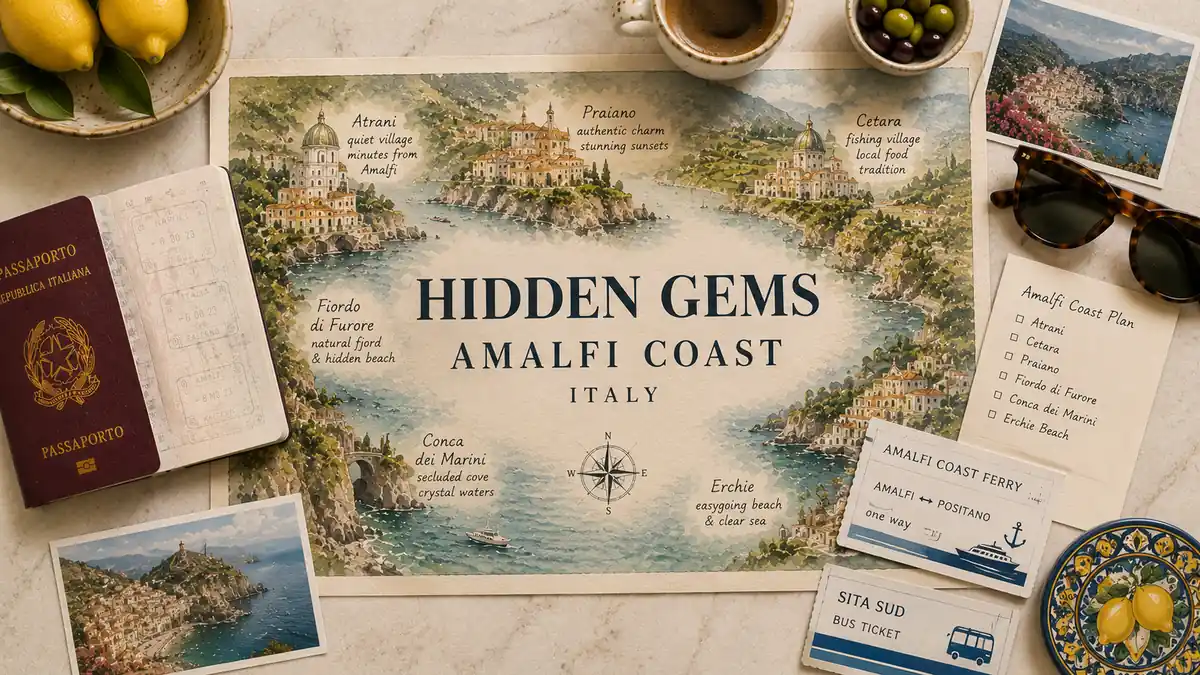
You’ve chosen the Amalfi Coast — now you want the parts of it that everyone else misses. Positano, Amalfi, and Ravello earn their fame, but their lanes and beaches fill fast from late spring onward, and the coast’s real character often hides one town over. The good news: genuinely underrated places sit within easy reach of the headline resorts, quiet enough to feel like a discovery yet close enough to fold into a trip you’ve already planned. This guide is a curated shortlist of those hidden gems — a handful of quieter seaside towns, tiny clifftop villages, and off-radar beaches, each with one clear reason to choose it. It skips the crowds and the guesswork, and points you toward the calm corners of the coast worth building a day around.
Quick Answer
Atrani, Cetara, and the Fiordo di Furore are the Amalfi Coast’s strongest hidden gems. The choice splits into quiet local towns and villages versus off-radar beaches and coves, all easy escapes from Positano and Amalfi crowds. Atrani suits travelers who want the quietest add-on within walking distance of the famous towns.
Trust Layer
Tripstou selection guide for travelers choosing between multiple places. Covers selection criteria, traveler fit, and trip value.
Produced with AI assistance and reviewed by Alex Perrut, working in tourism since 2015, for the Tripstou editorial team. See our editorial process for details.
Last factual review: July 4, 2026.
Official sources consulted: Italia.it, ENIT.
Key Takeaways
- Atrani is the easiest hidden gem to add — the coast’s smallest village sits minutes on foot from Amalfi.
- Cetara rewards food-first travelers, built around its fishing harbor and centuries-old colatura di alici anchovy tradition.
- Praiano gives you Positano’s coastline and famous sunsets with a fraction of the crowds and none of the congestion.
- The best hidden beaches — Fiordo di Furore, Conca dei Marini, Erchie — stay quiet because reaching them takes real effort.
- Cluster gems that share a stretch of coast, and treat the hardest-to-reach cove as its own dedicated day.
- Confirm grotto access, boat schedules, and seasonal openings locally, since these shift and are easy to get wrong.
Table of Contents
Amalfi Coast hidden gems swap crowds for coastal character
The Amalfi Coast’s best hidden gems are quieter towns and beaches overlooked beside Positano and Amalfi. A place earns a spot here by staying genuinely local, keeping crowds thin, and sitting within easy reach of the headline resorts. Character and calm decide the list, not fame.
Positano, Amalfi, and Ravello draw almost every visitor, which is exactly why the coast’s quieter corners stay quiet. You can read up on those headline towns and other big-name Italian destinations in our guide to Italy’s most famous places — treat them as the crowded contrast these gems are measured against. If you want the same idea at national scale, hidden gems across Italy zooms out beyond Campania.
Most of these picks sit a short hop from a famous town, so choosing a gem rarely means giving up the scenery — only the queues. That proximity is the real advantage here: you swap the crowd, not the coastline.
Underrated seaside towns worth choosing over Amalfi
Cetara and Minori are the underrated seaside towns to choose for a quieter, more local coastal day. Both trade the polished resort scene of Amalfi for working harbors, everyday pace, and food traditions that still belong to residents rather than tour groups. You get the same coastline with far fewer crowds.
Both towns reward the traveler who eats where the boats land — Cetara’s anchovies and Minori’s pastries are the reason to come, not a side note. Come hungry.
Cetara guards the coast’s anchovy tradition
Cetara is the coast’s fishing town, and it made this list because it still works for a living. Its boats bring in anchovies that become colatura di alici, a prized amber fish sauce with roots in Roman garum. The result is a place built around its harbor and its kitchen, not around visitors.
What sets Cetara apart is that its identity is edible: the town’s fame rests on a condiment locals have made for centuries, and that alone marks it out from the resort towns nearby.
Pick this if: you want a genuine working village where the food tradition, not the scenery, is the reason to come.
Minori trades glamour for a quiet local beach town
Minori is the low-key beach town where daily life carries on at its own pace. It skips the glamour of its neighbors in favor of a broad, easygoing seafront, a sandy beach, and a long pastry-and-lemon tradition that fills its bakeries. Families and longtime residents give it a lived-in, unhurried feel.
Where Minori stands out is its rhythm: it stays a real town first and a destination second, even in high season.
Pick this if: you want a relaxed slice of everyday Italian coastal life instead of a photogenic showpiece.
Off-the-beaten-path villages and clifftop hamlets
Atrani and Praiano are the tiny, off-radar spots that stay calm even in peak season. One is the coast’s smallest village, tucked beside Amalfi yet largely ignored; the other is a spread-out clifftop hamlet with Positano’s setting and none of its density. Both reward travelers willing to step just off the main drag.
Neither village has a marquee sight, and that is exactly the point — Atrani and Praiano stay quiet precisely because there is nothing here to queue for.
Atrani stays the coast’s smallest, calmest village
Atrani is the smallest village on the Amalfi Coast, and it stays calm despite sitting a short walk from Amalfi. A tight cluster of houses, a piazza, and a small beach fill a ravine that keeps it hidden from the coast road above. Most day-trippers pass right over it.
Atrani’s distinction is its scale: it is small enough to feel like a single connected neighborhood, with a real square where residents still gather in the evening.
Pick this if: you want the easiest quiet escape on the coast, minutes on foot from Amalfi but a world calmer.
Praiano is the quieter alternative to Positano
Praiano is the clifftop village that gives you Positano’s coastline with a fraction of the crowds. It stretches along the road between Positano and Amalfi, its houses and church terraces angled west for some of the coast’s finest sunsets. There is no single tourist core here, so crowds never concentrate.
What sets Praiano apart is the light: its west-facing position makes it the coast’s sunset village, an atmosphere the busier towns can’t match at day’s end.
Pick this if: you want Positano’s scenery and evening glow without its congestion and price of fame.
The coast’s hidden beaches reward the effort to reach them
The Fiordo di Furore, Conca dei Marini, and Erchie are the coast’s best off-radar beaches. Each stays quiet for one simple reason: reaching it takes stairs, a boat, or a walk that filters out the casual crowd. Harder access is the trade you make for space on the sand.
The access barrier is the whole appeal: a beach that takes effort to reach is a beach you’ll have closer to yourself. Treat any grotto, boat, or seasonal opening detail as something to confirm locally before you set out.
Fiordo di Furore hides a beach inside a sea gorge
The Fiordo di Furore is a tiny beach tucked inside a narrow sea gorge beneath a high arched bridge. A former fishing hamlet clings to the ravine walls, and a small strip of sand meets the water where the gorge opens to the sea. It is one of the coast’s most dramatic and least expected settings.
Its distinction is the geography: a fjord-like cleft in the cliffs is rare on this coastline, which is why it feels hidden even once people find it.
Pick this if: you want the coast’s most cinematic hidden cove and don’t mind the steps down to reach it.
Conca dei Marini pairs a quiet cove with the Emerald Grotto
Conca dei Marini is a quiet fishing cove best known for the Grotta dello Smeraldo, the Emerald Grotto. The sea cave glows green where sunlight passes up through the water, and the village keeps a small, sheltered beach below its cliffs. It draws far fewer people than the famous towns along the same road.
What sets it apart is the pairing: a calm swimming cove and a natural sea-cave spectacle sit within one small village.
Pick this if: you want a swim and a natural wonder in a single stop, with no crowd around either. Confirm grotto access and seasonal hours locally before you go.
Erchie sits at the end of the Sentiero dei Monaci
Erchie is a small beach village reached along the Sentiero dei Monaci, the old monks’ path. Two coves, a fishing hamlet, and the remains of a watchtower sit at the base of terraced hills, well away from the coast’s busiest stretch. Its position keeps arrivals low and the beach relaxed.
Erchie’s distinction is the approach: arriving on foot along a historic footpath sets a slower tone before you even reach the sand.
Pick this if: you like pairing a gentle coastal walk with a quiet beach at the finish.
Tours and activities
Book skip-the-line tickets, day trips and local tours with free cancellation on most activities.
You can also browse everything on getyourguide.com.
Tripstou may earn a commission if you book through this link, at no extra cost to you.
How do you fit these hidden gems into an Amalfi Coast itinerary?
Add one to three gems by pairing a quiet town for a slow day with beach coves reached en route. Anchor the trip around the famous towns you already planned, then slot the quiet picks into gaps instead of building a separate circuit. One or two gems per day keeps it unhurried.
A simple way to group them: cluster towns that share a stretch of coast, and treat the harder-to-reach beaches as a single dedicated outing.
- Eastern cluster: Cetara, Erchie, and Minori sit toward the Salerno end and pair naturally on one day.
- Central escape: Atrani sits beside Amalfi, easy to fold into a day you’re already spending there.
- Western sunset: Praiano and the Furore and Conca coves line the road toward Positano.
For the actual routes, ferries, and timing, lean on our Amalfi Coast travel guide instead of over-planning here. If you’d rather fill a day with experiences than more towns, our roundup of things to do on the Amalfi Coast covers that side of the trip.
The gems near the famous towns cost almost no extra travel — it’s the beaches that need their own slot. Build the day around the hardest-to-reach cove and let the easy towns fall in around it.
Frequently Asked Questions
How do you get to the smaller Amalfi Coast towns?
Most smaller towns sit along the main coast road, reached by the SITA bus that links Amalfi, Positano, and Salerno. Seasonal ferries connect several seafront villages like Cetara and Minori. From Amalfi, Atrani is a short walk. Confirm current bus and ferry schedules locally before you set out.
When is the Amalfi Coast least crowded?
The Amalfi Coast is quietest outside the summer peak, in the shoulder months of spring and autumn. Late spring and early autumn keep the weather mild while crowds thin noticeably compared with July and August. Winter is quietest of all, though some seasonal ferries and businesses scale back or close.
Which Amalfi Coast town is best for avoiding tourists?
Atrani is the best town for avoiding tourists, staying calm despite sitting minutes on foot from busy Amalfi. Its position in a hidden ravine keeps day-trippers on the road above. For a working-town feel with even fewer visitors, Cetara at the quieter Salerno end is the strong alternative.
Are the Amalfi Coast’s hidden gems worth visiting over Positano?
Yes, if you value calm and local character more than Positano’s postcard fame and buzz. The hidden gems trade famous views and nightlife for quieter lanes, working harbors, and space on the beach. Most sit close enough to Positano and Amalfi to visit both, so it need not be either-or.
Do you need a car to visit the Amalfi Coast’s hidden gems?
No, you rarely need a car, and it often causes more hassle than help. The coast road is narrow and parking is scarce and pricey, so the SITA bus and seasonal ferries reach most towns more easily. A car only helps for the remotest beaches with sparse connections.
How many hidden gems can you fit into one trip?
Plan for one to three gems across a typical Amalfi Coast trip, roughly one or two per day. Quiet towns beside the famous ones add barely any travel, while the hidden beaches each need their own slot. Cluster nearby picks together and keep the pace unhurried rather than cramming.
Related Guides
Keep planning the quieter side of your trip with these related Tripstou guides:
- Amalfi Coast travel guide — routes, getting around, and the best time to visit for the whole coast.
- Things to do on the Amalfi Coast — experiences and activities once you’ve picked your places.
- Best places to visit in Italy — the famous headline destinations these gems are measured against.
- Hidden gems across Italy — the same off-radar idea at national scale, beyond Campania.
- Best time to visit Italy — the national seasons behind the quieter windows these places reward.
- Italy itinerary — how a coastal leg fits into a longer route without backtracking.
Did this guide save you time or money? Tripstou is independent and reader-funded — if you'd like to give something back, you can support the site with a crypto contribution of any size.