Venice is one of Italy’s most expensive cities to visit, and most of that cost comes down to one thing: the historic center sits on islands where everything — hotels, deliveries, even your morning coffee — carries a logistics premium. A short trip here usually runs higher per day than the same trip in Rome or Florence, mostly because of where you sleep. This guide sizes a realistic Venice budget by travel style and by trip length, then breaks the bill into its four moving parts. You’ll see daily ranges for budget, mid-range, and luxury travel, two- and three-day totals, and the specific Venice costs that catch people out — the vaporetto, the gondola, and the day-tripper access fee. It also shows where the money actually goes and how to cut it without gutting the trip. The tiered answer starts below.
Quick Answer
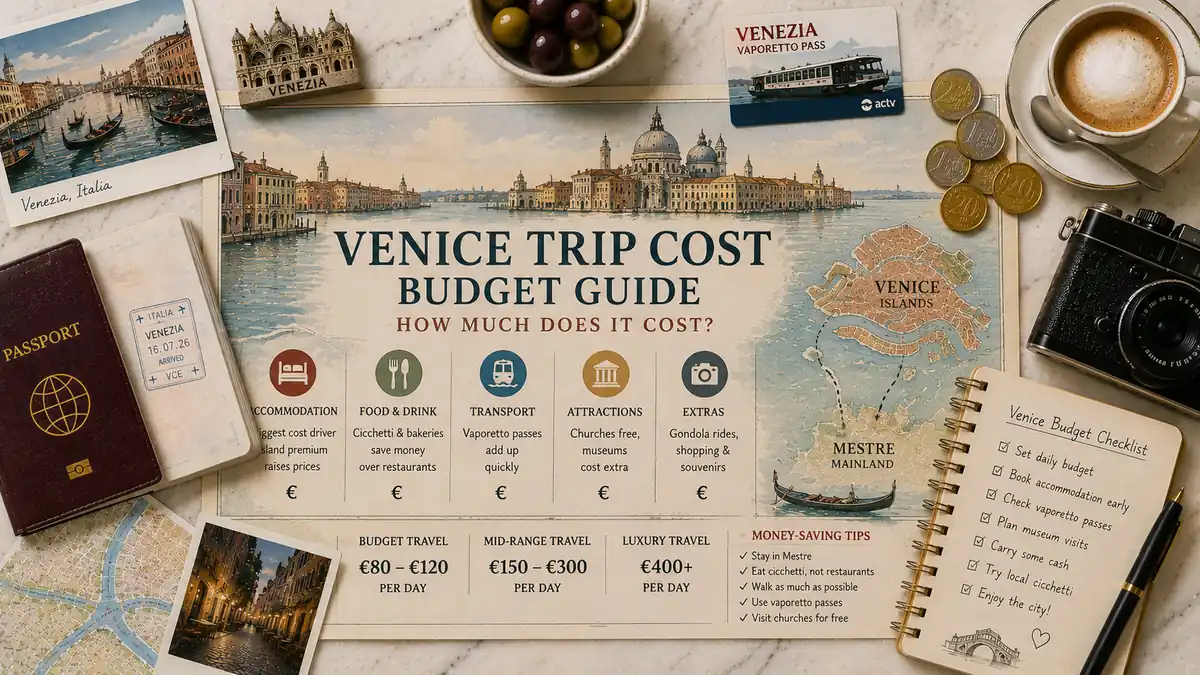
A Venice trip costs roughly €80–€120 per day budget, €150–€300 mid-range, and €400-plus for luxury, per person. Accommodation on the islands — the Venice island premium — moves the number most. Mid-range visitors save fastest by basing in Mestre across the water and eating at cicchetti bars instead of sit-down restaurants.
Trust Layer
Tripstou planning guide for travelers resolving one travel decision. Covers the main variable, traveler context, and practical tradeoffs.
Produced with AI assistance and reviewed by Alex Perrut, working in tourism since 2015, for the Tripstou editorial team. See our editorial process for details.
Last factual review: July 16, 2026.
Official sources consulted: italia.it, enit.it.
Key Takeaways
- A Venice trip runs roughly €80–€120 a day on a budget, €150–€300 mid-range, and €400-plus for luxury, per person.
- Accommodation is the dominant line on a Venice budget — where you sleep decides more than any other choice.
- The island premium pushes Venice roughly 20–30% above Rome or Florence, driven by car-free logistics, not tourist gouging.
- Basing in Mestre and eating at cicchetti bars can roughly halve a mid-range daily budget without gutting the trip.
- Longer stays lower your per-day average, since fixed arrival costs spread across more nights than a short weekend.
- The day-tripper access fee is only a few euros and applies to excursion visitors, not overnight guests.
Table of Contents
How much does a Venice trip cost per day?
A Venice trip costs roughly €80–€120 per day for budget travel and €150–€300 for mid-range, per person. Luxury trips start around €400 daily and climb without a ceiling. The gap between tiers is driven almost entirely by your hotel and how you eat, not by sightseeing.
| Travel style | Daily budget (per person) | Where you sleep | How you eat |
|---|---|---|---|
| Budget | €80–€120 | Hostel dorm or a room in Mestre | Cicchetti, bakeries, picnic lunches |
| Mid-range | €150–€300 | Three-star hotel or island B&B | One sit-down dinner, casual lunches |
| High-end | €400 and up | Canal-view four- or five-star | Restaurant dining, wine, aperitivo |
What each style actually buys in Venice looks like this:
- Budget (€80–€120/day): a hostel dorm or a simple mainland room, cicchetti and bakery meals, and walking everywhere. Venice is unusually kind to travelers on foot — the entire center is free to wander and endlessly walkable.
- Mid-range (€150–€300/day): a three-star hotel or B&B, one sit-down dinner, a couple of paid museums, and vaporetto hops. This is where the island premium bites hardest, because mid-range island room rates jump well above their mainland equivalents.
- High-end (€400+/day): a canal-view hotel, restaurant dining, a private water taxi, a gondola. Venice rewards luxury spending with settings few cities can match, and it prices them to match.
Is Venice expensive to visit?
Yes, Venice is expensive — moderately so, and mainly because of its geography. Prices run roughly 20–30% above Rome or Florence for a comparable trip, driven by the island premium: hotels, restaurants, and supplies all cost more to run on car-free islands reached only by boat.
The premium is baked into logistics, not tourist gouging. Everything that reaches a Venice island arrives by boat and is moved the last stretch by handcart — produce, laundry, luggage, building materials. That labor sits inside the price of a canal-side coffee as much as a hotel room, which is why even modest cafes charge more than their mainland cousins.
Two things soften the gap. The premium concentrates in accommodation and waterside dining, so travelers who sleep on the mainland and eat at bacari feel far less of it. And Venice charges nothing for its greatest asset — wandering the alleys and canals costs zero, so a walking-heavy trip narrows the distance to a Rome or Florence budget.
For where Venice sits inside a longer national trip, see our Italy trip cost guide; for the wider set of Venice planning pages, start with the Venice travel guide.
How much do you need for 2 or 3 days in Venice?
A two-day Venice trip costs roughly €250–€400 on a budget and €500–€1,200 mid-range, per person. A third day adds one more night plus a day of food and transit. Longer stays quietly lower your per-day average, because fixed arrival costs spread across more nights.
How the length of the stay shapes the total:
- Two days (€250–€400 budget / €500–€1,200 mid-range): enough for St Mark’s, the Rialto, and one lagoon island like Murano — a focused first visit. Fits weekenders who want the highlights without a long hotel bill. For how to fill the time, see our two-day Venice itinerary.
- Three days (roughly €370–€600 budget / €750–€1,800 mid-range): adds Burano, the Dorsoduro museums, and slower canal time. Fits travelers who want Venice to breathe rather than blur. Our three-day Venice itinerary maps the extra day.
- A week: the per-day average drops noticeably, since your flight, transfers, and first-day setup costs are amortized. Fits slow travelers using Venice as a lagoon base. Beyond three or four days, though, most visitors run low on distinct Venice and start day-tripping.
Because arrival costs are fixed, adding a night often lowers your Venice day-rate more than trimming daily spending does — the third day frequently costs less per day than the first two. Short trips pay the highest average.
Venice cost breakdown: accommodation, food, transport, activities
Accommodation dominates a Venice budget, followed by food, then activities, with transport usually the smallest line. On the islands, lodging can swallow half or more of your daily spend. Food comes next and swings widely by style, while vaporetto fares and museum entries stay comparatively modest.
The four categories, in order of impact:
- Accommodation: the dominant lever — on-island rooms command a premium, while mainland Mestre runs much cheaper. Full detail in the next section.
- Food: from a few euros for cicchetti and a spritz at a bacaro up to €40–€80 a head at a canal-side restaurant. Where you eat matters more than what.
- Activities: mostly optional. St Mark’s Basilica is cheap or free to enter; the Doge’s Palace, the Museum Pass, gondolas, and island boat trips are the paid extras.
- Transport: modest, and mostly the vaporetto plus your airport transfer. Walking covers most of the city for nothing.
Eating in Venice: where the food budget really goes
Food is the category you control most in Venice. The city’s cheapest great meal is cicchetti — small plates at a bacaro, the traditional Venetian wine bar — where a few euros buys a plate and a glass of wine. Grazing across two or three bacari makes a full dinner for a fraction of a sit-down bill. Restaurants with canal views charge for the setting, and the worst tourist traps cluster right around St Mark’s. Walk five minutes into a quieter sestiere and prices ease.
How much is a gondola ride and a vaporetto ticket?
A standard gondola ride runs a set rate of roughly €80–€90 for about 30 minutes, split across up to five passengers, with higher evening rates. A single vaporetto ticket costs around €9–€10 and is valid for a short window; multi-day travelcards cut the per-ride cost sharply for anyone hopping between islands.
These are costs, not usage guides. For how the vaporetto network, ticket types, and travelcards actually work, see our Venice transport guide. Your airport transfer is the other transport line to budget: options span a cheap bus up to a pricey private water taxi, and we compare the Venice airport transfer methods separately.
Why accommodation is the biggest expense in Venice
Accommodation is the biggest expense of any Venice trip, and where you sleep decides your whole budget. A room on the historic islands carries the steepest version of the island premium, often costing noticeably more than an equivalent room a short train ride away in Mestre on the mainland.
Rough nightly bands for a double room:
- Hostel dorm or budget mainland room: around €30–€70 a night, lowest in Mestre.
- Three-star on the islands: often €120–€250, and higher in peak season.
- Four- and five-star with canal views: €300 upward, with no real ceiling.
The core trade-off is location versus price. Staying on the islands buys the thing most people come for — stepping out of your door into Venice at dawn, after the day-trippers have gone. Mestre and the mainland cost far less and sit 10–15 minutes away by frequent train, but you give up the early-morning and late-evening quiet for the savings. Which side wins depends on how much that atmosphere is worth to you and how many nights you’re paying for it.
The island premium is really a per-night tax on atmosphere — it only pays off if you’re actually out at dawn and dusk to collect it. Travelers who leave early and return late spend most of that premium asleep.
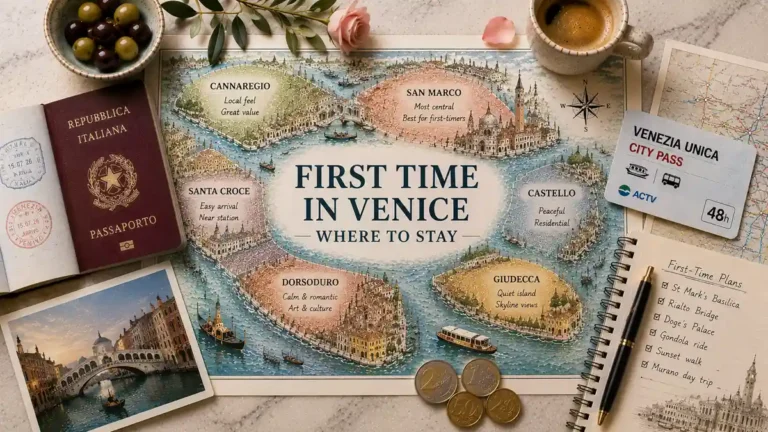
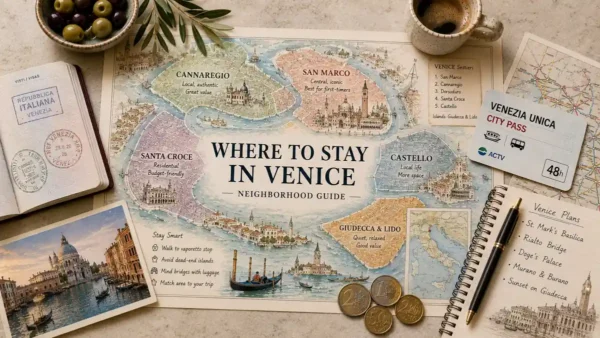
For which specific areas fit your trip and budget, see our Venice neighborhood guide — this page prices the bands, that one ranks the areas.
Hotels and places to stay
Compare hotels, apartments and stays for your dates in one search.
Search hotels and stays on hotels.com →
Tripstou may earn a commission if you book through this link, at no extra cost to you.
How much is the Venice day-tripper access fee?
The Venice day-tripper access fee is a few euros, and only day visitors pay it. The charge commonly falls around €5–€10 and applies on selected high-traffic days, not every day of the year. Overnight guests who pay their hotel’s tourist tax are exempt, so the fee mainly affects excursion visitors.
For most travelers reading a trip-cost guide, the fee barely registers. If you’re sleeping in Venice, it won’t touch you at all. It exists to manage the flood of day-trippers who arrive by train or cruise for a few hours and leave, and it’s collected through an online booking and a QR code on active days. Because the price, dates, and exemptions get adjusted periodically, day-trippers should confirm the current rules on the official channel before traveling.
How to visit Venice on a budget
The biggest saving in Venice is sleeping on the mainland instead of the islands. Basing in Mestre cuts your largest cost while leaving the city 10–15 minutes away by train. Eating at cicchetti bars is the second big lever. Together, those two moves can roughly halve a mid-range daily budget.
The savings ladder, from highest impact down:
- Sleep in Mestre or on the mainland. Suits budget and mid-range travelers who don’t need to be inside Venice at night. Trade-off: you miss the quiet early-morning and late-evening city and add a short daily train commute.
- Graze at bacari, not restaurants. Suits anyone comfortable with small plates and standing room. Trade-off: less formal dining, though many travelers find the cicchetti crawl the more memorable meal anyway.
- Walk the city and skip short vaporetto hops. Suits able walkers on shorter trips. Trade-off: bridges and dead ends make walking slow, and a travelcard earns its price once you’re island-hopping to Murano or Burano.
- Visit in shoulder season. Suits flexible travelers. Trade-off: cooler weather and some acqua alta risk, but hotel rates — the cost that matters most — drop sharply outside summer and Carnival.
- Skip the private water taxi. Suits anyone not hauling heavy luggage far. Trade-off: the vaporetto or airport bus costs a fraction as much, but it’s slower and busier.
The one saving that backfires in Venice is over-optimizing the vaporetto. Skipping a travelcard to save a couple of euros usually costs more once you add up the single-ticket price of every island hop and airport leg. Do the math on your route first. For more on-the-ground ways to stretch a Venice budget, see our Venice travel tips.
Frequently Asked Questions
Is Venice more expensive than Rome or Florence?
Yes, Venice typically runs about 20–30% more than Rome or Florence for a comparable trip. The gap comes almost entirely from accommodation and waterside dining, where the island premium bites. Travelers who sleep in Mestre and walk the city instead of eating canal-side close most of that difference.
Can you visit Venice on 50 euros a day?
Barely, and only by sleeping on the mainland. Fifty euros a day works if you take a Mestre hostel dorm, eat cicchetti and bakery food, and walk everywhere, skipping paid attractions. It leaves nothing for a gondola or sit-down meals, so most budget travelers should plan closer to €80 daily.
How much cash should I bring to Venice?
Carry a small amount of cash — enough for a day or two of coffees, cicchetti, and vaporetto tickets. Most hotels, restaurants, and shops take cards, but small bacari, market stalls, and some gondoliers prefer cash. Around €50–€100 per person for a short trip covers the card-averse corners comfortably.
Is the Venice Museum Pass worth the cost?
Usually, if you plan to see three or more civic museums. The Museum Pass bundles the Doge’s Palace with the Correr and several others, so it pays off once you visit a handful. Travelers doing only the Doge’s Palace and mostly free churches rarely recover its cost.
Do children pay the Venice day-tripper access fee?
Generally no — the day-tripper access fee typically exempts young children, alongside overnight guests, residents, and several other categories. Because the exemptions and age thresholds are adjusted periodically, families visiting for the day should confirm the current rules and register any required exemption on the official booking channel before traveling.
Is a day trip to Venice cheaper than staying overnight?
Yes, on paper — skipping a night removes the island premium, the priciest part of any Venice trip. But day-trippers pay the access fee on busy days, get the worst of the crowds, and miss the quiet dawn and dusk hours. For a first visit, one or two nights usually buys far more than it costs.
Related Guides
- Venice travel guide — the cluster hub that routes every Venice planning decision.
- Where to stay in Venice — which area fits your budget and trip once you know the bands.
- Venice transport guide — how the vaporetto, tickets, and travelcards actually work.
- Venice in 2 days — a focused plan for a short first visit.
- Venice in 3 days — the slower route with the lagoon islands.
- Italy trip cost guide — how Venice fits into a wider national budget.
Did this guide save you time or money? Tripstou is independent and reader-funded — if you'd like to give something back, you can support the site with a crypto contribution of any size.