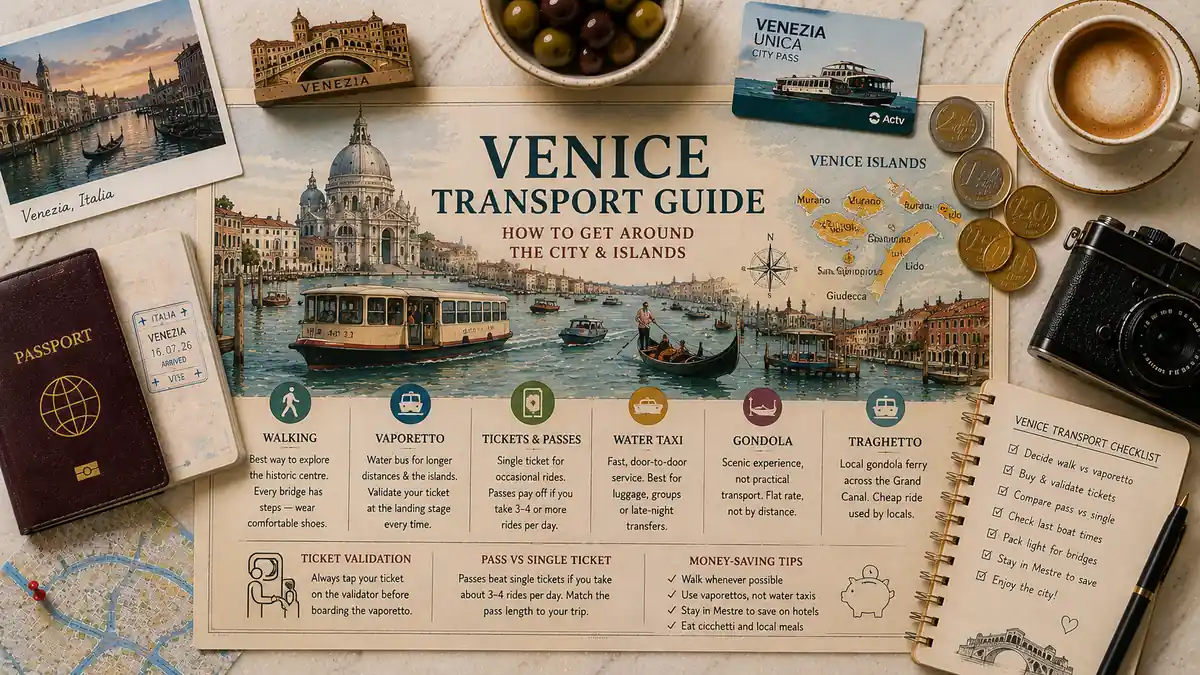
Venice is a car-free island city, and that single fact shapes every transport decision you make there. There are no cars, no buses, and no metro inside the historic centre — just footpaths, bridges, and water. So the real question is simple: when do you walk, and when do you take a boat? For most visitors, walking is the default and the vaporetto water bus fills the gaps, with a water taxi kept in reserve for speed or heavy bags. This guide resolves the two decisions that trip up first-timers: whether to walk or ride, and whether a vaporetto pass is worth buying. It covers moving around the city and out to the islands only. Getting in from the airport or arriving by train are separate journeys, handed off where they come up.
Quick Answer
Venice is car-free, so you get around mainly on foot, plus the vaporetto water bus for longer trips. Your split between walking and boats depends on distance, luggage, and whether you visit the outer islands. Most short-stay visitors walk and buy single vaporetto rides, adding a pass only for several boats a day.
Trust Layer
Tripstou planning guide for travelers resolving one travel decision. Covers the main variable, traveler context, and practical tradeoffs.
Produced with AI assistance and reviewed by Alex Perrut, working in tourism since 2015, for the Tripstou editorial team. See our editorial process for details.
Last factual review: July 16, 2026.
Official sources consulted: italia.it, enit.it.
Key Takeaways
- Walking is Venice’s primary mode; the car-free centre is small enough to cross on foot in under an hour.
- Take the vaporetto water bus mainly for the Grand Canal’s full length, heavy luggage, or trips to the outer islands.
- A vaporetto pass only beats single tickets when you take roughly three or four boat rides a day.
- Match any pass to your stay length, since an unused day on a longer card is wasted money.
- A water taxi buys speed and door-to-door service at a premium; a gondola is an experience, not real transport.
- Always validate your ticket at the landing stage every time you board, since there are no on-board sales.
Table of Contents
How do you get around Venice?
You get around Venice on foot and by vaporetto — the car-free city has no cars, buses, or metro. Walking handles most journeys across the compact centre. The vaporetto water bus covers the Grand Canal and the outer islands, while a private water taxi is the fast, premium option.
Think of it as four modes with distinct jobs. Walking is your default and costs nothing. The vaporetto earns its place on long crossings, along the Grand Canal, and to the islands. A water taxi buys speed and door-to-door service at a premium, and the traghetto is a cheap standing-gondola shortcut straight across the canal. The table below shows when each one wins.
| Mode | Best for | Speed | Cost signal |
|---|---|---|---|
| Walking | Most trips across the compact centre | Usually fastest door to door | Free, no ticket needed |
| Vaporetto | Grand Canal and island hops | Slow but steady on water | Single ride or timed pass |
| Water taxi | Speed, groups, heavy luggage | Fastest boat, direct routing | Premium flat or metered band |
| Traghetto | Crossing the Grand Canal quickly | A few minutes standing | Low, a couple of euros |
Everything here is intra-city movement. If you are still planning the wider trip, start from the Venice travel guide for the city overview. Arriving is a separate step: for the run in from Marco Polo or Treviso, see getting from Venice airport to the city, and if you come by rail into Santa Lucia station, our Italy train itinerary covers the routes there. Once you are in the centre, the modes above are all you need.
Is Venice walkable?
Yes, Venice is highly walkable, and most journeys are faster on foot than by boat. The historic centre is small and dense, so you can cross it in well under an hour. The main variables are stepped bridges, luggage, and tired legs at the end of a long day.
The catch is the bridges. Hundreds of them arch over the canals, and nearly all have steps rather than ramps, which slows anyone with a suitcase, stroller, or mobility limits. There are no long climbs, but the constant up-and-down adds up over a full day of sightseeing. Comfortable shoes matter more here than in almost any other European city.
Because Line 1 stops at nearly every landing and the Grand Canal curves in a long S, a route that looks slow on the map often walks faster than it rides. Where you sleep changes this maths too: a base near the main sights keeps you on foot all day, while an outer location leans harder on the vaporetto — worth weighing when you decide where to stay in Venice.
What is a vaporetto and how do the lines work?
A vaporetto is Venice’s public water bus, run by ACTV along the Grand Canal and to the islands. It works like a bus route on water, with fixed stops called landing stages. Grand Canal lines connect the main sights, while separate island lines reach Murano, Burano, Torcello, and the Lido.
You board at a floating pontoon marked with the line number and direction, tap or scan your validated ticket, and step on. Lines are numbered, not colour-coded, so read the sign at the stage carefully — the same pontoon often serves boats going opposite ways. The two you will use most run the Grand Canal.
Line 1 vs Line 2: which to take
Take Line 1 for the scenic, all-stops trip down the Grand Canal, and Line 2 when you want to cross the city faster with fewer stops. Line 1 is the classic sightseeing ride, calling at nearly every palazzo between Piazzale Roma and San Marco. Line 2 skips the minor landings, so it suits getting between key points quickly. Both run every several minutes through the day and thin out at night, so check the last departures if you are out late.
How do vaporetto tickets work, and what do they cost?
Vaporetto tickets are time-limited single rides you buy before boarding and validate at the stop. A single fare lets you travel one way within a fixed window, transfers included, but it is not a return ticket. A single ride costs roughly €9–€10, so heavy boat use adds up quickly.
Treat that figure as a guide and check the current fare before you travel, since ACTV adjusts prices periodically. The practical mechanics are simple once you know the order of operations:
- Buy at a staffed ticket office, an automatic machine, or the ACTV app before you reach the pontoon.
- Validate by tapping the card on the reader at the landing stage every time you board — not just the first time.
- Keep the ticket active within its time window; you can transfer between lines until it expires.
- Expect no ticket sales on board, so never board without a valid, validated fare.
The window is short, so a single ticket is built for one journey plus connections, not a day of hopping on and off. That is exactly the calculation that decides whether a pass beats singles.
Is a vaporetto pass worth it, and which one?
A pass pays off only if you take several vaporetto rides a day. ACTV sells timed travel cards for 24, 48, and 72 hours, plus a 7-day option, covering unlimited rides in that window. Below roughly three or four boats a day, single tickets usually cost less.
The break-even is straightforward: divide a pass price by the single-ticket fare to see how many rides it takes to pay for itself, then be honest about whether you will hit that number. Pick the duration that matches your stay, not the longest one on offer — an unused day on a 72-hour card is money gone.
Because walking covers most of central Venice, many visitors never ride enough boats to justify even a 24-hour pass; it mainly wins if your base sits far out or you island-hop most days. On a tight schedule, map your boat use against your plan first — our 2-day Venice itinerary shows how few rides a short visit really needs. Treat all pass prices as ranges and confirm the current rates before buying.
Tours and activities
Book skip-the-line tickets, day trips and local tours with free cancellation on most activities.
You can also browse everything on getyourguide.com.
Tripstou may earn a commission if you book through this link, at no extra cost to you.
When is a water taxi or traghetto worth it?
Take a water taxi for speed or heavy luggage; take a traghetto only to cross the Grand Canal. A water taxi is a private motorboat that runs door to door, fast but expensive. A traghetto is a shared standing gondola that ferries you across the canal for a couple of euros.
The two solve opposite problems. A water taxi buys time and comfort: it drops you at your hotel’s water entrance and skips the walk-and-wait of the vaporetto, which matters most with bags or a group. A traghetto is a pure shortcut, saving a long detour to the nearest bridge where the Grand Canal has no crossing nearby.
A water taxi’s flat fare runs into the tens of euros even for a short hop, so it earns its price mainly when split across a group or when the alternative is dragging suitcases over a string of stepped bridges. The gondola, by contrast, is an experience, not transport — worth doing once for the ride itself, not for actually getting somewhere.
How do you get to Murano and Burano?
You reach Murano and Burano by vaporetto, mainly from the Fondamente Nove stops on the northern edge. Murano is the closer glass-making island, a short hop away. Burano, known for lace and painted houses, sits further out and takes longer. Island lines run regularly by day and less often at night.
The practical order is to do Murano first, then continue to Burano, since they line up on the same northern side of the lagoon. Journey times run from a short crossing to Murano up to a longer ride out to Burano, and frequencies drop in the evening — check the last returning boats before you set off so you are not stranded. Torcello sits just beyond Burano and is usually paired with it on the same trip.
Keep this to the transport question: which boat, from which stop, roughly how long. How to sequence the islands into a wider day belongs with your overall plan, not here.
Frequently Asked Questions
Can you get fined for riding the vaporetto without a valid ticket?
Yes, riding without a validated ticket risks an on-the-spot fine plus the fare. Inspectors board vaporettos and check that your ticket was tapped at the landing stage, since there are no sales on board. Always buy and validate before you step on, even for a single short hop.
Is a gondola transport or just for tourists?
A gondola is essentially a paid experience, not practical transport for getting around Venice. Rides follow scenic loops, not useful routes, and the flat price reflects the romance, not the distance. If you simply need to cross the Grand Canal, take the traghetto — a cheap standing-gondola ferry that locals actually use.
How do you get around Venice with luggage?
With luggage, walking is manageable but slow because most bridges have steps, so a wheeled suitcase means constant lifting. For heavier bags, take the vaporetto along the Grand Canal toward your stop, then walk the short final stretch. A water taxi costs more but drops you nearest your accommodation’s entrance.
Do vaporettos run late at night in Venice?
Yes, but service thins out considerably after the evening, with far fewer boats and longer waits. A handful of night lines keep running through the small hours on the main Grand Canal route, though island connections drop off first. Check the last departure for your stop before heading out late.
Will Google Maps work for walking around Venice?
Google Maps works for walking directions in Venice, but expect it to struggle with the maze of narrow alleys and unmarked turns. Offline maps and the yellow wall signs pointing to San Marco, Rialto, and the station are often more reliable. Getting a little lost here is part of the experience.
Is Venice’s vaporetto accessible for wheelchairs and strollers?
The vaporetto is the most accessible way to move around Venice, since boats board at level floating pontoons and avoid the stepped bridges. Staff can help with ramps at the landing stages. Walking is harder with wheels because hundreds of bridges have steps, so the water bus often becomes the practical choice.
Related Guides
- Venice travel guide — the full city overview and where this transport guide fits.
- Getting from Venice airport to the city — the arrival transfer this page hands off.
- Where to stay in Venice — how your base changes how much you walk or ride.
- 2-day Venice itinerary — fitting walking and vaporetto trips into a short visit.
- Italy train itinerary — arriving into and leaving Santa Lucia station by rail.