One spare day in Rome forces a real choice. The candidates run from a 25-minute suburban ride to a high-speed run that takes the morning and the evening with it, and every hour on a train is an hour not spent in the city you came for. Most lists solve this by naming twenty options and ranking none of them. This page does the opposite. It sorts a shortlist of seven trips on one axis — what the round trip costs against what the day gives back — and states plainly which ones are worth committing to and which quietly fail. You get the tier each trip belongs to, the mechanics of getting there and back, the traveler each one suits, and an honest skip list of famous names that do not survive the return journey. Geography is not the sorting principle here. Time is.
Quick Answer
Ostia Antica is the strongest day trip from Rome: shortest journey, largest payoff. The deciding variable is how much of the day the return journey eats: short hops leave an evening in Rome; high-speed trips do not. Pick Pompeii or Florence instead if you will start early and stay out all day.
Trust Layer
Tripstou selection guide for travelers choosing between multiple places. Covers selection criteria, traveler fit, and trip value.
Produced with AI assistance and reviewed by Alex Perrut, working in tourism since 2015, for the Tripstou editorial team. See our editorial process for details.
Last factual review: July 28, 2026.
Official sources consulted: italia.it, enit.it.
Key Takeaways
- Ostia Antica is the strongest overall pick: a full Roman port city reached in about 25–30 minutes from Piramide.
- Choose a half-day trip on a short Rome stay; a full day out removes a fifth of a five-day visit.
- Tivoli and Orvieto justify a whole day by regional train, but the return timetable, not the site, sets your deadline.
- Naples gives the best payoff per travel hour of the high-speed picks, at about 70 minutes each way from Termini.
- Book high-speed seats in advance for the departure you want, accepting that the locked return then shapes the entire day.
- Skip the Amalfi Coast, Capri and Cinque Terre as day trips — the round trip outlasts the time on the ground.
Table of Contents
Which Day Trips From Rome Are Actually Worth It?
Ostia Antica is the day trip worth taking first, and the rest sort into three tiers. Every trip on this page pays back its travel time in some form; the tiers differ in how much of the day they cost. Short hops, full-day regional runs, and long-range high-speed trips each buy something different.
The filter is arithmetic on your day, not distance on a map. A trip earns its place when the hours on the ground clearly outweigh the hours spent moving, and when what waits at the other end cannot be substituted by something inside Rome. That second test removes most of the options competing lists keep.
- Short hop (under about an hour each way): buys a real site and hands back the afternoon or evening — fits first-time visitors on a tight three- or four-day stay.
- Full-day regional train: buys a whole town or a two-site day and takes the day with it — fits repeat visitors, or anyone staying five days or more.
- Long-range high-speed: buys a second city, at the cost of every hour between the first train out and the last train back — fits travelers who want the day out to feel like a separate destination.
Count the cost on the Rome side too. A full day out removes a fifth of a five-day stay from the Forum, the Vatican and the neighbourhoods you booked the trip for, which is why a first visit of three days or fewer should usually stay put. If the stay itself is still taking shape, our Rome travel guide covers planning the rest of your time in the city.
The trips that disappoint are rarely the far ones — they are the near ones taken late. A site reached at two in the afternoon gives you a rushed hour before the last useful return; the same site at nine in the morning is a genuine half day, and that gap is entirely under your control.
Which Rome Day Trips Take Under Two Hours by Train?
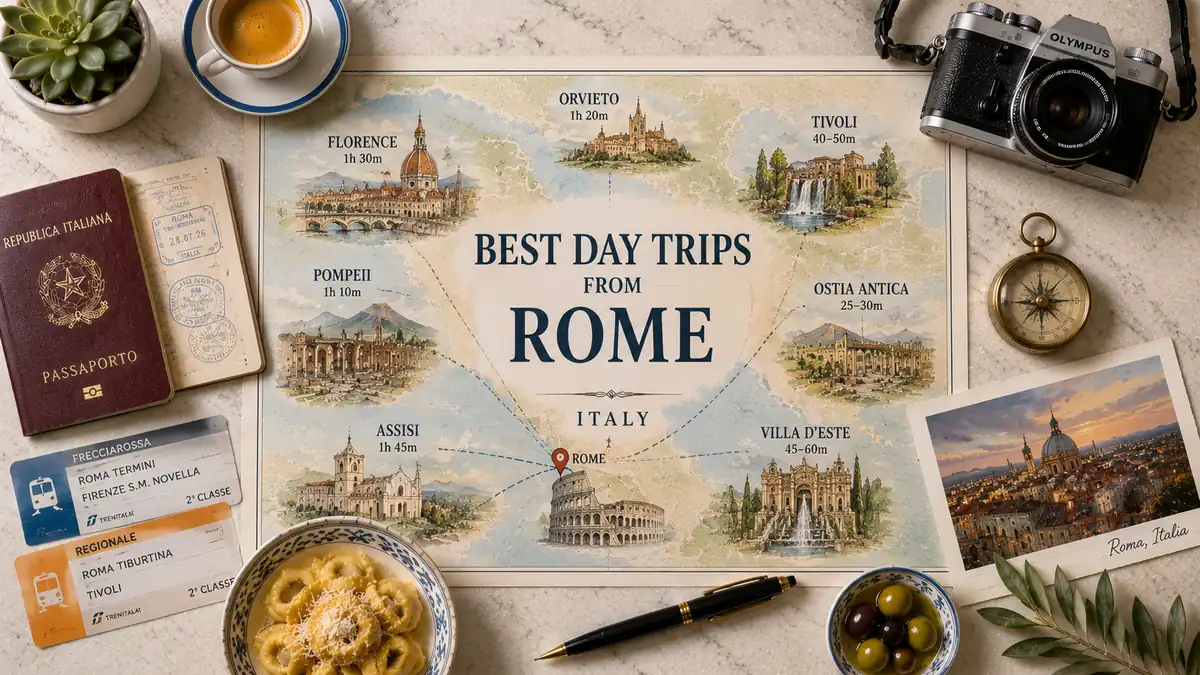
Ostia Antica, Naples and Florence all clear the two-hour line by train from Rome. Ostia Antica takes about 25–30 minutes on the Metromare line, Naples about 70 minutes by Frecciarossa, and Florence roughly 1h30–1h40 by high-speed train. Pompeii clears it too, with one change in Naples.
Times below are typical journey lengths and vary by service — check the timetable in both directions before booking.
| Day trip | Departure point and line | Time each way | Shape of the day |
|---|---|---|---|
| Ostia Antica archaeological park | Piramide (metro B), Metromare line | About 25–30 minutes each way | Half day, back in Rome by lunch |
| Naples city centre | Roma Termini, Frecciarossa high-speed | About 70 minutes each way | Full day in one city, early start |
| Pompeii archaeological site | Termini to Naples, then Circumvesuviana | About 70 minutes plus roughly 36 minutes | Full day with a change at Napoli Garibaldi |
| Florence historic centre | Roma Termini to Firenze S.M.N., high-speed | Roughly 1h30–1h40 each way | Full day, one afternoon on the ground |
Two hours each way is the threshold that matters because it is the point where the return journey stops leaving you a usable afternoon. Under it, you choose when to come home. Over it, the timetable chooses for you, and the last convenient departure quietly becomes the deadline for everything you do on the ground.
A change of train costs more than the minutes it adds. The Naples–Pompeii leg runs on the Circumvesuviana in about 36 minutes, roughly every 30 minutes, with no advance booking — convenient in principle, less predictable in practice, since it is a local commuter line exposed to delays and strike days. Every transfer also adds waiting time that no published journey figure shows you.
Ostia Antica is the exception to all of this: it runs on the same standard Rome transport ticket you use for the metro, so there is no separate rail booking at all. The remaining picks — Tivoli, Orvieto and the Castelli Romani — are regional-train trips handled in the two sections below. Reaching your departure station is part of the journey: our guide to getting around Rome explains what a standard city ticket does and does not cover.
Half-Day Trips From Rome That Leave You an Evening in the City
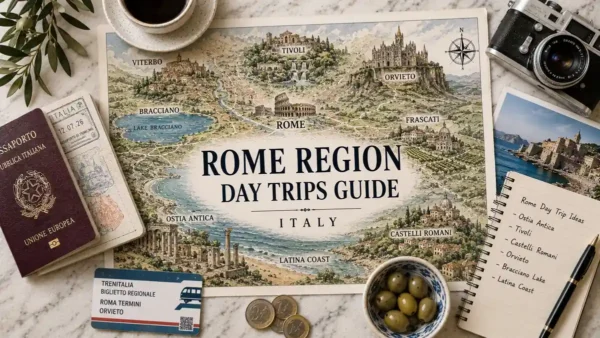
Ostia Antica is the strongest half-day trip from Rome, with the Castelli Romani close behind. Ostia gives you a full Roman city in a morning; Frascati and the hill towns build the day around eating and drinking instead. Both hand back an afternoon or an evening in Rome, which is the whole point.
These two sit close enough that the journey never becomes the day itself. For how the near-Lazio picks sit geographically, our guide to the wider region around Rome maps them out. The hours you keep are the actual prize, so decide in advance what they are for — our list of what to do with the rest of your day in Rome is the other half of this decision.
Ostia Antica
Ostia Antica leads the shortlist because it delivers a full Roman port city for the price of a metro-length journey. The Metromare line from Piramide takes about 25–30 minutes and the site is a short walk from the station. Among the seven picks it is the only one you reach on a standard Rome transport ticket, and the only major Roman site you can be back from before lunch. Entry is ticketed separately at standard state-site rates. The park closes on Mondays, and its closing hour shifts with the season, so plan around the shorter winter pattern if you are visiting outside summer.
Pick this if: you want a serious archaeological day without surrendering the whole day to get it.
Frascati and the Castelli Romani
Frascati and the Castelli Romani made the list as the one pick where the payoff is a table, not a monument. The draw is a long lunch, local wine and the view back toward the city — nothing here has to be queued for, ticketed, or timed to an entry slot. That is why it survives a late start better than anything else on the page: leave after a slow morning and you still get everything the trip offers. It is also the weakest choice for anyone whose day is measured in sights, because there is no headline site to aim at.
Pick this if: your idea of a day out is a long lunch with a view, not a ticket queue.
The half-day tier is also the only one where the decision is reversible. If Ostia disappoints you by noon, you are back at Piramide within half an hour and the afternoon is still yours; abandon Florence at noon and the day has already gone into trains. That asymmetry, more than any journey time, is why the short hops suit a short stay.
Full-Day Trips From Rome by Regional Train
Tivoli and Orvieto are the regional-train trips that justify a whole day out of Rome. Both ask for more than the journey time suggests: Tivoli spreads across two large sites, and Orvieto is a whole hill town, not a single monument. Neither compresses into half a day without losing the point.
A full day out is an entire slot removed from a short Rome stay, which is why these two work best from the fourth day onward. If your visit is fixed at three days, our three-day Rome itinerary shows where a day out can fit and what it displaces.
Tivoli
Tivoli made the list because two major sites sit within one day of each other, roughly 30 km east of Rome. Here the opening pattern, not the journey, dictates the shape of the day: Villa d’Este opens on Monday afternoons only, from 14:00, so a Monday visit is an afternoon visit or nothing at all. Both villas close on New Year’s Day and Christmas Day, and both are free on the first Sunday of the month — a saving that arrives with the crowd it implies. The two sites sit far enough apart that doing both, plus the transfer between them, realistically is the day. Each charges its own entry.
Pick this if: you want two headline Roman sites in one day and accept giving up the evening in Rome for them.
Orvieto
Orvieto qualifies because the town itself is the attraction, roughly 125 km north of Rome. Nothing here is a site to be visited; you visit a place, walk its streets, and stop when you feel like stopping. That makes it the most forgiving trip on the page: no entry slot to miss, no closing hour that ends the day early. It is also the one pick that reads as a preview of a different region, which is why travelers who like it tend to come back for Umbria properly later. Journey times vary by service, so confirm the timetable both ways before committing the day.
Pick this if: you want a whole town to yourself for a day and no schedule to obey once you arrive.
These two punish a slow start harder than the high-speed picks do. Regional services run less often than the high-speed departures to Florence, so the return train — not the site, not your energy — sets the real deadline. Check it first. Then build the day backwards from it.
Tours and activities
Book skip-the-line tickets, day trips and local tours with free cancellation on most activities.
You can also browse everything on getyourguide.com.
Tripstou may earn a commission if you book through this link, at no extra cost to you.
Day Trips From Rome by High-Speed Train
Naples, Pompeii and Florence all work as day trips from Rome by high-speed train. Each takes the whole day and returns a different city, so the question is what you accept losing in Rome. Naples gives the best payoff per travel hour; Florence gives the easiest journey and the hardest compromise.
High-speed seats behave like airline seats, and the booking decision shapes the day more than most travelers expect:
- Book well ahead: the lowest fares and a seat on the departure you actually want — the tradeoff is a fixed train you cannot abandon if the day goes badly.
- Book a day or two out: still a reserved seat on a chosen service, usually at a higher price — suits travelers who want to see the forecast first.
- Buy on the day: full flexibility at the top of the price range, with no guarantee on busy morning departures — sensible only outside peak periods.
Booking early changes the itinerary here, not just the fare. An advance ticket locks the return, and the locked return is what decides whether Florence gets a real afternoon or a hurried three hours. If the long-range trip is starting to look like the better half of the holiday, turning it into a leg beats bouncing back the same night — our Italy train itinerary covers routing Rome, Naples and Florence as stops instead of return journeys.
Naples
Naples returns more per hour of travel than anything else on this page: about 70 minutes from Roma Termini on a Frecciarossa, for an entire city at the other end. It is the only pick that is a full city instead of a site, and the day is spent deciding what to skip — the archaeological museum, the historic centre, the food, or the harbour, but not all four. That is a constraint, not a complaint. Naples rewards a night, and a day trip is a sampler you take with your eyes open. The return is rarely the difficulty; leaving is.
Pick this if: you want a second Italian city inside your Rome trip and are content to see a tenth of it.
Is Pompeii Worth a Day Trip From Rome?
Pompeii is worth a day trip from Rome if you accept an early start and a change of train. Roma Termini to Napoli Centrale takes about 70 minutes by Frecciarossa. From Napoli Garibaldi, the Circumvesuviana reaches Pompei Scavi–Villa dei Misteri in about 36 minutes, roughly every 30 minutes, with no advance booking needed on that leg. The commuter line is the weak link, more exposed to delays and strike days than the high-speed network, so leave slack around your booked return. The site runs a longer summer schedule and a shorter winter one, which means the season, not the timetable, decides how many hours you get inside. Tickets, entry rules and on-site routing are a separate job: our guide to how to visit Pompeii handles them.
Pick this if: you would happily build an entire day around one archaeological site and want the most complete Roman city there is.
Is Florence Worth a Day Trip From Rome?
Florence is worth a day trip from Rome, though it returns the least of what it deserves. Roma Termini to Firenze S.M.N. takes roughly 1h30–1h40 by high-speed train, with multiple departures per hour, and the station sits inside the city — no transfer, no final leg, no ambiguity. The journey is the easy part. The difficulty is that a two-night city gets compressed into one afternoon: you will choose one major museum or none, and everything else becomes a walk. Book the first practical train out and the latest sensible one back, or the day turns into a commute with sightseeing attached. For what to prioritise on the ground, see our guide to what to do in Florence.
Pick this if: you already know you will return to Florence properly and want a first look now.
Train and bus tickets
Compare routes, schedules and prices across rail and bus operators in one search, with mobile tickets on your phone.
New to Omio? Code NEW10 takes 10% off your first booking — or APPNEW10 if you book inside the Omio app. Both apply to bookings up to €80.
Search routes and compare prices on Omio →
Tripstou may earn a commission if you book through this link, at no extra cost to you.
The Day Trips From Rome That Are Not Worth the Day
A day trip from Rome fails when the round trip takes more of the day than the destination gives back. That rule disqualifies the Amalfi Coast, Capri and Cinque Terre, all of which appear on lists that then hedge. Each is a real destination; none is a day.
The test is deliberately blunt, and it is applied to transit time alone — never to price. A destination that needs two changes and a final road or sea leg has already spent your usable hours before you arrive.
- Amalfi Coast: the train reaches the region’s edge; the coast road does the rest, slowly, in both directions.
- Capri: a train plus a ferry each way, with the ferry timetable deciding when your day ends.
- Cinque Terre: the far side of the country by rail, and five villages that need the hours the journey consumes.
- Siena and Pisa: possible on paper through Florence, but the transfers eat the time the visit needs.
- Umbrian hill towns beyond Orvieto: reachable, then bounded by a return timetable that starts too early to matter.
The tell is always the same. When a list describes a destination in terms of what you can squeeze in, it has already answered the question and hoped you would not notice. Orvieto is the honest northern limit for a regional-train day, and Naples the honest southern one.
Frequently Asked Questions
How far in advance should you book train tickets for a day trip from Rome?
Book high-speed tickets to Naples or Florence as soon as your dates are fixed. Advance fares sit well below on-the-day prices, and the early departures that make a day trip work are the first to fill. Regional trains to Tivoli and Orvieto need no advance purchase at all.
Can you visit the Amalfi Coast as a day trip from Rome?
No — not in any form worth the day. Reaching the coast means a high-speed train south, then a slow road or ferry leg, and the same again in reverse. The usable hours disappear into transit. See the Amalfi Coast from a base in Naples or Sorrento instead.
Can you do Cinque Terre as a day trip from Rome?
No. The five villages sit far up the north-west coast, and the rail journey each way consumes most of the daylight you would need on the ground. Cinque Terre works as a two-night stop on a wider Italian rail route, not as a return trip from Rome.
What time do you need to leave Rome for a full-day trip?
Leave on one of the first morning departures. The practical test is arithmetic: take the last useful return train, subtract the journey in both directions, and see what is left. If fewer than four or five usable hours remain on the ground, the trip is not a full day.
Can you visit Siena or Pisa as a day trip from Rome?
Both are possible and neither is advisable. Each requires travelling to or through Tuscany with a change of train, which leaves a short window on the ground for a town that deserves longer. If Tuscany is the draw, Florence is the honest day trip from Rome.
Are day trip sites near Rome closed on Mondays?
Some are. The Ostia Antica archaeological park closes on Mondays, so a Monday day trip has to go elsewhere. Villa d’Este in Tivoli opens on Monday afternoons only, from 14:00, which turns a Monday visit into an afternoon visit. Check each site before you fix the day.
Related Guides
Use these guides to place a day trip inside the wider plan — the city itself, the region around it, the transport, and the destinations this page only samples.
- Rome travel guide — planning the rest of your time in Rome, from days needed to where to base yourself.
- The wider region around Rome — how the surrounding area fits together beyond the shortlist above.
- Getting around Rome — metro, bus and ticket coverage, including reaching your departure station.
- Three-day Rome itinerary — where a full day out fits in a fixed short stay.
- Things to do in Rome — what to do with the half day or evening you keep.
- How to visit Pompeii — tickets, entry rules and on-site routing once you arrive.
- What to do in Florence — priorities for an afternoon and for a proper return visit.
- Italy train itinerary — turning a long-range day trip into a real rail leg.
Did this guide save you time or money? Tripstou is independent and reader-funded — if you'd like to give something back, you can support the site with a crypto contribution of any size.