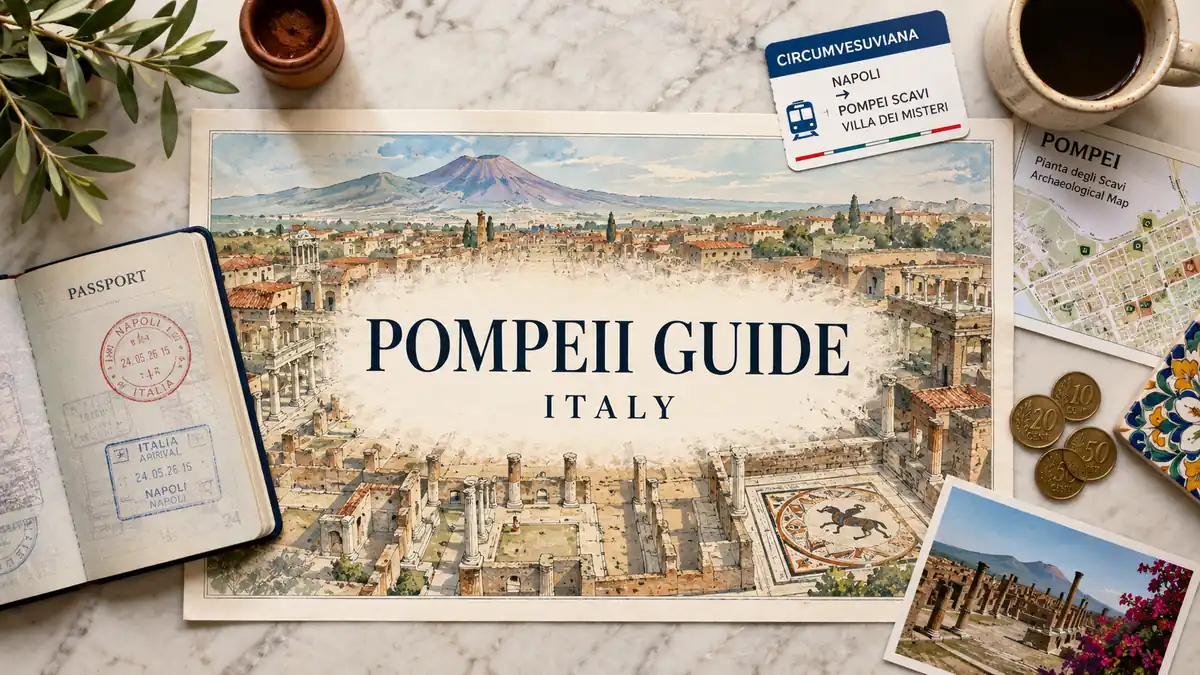
Pompeii is already decided. The trip is booked, the site is on the list, and what remains is mechanics: which train, which station, which ticket, which gate, and how much of the day to hand over. That last question is where most visits go wrong. Pompeii is not a ruin field you photograph and leave — it is a complete Roman town of streets, shops, houses and public buildings, and its scale is what sets the timing, the ticket tier and the guiding decision alike.
This guide closes the practical loop in one place: the Naples leg and the station you must not miss, the ticket most visitors actually need and where to buy it, the opening hours and the last-admission cutoff that really constrains your day, the entrance that suits how you arrive, how long the site genuinely needs, whether a guide earns its place, and a walking order that keeps you moving forward.
Quick Answer
Take the Circumvesuviana to Pompei Scavi–Villa dei Misteri, book a morning entry, and allow half a day. How much you want to see — the ancient city alone, or the suburban villas as well — sets the ticket tier. Most visitors do best entering early at Porta Marina and walking the site independently.
Trust Layer
Tripstou planning guide for travelers resolving one travel decision. Covers the main variable, traveler context, and practical tradeoffs.
Produced with AI assistance and reviewed by Alex Perrut, working in tourism since 2015, for the Tripstou editorial team. See our editorial process for details.
Last factual review: July 28, 2026.
Official sources consulted: Italia.it, ENIT.
Key Takeaways
- Get off at Pompei Scavi–Villa dei Misteri, not Pompei Santuario, which leaves you a walk from the wrong end.
- Book online in advance and take a morning slot — the daily cap leaves far fewer afternoon places.
- The standard ancient-city ticket suits nearly everyone; only pay up for the suburban villas if Villa dei Misteri is the reason you came.
- Allow three to four hours; a full day buys quiet outer streets, not additional headline sights.
- Take a short guided introduction, then continue alone — skip a full tour if your window is tight.
- Free first-Sunday entry costs you the calm morning hours, so take it only on a tight budget.
Table of Contents
How do you get to Pompeii from Naples?
Take the Circumvesuviana to Pompei Scavi–Villa dei Misteri, roughly half an hour from central Naples. Trains run on the Naples–Sorrento line, around every half hour at peak times. That station sits opposite the site’s Porta Marina side, so you walk straight from the platform to the gate.
The practical spine of the trip is short enough to memorise:
- Line: Circumvesuviana, Naples–Sorrento route, which runs seasonal timetables.
- Station: Pompei Scavi–Villa dei Misteri, not any other Pompei stop.
- Journey time: approximately half an hour from central Naples.
- Frequency: roughly every half hour at peak times, and thinner early and late.
- Fare: a low single-digit euro fare, bought at the station before you board — check the operator’s current tariff when you travel.
Pompei Scavi–Villa dei Misteri vs Pompei Santuario: the station you must not miss
Pompei Scavi–Villa dei Misteri is the stop for the archaeological park, and Pompei Santuario is not. Santuario is a separate arrival serving the modern town of Pompei, leaving you roughly a quarter-hour walk from the Piazza Anfiteatro side of the site — the opposite end from where most visitors intend to start. It is not a disaster. It is simply a longer, hotter, less useful beginning to the day, and it happens to people who hear “Pompei” on an announcement and stand up.
The name is the whole trick: if the platform sign does not carry the word Scavi, you have landed in the modern town instead of at the excavations.
Arriving from Rome works on the same principle — mainline train to Naples, then this local line — and the round-trip feasibility and Rome-side timings are settled separately in our guide to Pompeii as a day trip from Rome. Coming from the Sorrento side, the same line simply runs in the other direction, so the station advice is unchanged; basing decisions on that coast belong with the Amalfi Coast. And getting from your hotel to the departure platform in the first place is a city question, not a Pompeii one: tickets, passes and the metro are covered in getting around Naples.
Which Pompeii ticket should you buy, and where do you buy it?
Most visitors need the standard ancient-city ticket, bought in advance through the park’s official online channel. A step-up tier adds the suburban villas, including Villa dei Misteri, plus the shuttle that reaches them. Booking ahead is the default here, not a precaution. A daily visitor cap makes same-day entry a gamble.
Prices below are the park’s official tariff, current at the last factual review.
| Ticket tier | What it covers | Who it suits |
|---|---|---|
| Ancient city, standard entry — €20 | The excavated ancient town of Pompeii itself | Nearly every first-time visitor on a half-day |
| Ancient city plus suburban villas — €25 | The town, the suburban villas and the shuttle between them | Visitors set on seeing Villa dei Misteri |
| Pompeii Plus, three-day multi-site — €30 | Pompeii plus other park sites across three days | Travelers pairing Pompeii with a second site |
| Single outlying site entry — €8 | One outlying park site on its own ticket | Anyone visiting an outlying site without Pompeii |
| Annual pass to the park — €45 | Repeated entry across the park for a full year | Frequent returners and residents, not holiday trips |
| Reduced entry, EU citizens 18–25 — €2 | The same access as the standard ancient-city ticket | EU citizens aged 18 to 25 carrying valid ID |
Do you need to book Pompeii tickets in advance?
Yes — book in advance, and book a morning slot. The park works to a daily admission cap split into a large morning band and a much smaller afternoon one, so the afternoon is the half that fills first and leaves latecomers waiting. Vivaticket is currently the park’s official online channel. Buy direct if all you want is entry, since the ticket itself is identical and the sourcing is not.
Choosing the tier is a time decision disguised as a price decision. The villa tier costs little more, but reaching the suburban villas means walking to the edge of the site and back, and that is the part travelers overestimate at the booking stage and regret at hour three. Decide your duration first, in the section below, then buy the tier that duration can actually deliver.
What are Pompeii’s opening hours and last admission?
Pompeii opens at 09:00 every day, and its closing time shifts with the season. Summer runs late into the evening; winter closes in the afternoon. Last admission always falls well before the gates shut. The site closes only on 25 December and 1 January, so the season, not the calendar, is what you plan around.
- Summer season (roughly mid-March to mid-October): last admission 17:30, closing 19:00.
- Winter season (roughly mid-October to mid-March): last admission 15:30, closing 17:00.
- Closures: 25 December and 1 January; opening stays at 09:00 year-round.
The last-admission cutoff is the constraint that actually shapes a day, because it lands well before closing and nobody plans around it. In winter especially, an arrival that feels like “early afternoon” is already close to the door being shut behind you. Plan backwards from last admission, not from closing time.
What’s the best time of day and year to visit Pompeii?
Go early: a morning entry in spring or early autumn is the strongest combination. Pompeii has almost no shade, and the stone holds heat from late morning onward. Crowds build steadily after opening, so the first hour inside the gates is the calmest and coolest you will get.
Morning-first is not a preference here. It is the design of the place. You are walking uneven paving through open streets with few trees and little cover, and by midday in high summer the site radiates heat back at you, while the houses that do offer shade are the ones everyone else is standing in. Coach groups compound through the late morning, so the difference between a 09:00 entry and an 11:00 entry is not two hours of sleep — it is a different site. The admission cap reinforces the same choice: the afternoon band is far smaller than the morning one, which means fewer slots and less flexibility if your plans move.
Season follows the same comfort logic. April to early June and September to October give you workable temperatures and enough daylight for a relaxed pace; July and August are physically demanding at a site with nowhere to retreat to. Winter is genuinely pleasant to walk but ends early, so the shorter closing time has to be built into the plan. This sits inside wider Italian seasonality, worth reading before you lock dates if you are planning a trip to Italy around several cities.
Entry is free on the first Sunday of each month, and that is a real trade, not a gift. On a free first Sunday you save the ticket price and pay it back in queue time — at Pompeii the scarce resource is cool, uncrowded morning hours, not euros. Take it if you are on a tight budget, arrive before opening, and accept a busy site. Skip it if your schedule is fixed, if you are visiting in high summer, or if this is your one shot at the place.
On a short city stay, Pompeii works best as the first full morning, when you are freshest and the day still has an afternoon left in it — see how that fits around two days in Naples.
Which entrance should you use at Pompeii?
Use Porta Marina if you arrive by train at Pompei Scavi, which covers most visitors. Pompeii has three ticketed entrances: Porta Marina, Piazza Esedra and Piazza Anfiteatro. The right gate follows how you arrive and which part of the town you want to reach first. Confirm yours when you book.
The choosing principle matters more than the list. Your gate should be the one closest to your arrival point and — where you have a genuine choice — the one that puts the part of the site you most want to see at the start of your walk, while you are still fresh and the light is still low. Everything else is detail.
- Porta Marina: the gate for train arrivals at Pompei Scavi–Villa dei Misteri. It brings you up into the western end of the town and puts the Forum near the beginning of the visit.
- Piazza Esedra: sits alongside Porta Marina at the same end of the site, and is the alternative when Porta Marina is congested or closed.
- Piazza Anfiteatro: the eastern gate, used by coach arrivals and by anyone walking in from the modern town. It opens the visit at the Amphitheatre end instead of the Forum.
The park rotates which gates are open, so check which entrance is active at the time of your booking and match your ticket to it. Arriving at a closed gate costs you the walk around the perimeter, which is long enough to matter on a hot morning.
How long do you need at Pompeii?
Allow half a day at Pompeii — three to four hours is what most visitors actually use. The site is a complete buried town, not a compact ruin, and the walking distances inside it are real. A full day buys the quiet far corners and the suburban villas, not more highlights.
- About two hours — the fast loop. Buys the Forum, one bath complex, a couple of major houses and the main street. Fits travelers on a fixed transfer or a tight connection who would otherwise skip the site entirely.
- Three to four hours — the standard visit. Buys the whole spine of the town — Forum, theatres, baths, the famous houses and the Amphitheatre — at a pace that allows stopping. Fits nearly everyone visiting once.
- A full day — the complete site. Buys the outer streets, the emptier residential blocks and the suburban villas, with a proper break in the middle. Fits returning visitors, archaeology enthusiasts and anyone travelling in cool weather.
Time inside Pompeii is spent on distance, not on density: the far corners cost you walking, and what they buy back is silence, not extra sights. That is the honest case for the half-day. Four unhurried hours cover what almost everyone came for, and a fifth and sixth hour deliver diminishing returns on tired legs.
A full day only makes sense if you have already decided you want the emptier edges of the site. If you would sooner add a second place to the day, that pairing decision — and which nearby site earns it — belongs with the wider Naples region, not here.
Half a day at Pompeii leaves you a real afternoon back in the city, which is the argument for going early in the first place. That afternoon is easy to fill from things to do in Naples, and if you are still choosing where to base yourself for the trip, start with the Naples travel guide.
Is a guided tour of Pompeii worth it, or should you go self-guided?
Some form of guiding is worth it at Pompeii, because the site explains itself less than most ruins. For most first-time visitors, a short guided introduction followed by independent walking gives the best return. A full tour delivers more context but fixes your pace, your route and your finish time.
Four options, and each one trades something different:
- Full guided tour. Suits first-timers who want the town interpreted properly and interiors pointed out. Tradeoff: you move at the group’s speed and finish when the group finishes.
- Audio guide. Suits independent visitors who still want structure and commentary. Tradeoff: it answers the questions it was written for, and none of yours.
- Fully self-guided. Suits repeat visitors, and anyone who has read ahead and wants to wander. Tradeoff: without preparation, large parts of the town read as anonymous walls.
- The hybrid — short guided introduction, then stay on alone. Suits most people visiting once. Tradeoff: you need to check that the tour releases you inside the site instead of walking you back out.
The hybrid is the recommendation, and the reason is structural. Book the guide for the first stretch and then let it go — the part of Pompeii that needs explaining is the beginning, when you are learning to read a Roman street, not the Amphitheatre at the far end, which is legible on sight. An hour or so of context front-loads everything you see afterwards, and then you get your own pace back for the houses you actually want to linger in.
Do not book a tour if you have been before, if you travel badly in groups, or if your window at the site is short — a fixed tour length fights a tight schedule, and you will spend the visit checking the clock. Families with young children often do better self-guided too, since stopping when you need to matters more than commentary nobody is listening to.
Tours and activities
Book skip-the-line tickets, day trips and local tours with free cancellation on most activities.
You can also browse everything on getyourguide.com.
Tripstou may earn a commission if you book through this link, at no extra cost to you.
What to see in Pompeii and how to walk the site
Work outward from your entrance instead of chasing a checklist across the site. A standard visit takes in the Forum, the theatre quarter, a bath complex, the House of the Faun and the Amphitheatre. Walking the town in one direction saves more time than any shortcut between famous houses.
Entering at Porta Marina, the natural order runs west to east and needs almost no navigation. You come up into the Forum, which is the town’s civic centre and the best place to get your bearings, then move through the nearby baths and the theatre quarter before heading along the main streets toward the grander houses and, eventually, the Amphitheatre at the far end. Walk it once, in sequence. Backtracking is what turns a comfortable three hours into an exhausting five.
- The Forum — the civic and religious heart, and your orientation point for everything after.
- The baths and the theatre quarter — the clearest surviving picture of how public life worked here.
- The main streets — stepping stones, cart ruts, bars and shopfronts; the town at street level.
- The House of the Faun and the larger houses — domestic scale, courtyards and floor decoration.
- The Amphitheatre and the eastern end — the emptiest, quietest stretch of the visit.
Villa dei Misteri is the one genuine decision inside the site. It stands outside the town walls at the far northwestern edge, so reaching it means a detour on foot at the point in the visit when you are least inclined to take one, and it needs the step-up ticket tier rather than the standard ancient-city entry. It is worth it if the painted rooms are a specific reason you came, if you are on a full day, or if you enter at Porta Marina and take it first while your legs are fresh. It is not worth it on a three-hour visit that also wants the Amphitheatre — that plan quietly asks for a full day and does not admit it.
Two or three sentences of context make the rest legible. This was a working town, buried and sealed rather than slowly abandoned, which is why the streets, shops and interiors survive at a level of ordinary detail almost nowhere else offers. That is what you are looking at: not monuments, but daily life stopped mid-sentence.
Frequently Asked Questions
Is Pompeii free on the first Sunday of the month?
Yes. The archaeological park opens free to all visitors on the first Sunday of every month. The cost lands elsewhere: free Sundays are among the busiest days at the gates, so arrive before opening if you use one, and expect slower movement through the popular houses and narrow streets.
Can you buy Pompeii tickets at the gate on the day?
Sometimes, though it is a gamble. The park works to a daily admission cap, and the afternoon band is far smaller than the morning one, so same-day availability disappears first in peak season. Booking online through the park’s official channel removes the only real failure point in the day.
Can you take a backpack into Pompeii or leave luggage there?
Yes, a small daypack is fine and is the sensible load for several hours of walking on uneven ancient paving. Wheeled luggage is impractical on stone streets and steps, so do not arrive straight from a station with it. Large bags and storage fall under the park’s own visitor rules, worth checking beforehand.
Does the Pompeii ticket include Villa dei Misteri and the suburban villas?
Only the step-up tier does. The standard ancient-city ticket covers the excavated town itself; the higher tier adds the suburban villas, Villa dei Misteri among them, plus the shuttle that reaches them. The difference is small at the till and larger in walking time, so choose it deliberately.
What should you wear and bring to Pompeii?
Closed shoes with grip, sun cover and more water than feels necessary. The ancient paving is uneven, worn and interrupted by stepping stones and kerbs, and the site offers almost no shade for hours at a stretch. Sandals and smooth soles turn a good visit into a careful one.
Is the Campania ArteCard worth it if you’re visiting Pompeii?
Only if Pompeii is one of several regional sites you plan to enter. A multi-site pass earns its keep on volume, so a single Pompeii visit almost never justifies one. Decide how many sites you will actually reach across the trip first, then compare that against a single entry.
Related Guides
- Naples travel guide — the parent guide for basing yourself in the city Pompeii is easiest from.
- Getting around Naples — city tickets, passes and the metro, including reaching the Circumvesuviana platforms.
- The wider Naples region — how Pompeii sits alongside the other sites nearby, and which pairing earns a full day.
- Things to do in Naples — what to do with the afternoon a half-day at Pompeii leaves you.
- Two days in Naples — where the Pompeii morning falls in a short city stay.
- Pompeii as a day trip from Rome — feasibility and the Rome-side timings, settled in full.
- The Amalfi Coast — for readers arriving from, or basing on, the Sorrento side.
- Planning a trip to Italy — wider timing, routing and country-level decisions.
Did this guide save you time or money? Tripstou is independent and reader-funded — if you'd like to give something back, you can support the site with a crypto contribution of any size.