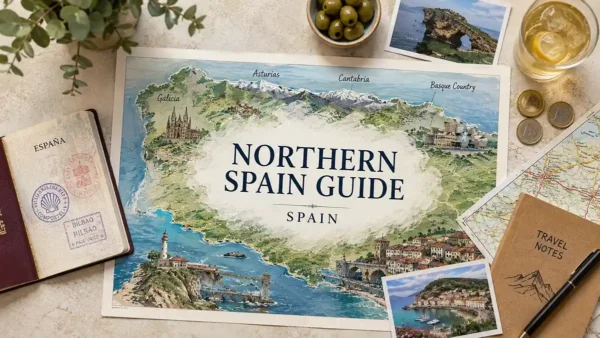
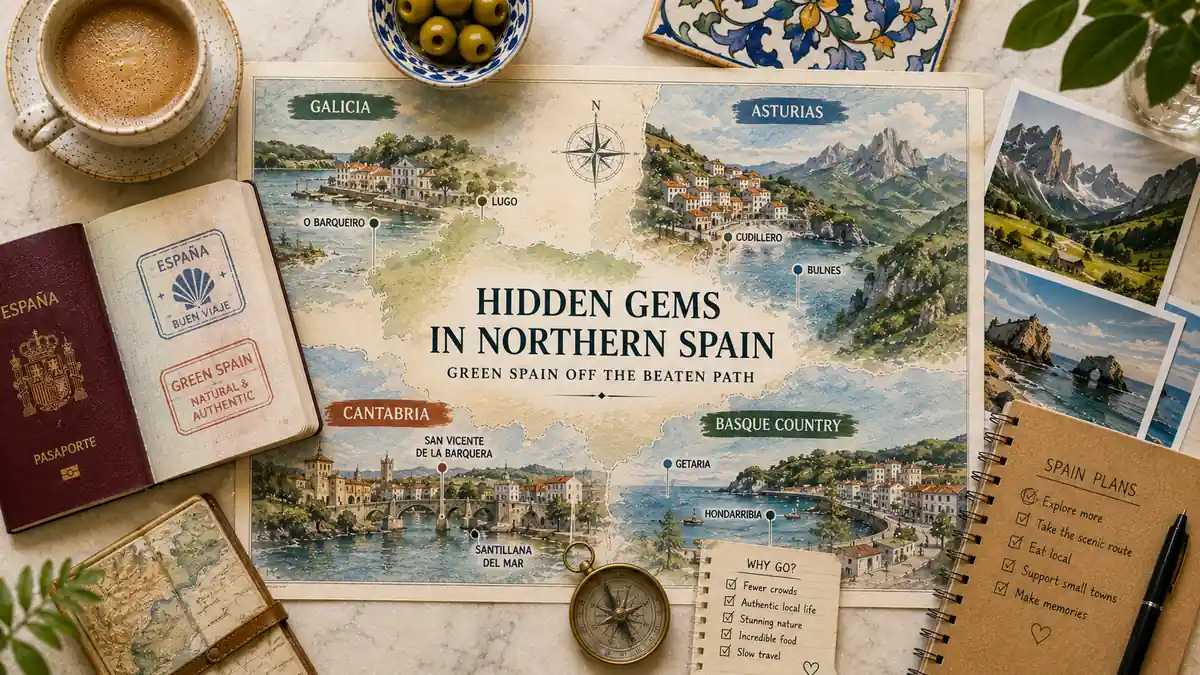
Northern Spain is having a moment. As travellers look past the crowded Mediterranean coast, Green Spain — the wet, mountainous north — is emerging as the country’s quieter, greener alternative. But the famous names carry the buzz: San Sebastián’s pintxos, Bilbao’s Guggenheim, Santiago’s cathedral, the headline peaks of the Picos de Europa. Those are worth seeing, and they are not hidden gems. The genuinely underrated destinations sit a valley or a headland beyond them. This guide is a curated shortlist of northern Spain’s most underrated towns and villages, spread across its four regions — Galicia, Asturias, Cantabria, and the Basque Country. Each pick comes with its strongest reason to go and a clear “pick this if” cue, so you can match places to your trip style. Whether you want colour-stacked fishing ports, remote stone hamlets, or empty Atlantic beaches, the point is the same: real northern-Spain character, without the queues.
Quick Answer
Northern Spain’s best hidden gems are underrated coastal and inland towns spread across its four green regions. They suit crowd-averse travellers and group by region — Galicia, Asturias, Cantabria and Basque Country — on a famous-versus-hidden axis. Pick coastal fishing villages like Cudillero or Getaria for scenery, or inland stone towns like Lugo for slow, crowd-free depth.
Trust Layer
Tripstou selection guide for travelers choosing between multiple places. Covers selection criteria, traveler fit, and trip value.
Produced with AI assistance and reviewed by Alex Perrut, working in tourism since 2015, for the Tripstou editorial team. See our editorial process for details.
Last factual review: July 19, 2026.
Official sources consulted: spain.info, Turespaña.
Key Takeaways
- Cudillero is the standout coastal pick for scenery — a photogenic amphitheatre fishing port that stays compact and walkable even on busy afternoons.
- Scenery-first travellers should favour coastal villages like Cudillero or Getaria; slow travellers gain more from inland picks like Bulnes or Fragas do Eume.
- The real tradeoff is access versus remoteness: coastal picks are effortless day-trips, while mountain hamlets like Bulnes cost a half-day of effort.
- Timing beats secrecy in Green Spain: visit shoulder months, arrive early, or stay overnight, and even the busier picks stay calm.
- These picks are places to go, not experiences or routes — pair them with a region guide for driving, timing, and things to do.
Table of Contents
What makes a northern Spain destination a genuine hidden gem?
A genuine hidden gem in northern Spain is a lesser-visited town or village off the famous trail. It skips the headline stops — San Sebastián, Bilbao, Santiago — and sits across Green Spain’s four regions. What qualifies here is a real destination, chosen on a crowd-free, off-the-beaten-path axis rather than name recognition.
The line between famous and hidden matters because northern Spain’s big names are already saturated. San Sebastián’s pintxos bars, Bilbao’s Guggenheim, and the Camino’s finish in Santiago pull the bulk of visitors — so they belong on our guide to the country’s most famous places to visit in Spain, not here. The picks below deliberately sit one valley or one headland away from that traffic.
Northern Spain is only part of a wider national picture, too. If you are weighing underrated spots the whole country over, the broader hidden gems across Spain open up the field beyond the green north. This page stays strictly northern, and strictly about places — not experiences or logistics.
One thing worth naming up front: “hidden” here means under-visited relative to the headline stops, not undiscovered. Green Spain’s visitor numbers are climbing every season. The honest promise is fewer crowds, not empty streets.
Galicia’s most underrated coast and countryside
Galicia’s underrated highlights sit on its far northern coast and deep green interior. The region’s rías (drowned river estuaries), Atlantic forest, and a fully walled Roman town stay quiet because most visitors stop at Santiago. Reach past the cathedral city and Galicia turns into fishing villages, empty beaches, and misty woodland.
O Barqueiro
O Barqueiro is a tiny fishing village on the Rías Altas, Galicia’s least-touristed northern coastline. Stone houses step down to a sheltered estuary where small boats still land the day’s catch. What sets it apart from the busier rías further south is how little has been built for tourism — it stays a working village first. Pick this if: you want a barely-visited fishing village with slow harbour mornings and no tour buses.
Lugo
Lugo is the only city ringed by fully intact Roman-era walls you can walk right around. The circuit crowns a compact old town of granite squares and tapas bars that sees a fraction of Santiago’s foot traffic. Its draw is architectural completeness, not scenery — a rare surviving piece of Roman engineering. Pick this if: you love walkable history and old-town atmosphere over coast and beaches.
Fragas do Eume
Fragas do Eume protects one of Europe’s best-preserved Atlantic coastal forests, threaded by a river and a hidden riverside monastery. Ferns, oaks, and mist give it a lost-world feel that is rare this far west. Its appeal is deep-green woodland walking, not harbours or sand. Pick this if: you are a nature-first traveller chasing rare Atlantic forest and quiet trails.
Cíes and Ons islands
The Cíes and Ons islands guard the mouth of the Vigo estuary with white-sand beaches and clear Atlantic water often compared to the Caribbean. They stay uncrowded because access is deliberately limited: visits generally run seasonally, by ferry, and often require arranging a permit in advance — so check the current rules well before you travel. Pick this if: you want standout Atlantic beaches and don’t mind planning access ahead.
Galicia splits west and north. The Rías Baixas near Vigo have the celebrated beaches and the summer crowds, while the northern Rías Altas trade a little sunshine for far emptier shores — worth knowing before you decide which coast to base on.
Asturias hidden gems, from fishing ports to stone villages
Asturias pairs colour-stacked fishing ports with remote stone villages on the edge of the Picos de Europa. Its dramatic coast and mountain hamlets stay under the radar because travellers rush between Galicia and the Basque Country. Slow down and Asturias delivers cliff-backed harbours, green valleys, and some of Green Spain’s most photogenic small towns.
Cudillero
Cudillero tumbles down a steep ravine to a tiny harbour, its brightly painted houses stacked in a natural amphitheatre. It is arguably the most photogenic fishing port in Asturias, and small enough to feel intimate even on a busy afternoon. What makes it distinct is that vertical, colour-block setting — no other pick here looks like it. Pick this if: you want the most striking fishing-port views and a compact, walkable centre.
Ribadesella
Ribadesella sits where the Sella river meets the sea, splitting into a long town beach and a working fishing quarter. It makes an easy, low-key coastal base, with prehistoric caves and estuary walks close by. Unlike car-free Bulnes inland, it is relaxed and easy to reach — a place to settle into, not a summit to earn. Pick this if: you want a laid-back coastal base blending beach, river, and quiet evenings.
Bulnes
Bulnes is a car-free stone hamlet buried deep in the Picos de Europa, with just a handful of houses and no road in. You reach it on foot up a gorge path, or by a funicular railway cut into the mountain — confirm current operation before relying on it. Its appeal is genuine remoteness: this is as far off-grid as Green Spain’s villages get. Pick this if: you want a truly remote, car-free mountain hamlet and don’t mind the effort of getting there.
Asturias forces one honest choice. The coast picks are effortless day-trips, while the mountain hamlets cost you a half-day of climbing or waiting on the funicular — plan Bulnes as the whole day, not a detour squeezed between beaches.
Cantabria’s quiet medieval towns and coast
Cantabria’s underrated draw is its preserved medieval character, from cobbled inland towns to fishing ports under mountains. The region is small and often overlooked between the Basque Country and Asturias, yet it holds some of Green Spain’s best-kept historic centres. Beyond the beaches of Santander, Cantabria stays quietly old-world and easy to explore slowly.
Santillana del Mar
Santillana del Mar is a near-perfectly preserved medieval town of honey-coloured stone, cobbled lanes, and a Romanesque collegiate church. Famously nicknamed “the town of three lies” — neither holy, flat, nor by the sea — it draws day-trippers but empties beautifully by evening. Its distinction is architectural preservation: few northern towns feel this intact. Pick this if: you want a storybook medieval town and are happy to time your visit around the day crowds.
San Vicente de la Barquera
San Vicente de la Barquera is a fishing town strung along an estuary, with the snow-capped Picos de Europa rising directly behind its harbour. That mountain-meets-sea backdrop is its signature — a coastal pick with an alpine skyline no other town here matches. A hilltop castle and old bridge anchor a laid-back seafood scene. Pick this if: you want a working coastal town framed by dramatic mountains.
Timing beats distance in Cantabria. Its star towns are tiny and sit right off the main road, so they fill with midday coach parties and then empty — arrive early or stay overnight to have them to yourself.
Basque Country escapes beyond San Sebastián
The Basque hidden gems sit in small coastal towns beyond the big-name cities. San Sebastián and Bilbao get the attention, but the fishing villages along the coast keep the region’s food culture without the queues. Leave the cities and the Basque Country becomes txakoli vineyards, walled old towns, and harbours where the day’s catch still sets the menu.
Getaria
Getaria is a compact fishing village that doubles as the home of txakoli, the Basque Country’s lightly sparkling white wine. Vineyards tip down to the sea around a harbour still busy with grilled-fish restaurants and working boats. What sets it apart is that food-and-wine identity at the source — this is where txakoli is poured from height and drunk fresh. Pick this if: you are a food-and-wine traveller who wants txakoli and grilled fish where they are made.
Hondarribia
Hondarribia is a walled border town facing France across the Bidasoa estuary, its old quarter stacked with brightly painted, timber-balconied houses. The colourful Marina fishermen’s district and a hilltop castle give it a distinct frontier character no other pick shares. It is easy to reach yet feels a world away from the city crowds. Pick this if: you want a colourful walled old town and a quick hop across to the French Basque coast.
Proximity is the Basque catch. These villages sit close enough to San Sebastián that they make easy half-days, but stay overnight and you swap the city’s prices and crowds for a quiet harbour at dawn.
How do you choose which hidden gems fit your trip?
Match your picks to two things: coast versus inland, and how much crowd-avoidance matters to you. Coastal fishing villages win on scenery and easy access; inland stone and mountain towns win on quiet and depth. Then let regional character — Galicia’s wildness, Asturias’s drama, Cantabria’s history, the Basque food scene — break the tie.
A fast way to shortlist is to start from what you most want to see:
- Prettiest coastal villages: Cudillero, Getaria, and San Vicente de la Barquera — colour, harbours, and sea views with minimal effort.
- Quietest inland escapes: Fragas do Eume, Bulnes, and O Barqueiro — remote, slow, and genuinely uncrowded.
- Best for medieval history: Lugo and Santillana del Mar — walkable old stone and preserved centres.
- Best for food and wine: Getaria — txakoli and grilled fish at the source.
- Best standout beaches: the Cíes and Ons islands — plan access ahead.
Crowd tolerance is the quiet decider. Green Spain is getting more popular every season, so the honest play is timing over secrecy — visit shoulder months, arrive early, or stay overnight, and even better-known picks like Santillana del Mar stay calm. Chasing places nobody has found is the wrong goal. Managing when you show up is the right one.
Once you have a shortlist, the next steps are route and activity depth. To turn these picks into a loop with driving and timing advice, plan around the full northern Spain travel guide. And to fill each stop with more than wandering, browse the best things to do in northern Spain.
Frequently Asked Questions
Is northern Spain worth visiting, or better than the southern coast?
Yes, northern Spain is well worth visiting, especially if you want green landscapes and fewer crowds. Its Atlantic “Green Spain” coast trades the hot beaches and big resorts of the south for misty mountains, fishing villages, and standout food. It is not better or worse than the south — just quieter, cooler, and more low-key.
Are these hidden gems actually still crowd-free?
Mostly, but “hidden” means under-visited, not empty. Green Spain’s popularity climbs every season, so the honest promise is fewer crowds than San Sebastián or Santiago, not deserted streets. Smaller inland picks like Bulnes or O Barqueiro stay genuinely quiet, while well-known towns like Santillana del Mar fill at midday — so time your visit early or late.
What’s the difference between hidden gems and the best-known places in northern Spain?
The best-known places — San Sebastián, Bilbao, Santiago, the Picos headline sights — draw the crowds and carry the fame. Hidden gems sit a valley or headland beyond them: lesser-visited towns and villages like Cudillero, Lugo, or Getaria that keep the region’s character without the queues. Famous places are the icons; hidden gems are the detours.
Which region is best for a first northern-Spain hidden-gems trip?
Asturias is the easiest first choice: it packs photogenic fishing ports, mountain villages, and green valleys into a compact, scenic stretch. The Basque Country suits food-focused travellers, Galicia rewards those chasing wild, remote coast, and Cantabria fits medieval-town lovers. For a balanced first trip mixing coast and mountains, start with Asturias.
Are northern Spain’s coastal villages or inland towns more worth the detour?
Both reward the detour, but in different ways. Coastal villages like Cudillero, Getaria, and San Vicente de la Barquera win on scenery and effortless access. Inland picks like Lugo, Bulnes, and Fragas do Eume win on quiet, depth, and genuine remoteness. Scenery-first travellers should lean coastal; slow travellers gain more inland.
What’s the single most underrated place to visit in northern Spain?
For genuine off-the-radar quiet, O Barqueiro on Galicia’s Rías Altas is among the least-visited — a working fishing village with few tourists. If you want striking looks instead, Cudillero’s amphitheatre of painted houses wins. “Most underrated” depends on whether you value emptiness or scenery, but O Barqueiro edges it for sheer under-the-radar calm.
Related Guides
- Northern Spain travel guide — route planning, when to go, and budgeting for the whole region.
- Hidden gems across Spain — the wider national picture, beyond the green north.
- Best places to visit in Spain — the famous headline destinations these picks sit beside.
- Things to do in northern Spain — experiences and activities to fill each stop.
Did this guide save you time or money? Tripstou is independent and reader-funded — if you'd like to give something back, you can support the site with a crypto contribution of any size.