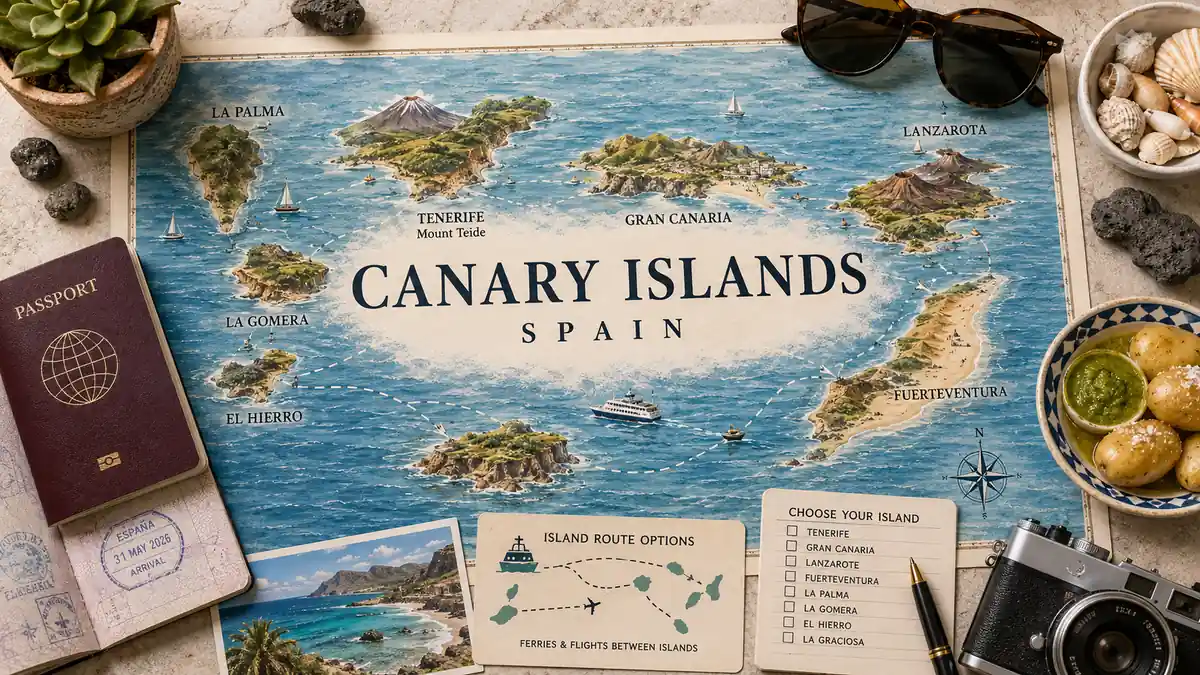
The Canary Islands are Spain’s year-round, winter-sun archipelago — seven volcanic islands scattered across the Atlantic off northwest Africa. They deliver mild temperatures in every season, dramatic volcanic terrain, black-sand and golden beaches, and a distinct character on each island. That variety is also the catch: with seven different islands to choose from, the real planning question is not whether to go, but which island (or islands) fits you, and how to shape the trip around it. This guide answers that head-on. It orients you across all seven islands, matches each to a traveler type, settles the one-island-versus-island-hopping decision, and frames how long to stay and when to go — then points you to dedicated guides for the finer details.
Quick Answer
The Canary Islands reward a trip and suit year-round and winter sun; pick your island by what you want most. For most trips one island is enough; island-hop only with more time or a specific reason. First-timers do best on Tenerife or Gran Canaria for variety, while quieter islands suit nature and calm.
Trust Layer
Tripstou region guide for travelers planning a regional trip. Covers sub-areas, trip shape, base strategy, timing, and mobility tradeoffs.
Produced with AI assistance and reviewed by Alex Perrut, working in tourism since 2015, for the Tripstou editorial team. See our editorial process for details.
Last factual review: June 19, 2026.
Official sources consulted: the European Union, official EU travel advice, ETIAS entry information.
Key Takeaways
- The Canaries are seven distinct islands, so choose by your top priority rather than the name you already recognize.
- Base on one island for most trips; island-hop only with two weeks or more, or a specific reason.
- Plan roughly one week for a single island and ten days to two weeks if you add a second.
- Tenerife and Gran Canaria suit first-timers wanting variety, while quieter islands reward nature, stargazing, and calm.
- The Canaries stay mild year-round, making winter their standout season for reliable warmth when much of Europe turns cold.
- Rent a car to explore each island, and use short inter-island flights or ferries when you do decide to hop.
Table of Contents
Why Visit the Canary Islands
The Canary Islands are worth a trip for reliable warmth, volcanic scenery, and seven genuinely different islands. This Atlantic archipelago off northwest Africa stays mild all year, which makes it Europe’s strongest winter-sun base. Dramatic volcanic landscapes, black-sand beaches, and high peaks add variety few destinations match.
The pull is simple: while much of Europe turns cold and grey, the Canaries hold steady, comfortable temperatures through winter. That alone makes them a standout escape, but the scenery seals it. Teide National Park on Tenerife crowns the archipelago with Spain’s highest peak, and each island layers in its own mix of beaches, craters, forests, and dark skies.
The Canaries also sit apart from mainland Spain in feel and geography, so they reward travelers as a destination in their own right rather than a day-trip add-on. If you are still mapping the wider country, our Spain travel guide frames the national picture, while Spain’s islands overview places the Canaries alongside the country’s other archipelagos. For a direct contrast, the Balearic Islands guide shows how the Mediterranean islands differ — the Canaries win on winter sun and volcanic drama, the Balearics on summer Mediterranean energy.
The Seven Canary Islands at a Glance
There are seven main inhabited Canary Islands, and each is a distinct travel choice you pick by its draw. Tenerife and Gran Canaria carry the most resorts and variety, while smaller islands trade nightlife for nature and quiet. Choose by what you want most, not by the name you know best.
The seven islands split broadly into the busy, resort-heavy big islands and the quieter, nature-led smaller ones. The table below maps each to its headline draw and the traveler it suits, using stable island roles rather than fares or seasonal detail.
| Island | Headline draw | Vibe | Who it suits |
|---|---|---|---|
| Tenerife | Teide National Park and Spain’s highest peak | Largest and most resort-heavy island | First-timers wanting variety and easy logistics |
| Gran Canaria | Beaches, dunes, and a lively capital city | Varied, with resorts and a mountainous interior | Travelers who want a bit of everything |
| Lanzarote | Timanfaya volcanic landscapes and striking design | Otherworldly, moon-like volcanic scenery | Visitors drawn to dramatic terrain and art |
| Fuerteventura | Long sandy beaches and steady Atlantic winds | Laid-back, beach- and watersport-focused | Beach lovers, surfers, and windsport fans |
| La Palma | Dark-sky stargazing and lush green nature | Quiet, green, and nature-driven throughout | Hikers, stargazers, and nature seekers |
| La Gomera & El Hierro | Ancient forests and an unhurried, remote calm | Authentic, crowd-free, and off the beaten path | Travelers wanting quiet and authenticity |
Use the comparison as a shortlist tool, not a ranking — there is no single best island, only the best fit for your trip. If beaches drive your choice, the resort and beach-led islands stand out; you can see how they sit within the country in our roundup of the best places to visit in Spain and the wider best beaches in Spain, without treating any one island as a ranked winner.
Which Canary Island Is Right for You
For most first-time visitors, Tenerife or Gran Canaria is the right Canary Island for variety and easy logistics. Beyond that, the right island depends on your priority: beaches and wind, hiking and nature, dark-sky stargazing, or calm and authenticity. Match the island to your main reason for going.
The cleanest way to choose is to lead with your single biggest priority, then let the island follow:
- First trip and variety: Tenerife or Gran Canaria — the most infrastructure, the widest mix of beaches, mountains, and resorts, and the simplest logistics. Tradeoff: busier and more developed than the smaller islands.
- Beaches and wind: Fuerteventura — long sandy beaches and dependable winds for surfing and watersports. Tradeoff: quieter on culture and nightlife.
- Hiking and nature: La Palma — green landscapes and serious trails for active travelers. Tradeoff: fewer big resorts and less beach focus.
- Stargazing: La Palma again — among the clearest dark skies in Europe. Tradeoff: best enjoyed by those happy with a slower, nature-led trip.
- Quiet and authenticity: La Gomera or El Hierro — remote, unhurried, and uncrowded. Tradeoff: limited resort comfort and harder to reach.
- Volcanic drama and design: Lanzarote — striking volcanic scenery and distinctive island design. Tradeoff: starker, drier landscapes than the green islands.
If two islands tie on your priority, let practical access break the tie: the larger islands are easier to reach and move around, which matters most on a first or shorter trip.
One Island or Island-Hopping?
One island suits most Canary Islands trips; island-hop only when you have extra time or a clear reason. Each island deserves several days, and moving between islands eats into a short trip. Basing on one island gives depth and a relaxed pace, while hopping suits longer stays or travelers chasing contrast.
The case for a single base is strong on most trips. You unpack once, settle into a rhythm, and use day trips to cover an island’s range without losing time to transfers. For a week or a winter-sun break, one island is almost always the better call.
Island-hopping earns its place when you have two weeks or more, or when you want to pair genuinely different experiences — say, a resort island with a quiet nature island. The tradeoff is real: each move costs a half-day or more and adds planning, so hopping rewards time over speed. If you are weaving the Canaries into a broader trip, our Spain itinerary guidance shows how to position the islands within a wider route rather than building a day-by-day island hop here.
How Many Days You Need in the Canary Islands
Most Canary Islands trips work well in about one to two weeks, depending on how many islands you visit. A single island fills a comfortable week without rushing. Adding a second island, or wanting a slower pace, pushes the trip toward ten days or two weeks.
As broad guidance: a week is the sweet spot for one island, long enough to mix beach days, a couple of excursions, and downtime. Stretch to ten days or two weeks if you want a second island or a genuinely unhurried pace. A short long-weekend works only if your aim is pure winter sun and rest on a single base.
Exact pacing depends on the wider trip rather than the islands alone. For ready-made frames you can adapt, see our 7-day Spain itinerary, 10-day Spain itinerary, and 14-day Spain itinerary — then carve out the island portion to match the length above.
When to Visit the Canary Islands
The Canary Islands are good to visit year-round, but winter is their standout season for reliable warmth. Mild Atlantic temperatures hold across all months, so there is no truly bad time to go. Winter draws sun-seekers escaping colder Europe, while spring and autumn balance warm weather with thinner crowds.
The islands’ selling point is consistency: the Atlantic keeps temperatures gentle and stable, without the heat extremes of mainland Spain. Winter is when that advantage matters most, turning the Canaries into one of Europe’s few dependable warm escapes. Spring and autumn shoulder periods offer much of the same comfort with a calmer feel, and summer is warm but rarely oppressive.
Your best window ultimately tracks your priority — guaranteed winter sun, fewer crowds, or watersport conditions. For how the islands fit the country’s wider seasonal picture, see our guide to the best time to visit Spain, and keep your timing flexible rather than tied to a single month.
Getting Around the Canary Islands
Inter-island flights and ferries connect the Canary Islands, while a rental car is the practical way to explore each one. Short flights and passenger ferries link the islands, so hopping is straightforward when you plan it. On any single island, public transport thins outside resort zones, which makes a car the easiest way around.
Between islands, you have two options: quick inter-island flights and passenger ferries, both of which connect the main islands regularly. Either works well for hopping; the right choice depends on the specific route and how much luggage you carry. Treat the network as reliable but plan the legs in advance rather than improvising.
On the ground, a rental car unlocks each island. Buses serve the main towns and resorts, but beaches, viewpoints, and trailheads are far easier to reach by car, especially on the larger or more rural islands. For broader driving and rail context across Spain, see our Spain road trip guide and Spain train itinerary, and book island car hire ahead in peak winter weeks.
Train and bus tickets
Compare routes, schedules and prices across rail and bus operators in one search, with mobile tickets on your phone.
New to Omio? Code NEW10 takes 10% off your first booking — or APPNEW10 if you book inside the Omio app. Both apply to bookings up to €80.
Search routes and compare prices on Omio →
Tripstou may earn a commission if you book through this link, at no extra cost to you.
Planning Your Canary Islands Trip
Once you’ve chosen your island, a few practical decisions remain: budget, packing, food, and staying safe. These details vary by island and travel style, so dedicated guides handle them better than a regional overview. Use the orientation above to pick where you go, then finish with focused planning resources.
This guide’s job is to get you to the right island and the right trip shape; the finishing details live in purpose-built guides. To round out your planning, work through the ones that apply to your trip:
- Set a realistic budget with our Spain trip cost guide.
- Pack for mild, breezy island weather using the Spain packing list.
- Eat well and know what to try with the Spain food guide.
- Stay alert to common scams in Spain in busier resort areas.
- Travelling alone? See our guidance on solo female safety in Spain.
Frequently Asked Questions
Which Canary Island has the best beaches?
Fuerteventura is widely considered the best Canary Island for beaches, with long stretches of golden sand and dependable winds for watersports. Gran Canaria adds dramatic dunes and resort beaches, while Tenerife mixes golden and volcanic black-sand shores. Choose by whether you want sweeping sand, dunes, or easy resort access.
Are the Canary Islands part of Spain?
Yes, the Canary Islands are a Spanish archipelago and one of Spain’s autonomous communities, despite lying off the northwest coast of Africa rather than near mainland Spain. They use the euro and Spanish is the official language, so they feel distinctly Spanish while keeping their own island character and Atlantic climate.
What language do people speak in the Canary Islands?
Spanish is the official language across all seven Canary Islands, spoken with a distinctive Canarian accent closer to Latin American Spanish than mainland Castilian. In the main resort areas on Tenerife, Gran Canaria, Lanzarote, and Fuerteventura, English and German are also widely understood, making the islands easy to navigate for international visitors.
Which Canary Island is best for families?
Tenerife and Gran Canaria are the best Canary Islands for families, thanks to their wide range of resorts, sandy beaches, and easy logistics. Both offer family-friendly attractions, gentle swimming spots, and plenty of accommodation. Lanzarote also suits families wanting calmer resorts and striking volcanic scenery without the busier crowds of the larger islands.
Which Canary Island has the best nightlife?
Tenerife has the liveliest nightlife in the Canary Islands, concentrated around the southern resorts, with Gran Canaria a close second for bars, clubs, and entertainment. The smaller islands like La Palma, La Gomera, and El Hierro are far quieter, geared toward nature and relaxation, so choose a larger island if evenings out matter.
Do you need a visa to visit the Canary Islands?
The Canary Islands follow the same entry rules as mainland Spain, since they are Spanish territory inside the European Union and the Schengen Area. Travelers from within the EU need only an ID card, while many non-EU visitors can enter visa-free for short stays. Always check your nationality’s current requirements before booking.
Which Canary Island is easiest to get to?
Tenerife and Gran Canaria are the easiest Canary Islands to reach, with the largest airports and the widest choice of direct international flights. The smaller islands such as La Gomera and El Hierro often require an extra inter-island flight or ferry, so factor in that connection when planning a trip to the quieter islands.
Related Guides
- Spain’s islands overview — see how the Canaries fit among Spain’s archipelagos.
- Balearic Islands guide — compare the Canaries with Spain’s Mediterranean islands.
- Spain travel guide — plan the wider country around your island trip.
- Spain itinerary — position the islands within a broader route.
- Best time to visit Spain — set your timing in the national context.
- Best places to visit in Spain — see where the islands sit among top destinations.
- Things to Do in the Canary Islands — the experiences worth your time.
- Hidden Gems in the Canary Islands — underrated places beyond the usual list.
- Tenerife Travel Guide
Did this guide save you time or money? Tripstou is independent and reader-funded — if you'd like to give something back, you can support the site with a crypto contribution of any size.