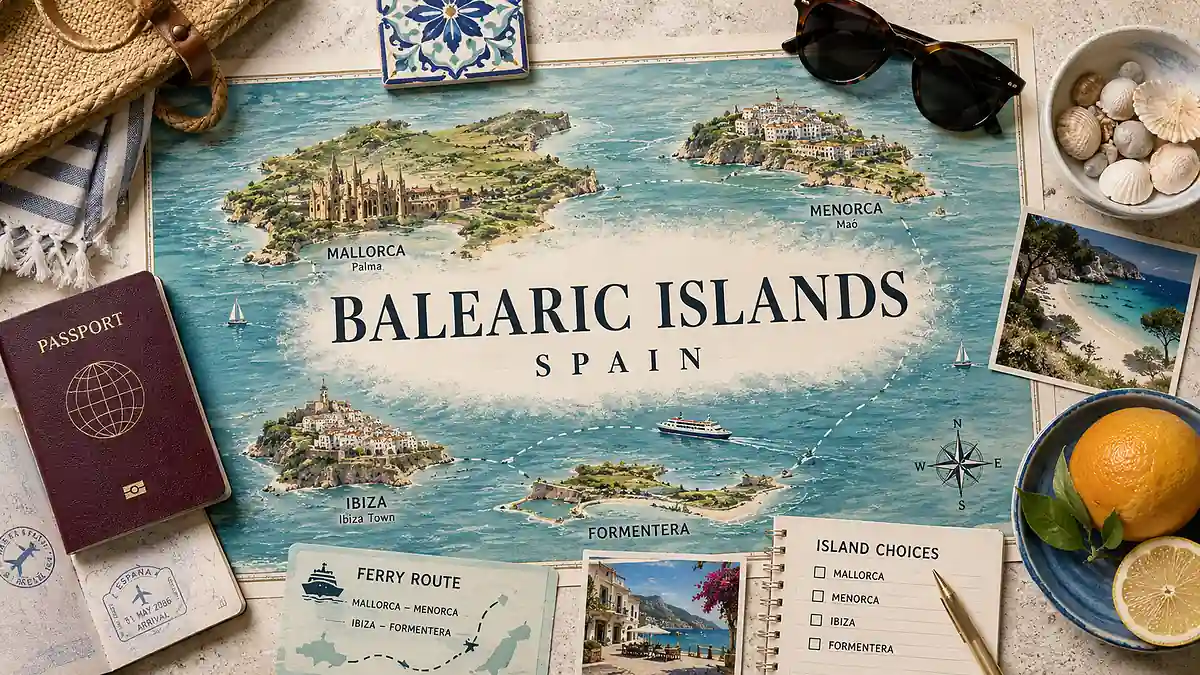
The Balearic Islands are one western-Mediterranean group made up of four distinct islands: Mallorca, Menorca, Ibiza, and Formentera. They share a sea and a climate, but each one delivers a different trip. Mallorca pairs mountains with culture and variety. Menorca trades volume for quiet and unspoiled coast. Ibiza runs on nightlife and bohemian style. Formentera is the small, beach-only outlier. The common mistake is treating the Balearics as a single destination and picking the most famous name. The better move is to match one island to how you actually want to travel. This guide differentiates the four islands, maps traveler type to island, and explains when a single island beats island-hopping. It also covers how many days the region needs, broad timing, getting around, and rough cost positioning, with links to deeper planning pages where you need them.
Quick Answer
Yes, the Balearic Islands are worth visiting: four distinct islands, each built for a different kind of trip. Your priority decides which one — culture and mountains, quiet nature, nightlife and bohemian style, or beach-only escapes. Pick one island for a short trip; combine islands only when you have longer.
Trust Layer
Tripstou region guide for travelers planning a regional trip. Covers sub-areas, trip shape, base strategy, timing, and mobility tradeoffs.
Produced with AI assistance and reviewed by Alex Perrut, working in tourism since 2015, for the Tripstou editorial team. See our editorial process for details.
Last factual review: June 19, 2026.
Official sources consulted: the European Union portal, the EU travel portal, and the official ETIAS information page.
Key Takeaways
- Treat the Balearics as four distinct islands rather than one destination, and choose the island that matches your trip’s priority.
- Match traveler type to island: Mallorca for culture and mountains, Menorca for quiet nature, Ibiza for nightlife, Formentera for beaches.
- Stick to one island for a short trip; only combine two islands when you have ten or more days.
- Allow four to five days for a single island and ten-plus to thread two without losing time to transfers.
- Visit in late spring or early autumn for warm, swimmable weather with thinner crowds and gentler prices than peak summer.
- Budget more here than mainland Spain, with Ibiza priciest and the quieter islands kinder to a budget outside high season.
Table of Contents
The Four Balearic Islands and What Each Is Known For
Mallorca, Menorca, Ibiza, and Formentera are the four Balearic Islands, and each one is known for something different. Mallorca is the largest and most varied, Menorca the quiet and unspoiled one, Ibiza the nightlife and bohemian capital, and Formentera the smallest, a beach-only escape reached by ferry.
The differences are real and consistent, which is why your choice of island matters more than your choice of region. Mallorca offers the broadest range, from a mountain range and historic towns to busy resorts and quiet coves. Menorca stays calmer and more low-key, with a coastline that feels less developed. Ibiza is defined by its club scene but also carries a long-standing bohemian, design-led side. Formentera is tiny, car-light, and built almost entirely around its beaches and clear water.
| Island | Defining character | Best for |
|---|---|---|
| Mallorca (largest) | Mountains, beaches, towns, and culture in one varied island | First-timers wanting variety and a balanced trip |
| Menorca (quietest) | Calm, unspoiled coast and a slower, low-key pace | Families, couples, and travelers seeking quiet nature |
| Ibiza (liveliest) | World-famous nightlife with a bohemian, design-led side | Nightlife seekers and style-driven, social travelers |
| Formentera (smallest) | Clear water and beach-only days, reached by ferry | Beach purists adding a slow island escape |
The Balearics sit within Spain’s wider island offer, which you can place in context through the Spain islands overview and the broader Spain travel guide. If you are weighing a completely different archipelago, the Atlantic Canary Islands are a separate region with a different climate and feel, not part of the Balearics.
Which Balearic Island Suits Your Trip?
The right Balearic island depends on your single biggest priority for the trip. Choose Mallorca for culture and mountains, Menorca for quiet nature, Ibiza for nightlife and bohemian style, and Formentera for beach-only days. Match the island to how you want to travel, not to the most familiar name.
Most travelers fit cleanly into one of four profiles, and the island follows from the profile:
- Culture, mountains, and variety: Mallorca, the most well-rounded island for a balanced first trip.
- Quiet, nature, and a slow pace: Menorca, the calmest and least crowded of the four.
- Nightlife and bohemian style: Ibiza, the social and design-led island built for going out.
- Beach-only simplicity: Formentera, the small, low-key escape for pure beach days.
If beaches are the deciding factor, Formentera and the quieter Menorcan coast tend to win, and you can compare them against the wider field on the best beaches in Spain. If food and island character matter as much as the coast, Mallorca and Menorca reward slower exploring, and the Spain food guide sets expectations for regional dining. The tradeoff is simple: chasing one priority hard usually means giving up another, so pick the island that fits what you care about most.
One Island or Island-Hopping the Balearics?
Stick to one island for a short trip, and only island-hop with longer time. Inter-island transfers cost you part of a day each way, so hopping pays off only when you have enough nights to absorb them. For most one-week trips, a single island gives a deeper, less rushed experience.
Island-hopping works best as a two-island plan with a clear logic, such as pairing nearby Ibiza and Formentera, rather than trying to touch all four. Each move adds packing, transfers, and a check-in day you lose to logistics. Travelers with ten days or more, and a tolerance for transfer days, can reasonably combine two islands; everyone on a tighter schedule gets more from going deep on one. When you do want to thread islands into a wider Spanish trip, the Spain itinerary guide shows how to sequence the region without overloading the route.
How Many Days You Need in the Balearics
Plan four to five days for a single Balearic island, and ten or more to combine two. That gives time for the coast, one or two inland trips, and unhurried beach days without constant moving. Shorter stays still work, but you trade depth for a faster, highlights-only pace.
The day-count scales with how much you want to see and how many islands you add. A long weekend covers the headline sights of one island. Four to five days lets a single island breathe, mixing beaches, a town or two, and some inland exploring. Adding a second island realistically needs ten days or more so transfer days do not eat your trip. To slot these stays into a full Spanish route, match your length to the 7-day Spain itinerary, the 10-day Spain itinerary, or the 14-day Spain itinerary.
When to Visit the Balearic Islands
Late spring and early autumn are the best times to visit the Balearic Islands. These shoulder seasons bring warm, swimmable weather with thinner crowds and easier prices than the midsummer peak. Peak summer delivers the liveliest scene but the most heat, crowds, and cost.
The main tradeoff is energy versus ease. Peak summer is when resorts, beach bars, and Ibiza’s nightlife run at full tilt, but it is also the busiest and most expensive window, with the strongest heat. The shoulder months keep the sea warm enough to swim while crowds and prices ease, at the cost of some seasonal venues winding down. For the detailed month-by-month picture and event timing, see the best time to visit Spain.
Getting To and Around the Balearic Islands
You reach the Balearic Islands by plane or ferry, then move between them by ferry. Flights serve the main islands directly, while ferries connect the mainland and link the islands to each other. A rental car is genuinely useful on the larger islands and rarely needed on the smallest.
For getting there, flying is usually fastest to the main islands, while ferries suit travelers bringing a car or starting from the mainland coast. Once on an island, mobility depends on size: Mallorca and Menorca reward a car for reaching scattered coves and inland towns, while Formentera is small enough to handle on two wheels. For driving strategy on the larger islands and how a car changes your trip, see the Spain road trip guide.
Train and bus tickets
Compare routes, schedules and prices across rail and bus operators in one search, with mobile tickets on your phone.
New to Omio? Code NEW10 takes 10% off your first booking — or APPNEW10 if you book inside the Omio app. Both apply to bookings up to €80.
Search routes and compare prices on Omio →
Tripstou may earn a commission if you book through this link, at no extra cost to you.
What to Budget for the Balearics
The Balearics sit at the pricier end of Spain, especially in peak summer. Accommodation and dining swing sharply between the busy peak and the calmer shoulder months, when value improves noticeably. Ibiza skews the most expensive, while Menorca and Formentera can run gentler outside high season.
Your budget is shaped more by timing and island choice than by the region itself. Peak summer pushes accommodation and going-out costs to their highest, while shoulder months soften both. Ibiza carries a premium driven by its nightlife and beach clubs, whereas the quieter islands stretch a budget further, particularly off-peak. For a structured breakdown of what a Spanish trip costs and how to plan around it, see the Spain trip cost guide.
Frequently Asked Questions
Which Balearic island is best for first-time visitors?
Mallorca is the best Balearic island for first-time visitors. As the largest and most varied island, it combines mountains, historic towns, beaches, and resorts in one place, so newcomers can sample the region’s full range without committing to a narrow theme or hopping between several islands on a first trip.
Can you island-hop the Balearics in a week?
You can island-hop two Balearic islands in a week, but it is tight. A sensible pairing is nearby Ibiza and Formentera, since the short transfer wastes less time. Trying to cover three or four islands in seven days leaves most of your trip lost to packing, ferries, and check-ins.
Which Balearic island is the quietest?
Menorca is the quietest of the main Balearic Islands. It stays calmer and less developed than Mallorca or Ibiza, with an unspoiled coastline and a slower pace that suits families and couples. Tiny Formentera is also very peaceful, but it is a small beach-only escape, not a full island base.
Do you need a car in the Balearic Islands?
You need a car on the larger Balearic Islands but not the smallest. On Mallorca and Menorca, a rental reaches scattered coves, villages, and inland sights that transit misses. On tiny Formentera, bikes or scooters are usually enough, and Ibiza sits in between depending on how far you roam.
Which Balearic island is best for nightlife?
Ibiza is the best Balearic island for nightlife. It is the region’s club capital, famous for its world-renowned venues, beach clubs, and summer DJ scene. Alongside the parties, Ibiza keeps a long-standing bohemian, design-led side, so it appeals to social, style-driven travelers even beyond the dancefloor.
Is Formentera worth visiting on its own?
Formentera is worth visiting on its own if beaches are your whole priority. The smallest Balearic island is built around clear water and slow, car-light days. Most travelers reach it by ferry through neighboring Ibiza, which makes the two a natural pairing, not two separate trips.
Related Guides
Continue planning your Spanish trip with these related guides:
- Best places to visit in Spain — where the Balearics fit among the country’s top destinations.
- Spain train itinerary — rail-based routing for the mainland legs around your island time.
- Spain packing list — what to bring for island and beach-heavy travel.
- Common scams in Spain — what to watch for in busy tourist areas.
- Solo female safety in Spain — practical safety guidance for independent travelers.
- Things to Do in the Balearic Islands — the experiences worth your time.
- Hidden Gems in the Balearic Islands — underrated places beyond the usual list.
- Mallorca Travel Guide
Did this guide save you time or money? Tripstou is independent and reader-funded — if you'd like to give something back, you can support the site with a crypto contribution of any size.