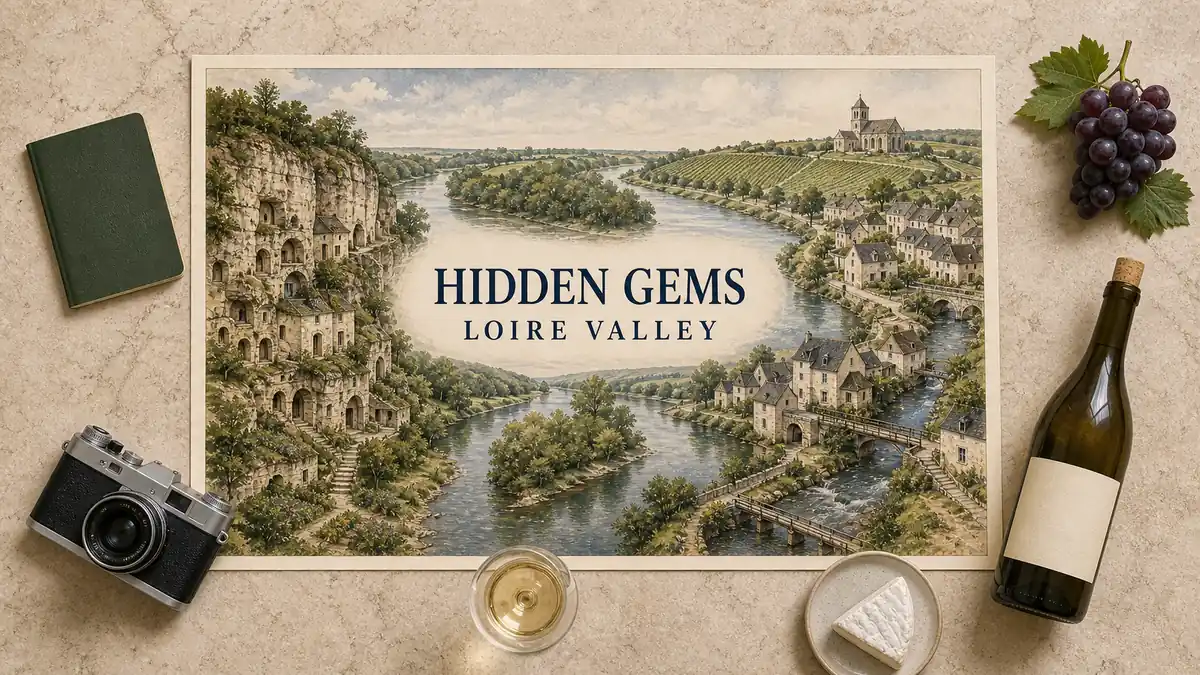
Search for hidden gems in the Loire Valley and half the results are not in the Loire Valley. Villages from the Atlantic coast, from Berry, from the Mayenne bocage get filed under the valley because an administrative region borrows its name, and the lists copy each other until the error looks like consensus. Even official tourism boards do it. The villages themselves are often lovely. They are simply somewhere else, which makes them useless the moment you have anchored a trip on the river corridor and want to know what is quiet within reach of it.
This page holds a stricter line. Every pick below is genuinely lesser-known and genuinely inside the Val de Loire, and the picks arrive grouped by area so each cluster works as a single loop. Chambord and Chenonceau keep their crowds. They are the contrast here, not the content.
Quick Answer
The Loire Valley’s most overlooked places are the cliff villages of the Vallée du Loir and the Saumurois troglodyte belt. Five area groups organise the shortlist, each one sitting inside the real river corridor and each working as a single loop. Heritage-first travelers should head upstream to the Loiret, for Saint-Benoît-sur-Loire and Germigny-des-Prés.
Trust Layer
Tripstou selection guide for travelers choosing between multiple places. Covers selection criteria, traveler fit, and trip value.
Produced with AI assistance and reviewed by Alex Perrut, working in tourism since 2015, for the Tripstou editorial team. See our editorial process for details.
Last factual review: August 23, 2026.
Official sources consulted: France.fr, Atout France.
Key Takeaways
- The Vallée du Loir is the strongest genuinely hidden area — a different river north of Vendôme, with cliff-cut villages.
- If a village is not on the Loire or in a valley that feeds it, it is not the Loire Valley.
- Heritage-first travelers should head upstream to the Loiret; troglodyte hunters should go west to the Saumurois cave belt.
- Chinon, Loches, Saumur and Angers are under-used, not hidden; treat them as the baseline, not as discoveries.
- Quiet is bought with car dependence, limited services and short opening — budget one area group per free day.
- Visit villages later in the day, after the coach circuit has moved on, and pair them with one headline sight.
Table of Contents
What Actually Counts as the Loire Valley?
The Loire Valley is the river corridor running roughly from Sully-sur-Loire down to Chalonnes-sur-Loire. That corridor is the standard this page applies. Two administrative regions borrow the name and stretch far beyond it, which is where almost every misplaced pick comes from. Get the boundary right and the shortlist changes completely.
Three different things answer to the name. The Val de Loire is the river corridor itself, the classified landscape strung along the water between Sully-sur-Loire and Chalonnes-sur-Loire. Centre-Val de Loire is an administrative region that reaches deep into Berry and the Beauce, far from any riverbank. “Atlantic Loire Valley” is a tourism brand covering Loire-Atlantique and the wider Pays de la Loire, out at the estuary and down towards the Vendée. All three names are legitimate. Only one is a valley.
That mismatch is why the same handful of places keeps appearing on Loire Valley lists without belonging on one:
- Trentemoult — a former fishing village inside Nantes, at the estuary end of the river.
- Sancerre — a hilltop wine town in the Cher, far upstream of the classified corridor.
- Vouvant, Sainte-Suzanne, Piriac-sur-Mer — the Vendée bocage, the Mayenne, and the Atlantic coast respectively.
- Clisson, Levroux, Gargilesse-Dampierre, Illiers-Combray — the Nantes hinterland, Berry, the Creuse valley, and Proust’s corner of the Beauce.
None of them are picks here, and this is the only place they appear. The precision test is one you can run yourself: if a “Loire Valley” village is not on the Loire or in one of the tributary valleys that feed it, it was filed by a marketing region and not by geography.
The famous eight — Chambord, Chenonceau, Amboise, Blois, Tours, Villandry, Azay-le-Rideau and Chaumont — are genuinely in the corridor and genuinely worth their crowds, which is why they belong on a shortlist of the best places to visit in France and not on this one. If you want the same famous-versus-overlooked axis applied at national scale, the wider survey of hidden gems across France runs it region by region.
What follows is grouped into five areas: the Indre and Indrois valleys in Touraine, the Vallée du Loir, the Loiret upstream of Orléans, the Saumurois troglodyte belt, and the western end past Angers. Each group is a cluster tight enough to drive in one outing. That is the only grouping that helps once you are actually there, because an alphabetical run of twelve scattered villages is a list, not a plan.
Chinon, Loches, Saumur and Angers Are Under-Used — Not Hidden
Chinon, Loches, Saumur and Angers are the valley’s best-known quiet towns — under-used, but not hidden. They already appear in every guidebook and in every forum thread about escaping the coach circuit. This page treats them as the baseline, not as picks — the standard everything below has to beat.
Two forces decide which parts of the valley stay busy. The first is the Paris day-trip radius. The eastern half of the corridor is close enough to the capital for a there-and-back day, and the western half is not, so Anjou and the Saumurois thin out sharply as you travel downstream. The second force is coach logistics. Group tours need parking, ticketed entry and a fixed timetable, so they concentrate on a short roster of headline sights and leave the ground between them almost untouched.
Quiet in the Loire is rarely a matter of remoteness. It is about not being on a bus route. That is worth knowing, because it means quiet is a short distance away and not a long one: the emptiest villages here often sit within sight of the busiest sights, on the wrong side of a bridge or a ridge.
The four towns above occupy exactly that gap, which is why they are the standard answer when someone asks where to escape the crowds. They are real towns with real streets and thinner visitor numbers than the headline sights, and they are also thoroughly documented in English and easy to reach. Nothing about them is a discovery. They set the floor. Which of them makes sense as a base is a planning question, decided a level up and not here.
Touraine’s Quiet Side: The Indre and Indrois Valleys
South-east of Tours, the Indre and Indrois valleys hold Touraine’s most overlooked villages inside one easy loop. These are tributary valleys, close to the main corridor but off the road that links the famous sights. Four villages anchor the loop, and each earns its place for a different reason.
Both rivers run roughly parallel to the Loire, a short drive south of it, and that geometry is exactly why they stay quiet. A visitor working through the headline sights along the main river has no reason to cross into them, and no signposted route invites it. The four villages below sit close enough together that visiting all of them costs little more than visiting two, which makes this the most efficient group on the page for anyone based between Tours and Loches.
Montrésor
Montrésor is a single street of pale tufa houses strung along the Indrois beneath a spur of rock, with a château on the spur above it. What separates it from the other villages in this group is the water. A mill stream runs the length of the lower village, crossed by wooden footbridges, with a riverside path that lets you see the whole settlement from the outside — the exterior view most villages of this size simply cannot offer. It stays quiet because it sits well beyond the main corridor, with no through traffic and nothing passing by accident. People arrive because they meant to. There is no useful public transport, so plan on driving.
Pick this if: you want a village that reads well from the outside and you are willing to leave the corridor to reach it.
Chédigny
Chédigny is a working village that planted itself into a garden. Verges, walls, doorsteps and roadsides carry roses and perennials until the planting becomes the village’s structural fabric, and the crucial part is that people live inside it — this is a street plan, not an attraction behind a gate. That is what sets it apart from every other village on this page: the interest sits at eye level along ordinary lanes, with no monument to walk towards. It has stayed overlooked precisely because it has nothing to put on a poster, which is the argument for going. It sits in the countryside between the two rivers and needs a car.
Pick this if: you like places where the appeal is in the everyday fabric and you do not need a headline sight.
Crissay-sur-Manse
Crissay-sur-Manse is a small stone village in the Manse valley where the houses have kept their mullioned windows and steep slate roofs almost uniformly. That coherence is the case for it. Most villages of this size have one good street and a great deal of later infill, while this one reads as a single period from end to end, with the church closing the composition at the top. It is overlooked because it is tiny, sells you nothing, and sits on a minor road between two valleys that most routes never join. Come expecting a short walk and a long look, not a half-day. Access is by car on small roads.
Pick this if: you care about architectural coherence and are content with a village that offers nothing but itself.
Beaulieu-lès-Loches
Beaulieu-lès-Loches sits across the Indre from Loches and is a Petite Cité de Caractère in its own right. Its distinguishing feature is the contrast with its famous neighbour. Loches has the fortified hill and the visitors; Beaulieu has abbey ruins, low streets running along the water, and almost nobody on them, all within walking distance of the crowd. That closeness is also why it stays quiet — people look at Loches, conclude they have seen the area, and never cross the river. It is the one pick in this group you can reach on foot from a town base.
Pick this if: you are already visiting Loches and want the empty half of the same stop.
The Vallée du Loir Is a Different River — and the Better Secret
The Vallée du Loir — a different river, north of Vendôme — is the strongest genuinely hidden area near the Loire Valley. The Loir has no final e, no tour circuit, and cliff villages cut straight into soft tufa. English-language guides barely mention it, which is a large part of why it stays quiet.
The Loir and the Loire are two rivers, not two spellings. The Loir runs north of the Loire, roughly parallel to it, and joins the Sarthe well outside the classified corridor. The confusion in English is constant, and it is the reason this valley goes missing from lists that will happily pad themselves with places three departments away. Anyone driving between the Loire and Normandy or Le Mans crosses it without registering it.
Two rivers, one name — and the misspelling is doing real work. The Loir stays empty largely because planners searching in English for “Loire” never surface it, which makes this the rare place where somebody else’s mistake is directly to your advantage. What the Loir has that the main river mostly lacks is cliff: its banks are soft tufa cut into vertical faces, and villages were dug into those faces instead of built in front of them. Montoire-sur-le-Loir makes the natural waypoint on the drive between the two villages below.
Trôo
Trôo is a village built vertically into a tufa cliff above the Loir, its cave dwellings stacked on terraces linked by stairways and narrow lanes, and it is a Petite Cité de Caractère. What separates it from the Saumurois cave villages further west is the gradient. Those are largely horizontal, cut into low faces along a road, while Trôo climbs: you walk up through several levels of dwelling, tunnel, garden and stairway to reach the mound at the top, with the whole valley opening below you. It stays quiet because it is on the wrong river for the tour circuit. Reaching it means driving.
Pick this if: you want troglodyte architecture you can climb through, not look at from a car park.
Lavardin
Lavardin is a village of low stone houses along the Loir beneath a ruined keep on the ridge above. The village is the reason to stop. A medieval bridge crosses to the far bank, the church holds wall paintings, and the lane along the water runs as one uninterrupted stretch of vernacular stone with no modern edge to interrupt it. It is overlooked for the same reason as Trôo — wrong river, wrong search term — and because it sits close enough to its neighbour that lists mention one or the other and never both. In practice the two are a single stop. Car only.
Pick this if: you want the Loir’s riverside stone and medieval fabric without the climbing that Trôo demands.
Is the Eastern Loire Around Orléans Worth Visiting?
Yes, for heritage-first travelers: the Loiret upstream of Orléans holds the valley’s emptiest first-rank sights. This is where the corridor begins, above the château belt, and almost every itinerary starts downstream of it. If Romanesque and Carolingian building interests you more than Renaissance display, this stretch outranks everything below it.
The Loiret gets skipped for a structural reason, not a quality one. Itineraries are built around the famous sights, those sights cluster between Blois and Tours, and anything upstream of Orléans falls off the end of the map people are working from. The buildings up here are centuries older than that circuit and belong to a different chapter of French history altogether, which is why the contrast is so sharp: first-rank monuments, almost no queue culture around them.
Two waypoints frame the stretch. Downstream, between this cluster and the château belt, Saint-Dyé-sur-Loire is a Petite Cité de Caractère on the riverbank and makes a natural pause. Upstream, the corridor simply ends — Briare and its canal crossing of the river sit just beyond the classified limit, which is where this page’s boundary stops.
Saint-Benoît-sur-Loire
Saint-Benoît-sur-Loire holds Fleury Abbey, founded around 630 and among the oldest Benedictine houses anywhere, and the village around it is a Petite Cité de Caractère. The porch-tower is the distinguishing feature: a two-storey Romanesque structure carrying carved capitals, functioning as a building in its own right rather than a doorway, and the church behind it predates the valley’s Renaissance architecture by centuries. It is quiet because it sits upstream of the itinerary belt and asks for a detour that no standard route provides. Reaching it means driving out from Orléans.
Pick this if: you rate Romanesque architecture above Renaissance and will drive upstream to see the best of it.
Germigny-des-Prés
Germigny-des-Prés holds a Carolingian oratory whose apse carries a Byzantine mosaic, one of very few survivals of its kind in France. Scale is what makes the visit distinct. This is a small square building in a small village, and the mosaic sits directly overhead in a space you can cross in a few paces, with nothing between you and it. Nothing about the village signals what is inside, which is exactly why it stays overlooked while comparable objects elsewhere draw queues. It is a short drive from Saint-Benoît-sur-Loire, so the two work as one stop.
Pick this if: you want a genuinely rare object seen at close range, with no crowd management around it.
Yèvre-le-Châtel
Yèvre-le-Châtel is a small walled village on a rise above the Rimarde, inland from the river in the Loiret’s Gâtinais country. Its layout is the case for it: the settlement is enclosed by its fortifications, holds two churches — one of them roofless and left as a shell — and has gardens grown into the defensive perimeter, giving an unusually intact medieval plan for a place this small. It is the one pick in this group that leaves the riverbank, and it is overlooked because it sits off every valley route. Car only.
Pick this if: you like fortified villages and are routing between the Loire and Paris or Burgundy.
The Saumurois Is the Loire’s Troglodyte Heartland
For troglodyte villages, go to the Saumurois — the valley’s densest belt of cave-built settlement. Centuries of tufa quarrying hollowed out the hillsides, and people moved into the galleries. It is also the valley’s quietest famous-grade corner, sitting west of the Paris day-trip range. Five villages show it at its clearest.
The Saumurois is cave country because of what the stone allowed. Tufa is soft enough to cut by hand and firm enough to stand without support, so quarrying and dwelling became the same act: a house was the hole its own walls came out of. The result is a landscape where chimneys rise straight out of fields and whole streets sit behind rock faces instead of in front of them.
One distinction is worth carrying through this section. Cave villages and cave attractions are not the same visit, and the settlements below stay interesting in direct proportion to how little of them has been converted into a ticketed site. Between the picks, Le Thoureil and Chênehutte-Trêves-Cunault line the riverbank road west of Saumur, and Le Puy-Notre-Dame stands inland on its ridge. What you actually do once you are here is a separate question, answered in the guide to things to do in the Loire Valley; this page stops at where to go.
Candes-Saint-Martin
Candes-Saint-Martin stands exactly where the Vienne meets the Loire, and the confluence is the reason to go. The village is one slope of white tufa houses running down to the water, with a fortified church at the bottom and a viewpoint above the roofs that takes in both rivers at once — a piece of geography no other village in the corridor can offer. It stays relatively quiet because it sits at the far western end of the famous belt, past the point where most day trips turn around. Driving is the practical option, though Saumur is close.
Pick this if: you want the valley’s best river geography in a village you can walk end to end.
Montsoreau
Montsoreau is a riverside village strung along the Loire’s south bank at the Anjou–Touraine border, its white houses stacked between the water and the cliff behind, with a château standing at the river’s edge below. The village’s own case is that cliff: dwellings and workshops run back into the rock behind the main street, so the settlement is two-layered, a river frontage in front and a troglodyte one behind. It stays quieter than its position suggests because visitors treat it as a photo stop between bigger names. It is a short drive from Candes-Saint-Martin, effectively the same outing.
Pick this if: you want a village with two faces — a river street in front and a cut-rock one behind it.
Turquant
Turquant is a village where the cave fabric is the village: dwellings, workshops and storage cut back into the tufa face, with built frontages added in front of them. What sets it apart from the others here is that the caves have been reoccupied. Craft workshops and studios have moved into the old galleries, so the rock is in current use, not interpreted for visitors behind a rope. That is also why it keeps a low profile — there is no single monument to anchor a listing, only a village that happens to be half underground. Car access, along the road east of Saumur.
Pick this if: you want to see cave architecture still being lived and worked in.
Le Coudray-Macouard
Le Coudray-Macouard is an inland village of tufa houses and walled gardens south of Saumur, laid out along a spine of lanes with a manor closing one end. What is underneath is the distinguishing feature: the village sits over an extensive network of cut cellars and galleries, so the built village and the excavated one occupy the same footprint, and the street you walk is only the visible half. It stays quiet because it is inland, off the river road, and signposted from nothing. Driving is the only realistic access.
Pick this if: you want an inland tufa village with no river traffic and no tour rhythm at all.
Rochemenier, in Doué-en-Anjou
Rochemenier is an underground farming village — dwellings, barns, stables and a chapel dug down into the plateau around open courtyards, preserved as a museum. It is the clearest demonstration on this page of how these settlements actually worked, because it shows the agricultural version of the technique: not caves cut sideways into a cliff face, but pits sunk from flat ground with rooms opening off them. That is a wholly different way of building. It stays under the radar because it is inland and unglamorous next to the river villages. It needs a car.
Pick this if: you want to see how an entire farming settlement was dug down into flat open ground.
West of Angers: Loire Islands and Layon Wine Villages
West of Angers the valley empties out — Loire island villages and Layon wine villages that English lists never reach. This is the corridor’s final stretch, running down to Chalonnes, and it lies far beyond any day-trip radius. Route this far only if Anjou is already part of the trip.
The far west is empty for the plainest reason available: it is the end of the line. Travelers coming from Paris or Tours run out of trip before they get there, and travelers coming from Nantes are usually heading for the coast instead. The river changes character here too. It braids around sandy islands and low levees, so the landscape becomes water and horizon where upstream it was cliff and terrace. Blaison-Gohier and Denée sit between the river and the Layon and make the natural links across this stretch.
Béhuard
Béhuard is an island commune in the Loire, a village built on a rock in mid-river and reached by a low road the river closes when it rises. The setting is the entire case. You are standing inside the riverbed, water on both sides and sand flats running away from you, around a cluster of stone houses and a chapel built into the rock itself. It stays obscure because almost nothing in English mentions that the Loire has inhabited islands at all. It needs a car, and the access road is weather-dependent.
Pick this if: you want to stand in the middle of the Loire, not beside it.
Savennières
Savennières is a small village on the Loire’s north bank whose name travels much further than its size, because the steep schist slopes behind it are among the most distinctive vineyard ground on the river. As a destination it is quiet and largely residential — a Romanesque church, a handful of lanes, and slopes dropping straight to the water, with the vines visible from the village streets. It stays overlooked because people know the name from a wine list and never picture it as a place you can walk around. It sits on the riverbank road west of Angers; driving is the practical way in.
Pick this if: you know the wine and want to see the ground it comes from, without building a day around tasting.
Aubigné-sur-Layon
Aubigné-sur-Layon is a compact stone village in the Layon valley south of the river, built around a fortified gate and a church with the old lanes intact behind them. Texture is what separates it from the river villages: this is dark schist and slate country instead of white tufa, so the whole palette changes the moment you cross south, and the Layon reads as a different region entirely. It stays unknown because this is wine country that sells direct and never needed visitor traffic. Car only, on narrow roads between vineyards.
Pick this if: you want to see how completely the Loire’s building stone and landscape change south of the river.
Can You Reach These Villages Without a Car?
Mostly no — the genuinely quiet villages sit off the rail lines, and reaching them comfortably means driving. That is the trade-off the lists never state: quiet is bought with car dependence. The picks closest to towns are the exceptions; the rest need wheels of some kind. Plan the shortlist around that, not around the map.
Three things come with quiet, and they arrive together. Villages of this size carry few services, so food and shopping are limited and irregular. Opening tends to be short and unpredictable, particularly in the middle of the day and outside the busiest part of the year. And nearly all of these places sit on minor roads with no scheduled service worth planning around. None of that is a reason to skip them. It is a reason to treat them as stops on a driving day instead of as places to sleep.
The scheduling lever most people miss is the time of day, not the season. Coach groups run a fixed circuit on a fixed timetable, which is why the same village is noticeably quieter later in the day than at midday — and why pairing a headline sight in the morning with a village group afterwards works better than doing it the other way round.
The five area groups are built to slot into a trip that already has the famous sights in it. A trip anchored between Blois and Tours pairs naturally with the Touraine loop, and with the Loir if you are willing to reach north. A trip anchored on Saumur or Angers pairs with the troglodyte belt and the western stretch. A trip starting at the upstream end pairs with the Loiret. Each group is one outing, so the honest arithmetic is one group per free day.
Basing, getting around, trip length and when to come are all decided a level up, in the Loire Valley guide — which is also where to go if the châteaux themselves are what you want to plan the trip around.
- Car: assume you need one for every group; the pair beside Loches is the only walkable exception.
- Services: assume limited and irregular, and carry what you need for the middle of the day.
- Pacing: one area group per free day, not a village checklist strung across the valley.
- Placement: use these as the second half of a day, after the headline sight, once the coaches have moved on.
Train and bus tickets
Compare routes, schedules and prices across rail and bus operators in one search, with mobile tickets on your phone.
New to Omio? Code NEW10 takes 10% off your first booking — or APPNEW10 if you book inside the Omio app. Both apply to bookings up to €80.
Search routes and compare prices on Omio →
Tripstou may earn a commission if you book through this link, at no extra cost to you.
Frequently Asked Questions
Is Sancerre part of the Loire Valley?
No. Sancerre sits in the Cher, far upstream of the classified corridor that begins at Sully-sur-Loire. It appears on Loire Valley lists because it stands above the same river and inside the administrative region that borrows the valley’s name. Neither of those makes it part of the valley.
Is the Vallée du Loir part of the Loire Valley?
Not officially — the Loir is a separate river north of Vendôme, outside the classified corridor. It belongs on this page anyway because it feeds the Loire’s own basin and sits close enough to slot into the same trip. Places filed under the Loire name from the coast or from Berry fail both tests.
Is Montrésor worth visiting?
Yes, if you want a short, high-quality village stop and are willing to drive off the main corridor. Montrésor is one street of pale tufa houses above a mill stream, walkable end to end and back. Pair it with Chédigny and Beaulieu-lès-Loches so the drive earns a full outing.
When is the quietest time to visit Loire Valley villages?
Outside the summer peak and away from the middle of the day. These villages rarely draw a crowd at any point, so off-peak travel mainly buys calmer headline sights, not calmer villages. Choose your timing around the famous stops you are pairing them with, not around the villages themselves.
Do small Loire Valley villages have restaurants and shops?
Assume not. Villages of this size carry few services, and what exists opens on short, irregular hours that are easy to miss. Plan food around the larger towns — Loches, Chinon, Saumur, Angers — or carry it with you, and treat any open café you find as a bonus.
Can you visit Loire Valley hidden gems as a day trip from Tours?
Some of them, yes. The Indre and Indrois loop works comfortably from Tours, and the Vallée du Loir is reachable if you accept a longer drive north. The Saumurois stretches a Tours day thin, and the western Anjou villages past Angers do not work as a day trip at all.
Related Guides
These four guides carry the questions this page deliberately leaves alone — how the valley gets planned, what there is to do once you arrive, and how the same famous-versus-overlooked axis works at national scale.
- Loire Valley guide — basing, getting around, trip length and timing, plus the château planning this page routes away from.
- Things to do in the Loire Valley — the experiences behind the destinations, and what is worth building a day around.
- Hidden gems across France — the same overlooked-destinations axis applied to the whole country, region by region.
- Best places to visit in France — the famous-destination counterpart, including the Loire names this page keeps as contrast.
Did this guide save you time or money? Tripstou is independent and reader-funded — if you'd like to give something back, you can support the site with a crypto contribution of any size.