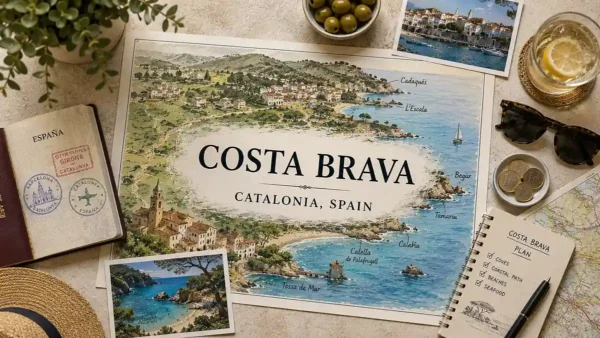
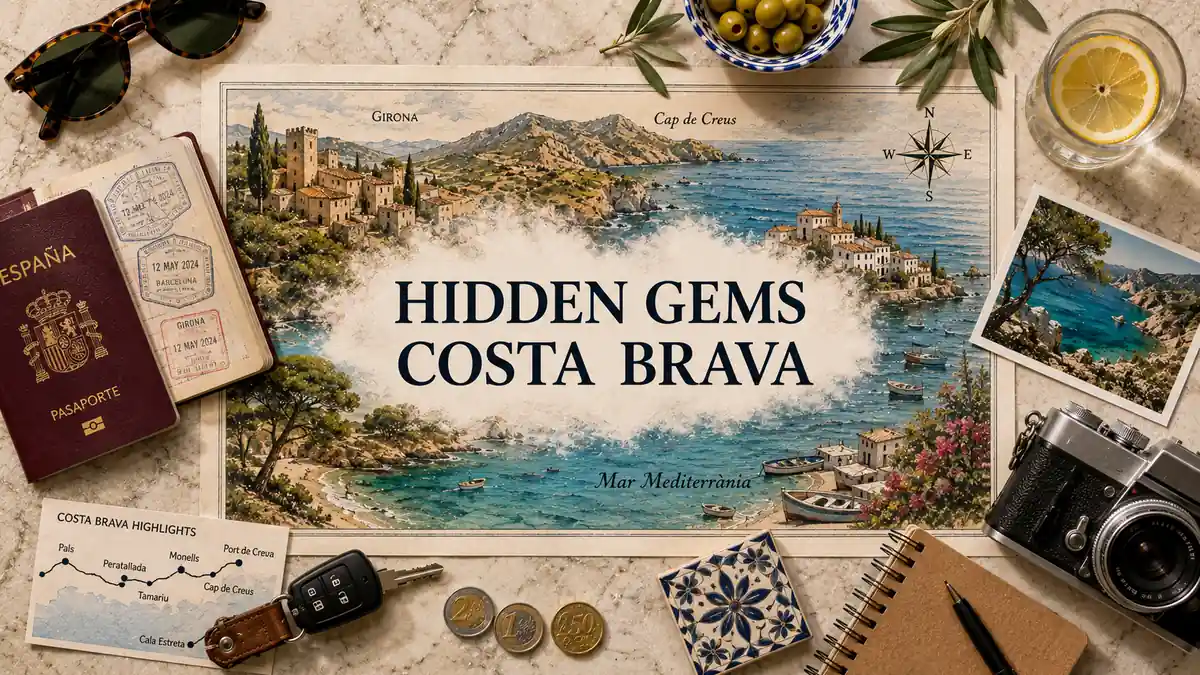
Costa Brava’s headline names — Tossa de Mar, Cadaqués, Lloret — pull the crowds every summer, and for good reason. But the coast’s genuinely underrated places sit one detour off that trail: walled medieval villages a short drive inland, working fishing coves the day-trippers skip, and near-empty beaches reached only on foot. This is a curated cut, not the recycled “secret towns” list that quietly smuggles in the famous names. Every pick here earns its place on one test — it stays quiet when the marquee stops overflow. Below you’ll find the strongest inland villages, the emptiest coves, and the wild far north, grouped so you can match each to your trip. For every place, you get what makes it distinct from its neighbors, who it suits, and the one tradeoff of going hidden: a little more access effort in exchange for far fewer people.
Quick Answer
Costa Brava’s best hidden gems split into inland medieval villages and quiet coastal coves. The strongest picks — Pals, Peratallada, and Monells inland, plus Tamariu, Sa Tuna, and Port de la Selva on the coast — favor slow travelers and couples over the marquee names. Prioritize the villages for atmosphere; a car opens up the emptiest coves.
Trust Layer
Tripstou selection guide for travelers choosing between multiple places. Covers selection criteria, traveler fit, and trip value.
Produced with AI assistance and reviewed by Alex Perrut, working in tourism since 2015, for the Tripstou editorial team. See our editorial process for details.
Last factual review: July 19, 2026.
Official sources consulted: spain.info, tourspain.es.
Key Takeaways
- A genuine Costa Brava hidden gem stays quiet when the marquee names overflow — the cut is crowd relief, not obscurity.
- For medieval atmosphere, prioritize the inland villages: Monells for silence, Peratallada for the fullest stone core, Pals for the hilltop view.
- The emptiest coves — Cala Estreta, Platja del Castell, Cala Futadera — stay quiet only because you have to walk in.
- Couples and slow travelers fit the inland villages; families and beach-first trips fit the accessible coves and fishing hamlets.
- Going hidden trades a little more access effort — a walk, a detour, or the longest drive — for far fewer people.
- Stay overnight inland — the medieval squares only truly empty once the day-trippers drive back to the coast.
Table of Contents
What makes a Costa Brava spot a genuine hidden gem?
A genuine Costa Brava hidden gem stays quiet and under-visited even when the famous names overflow. The test is crowd relief, not obscurity: a place earns the list because it sits one detour off the main trail, keeps its working character, and rarely appears on the recycled secret-towns roundups.
That cut matters because most “hidden Costa Brava” lists are not hidden at all. They lead with Tossa de Mar’s castle and Cadaqués’s whitewashed harbor — beautiful, but firmly on every coach itinerary and heaving by late morning. Those belong on a roundup of the best places in Spain, not here. This page draws the line at places you can still have to yourself.
Two things separate the real gems from the famous stops. First, access friction: the quietest places take a detour, a walk, or the longest drive, and that effort is exactly what thins the crowds. Second, lived-in character — a working fishing cove or a village where people still live beats a pretty spot that has been fully handed over to visitors. Apply both filters and the coast’s underrated shortlist gets short fast.
If you’re weighing Costa Brava against off-beat trips elsewhere in the country, our national roundup of hidden gems in Spain sets the wider context. Everything below stays Costa Brava–specific.
Hidden medieval villages inland
Inland Costa Brava hides walled medieval villages that stay quiet even when the coast fills up. A short drive inland, stone lanes, arcaded squares, and hilltop old towns trade sea views for near-empty streets — the group that suits couples and slow travelers most.
These three form the strongest inland cluster, close enough together to string into one unhurried day. Each earns its place for a different reason, so the choice comes down to what you want from a medieval village: the view, the fabric, or the silence.
Pals
Pals is a medieval hilltop old town of honey-colored stone, crowned by a Romanesque watchtower and Gothic lanes that open onto views across the rice paddies to the sea. What sets it apart from the other two is the setting — Pals looks outward from its ridge, so the reward is the panorama as much as the streets themselves.
Pick this if: you want the photogenic hilltop and don’t mind sharing it with a handful of other wanderers.
Peratallada
Peratallada is a fortified stone village whose name means “carved rock” — its defensive moat was cut straight into the bedrock, and the medieval core is among the best-preserved in Catalonia. It’s the busiest and most restaurant-heavy of the three, which makes it the easiest for a long lunch but the least sleepy after dark.
Pick this if: you want the most complete medieval fabric and a proper dinner without leaving the walls.
Monells
Monells is the quietest of the three, built around an arcaded stone plaça so untouched it has doubled as a film set. It has fewer shops and fewer visitors than Pals or Peratallada, which is exactly the point: you get the same medieval streets with almost none of the foot traffic.
Pick this if: you want the calmest square and are happy to trade restaurants for silence.
Peratallada draws the most day-trippers of the three, so start early or start in Monells — the same stone lanes, a fraction of the people.
Secret coves and hidden beaches
Costa Brava’s quietest coves trade easy access for near-empty sand well off the main beach circuit. Access is the filter here. The harder a cove is to reach on foot, the emptier it stays, so steep paths and walk-in-only inlets hold their calm long after the drive-up beaches fill.
The three below are genuinely lesser-known — not the signature calas that show up on every list. All ask for a walk in, and none come with a beach bar you can rely on, so bring water, shade, and shoes. Keep access loose in your planning: paths, parking, and how far you’ll carry your gear vary, and they’re worth checking locally before you set off.
Cala Estreta
Cala Estreta sits north of Palamós at the end of a walking track — no road, no beach bar, no development, just a string of small rocky inlets and clear water. It’s one of the emptiest swimmable coves on this stretch precisely because you have to walk in to reach it.
Pick this if: you’ll trade every facility for near-solitude and need nothing but the water and the shade you carry.
Platja del Castell
Platja del Castell, also near Palamós, is a rare undeveloped sweep of sand — locals blocked a resort here, and the beach stays wild as a result. A short walk from the parking keeps it far calmer than the built-up beaches nearby, with an ancient Iberian settlement on the headland above.
Pick this if: you want real sand rather than rock, but still want to leave the crowds behind.
Cala Futadera
Cala Futadera lies on the wild stretch between Tossa de Mar and Sant Feliu de Guíxols, reached by a long stairway down from the coast road. The descent is the whole filter — the cove stays near-empty while the road-accessible beaches nearby fill by midday.
Pick this if: your knees are fine with a steep climb back up and you want a cove that feels earned.
Any Costa Brava cove you can drive right up to has already been found — the walk down to Cala Estreta or Futadera is the entire reason they stay empty. Once you’ve found your cove, our guide to things to do in Costa Brava covers the coastal-path walks, kayaking, and diving that make the calas worth the effort.
Quiet fishing villages and the wild far north
The far north hides working fishing hamlets and wild headland walks the day-trip crowds rarely reach. The payoff scales with distance from Barcelona: the furthest coves and the Cap de Creus headland stay quietest precisely because they take longest to get to.
These are the picks for travelers willing to drive further for a bigger drop in crowds. Two are pocket-sized fishing coves; the third is a low-key base for the wildest corner of the coast.
Tamariu
Tamariu is the smallest and quietest of the three Palafrugell coves, a crescent of pines and fishing boats with a fraction of the development of its neighbors. It never grew the way the nearby resorts did, so it keeps a slow, local feel even in high season.
Pick this if: you want a swimmable cove with a real village behind it, not a resort strip.
Sa Tuna
Sa Tuna is a tiny fishing cove below Begur — a handful of whitewashed houses, a pebble beach, and a seawall you can walk out along. There’s barely anything here, which is the appeal: it feels like a hamlet that the big beach towns just down the coast forgot.
Pick this if: you want somewhere that reads as a hidden hamlet more than a beach destination.
Port de la Selva and Cap de Creus
Port de la Selva is a low-key fishing town on the far-north coast and the best base for the Cap de Creus headland and the mountaintop monastery of Sant Pere de Rodes. It’s the underrated alternative to Cadaqués next door — the same wild, wind-carved Cap de Creus light, without the traffic that clogs Cadaqués’s single approach road.
Pick this if: you’ll drive the furthest for empty headland walks, a monastery view, and the quietest corner of the coast.
Port de la Selva gives you the same Cap de Creus scenery that made Cadaqués famous, minus the day-trip traffic — base here to sleep, and drive into Cadaqués only if you want to see what the fuss is about. The far north takes the longest to reach, so plan for a real drive, not a day-trip dash; for drive times, bus connections, and where to base yourself across the region, the full Costa Brava guide handles the route planning.
Which hidden gems suit couples, families, or slow travel?
Couples and slow travelers fit the inland villages; families and beach-first trips fit the accessible coves. Match the group to the pace you want: quiet stone lanes and long dinners inland, easy sand and swimming on the coast, and the wild far north for travelers chasing solitude.
The picks sort cleanly by trip style, so use the table as a shortcut to your shortlist rather than reading every block in full.
| Traveler type | Best group | Top pick | Why it fits |
|---|---|---|---|
| Couples | Inland medieval villages | Peratallada | Stone lanes, walled dinners, no beach crowds |
| Slow travel | Inland medieval villages | Monells | Quietest square, few visitors, unhurried pace |
| Families | Accessible coves | Platja del Castell | Real sand and swimming, short walk in |
| Beach-first | Fishing coves | Tamariu | Swimmable cove with a village behind it |
| Solitude-seekers | The wild far north | Port de la Selva | Empty headland walks, furthest from the crowds |
The villages reward an overnight more than the coves do. Cove crowds thin out by late afternoon anyway, but the inland squares only truly empty once the day-trippers drive back to the beach — so if you can stay one night inland, that’s where it pays off most.
Frequently Asked Questions
Do you need a car to reach Costa Brava’s hidden gems?
A car helps for most of them, and it’s close to essential for the walk-in coves. The inland villages and larger fishing towns are reachable by train to Girona or Figueres plus a connecting bus, but the quiet coves and the far-north headland realistically need your own wheels.
How do you get to Costa Brava’s hidden gems from Barcelona?
Drive or take the train, depending on how far you’re going. From Barcelona it’s roughly a two-to-three-hour drive to the far coast, or a train to Girona or Figueres — about an hour — then a connecting local bus. Renting a car at the airport gives you the most reach for the quiet coves.
When is the best time to visit Costa Brava to avoid the crowds?
Late spring and early autumn are the sweet spot for dodging crowds. May, June, September, and early October bring warm-enough weather and swimmable sea without the July-and-August peak that fills even the quiet coves. Midweek beats weekends everywhere, and mornings clear the day-trippers from the inland villages.
Are Costa Brava’s hidden gems worth a day trip or an overnight?
Both work, but the far north rewards an overnight. Coves and inland villages near Girona make easy day trips, and cove crowds thin by late afternoon anyway. The Cap de Creus far north takes longest to reach, so staying a night in Port de la Selva turns a rushed dash into a proper visit.
Is Cadaqués a hidden gem or a famous spot?
Cadaqués is famous, not hidden — it’s a marquee stop that heaves in summer and clogs its single approach road. For the same wild Cap de Creus light without the traffic, base in nearby Port de la Selva instead. Cadaqués sits with the region’s best-known places, not its secrets.
Which hidden gem is best for a first visit?
For a first visit, start with Pals. Its honey-stone hilltop and rice-paddy views deliver the medieval-village atmosphere most people picture, it’s easy to reach, and it pairs naturally with Peratallada and Monells for an easy inland loop before you chase the quieter coves.
Related Guides
- Costa Brava guide — the full region planner for drive times, transport, timing, and where to base yourself.
- Things to do in Costa Brava — coastal-path walks, kayaking, diving, and the experiences at these places.
- Best places in Spain — where the famous headline stops fit, and how Costa Brava compares nationally.
- Hidden gems in Spain — the national off-beat context if you’re weighing regions against each other.
Did this guide save you time or money? Tripstou is independent and reader-funded — if you'd like to give something back, you can support the site with a crypto contribution of any size.