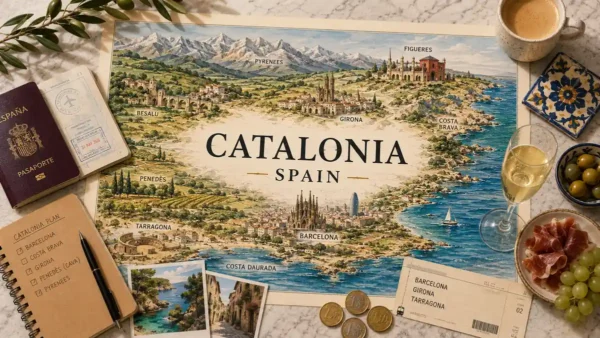
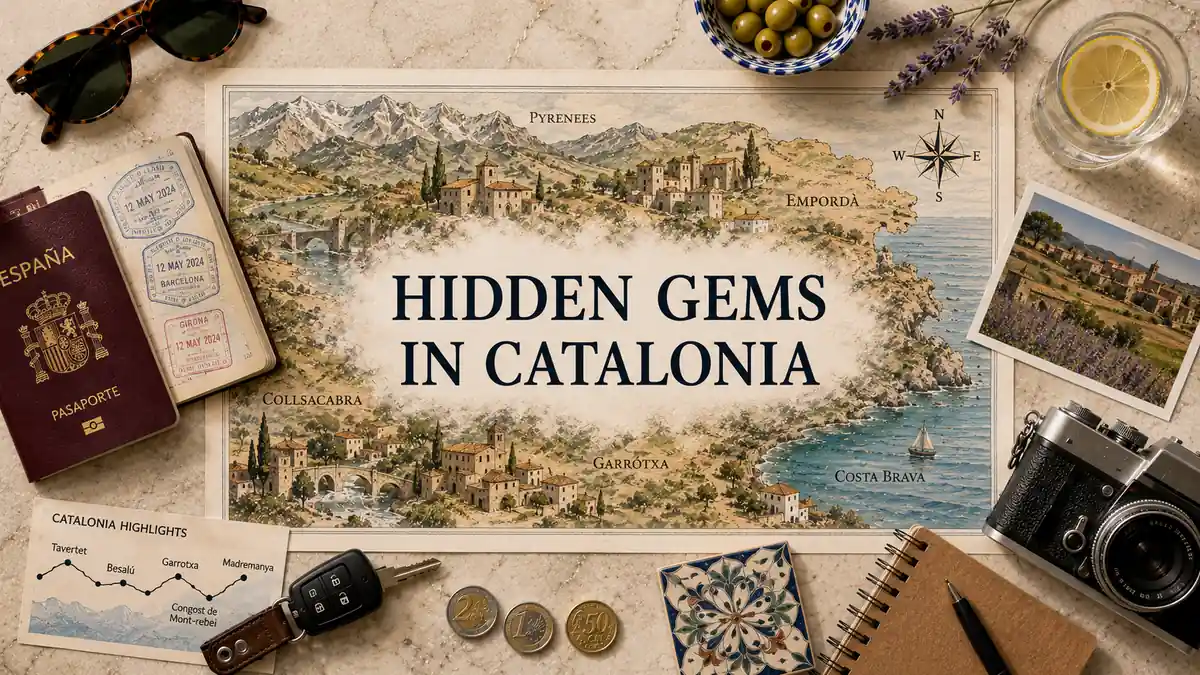
Catalonia is far bigger than Barcelona, yet most hidden-gems lists recycle the same ten places that stopped being secret long ago. Besalú, Rupit, and Cadaqués are lovely, but they appear on every roundup and fill their car parks by mid-morning in peak season. This guide separates the genuinely under-visited from the no-longer-secret. It foregrounds quiet stone villages that locals still drive to for lunch, plus a few wild natural areas that rarely make the English-language lists. Every pick is grouped by trip shape, so you can match it to how you actually travel: an easy day out of Barcelona, a deeper run into the inland Empordà, a push up into the Pyrenees, or a detour through the overlooked southern comarques. No Catalonia history lesson, no route to follow, no filler — just where to go and who each place suits.
Quick Answer
Catalonia’s real hidden gems pair lesser-known medieval villages like Madremanya and Guimerà with wild nature such as Congost de Mont-rebei. The picks group by distance from Barcelona and by villages versus nature, so they match your trip shape. Day-trippers stay in Garrotxa and Collsacabra, while deeper trips reach the Pyrenees and the southern comarques.
Trust Layer
Tripstou selection guide for travelers choosing between multiple places. Covers selection criteria, traveler fit, and trip value.
Produced with AI assistance and reviewed by Alex Perrut, working in tourism since 2015, for the Tripstou editorial team. See our editorial process for details.
Last factual review: July 18, 2026.
Official sources consulted: Spain.info, Turespaña.
Key Takeaways
- Madremanya is the strongest genuinely under-the-radar pick — a quiet honey-stone Empordà hamlet the English-language lists still miss.
- For a day trip from Barcelona, choose Tavertet: a clifftop Collsacabra hamlet that stays quiet where the poster villages don’t.
- Congost de Mont-rebei is the standout hidden natural wonder — a cliff-path gorge for confident hikers who plan logistics ahead.
- Besalú, Rupit, and Peratallada remain beautiful but are no longer secret, so visit them early or off-season to dodge crowds.
- A car unlocks most of these villages; without one you’ll reach only a handful of the better-connected picks.
Table of Contents
Is it worth going beyond Barcelona in Catalonia?
Yes — Catalonia rewards travel beyond Barcelona more than almost any region in Spain. Its best villages and wild landscapes sit inland, away from the crowded coast. This list applies one test — a place counts as hidden only if it stays quiet even in peak season.
The commodity list isn’t wrong, only overexposed. Besalú, Rupit, Peratallada, and Castellfollit de la Roca are genuinely beautiful, and this guide still recommends them further down. What it won’t do is pretend they’re undiscovered. They anchor every itinerary, coach tour, and photo roundup, so you’ll share them with a crowd from late spring through summer.
The genuinely hidden picks work differently. They tend to be smaller, harder to reach without a car, and short on the cafés and gift shops that follow fame. That’s the trade: you swap convenience for a village that still belongs to the people who live in it.
The most reliable tell for a still-quiet Catalan village is whether it has a coach car park. Once a place builds one, the buses have already found it.
For the wider trip — transport, seasons, and where to base yourself — see our Catalonia travel guide. The famous headline stops that this list deliberately skips live in Spain’s famous headline destinations. And if you’re touring more of the country, we cover hidden gems across the rest of Spain separately.
Medieval Villages Near Barcelona Worth a Day Trip
Tavertet is the strongest near-Barcelona medieval village most day-trippers miss. It’s a tiny clifftop hamlet in the Collsacabra with wide views over a reservoir. It sits within a day trip of the city yet stays far quieter than the poster villages, because it trades big-name landmarks for stone lanes and a cliff edge.
Tavertet
Tavertet earns its place because it stays genuinely quiet despite being drivable from Barcelona. The village is barely more than a cluster of old stone houses on a cliff, with footpaths leading out along the Collsacabra escarpment. There’s little to “do” beyond walking and looking, which is the point — for more structured outings across the region, see our roundup of things to do in Catalonia.
Pick this if: you want big views and quiet lanes within a day’s drive, and you’re happy that the attraction is the setting itself.
Rupit
Rupit is beautiful and no longer a secret. Its cobbled main street and the swaying suspension footbridge into the village appear on nearly every Catalonia roundup, and weekend crowds prove it. It still earns a visit for its preserved medieval core — just go early or off-season.
Pick this if: you want a picture-perfect village and don’t mind sharing it, ideally on a weekday morning.
Castellfollit de la Roca
Castellfollit de la Roca is famous for one unforgettable image: a row of houses perched on the lip of a sheer basalt cliff. The view from below is the whole draw, so plan it as a short stop. The village itself is small and quiet once the photo-stoppers move on.
Pick this if: you’re already crossing the Garrotxa and want a brief, dramatic detour.
Gironella
Gironella is the lesser-known pick here, a working town on the Llobregat with a compact medieval old quarter most visitors drive straight past. It won’t dazzle like the cliff villages, but that’s why it stays local — you’ll hear more Catalan than English in its old town. It rewards curiosity over a checklist.
Pick this if: you prefer a lived-in town over a polished set piece and want somewhere entirely off the tourist track.
Secret Empordà Villages Locals Still Keep
Madremanya is the inland Empordà village locals guard most quietly. It’s a honey-stone hamlet of restored farmhouses that rarely reaches the English-language lists. The wider inland Empordà hides medieval cores that stay calm while the nearby coast fills up. These are villages people still live in, not open-air museums.
Madremanya
Madremanya rewards travelers who want the Empordà without the tour buses. It’s a small huddle of restored stone houses and quiet lanes, with a Romanesque church at its heart and almost nothing built for tourists. That scarcity of cafés and shops is exactly why it stays quiet.
Pick this if: you want a genuinely sleepy base in the interior and don’t need restaurants and shops on the doorstep.
Palau-sator
Palau-sator is a tiny medieval village built around a stone watchtower, deep in the flat farmland of the Baix Empordà. It draws a trickle of in-the-know visitors but nothing like the coastal towns nearby. The whole place can be walked in a few minutes, and that’s part of its charm.
Pick this if: you’re exploring the inland Empordà by car and want to string together several quiet villages in a day.
Peratallada
Peratallada is known but earns it. Its carved-stone core — streets, arches, and buildings cut straight from the bedrock — is among the best-preserved medieval ensembles in the region, which is exactly why it’s no secret. Come midweek or early to enjoy it before the day-trippers arrive.
Pick this if: you want the Empordà’s most atmospheric medieval streets and will plan around the crowds.
Besalú
Besalú is a genuinely stunning medieval town, and also one of Catalonia’s most photographed — its fortified Romanesque bridge over the Fluvià is a regional icon. It belongs on this list honestly labeled: worth every minute, but firmly on the tourist map. Visit outside peak weekends for the best of it.
Pick this if: you want one showpiece medieval town and accept it comes with company.
Hidden Villages in the Catalan Pyrenees
The Boí Valley is the standout hidden corner of the Catalan Pyrenees. Its cluster of small stone churches carries UNESCO World Heritage status, yet the valley sees far fewer visitors than the coast or the big ski resorts. It suits travelers who pair high mountain scenery with deep medieval history.
Boí Valley and Taüll
Taüll is the heart of the valley’s Romanesque trail, home to celebrated stone churches whose original wall paintings rank among the finest medieval art in the country. Visiting the interiors depends on seasonal opening hours, so check locally before you plan a day around them. The setting alone — stone hamlets under high peaks — rewards the drive.
Pick this if: you love Romanesque history and want mountain scenery without resort crowds.
Beget
Beget is a remote stone hamlet tucked into the folds of the high Garrotxa, reached by a long, winding mountain road. That awkward access is exactly what has kept it small and quiet. It’s little more than a cluster of medieval houses and a Romanesque church, with almost no tourist infrastructure.
Pick this if: you want a genuinely remote mountain village and don’t mind a slow, winding drive to reach it.
In the high valleys, the village is open all year but its churches often aren’t — mountain opening hours shrink hard outside the warm months, so the interiors, not the drive, decide when to come.
Underrated Southern Catalonia: Tarragona and Lleida
Conesa and Guimerà are the standout overlooked villages of southern Catalonia, tucked into the inland comarques of Tarragona and Lleida. Almost no English-language list reaches them, because the region sits well off the Barcelona-to-coast axis most visitors follow. They suit travelers who want medieval Catalonia with essentially no other tourists around.
Conesa
Conesa is a walled medieval village in the Conca de Barberà, its twelfth-century defensive walls still ringing a quiet historic core. Barely anyone visits, and there’s little set up for those who do, which is the appeal. It’s the kind of place you have almost entirely to yourself.
Pick this if: you want raw, uncommercialized medieval history and are traveling the interior by car.
Guimerà
Guimerà cascades down a hillside in Lleida’s interior, its terraced medieval core stacked in tiers of stone houses linked by steep, narrow lanes. It’s one of the most striking village layouts in Catalonia and almost completely absent from English travel writing. The climb through its levels is the experience itself.
Pick this if: you’re drawn to dramatic village architecture and want somewhere the international crowds simply haven’t found.
Hidden Natural Wonders Beyond the Villages
Congost de Mont-rebei is Catalonia’s standout hidden natural wonder — a dramatic limestone gorge above a turquoise river. A narrow path clings to the sheer cliffs, and it stays wilder and less developed than better-known Spanish canyons because access is deliberately limited. It suits hikers who want raw scenery over easy convenience.
Congost de Mont-rebei
Mont-rebei is a walk-in gorge with no road through it — the experience is the cliff-hugging footpath itself, carved into the rock above the water. Access and parking are actively managed and the arrangements change between seasons, so check the current rules before you make the trip. It’s a demanding day out and worth every step for confident walkers.
Pick this if: you’re a comfortable hiker chasing dramatic landscape and will plan the logistics in advance.
Ebro Delta
The Ebro Delta is a vast, flat wetland at the southern tip of Catalonia, a patchwork of rice paddies, lagoons, and some of the best birdwatching in the Mediterranean. It feels a world away from the mountains and medieval villages — wide skies, flamingos, and long empty beaches. Exploring it works best by bike or boat, though specific tours and timetables shift seasonally.
Pick this if: you want big open nature and birdlife, and enjoy slow, flat cycling far from the crowds.
These two wonders pull in opposite directions: Mont-rebei demands stamina and a head for heights, while the Ebro Delta rewards doing almost nothing at all. Match the one to your energy, not just your photo wishlist.
Frequently Asked Questions
Is Besalú still a hidden gem?
Not really — Besalú stopped being a secret years ago. Its fortified Romanesque bridge makes it one of Catalonia’s most photographed towns, and coaches reach it easily. It’s still genuinely worth visiting for the medieval core; just come on a weekday or outside peak weekends to enjoy it without the crowds.
Is Cadaqués too touristy now?
Cadaqués draws heavy crowds in summer, so it no longer counts as a hidden gem. The whitewashed coastal town and Dalí’s nearby house at Portlligat are genuine highlights, but peak-season visitors fill its lanes and parking. Visit in spring or autumn, or early on a weekday, for a quieter experience.
Do you need a car to visit Catalonia’s hidden gems?
For most of them, yes — a car is the practical way to reach these villages. The genuinely quiet picks sit off the main rail lines, down winding inland or mountain roads with little public transport. Without a car you can still reach a few better-connected spots, but hiring one opens the full list.
When is the best time to visit Catalan villages to avoid crowds?
Late spring and early autumn are the sweet spot — mild weather with far thinner crowds than summer. Weekdays beat weekends everywhere, since Catalans day-trip to these villages on Saturdays and Sundays. Peak season, from late spring through summer, packs the famous picks; the genuinely hidden ones stay quiet year-round.
Which Catalan village is best for a first trip beyond Barcelona?
Tavertet is the easiest first step beyond Barcelona — a clifftop Collsacabra hamlet within a day’s drive that still feels quiet. It hands you dramatic views and stone lanes without a long journey or crowds. If you’d rather go deeper, Madremanya in the inland Empordà makes a calmer overnight base.
How much time do you need for Catalonia’s hidden villages?
A day trip covers one cluster near Barcelona, like Tavertet or the Garrotxa villages. To combine inland Empordà, the Pyrenees, and the southern comarques, plan three to five days with a car. These sit far apart, so spreading them across a wider Catalonia trip beats rushing them into one visit.
Related Guides
- Planning your Catalonia trip: transport, seasons, and bases
- Things to do in Catalonia
- Spain’s famous headline destinations
- Hidden gems across the rest of Spain
Did this guide save you time or money? Tripstou is independent and reader-funded — if you'd like to give something back, you can support the site with a crypto contribution of any size.