Your Paris trip is booked, and the worry list has already started: queues you should have skipped, a metro ticket you cannot work out how to buy, a waiter who seems irritated with you. Almost all of that friction comes from a handful of small, fixable things first-timers have no way of knowing yet. Paris is not hostile to visitors. It simply runs on conventions that stay invisible until you break one.
This page collects the tips that resolve those moments, grouped by theme so you can scan straight to the ones you need. Pacing and booking discipline come first, because they decide how the whole trip feels. Then the practical layer: how you actually pay for the metro now that paper tickets have gone — the tip most Paris lists still get wrong — plus cards and cash, reading a restaurant from the pavement, the greeting protocol, and the timing and tactics that keep queues and pickpockets out of your day.
Quick Answer
Paris goes smoothly if you book big sights ahead, pace days loosely, and greet with bonjour. The big change is ticketing: paper metro tickets have gone, so you load fares onto a contactless Navigo Easy card. Keep to two or three anchors a day; tipping is optional because service is included.
Trust Layer
Tripstou planning guide for travelers resolving one travel decision. Covers the main variable, traveler context, and practical tradeoffs.
Produced with AI assistance and reviewed by Alex Perrut, working in tourism since 2015, for the Tripstou editorial team. See our editorial process for details.
Last factual review: August 7, 2026.
Official sources consulted: France.fr, Atout France.
Key Takeaways
- Plan two or three anchors a day; Paris spreads further on the ground than the map suggests, and transfers eat hours.
- Buy a Navigo Easy card and load fares onto it — paper metro tickets have gone and bank cards do not tap at turnstiles.
- Say bonjour before anything else in every shop, bakery and ticket hall; skipping it is why visitors think Parisians are cold.
- Reserve timed slots weeks ahead in peak season for the handful of capacity-limited sights, and leave the rest of the day unbooked.
- Walk past restaurants that show photographs of the food; turning two streets off a monument improves both the cooking and the price.
- Book the first or last entry slot of the day; mid-morning to mid-afternoon is when every crowd arrives at once.
Table of Contents
Paris Punishes the Over-Packed Itinerary — Pace It Instead
The classic first-timer mistake is treating Paris like a checklist, and the fix is fewer anchors per day. The city spreads much further on the ground than it looks on a map, and every transfer eats time you did not budget. Two or three anchors a day is the honest maximum.
An anchor is one thing that owns a block of hours. One major sight, one neighbourhood to wander, one proper meal — that is a full Paris day, and it leaves room for the café stop that ends up being the memory. The Eiffel Tower, the Louvre and Montmartre are not a walking triangle: each pair is a metro ride plus a walk at both ends, and those joins are where itineraries quietly collapse.
Nothing on the must-do list is compulsory. Travelers who skip one famous interior and spend the afternoon in a park or a covered market rarely regret it, while the ones who queue for everything come home exhausted and vague about all of it. Pick the three or four sights you genuinely want, then defend the empty space around them.
A timed slot booked for mid-afternoon turns every hour before it into a countdown. Put your booked entries at the start of the day and the rest of the hours stop behaving like a schedule.
Where you sleep changes the arithmetic more than any hotel feature: staying reasonably central can save you an hour of commuting a day, and our guide to choosing where to stay in Paris covers those trade-offs. If you want the pacing principle turned into a working shape, the two days in Paris itinerary and the three-day version show how few anchors a realistic day actually holds. For trip shape and season, start with the main Paris travel guide.
What Should You Wear in Paris?
Wear shoes you have already broken in, because Paris is a walking city and the days are far longer on foot than you expect. Cobbles, gravel park paths and long stair climbs in metro stations punish new shoes within hours. Comfort here is a planning decision, not a style one.
Layers handle the rest. Weather turns over quickly, interiors run warm, and a packable waterproof layer saves more days than an umbrella does. Parisians dress plainly and in dark colours, so simple clothes attract less attention than obvious tourist kit, and that has a small side benefit around pickpockets. One extra item earns its space: a light scarf, because working churches expect covered shoulders and knees.
How Far Ahead Should You Book Paris Attractions?
Book the few sights with timed entry weeks ahead in peak season; the rest needs nothing. Only a short list of capacity-limited attractions genuinely sells out, and everything else in Paris still works on walking up. Booking discipline means protecting those few slots, then leaving the day unbooked around them.
Two lists are worth keeping straight before you open a single ticket page.
- Reserve a timed slot, weeks ahead in high season: the Eiffel Tower, the Louvre, the Catacombs, and any temporary exhibition that has been getting press.
- Book a few days out, if at all: mid-size museums, guided tours, river cruises, and dinner at places with a reputation.
- Never needs booking: parks and gardens, street markets, most churches, the walk along the Seine, Montmartre’s streets, department store rooftops, and neighbourhood restaurants at lunch.
Peak-season slots disappear in a predictable order: the first entries of the day go first, the last entries go next, and mid-afternoon times sit unsold because nobody wants to spend the best light indoors. If your dates are fixed and the early slot has gone, take the late one before you settle for the middle of the day.
Is the Paris Museum Pass Worth It?
The Paris Museum Pass is worth it if you will visit several paying museums on consecutive days, and not worth it otherwise. That is the whole decision rule, and most first trips fail it.
A first visit to Paris is usually light on museums and heavy on the free layer of the city: walking, parks, markets, churches, bridges and terraces. If your list is one big museum plus a lot of wandering, single tickets win comfortably. Watch the fine print as well. A pass does not always remove the reservation step at the headline sights, so check whether your must-see still wants a timed slot on top. And a pass you feel obliged to get value from starts quietly scheduling your trip for you.
Tours and activities
Book skip-the-line tickets, day trips and local tours with free cancellation on most activities.
You can also browse everything on getyourguide.com.
Tripstou may earn a commission if you book through this link, at no extra cost to you.
How Do You Pay for the Paris Metro Now Paper Tickets Are Gone?
Buy a Navigo Easy card and load fares onto it, because the paper Ticket t+ has been withdrawn. The card is a reusable contactless smartcard sold at station machines and staffed counters for a small one-off fee, then topped up with single fares or a pass whenever you need more.
The part that catches arriving travelers is what you cannot do. You cannot tap a bank card or a phone wallet on a metro or RER turnstile the way you can in London or Milan; contactless bank-card acceptance is being rolled out on buses first, while the barriers still want a Navigo card or a valid fare. Some handsets can carry fares through the official Île-de-France Mobilités app, and the physical card stays the fallback that always works.
Buy it at the first staffed counter you pass. Machine queues at the big arrival stations are where a lot of first hours in Paris quietly go, and the counter also lets you ask which fare you are loading.
Everything else about moving around the city — lines, zones, passes, buses and night service — lives in the Paris transport guide, and the ride in from the airports is covered in getting from Paris airports to the city.
Do You Need Cash in Paris, or Do Cards Work Everywhere?
Cards work almost everywhere in Paris, so you only need a small amount of cash as backup. Contactless payment is standard in shops, cafés, bakeries, museums and taxis, and card terminals are brought to your table at restaurants. Keep a few notes and coins for markets, tiny businesses and any tip you choose to leave.
Your PIN matters more here than your card brand. Chip-and-PIN is the norm, and unattended machines — ticket machines, station kiosks, some parking and self-service points — will reject a signature-only card outright. Know the number before you land, and carry a second card from a different network in case one is declined.
Cash still earns its place in a few specific spots: outdoor food markets, some boulangeries and bars with a card minimum, small purchases at busy counters, and coins for the tip you leave on the saucer. Withdraw from a bank ATM inside or attached to a branch, and always decline the machine’s offer to convert into your home currency.
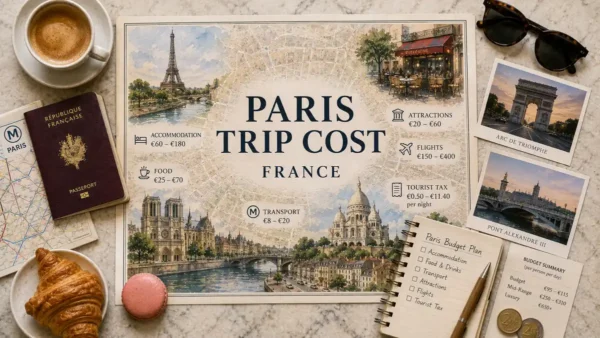
The biggest saving is on the clock, not the card. The same kitchens that price a dinner à la carte serve a two- or three-course lunch formule for far less, so eat your ambitious meal at midday. For totals, price bands and what a Paris day realistically adds up to, use the Paris trip cost breakdown.
Do You Tip in Paris Restaurants?
No, tipping is not expected in Paris restaurants, because service is included by law. The service compris line on your bill means the staff are already paid for serving you, and no percentage is calculated on top.
What people actually do is round up or leave a couple of coins after a good meal or a long terrace stay. Card terminals rarely offer a tip prompt, so if you want to leave something, leave it in cash on the table. Nobody will chase you for it, and no server will treat you differently for skipping it.
How Do You Avoid Tourist-Trap Restaurants in Paris?
Walk past any restaurant with photographs of the food outside; that one tell removes most tourist traps in Paris. Traps cluster where the footfall is, on the streets fanning off major monuments, and they compete on visibility instead of cooking. Turn two streets away from the sight and both prices and quality improve.
The visual tells are consistent enough to read from the pavement:
- Photographs of dishes on the menu board, or laminated menus in four or five languages.
- Someone stationed outside inviting passers-by in, in English, before you have stopped.
- A menu long enough to cover every French classic plus pizza and pasta.
- Prices not posted outside at all, when displaying them is the normal practice.
- A full dining room at half past six in the evening, hours before locals eat.
Two words decide what you are ordering. Menu means a fixed-price set meal of two or three courses, while la carte is the à la carte list — asking for “the menu” in English often gets you the set deal, which is usually the better value anyway. The plat du jour is the kitchen’s dish of the day and the cheapest way to eat what they are proud of.
The reliable Paris signal is the ardoise, the chalkboard with four or five dishes on it. A kitchen that rewrites its board every day is buying what looked good that morning, and a kitchen printing forty dishes is working from a freezer.
Reservations are worth thinking about before you arrive, not on the night. And when you sit down, ask for une carafe d’eau instead of accepting the bottled water they will otherwise bring.
Bonjour Is Not Optional: Etiquette That Changes How Paris Treats You
Greet first, always: saying bonjour before anything else visibly changes how you are treated in Paris. Skipping it reads as rudeness, and it is the most common reason visitors decide Parisians are cold. Open with bonjour, close with merci and au revoir, every time.
In a Paris shop you are a stranger until you speak. Bonjour is what turns you into a customer, and the service that follows is a different service — warmer, more patient, more willing to switch into English for you.
The triggers are specific and constant: entering a bakery, a pharmacy or any small shop, stepping up to a ticket window, boarding a bus, joining a market stall queue. Say bonjour first and your question second. In the evening, bonsoir replaces bonjour, and adding madame or monsieur softens any request. The other half of the protocol matters just as much — say merci, au revoir on your way out, even if you bought nothing.
| Situation | What to do | What to skip |
|---|---|---|
| Entering a shop or bakery | Say bonjour before you look at anything | Browsing in silence, then speaking |
| Needing help in English | Ask “bonjour, parlez-vous anglais ?” first | Launching straight into an English question |
| Ordering on a café terrace | Sit, wait, and greet the server first | Waving or calling across the terrace |
| Squeezing past on the metro | Say “pardon” and move through steadily | Pushing past without saying anything |
| Leaving a small business | Say “merci, au revoir” on your way out | Slipping out silently after you pay |
Volume is the other adjustment. Paris cafés and metro carriages run quieter than most visitors expect, so conversations stay at table level, phone calls happen outside, and a phone face-up on a restaurant table reads as impatience. In queues, know what you want before your turn arrives; bakery lines move fast and hesitation is the one thing that irritates everyone. Churches ask for covered shoulders and knees, hats off, and phones away during services.
These conventions run across the country, and the country-wide version is in our France travel tips. In Paris the difference is density: you will trigger the greeting rule a dozen times a day, in cafés, shops and ticket halls, and each one either helps you or costs you.
What’s the Best Time of Day to Visit Paris’s Big Sights?
Go at the first entry of the morning or the last slot of the day. Those two windows beat every other crowd tactic available to you. Mid-morning to mid-afternoon is when tour groups, school parties and walk-ups all arrive together, and the same rooms that feel unbearable at noon feel half empty at opening.
Plan for security while you are at it. The major sights run airport-style bag checks with a queue that is separate from the ticket queue, large backpacks and suitcases are usually refused, and a small bag moves you through in a fraction of the time. Travel light on museum days. It is a faster fix than any skip-the-line product.
Closures follow a pattern worth respecting: many Paris museums close one weekday, commonly Monday or Tuesday, and the closed day differs by institution. Check the specific site the week before, and check again the morning of, because a single unchecked closure can cost you the only slot you had for it.
A late slot pays twice. You skip the mid-day crush, and you walk back out at the hour Paris looks best, with the light going gold and the lamps coming on along the river.
How Do You Avoid Pickpockets in Paris?
Keep your phone and wallet in a zipped bag worn across your body, and keep back pockets empty. Pickpockets in Paris work where attention drops: turnstiles, packed metro carriages, escalators, and café terraces where bags hang off chair backs. Awareness does more for you than any anti-theft gadget.
The tactics that neutralise most of the risk are small and physical:
- Hold your bag in front of you at turnstiles, on escalators and in any crowd.
- Loop the strap around your leg or chair leg on a café terrace, never over the backrest.
- Use your phone standing still with your back to a wall, not while walking or in a doorway.
- Stand away from metro doors as they close, which is when snatch-and-run attempts happen.
- Split your money: one card and some cash on you, the rest left at your accommodation.
The street approaches follow scripts you can learn in a sentence each: a clipboard petition pushed towards your hands, a gold ring “found” at your feet, a friendship bracelet being tied to your wrist on the Montmartre steps, a shell game drawing a crowd near a bridge. Every one of them opens the same way, with a stranger inventing a reason for you to stop and use your hands. Keep walking and the script has nowhere to go.
None of this is a verdict on the city, only a set of habits. For the safety picture itself, including areas and how they feel at night, see our guide to safety in Paris.
Frequently Asked Questions
Do people in Paris speak English?
Yes, English is widely spoken in central Paris, especially in hotels, museums, restaurants and shops used to visitors. Staff outside those settings may speak little or none. Open with bonjour, then ask “parlez-vous anglais ?” — asking first, in French, almost always gets you a warmer and more willing answer.
Can you drink tap water in Paris restaurants?
Yes, and it is free. Ask for “une carafe d’eau” and the server brings a jug of tap water without comment or charge. Paris tap water is safe to drink everywhere, including public fountains. If you only say “water”, you will usually be brought bottled water you pay for.
What should you do if a strike or unexpected closure hits your trip?
Check the specific attraction’s own site the morning you plan to go, and keep a swap-in option for each day. Closures and transport disruption are usually announced short-notice, so a day built around one timed entry is fragile. Walking neighbourhoods, parks and markets rarely close and absorb a lost afternoon well.
Do you need an eSIM or SIM card for Paris?
An eSIM is the simplest option if your phone supports one, because you can activate data before you land instead of hunting for a shop on arrival. Paris has widespread free Wi-Fi, but you will want data for maps, tickets and translation. Compare the options in our guide to the best eSIM for France.
Do you need to book restaurants in advance in Paris?
For dinner at popular places, yes — often several days ahead, and the smallest dining rooms fill fastest. Lunch almost never needs a reservation, and neighbourhood bistros usually seat walk-ins at midday. If you have one restaurant you really want, book it before you leave home.
Related Guides
These pages pick up where each tip on this page stops.
- Paris travel guide — trip shape, season and how the city fits together.
- Getting around Paris — metro, RER, buses, zones and passes in full.
- Where to stay in Paris — how to choose a base and what each area trades off.
- Paris trip cost — realistic totals and price bands by travel style.
- Three days in Paris — the pacing principle turned into a workable route.
- Is Paris safe? — the verdict, area by area, beyond pickpocket tactics.
Did this guide save you time or money? Tripstou is independent and reader-funded — if you'd like to give something back, you can support the site with a crypto contribution of any size.