
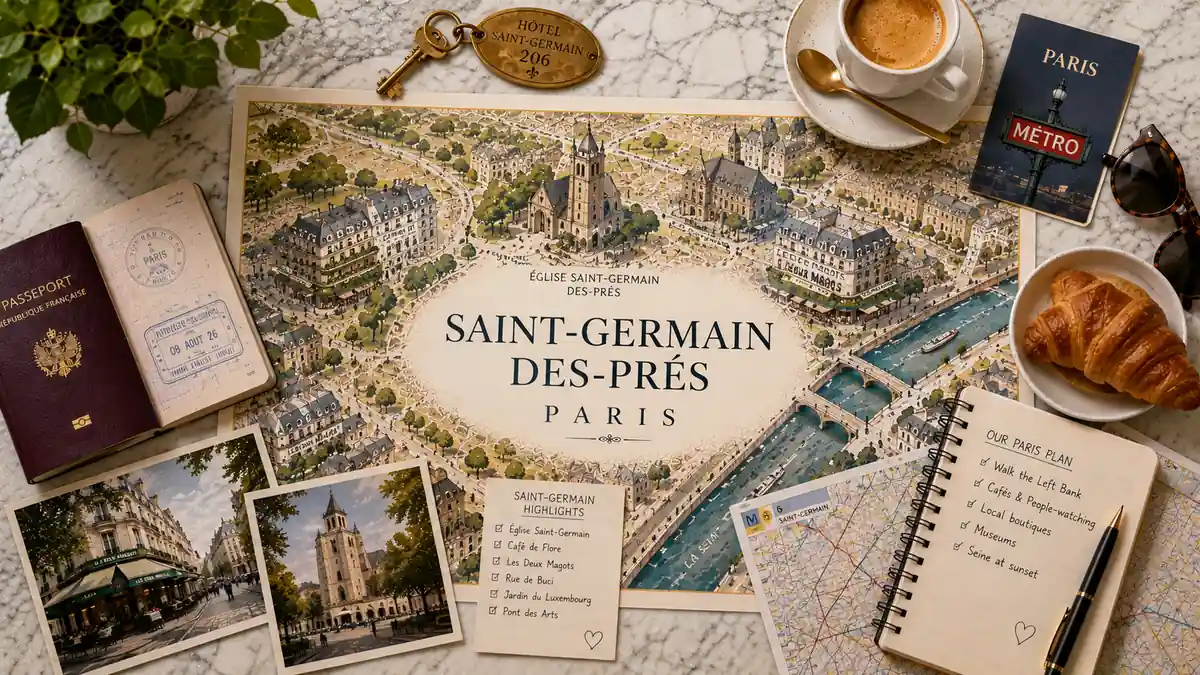
You are looking at a listing that says Saint-Germain, and the name is doing more work than you think. The quarter sits on the Left Bank, south of the Seine, mostly in the 6th arrondissement — but the label stretches across three arrondissements and covers two genuinely different districts. This guide resolves which version of the name a listing means, which pocket of the quarter to aim the pin at, and which streets actually sleep. It does not re-run the city-wide shortlist: the assumption here is that Saint-Germain is already on your map, and what is left to decide is where inside it you put your bed.
Quick Answer
Saint-Germain-des-Prés is a calm, polished, walkable Left Bank base in the 6th arrondissement, with expensive rooms and early evenings. The name is used at three sizes across three arrondissements, so verify where the listing actually sits. Aim the pin at one pocket and take a street one turn off Boulevard Saint-Germain if sleep matters.
Trust Layer
Tripstou stay guide for travelers choosing where to base. Covers area atmosphere, budget, convenience, noise, and traveler fit.
Produced with AI assistance and reviewed by Alex Perrut, working in tourism since 2015, for the Tripstou editorial team. See our editorial process for details.
Last factual review: August 7, 2026.
Official sources consulted: France.fr, Atout France.
Key Takeaways
- ‘Saint-Germain’ is used at three sizes across three arrondissements, so read the address before you trust the name.
- The quarter splits into five pockets that differ mainly in evening noise, so choose the pocket before the property.
- Saint-Germain sleeps early apart from the boulevard, rue de Buci and Odéon — one turn off them usually settles it.
- What the position buys is walking: the historic core on this bank on foot, the Right Bank across one bridge.
- Old buildings decide the room, so ask which way a window faces before you pay for the address.
Table of Contents
Where Is Saint-Germain-des-Prés in Paris?
Saint-Germain-des-Prés sits on the Left Bank of the Seine, in the 6th arrondissement of central Paris. It occupies the ground between the river and the Luxembourg gardens, with the Latin Quarter to the east and the 7th arrondissement to the west. Everything in this guide happens inside that rectangle.
The church that gives the quarter its name stands on place Saint-Germain-des-Prés, on the site of a 6th-century abbey, and it remains the point everything else is measured from. Walk north and you hit the quays and the bridges; walk south and you reach Saint-Sulpice and then the gardens; walk east and the addresses start belonging to another quarter.
Choosing between Paris areas in the first place comes down to how much you plan to walk, how central you need to be, and what the position costs you — that city-wide decision is resolved in our guide to where to stay in Paris. This page starts one level down.
Where Does ‘Saint-Germain’ Actually End?
‘Saint-Germain’ is used at three different sizes, and they span three arrondissements. One is the strict administrative quarter, one is the loose neighbourhood most people mean, and one is a separate district entirely. No booking site tells you which version a listing is using.
The strict version is small. As an administrative quarter, Saint-Germain-des-Prés is bounded by the Seine to the north, rue des Saints-Pères to the west, rue de Seine and rue Mazarine to the east, and rue du Four to the south. That perimeter is the narrowest honest reading of the name, and it takes in far less ground than most visitors picture.
The colloquial neighbourhood is larger, and sources disagree about how much larger. Some stretch it south past Saint-Sulpice to the Luxembourg gardens, some east to Odéon, some west across rue des Saints-Pères. The disagreement is itself the useful fact: there is no single agreed perimeter, which is exactly why a listing can stretch the name without saying anything untrue.
The Faubourg Saint-Germain is a different district altogether, in the 7th arrondissement. It lies west of the quarter: grand townhouses and ministries, a different fabric from the café streets around the church. A hotel there is entitled to the name it carries and is still not in Saint-Germain-des-Prés.
The eastern edge is simply where the label stops. Past rue de Seine and rue Mazarine, and certainly past the Odéon crossroads, addresses start belonging to the Latin Quarter in the 5th: the same short walk, a different name on the booking page.
The elasticity always pulls the same way — outward from the church, never toward it. A listing stretching the label is stretching toward the core it wants to borrow, so the further an address sits from place Saint-Germain-des-Prés, the more of the name is marketing.
How to Tell Which Saint-Germain Your Listing Is In
Three checks settle it before you pay, and none of them takes more than a minute.
- Read the arrondissement in the address before you read the name in the title. The 6th is the quarter, the 7th is the Faubourg side, the 5th is the Latin Quarter.
- Position the street against the named boundaries — the Seine, rue des Saints-Pères, rue de Seine and rue Mazarine, rue du Four. Inside them is the strict quarter; outside is a judgement call.
- Measure the walk to the church on place Saint-Germain-des-Prés. A few minutes on foot means the label holds in practice, whatever the perimeter says.
- Treat ‘Saint-Germain’ inside a property’s own name as branding. Plenty of hotels carry it legitimately from several streets away.
Which Part of Saint-Germain Should You Stay In?
Saint-Germain is not one uniform quarter — it splits into five pockets with different rhythms. They differ in noise, calm, walking distance to the river and how residential the streets feel after dark. One of the five is not even in the 6th arrondissement.
Landmarks below appear as orientation points for the pockets.
| Character | Arrondissement | Best for | |
|---|---|---|---|
| Place Saint-Germain-des-Prés & the Boulevard | Busiest and loudest, cafés around the church | 6th | Wanting everything within a two-minute walk |
| Rue Jacob to the Quays | Quiet grid of galleries and antique dealers | 6th | Central calm and the closest bridges |
| Odéon & Rue de Buci | Liveliest and latest streets in the quarter | 6th | Eating late without taking the metro |
| Saint-Sulpice & the Luxembourg Side | Calm, residential, shopping streets by day | 6th | Quiet nights with the gardens nearby |
| Rue du Bac & Sèvres-Babylone | Most residential, quietest evenings of the five | 7th | Undisturbed sleep with a longer walk east |
Place Saint-Germain-des-Prés & the Boulevard (6th Arr.)
This is the core, and the loudest place in the quarter to sleep. The church stands on the square, with Les Deux Magots, Café de Flore and Brasserie Lipp within sight of each other around the crossing. Staying here means never planning a route: the river, Odéon and Saint-Sulpice are all a few minutes off. It also means a boulevard that carries traffic and terrace noise long past dinner, so a street-facing window is a real commitment. Best for: travelers who want everything two minutes away and sleep through noise.
The Riverside Gallery Grid: Rue Jacob to the Quays (6th Arr.)
The strip between rue Jacob and the quays is the quietest central pocket in Saint-Germain. Rue Jacob, rue de Seine, rue Bonaparte and the small rue de Furstenberg run through a grid of galleries and antique dealers that shuts in the evening, which is precisely why the streets go still. The École des Beaux-Arts at 14 rue Bonaparte and the Delacroix museum at 6 rue de Furstenberg sit here as landmarks. You are also closest to the bridges. The trade is transport: several of these streets are a walk from any station. Best for: staying central without sleeping above a busy road.
Odéon & Rue de Buci (6th Arr.)
Odéon and rue de Buci are the liveliest and latest corner of the quarter. Rue de Buci keeps terraces busy after most of Saint-Germain has gone quiet, and the Odéon crossroads pushes traffic and voices through until late; rue Christine, one turn off it, is already a different kind of street. This pocket also bleeds east — a few streets past rue Mazarine and the address stops being Saint-Germain in any strict sense. Book here and you buy late convenience at the cost of the calm the quarter is known for. Best for: eating late on foot with no early start to protect.
Saint-Sulpice & the Luxembourg Side (6th Arr.)
South of the boulevard, around place Saint-Sulpice, the quarter turns calm and residential. Saint-Sulpice church anchors a square that empties in the evening, and rue Cassette and the streets running down toward the Luxembourg gardens are shopping streets by day and quiet by night. The metro station Saint-Sulpice, on line 4, sits right here, so calm costs you nothing in connection. What you give up is the river: the quays are a longer walk from this side than from the gallery grid. Best for: quiet nights with a park at the end of the street.
Rue du Bac & Sèvres-Babylone (7th Arr.)
Rue du Bac and Sèvres-Babylone are the most residential and quietest option — and they sit in the 7th arrondissement, not the 6th. This is where the label problem becomes concrete: listings here sell the Saint-Germain name from across the boundary, with Le Bon Marché as the local landmark. The streets are handsome, calm and genuinely lived-in, and the walk to place Saint-Germain-des-Prés is longer than from any pocket inside the 6th. Best for: putting residential quiet above being inside the quarter itself.
The pockets are small. Because everything in Saint-Germain is walkable from everything else, the choice is never really about access — what you are picking between is which street noise you inherit at eleven at night.
Is Saint-Germain-des-Prés Quiet at Night?
Mostly yes — the quarter goes quiet early, with three loud exceptions. Quiet here is a street-level property: the boulevard, rue de Buci and the Odéon crossroads stay awake while the side streets around them go still. One turn is usually all it takes.
That one turn does most of the work. Boulevard Saint-Germain carries traffic all evening and terraces well past dinner, but step a single street back into the grid behind it and the sound falls away, because those streets are narrow, residential and shuttered by then. The difference is immediate. It also matters more than which pocket you choose: a side street in the core beats a main road in the calmest pocket for sleep.
Quiet Streets to Look For — and the Loud Seams
These are the kind of street to look for. None of them is a promise of silence — any city street can surprise you on a given night.
- Rue Jacob and rue de Seine — narrow, gallery-lined, and closed up by evening
- Rue Bonaparte, on the stretch between the church and the river
- Rue Cassette, on the calm Saint-Sulpice side
- Rue Christine, one turn off the Odéon noise
- Rue du Pré aux Clercs, toward the western edge of the quarter
- Boulevard Saint-Germain — traffic and terraces, the loudest address in the quarter
- Rue de Buci — the terraces that run latest, loudest at weekends
- The Odéon crossroads — traffic, theatre crowds and late voices converging
A street that reads charming at eight in the evening is a different proposition at one in the morning, so judge Buci and the boulevard on their late hours instead of on photographs taken at dusk. On safety, the variable that actually changes street to street in Saint-Germain is noise, and the city-wide questions — including what a Paris trip costs overall — are handled in our complete guide to Paris.
Is Saint-Germain a Good Area to Stay In?
Yes, if you want calm, polish and central walking, and accept high prices and early evenings. The quarter trades energy for order: small hotels, gallery windows, café terraces that empty at a reasonable hour, and almost everywhere reachable on foot from the church. That suits some trips and starves others.
The texture is cafés, galleries, bookshops and small hotels packed into a few hundred metres. Les Deux Magots, Café de Flore and Brasserie Lipp sit around the church square, and the streets between rue Jacob and rue de Seine carry gallery and antique-dealer windows one after another — the reason the quarter reads as polished before it reads as lively.
Evenings follow that shape. Dinner runs late, the streets around it empty early, and by midnight most of the quarter is asleep apart from the seams. On a short trip that calm is a straightforward advantage: you sleep, you start early, and you are already in the middle of the city when you step out the door. On a longer stay the same quiet can feel like an early curtain, and evenings out tend to begin with a walk east or a bridge crossing.
The literary reputation — Sartre and de Beauvoir at the café tables of the post-war Left Bank — is a large part of why the address still commands what it does, and today it survives as atmosphere and price. The eastern edge carries a general student and academic presence spilling in from the neighbouring quarter, which shows up as slightly younger and later streets around Odéon and thins out as you move west.
Anyone can sit at those famous terraces for the price of a coffee. What staying here buys is waking up two minutes from them, with the streets to yourself before the day’s visitors arrive.
How Central Is Saint-Germain, Really?
Saint-Germain is genuinely central: most of the historic core is walkable from it. The Île de la Cité, the Latin Quarter, the Luxembourg gardens and the Musée d’Orsay in the 7th are all walks; the Louvre needs one bridge. Every pocket also has a metro station within a few minutes.
Walking is the real reason to book here. From the church you are a few blocks from the quays and the bridges, a few more from the Île de la Cité, and a short flat walk from either the 5th to the east or the gardens to the south. Nothing in that list requires a plan. Crossing a bridge opens the Right Bank — the Louvre and the Tuileries first — and adds little more than the width of the river to the walk.
Longer distances behave differently. The outer arrondissements, day trips out of the city and airport connections all start with the metro, and that is the point at which the station you sleep nearest starts to matter.
Centrality here is asymmetric: everything on this bank is a walk, and everything north of the river costs a bridge. A trip weighted heavily toward the Right Bank spends more of its day walking back than a Left Bank-weighted trip ever does — worth knowing before you decide the position is worth its price.
Which Metro Station Serves Which Pocket
Every pocket in this guide has a station within a short walk, and which one you are nearest matters more for late returns than for daytime sightseeing.
- Saint-Germain-des-Prés — the core, on the boulevard beside the church
- Mabillon — between the boulevard and the Buci streets
- Odéon — the Odéon crossroads and the eastern edge of the label
- Saint-Sulpice, on line 4 — the Saint-Sulpice square and the Luxembourg side
- Sèvres-Babylone — the western edge, toward Le Bon Marché
- Rue du Bac — the rue du Bac pocket in the 7th
The riverside gallery grid is the one pocket with no station sitting on top of it; Saint-Germain-des-Prés and Mabillon both serve it within a few minutes on foot.
What Are Hotels in Saint-Germain Actually Like?
Hotels in Saint-Germain are mostly small, polished properties inside old buildings. That stock decides more about your stay than the brand does: compact rooms, narrow staircases, small or slow lifts, and windows that face either a busy street or an interior courtyard. Ask which one before you book.
Old buildings set the terms. Rooms run smaller than the same rate would buy in a newer quarter, lifts are often tiny or stop short of the top floor, and light depends entirely on which side of the building you land on. None of that is a fault in any particular property — it is what a protected historic street can physically hold.
Aspect is the variable worth an email before booking. A courtyard-facing room in a building on Boulevard Saint-Germain can be quieter than a street-facing room three turns away, and a street-facing room on rue de Buci is a weekend gamble. Courtyard rooms usually pay for that quiet in light: many are darker and look onto a wall.
Hotel or apartment is the other structural choice. Apartments give you space and a kitchen in a quarter where eating out is consistently expensive; hotels give you lifts, daily service and someone at the desk. In this stock the trade is sharper than usual, because apartments in old buildings here often mean upper floors, steep stairs and no lift at all. Spend-wise the quarter runs mid-range to high-end with very little genuine budget stock, and at its lower end you are usually buying a smaller room in the same good position.
In this quarter the floor plan outranks the star rating. Two rooms in the same hotel, one facing the courtyard and one facing the boulevard, are effectively different bookings at the same price.
If what you actually want is a shortlist of properties at the top of the market — the grand hotels, the suites, the addresses people book by name — that is a different job, resolved in our guide to luxury hotels in Paris. This page stops at what the building will do to your stay.
Hotels and places to stay
Compare hotels, apartments and stays for your dates in one search.
Search hotels and stays on hotels.com →
Tripstou may earn a commission if you book through this link, at no extra cost to you.
Book Saint-Germain If — Book Elsewhere If
Book Saint-Germain if you intend to walk everywhere and want a quiet street to come back to. Book elsewhere if you need space for the money, a lift you can rely on, or an evening scene that runs past midnight outside your door. Both lists come down to physical conditions you can check.
Book here if:
- You will walk more than you ride, and want the historic core to start at your door.
- You sleep better on a narrow side street than on a main road, and are willing to book by street name.
- You want an early, quiet evening within two minutes of a busy one.
- You value polish and a small property over space and facilities.
- You are prepared to check an address against its arrondissement before you pay.
Book elsewhere if:
- You need a large room, a reliable lift or step-free access — the building stock fights all three.
- Your evenings run late and you would prefer the night to happen outside your door.
- You are travelling with heavy luggage and several flights of old stairs are a genuine problem.
- Weekend terrace noise would spoil the trip and you cannot confirm which way the room faces.
- You want to trade the address for space and facilities — that trade is unavailable inside this quarter.
The label check is the one step you cannot undo after booking. A room you dislike can sometimes be changed; a good room in the wrong arrondissement is an extra twenty-minute walk you take twice a day for the whole trip.
Whether the quarter fits your kind of trip is a separate question from whether it is a good quarter, and it is settled on the traveler pages instead of here. If you are weighing whether a first Paris trip should be based on the Left Bank at all, that is resolved in our guide to where to stay in Paris for the first time. The couples question turns on atmosphere as much as geography and is answered in where to stay in Paris for couples, while families weighing room size, lifts and park access against a central position should start with where to stay in Paris with kids.
Travelers who want the night to happen on their own street will get a direct answer in where to stay in Paris for nightlife, anyone working to a tight budget will find the areas that stretch it in where to stay in Paris on a budget, and the question of which areas concentrate the grand hotels is settled in where to stay in Paris for luxury.
If your shortlist has narrowed to two quarters, that side-by-side — noise, walking distances, building stock and label — is argued in full in Le Marais vs Saint-Germain.
Frequently Asked Questions
Why Is It Called Saint-Germain-des-Prés?
The quarter takes its name from the church on place Saint-Germain-des-Prés, which stands on the site of a Benedictine abbey founded in the 6th century. ‘Des-Prés’ means ‘of the meadows’, the open ground the abbey once sat in. It is among the oldest churches in Paris.
Is the Faubourg Saint-Germain the Same as Saint-Germain-des-Prés?
No. The Faubourg Saint-Germain is a separate district in the 7th arrondissement, west of the quarter, historically a suburb outside it. Hotels there carry the Saint-Germain name legitimately and still sit across the boundary. Check the arrondissement in the address, not the name in the title.
Is Saint-Germain the Same as the 6th Arrondissement?
No. Strictly, Saint-Germain-des-Prés is one of the four administrative quarters of the 6th arrondissement, bounded by the Seine, rue des Saints-Pères, rue de Seine and rue Mazarine, and rue du Four. In everyday use the name covers much more ground, and sources disagree about how much.
Is Boulevard Saint-Germain the Same as Saint-Germain-des-Prés?
No. Boulevard Saint-Germain is a long Left Bank street that runs through the quarter and continues well past its boundaries. An address on the boulevard can therefore sit outside Saint-Germain-des-Prés entirely. The street name settles which road you are on, never which quarter you are in.
Is Saint-Germain Expensive?
Yes, by Paris standards. The quarter sits mid-range to high-end with very little genuine budget stock, and eating out follows the same pattern. What the price buys here is position and polish rather than space, and there is no cheaper corner of the quarter to retreat to.
Related Guides
- Where to Stay in Paris — the city-wide area choice, if the quarter is not yet decided.
- Le Marais vs Saint-Germain — the head-to-head, once the shortlist is down to two.
- Where to Stay in Paris for the First Time — which base suits a first visit.
- Where to Stay in Paris for Luxury — which areas concentrate the top of the market.
- Luxury Hotels in Paris — actual properties at the top end, by name.
- Complete Guide to Paris — city-wide planning, costs and practicalities.
Did this guide save you time or money? Tripstou is independent and reader-funded — if you'd like to give something back, you can support the site with a crypto contribution of any size.