Two days in Paris works or fails on order, not on ambition. The city spreads across both sides of the Seine, and its icons sit far enough apart that a badly sequenced day loses an hour to backtracking and another to a queue you could have skipped. A 48-hour window cannot absorb either. This guide commits to one route built on one organising principle: the river splits the trip, with the Right Bank — everything north of the Seine — taking Day 1 and the Left Bank, to the south, taking Day 2. You also get the adaptation rules for when time shrinks, grows, or collides with a closed museum. If you are still choosing dates or getting your bearings, the broad Paris planning guide handles that layer. This page assumes the dates are set.
Quick Answer
Split Paris by the Seine: Right Bank icons on Day 1, the Eiffel Tower and Left Bank on Day 2. You walk within each block and take short metro hops between them — order matters more than sight count. Two days covers the icons for a first-timer; depth and day trips are what you give up.
Trust Layer
Tripstou itinerary guide for travelers planning a route. Covers pacing, stop count, stop order, base logic, and trip length.
Produced with AI assistance and reviewed by Alex Perrut, working in tourism since 2015, for the Tripstou editorial team. See our editorial process for details.
Last factual review: August 7, 2026.
Official sources consulted: France.fr, Atout France.
Key Takeaways
- Split the trip by the Seine — Right Bank on Day 1, Left Bank on Day 2 — to kill backtracking.
- Two days buys four half-day blocks: the icons, both banks and two interiors, never depth or day trips.
- Two full days on the ground needs three nights; a late arrival and early departure is not two days.
- Book one central base for both nights, walk inside each block, and use the metro only between them.
- Confirm every museum’s closing day before fixing which date is Day 1 — one shut door costs a quarter of the trip.
- When time shrinks, cut the second museum first; when it grows, add unhurried hours before adding another headline sight.
Table of Contents
Is 2 Days in Paris Enough?
Two days in Paris is enough for the icons and nothing more. You can walk the historic core, give one major museum a real visit, see the Eiffel Tower and cover both banks without sprinting. What you trade is depth, day trips, and the unstructured hours that make a city feel familiar.
The honest arithmetic is four half-day blocks. Two days on the ground gives you four usable halves, and each one holds either a district on foot or a major interior — never both. Paris has far more than four such blocks. That tension is the entire planning problem, and every decision further down this page exists to spend those four halves well.
The mistake that wrecks 48 hours in Paris is not picking the wrong sights. It is booking one interior too many, because every additional museum you enter is paid for with the walk between the ones you skipped — and the walking is where the city actually happens. Two great interiors across two days is the ceiling this route respects.
This trip suits first-timers, weekenders and stopover visitors above everyone else. Travelers who want museum depth, a Versailles day, or Montmartre evenings stacked on top of the core will find two days thin, because the route holds no spare block to donate. Anyone returning to Paris should ignore this sequence entirely and go deep on what they missed last time. Groundwork before you land — tickets, daily habits, first-day mistakes — sits in the first-time Paris tips.
How Many Nights Do You Need for Two Full Days?
Two full days in Paris needs three nights. Arriving on an evening flight and leaving after breakfast on the third morning gives you two complete days on the ground. Arriving mid-afternoon and flying out at midday does not — that combination is one day plus two fragments, and it will not carry this route. Transfer time is what eats the difference: getting in from the airport and back out again takes a real bite out of both edges of a short trip, and it always comes out of a sightseeing block, never out of sleep. The airport transport options cover which arrival route protects the most of your first day.
How to Split 2 Days in Paris: Right Bank, Then Left Bank
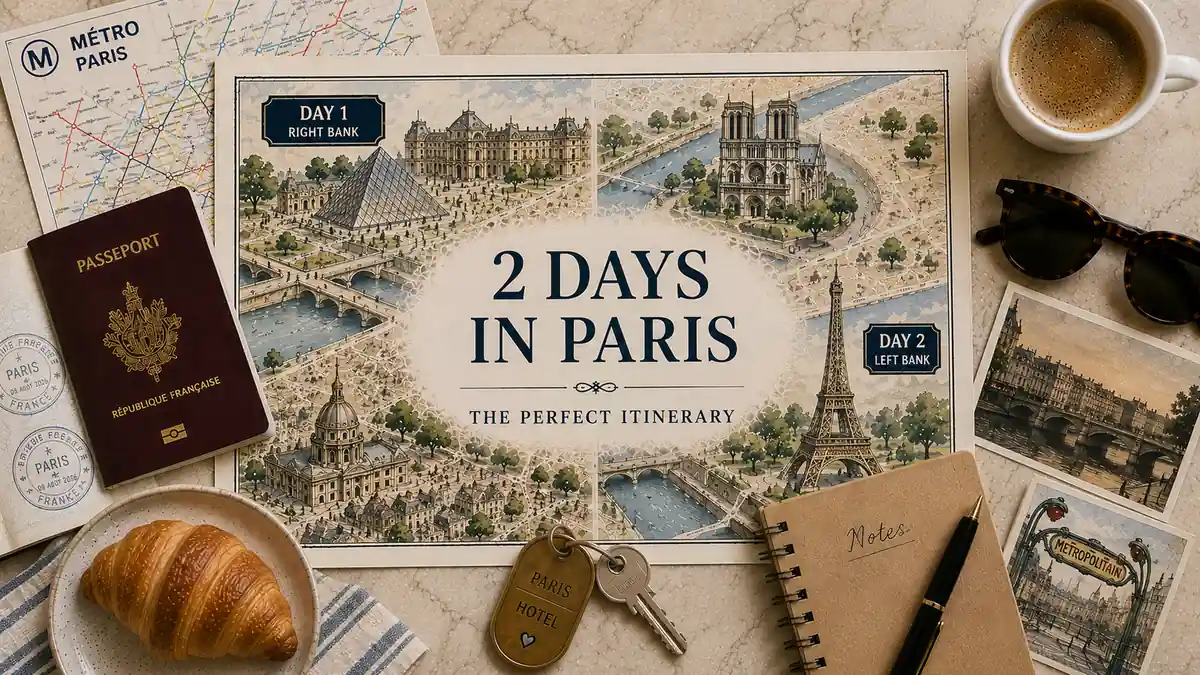
The split is geographic: Day 1 on the Right Bank, Day 2 on the Left. Grouping stops by side of the river, instead of by how famous each one is, removes almost all backtracking from a 48-hour trip. Each day then becomes a chain of neighbouring blocks you can walk.
Right Bank and Left Bank are simply the north and south sides of the Seine as it runs through the city. Parisians use the labels as shorthand for two different characters — monumental and grand to the north, older and denser to the south. For a two-day visitor, they matter for one practical reason: they tell you which sights cluster together.
Here is the route at a glance, one line per half-day block:
- Day 1 morning: Île de la Cité — the historic core
- Day 1 afternoon: The Louvre — the trip’s major interior
- Day 1 evening: Tuileries to the Arc de Triomphe — the ceremonial axis
- Day 2 morning: Eiffel Tower and Champ de Mars — the icon, taken first
- Day 2 afternoon: Musée d’Orsay — the second, smaller museum
- Day 2 evening: Saint-Germain and the Latin Quarter — the unticketed wind-down
The order inside each day follows the ground, not a ranking. Day 1 moves steadily west along one continuous line — island, museum, gardens, avenue — so no leg doubles back on itself. Day 2 moves east along the opposite bank, which means the trip finishes nearer the centre than it started and leaves the final evening walkable from almost any central base.
Running the two days in reverse works fine; running half of each day on each bank does not. An itinerary that crosses the river twice a day spends its best hour on bridges and metro stairs, and that hour is roughly what the bank split gives back to you.
Day 1: Île de la Cité, the Louvre and the Right Bank
Day 1 runs Île de la Cité, then the Louvre, then the Tuileries and the ceremonial axis west. It opens the trip because the historic core explains how Paris grew, and because these three blocks sit in a near-straight line along the Right Bank. You walk the whole day.
Start on Île de la Cité and give it the morning. The island is where the city began, it sits mid-river between the two banks, and walking it costs nothing. Notre-Dame is currently open to visitors with free entry, and a free optional online reservation is available to cut waiting — worth taking on a trip this short, since the alternative is queueing on your tightest morning. From the island, the Right Bank is one bridge away, which puts the Louvre within an easy walk before lunch.
The Louvre is Day 1’s major interior, and one interior is the limit. Give it the afternoon with a target — two or three wings, not the whole building — because a museum this size absorbs whatever time you hand it. The Louvre also closes one day a week, and that day is the pivot of the whole route. Check it on the museum’s own site first, and the rest of the sequence arranges itself around the answer.
Walk west from the Louvre through the Tuileries and finish on the axis toward the Arc de Triomphe. The gardens run directly off the museum’s western end, so the transition needs no transport and no decision. Keep this block loose. It is the one that absorbs whatever the Louvre overran by, and a metro hop covers the final stretch when legs give out. The island, the museum entrance and the Champs-Élysées are also the day’s three densest crowds, which makes them the day’s three best pickpocket opportunities — the Paris safety guide covers how to carry your things through them.
Day 2: The Eiffel Tower, Orsay and the Left Bank
Day 2 opens at the Eiffel Tower, moves to the Musée d’Orsay, and ends in Saint-Germain. It closes the trip on the bank you have not touched, and it takes the tower first because that is the one stop capable of swallowing a whole morning if it goes wrong.
Decide before the day starts whether you are going up the tower or only looking at it. Going up is a timed, queued commitment that can claim the morning; viewing it from Champ de Mars or the Trocadéro side takes a fraction of the time and delivers the image most visitors came for. That one choice determines whether Day 2 holds three blocks or two. From the tower, the south bank of the Seine runs east toward the Orsay — a pleasant walk at a stroll, a short metro hop when the morning has already run long.
The Musée d’Orsay is Day 2’s interior and the right counterweight to the Louvre: smaller, one collection, finishable in an afternoon without triage. It also carries a weekday closing day, and that constraint decides whether it can stay on Day 2 at all. Confirm the current closing day on the official site before you fix which of your dates is Day 1 and which is Day 2. A 48-hour trip offers no second slot to move it into.
End on foot in Saint-Germain and the Latin Quarter, immediately east and south of the museum. This block has no ticket, no queue and no closing day, which is precisely why it belongs at the end of a compressed trip — it flexes without breaking. If the day ran fast, it stretches into a long evening. If the Orsay ran long, it shrinks to an hour of walking and dinner, and nothing in the itinerary is lost.
Should You Stay in One Base for Both Nights?
Yes — book one central base for both nights and do not move. Changing hotels inside a 48-hour trip costs a check-out, a transfer and a check-in, which is most of a half-day block. Paris is compact enough at the centre that one well-placed base serves both banks comfortably.
At route level, the only requirement is this: your base should be central enough to reach both day blocks on foot or by one short metro ride. That is a lower bar than it sounds, because Day 1 and Day 2 both end near the middle of the city rather than at its edges. Anything that satisfies it will work for two nights.
Proximity to a good metro connection is worth more than proximity to any single landmark here, because you sleep beside one thing and visit six. Which area actually fits your budget and travel style is a separate decision with its own tradeoffs, resolved in the guide to where to stay in Paris. This route asks only that you choose one place and keep it.
Hotels and places to stay
Compare hotels, apartments and stays for your dates in one search.
Search hotels and stays on hotels.com →
Tripstou may earn a commission if you book through this link, at no extra cost to you.
Walking vs the Metro Between Blocks
Walk inside each block, take the metro between them. The route is built so every stop within a day sits within walking distance of the next, and the metro handles the long connections: base to first stop, bank to bank, and any leg your legs have stopped agreeing to. Both modes are load-bearing here.
Walking between the Louvre and the Tuileries is not transport on this route — it is the sightseeing. Swapping it for an underground ride saves a few minutes and deletes the best stretch of the afternoon. The same is true of the island, of the Left Bank streets between the Orsay and Saint-Germain, and of the riverside itself. These are the connective tissue the route is designed around.
The metro earns its place in three situations: the morning run from your base to the first stop, the crossing between banks at the start of Day 2, and any moment when weather or fatigue turns a pleasant walk into a slog. Use it without guilt in those cases. Tickets, passes and the mechanics of the network are covered in the Paris public transport guide; for this itinerary, all you need is the decision rule above.
Closing Days and Queues Can Break a 2-Day Route
One closed museum costs a two-day trip half its interior time. With four usable half-days and no reserve, there is no spare block to absorb a shut door or a long queue. Check the closing day of every ticketed anchor and book whatever can be booked before the route is locked.
The protective behaviour is small and takes minutes. It is also the difference between arriving with a route and arriving with a hope.
Which Museums Close on Which Days?
Paris’s major museums each close one weekday, and they do not all close on the same one. The Louvre, the Musée d’Orsay and most of the city’s other headline museums each go dark for a day, and those days do not line up into a rule you can memorise. Confirm each one on the museum’s official site before you decide which of your two dates becomes Day 1 — the closing days determine the day order, not the other way round. On a two-day trip the check is worth doing even if you are certain, because being wrong costs a quarter of the whole visit.
What to Book Before You Arrive
Book anything with timed entry before you leave home. Major Paris sites increasingly run on booked time slots, and a slot bought in advance converts a queue into an appointment — which on a 48-hour trip is the difference between two interiors and one. Notre-Dame is the clearest example of the principle: entry is free, and a free optional online reservation exists specifically to reduce waiting. The Paris Museum Pass is a separate calculation from booking, and what tickets and admissions add up to across two days belongs in the guide to what a Paris trip costs.
Tours and activities
Book skip-the-line tickets, day trips and local tours with free cancellation on most activities.
You can also browse everything on getyourguide.com.
Tripstou may earn a commission if you book through this link, at no extra cost to you.
How to Adapt This Route with More or Less Time
Cut the second museum first; add unhurried time before you add sights. The route’s spine is the historic core, one great museum and the Eiffel Tower, in that geographic order. Everything else is padding that can shrink, stretch or swap out without changing the fundamental shape of the trip.
- Cut first at one day: the Orsay and the Left Bank evening go. Keep Île de la Cité, the Louvre and a Trocadéro-side look at the Eiffel Tower — the spine survives on one bank plus a single river crossing.
- Add first with spare hours: depth, not distance. A second wing at the Louvre, a slower Latin Quarter evening, or a bridge crossing on foot at dusk all beat squeezing in a fourth headline sight.
- Swap for rain: move the interiors forward and the outdoor blocks back inside the same day. Each day already holds one ticketed indoor anchor, so a wet morning becomes a museum morning and the walking slides to the drier half.
- Swap for a closure: trade the two days whole, never their contents. If the Louvre’s closing day lands on your Day 1, run Day 2 first — the geography works identically in reverse.
| Time available | Pace | What it covers | What it gives up |
|---|---|---|---|
| One usable day | Forced march with no room for delay | The historic core and one major museum | The Left Bank and the tower up close |
| This two-day route | Brisk but walkable across four half-day blocks | Both banks, two interiors, the headline icons | Neighbourhood time, day trips, second-tier museums |
| Three days or longer | Unhurried, with one flexible block held spare | The icons plus a neighbourhood or a day trip | Very little inside central Paris itself |
A third day does not stretch this route — it unlocks what the bank split had to leave out, since Montmartre and the classic day trips both sit outside the two-bank spine. If your dates are still flexible, the 3 days in Paris itinerary is built around that extra block. At two days, adaptation means protecting the spine and letting the loose evening blocks absorb the damage.
Frequently Asked Questions
Is the Paris Museum Pass worth it for 2 days?
Usually not, on this route. The pass pays off when you enter several ticketed sites per day, and a two-day trip built around two interiors rarely reaches that count. Check how many of your chosen stops it actually covers before buying; on a longer, museum-heavy trip the maths flips.
Can you visit Versailles with only 2 days in Paris?
You can, but it consumes most of one of your two days. Getting out, queueing, walking the estate and getting back is a full-day commitment, which means dropping either the Left Bank or the Louvre. On a 48-hour first visit, the city itself is the better use of the time.
Can you do the Louvre and the Eiffel Tower on the same day?
Physically yes, but it wastes the advantage of the bank split. They sit on opposite sides of the Seine, so pairing them means a cross-city hop plus two queued entries in one day. If your dates force it, view the tower from ground level instead of going up.
Is a Seine river cruise worth it on a short Paris trip?
It is, if you treat it as an evening block instead of a sightseeing shortcut. A cruise covers a lot of riverfront with no walking, which suits tired legs at the end of Day 1 or Day 2. It will not replace a museum or a district, so do not budget it as one.
When is the best time of year for a short trip to Paris?
Shoulder seasons suit a 48-hour trip best. Fewer visitors means shorter queues, and on a route with no spare block, a queue you skip is time you keep. Long summer daylight helps the evening blocks but brings the heaviest crowds; winter shortens the usable day at the outdoor stops.
What should you do in Paris in 2 days if it rains?
Rain rarely costs you a block on this route. Each day already carries one ticketed indoor anchor, so the museums absorb the wet hours and the street walking waits for the dry ones. The one thing rain genuinely damages is the Eiffel Tower view, which is worth moving within Day 2 instead of cancelling.
Related Guides
These guides settle the decisions this route treats as fixed, and carry the execution detail it deliberately keeps out.
- Paris travel guide — broad planning, orientation and when to come.
- 3 days in Paris — the longer route and the block a third day unlocks.
- Where to stay in Paris — choosing the central base this route assumes.
- Getting around Paris — tickets, passes and how the metro network works.
- Paris airport transfers — arrival routes and protecting a short first day.
- Paris trip cost — what admissions, passes and two days add up to.
- Paris travel tips — first-timer practicalities before you arrive.
- Is Paris safe? — crowds, pickpockets and how the city feels at night.
Did this guide save you time or money? Tripstou is independent and reader-funded — if you'd like to give something back, you can support the site with a crypto contribution of any size.