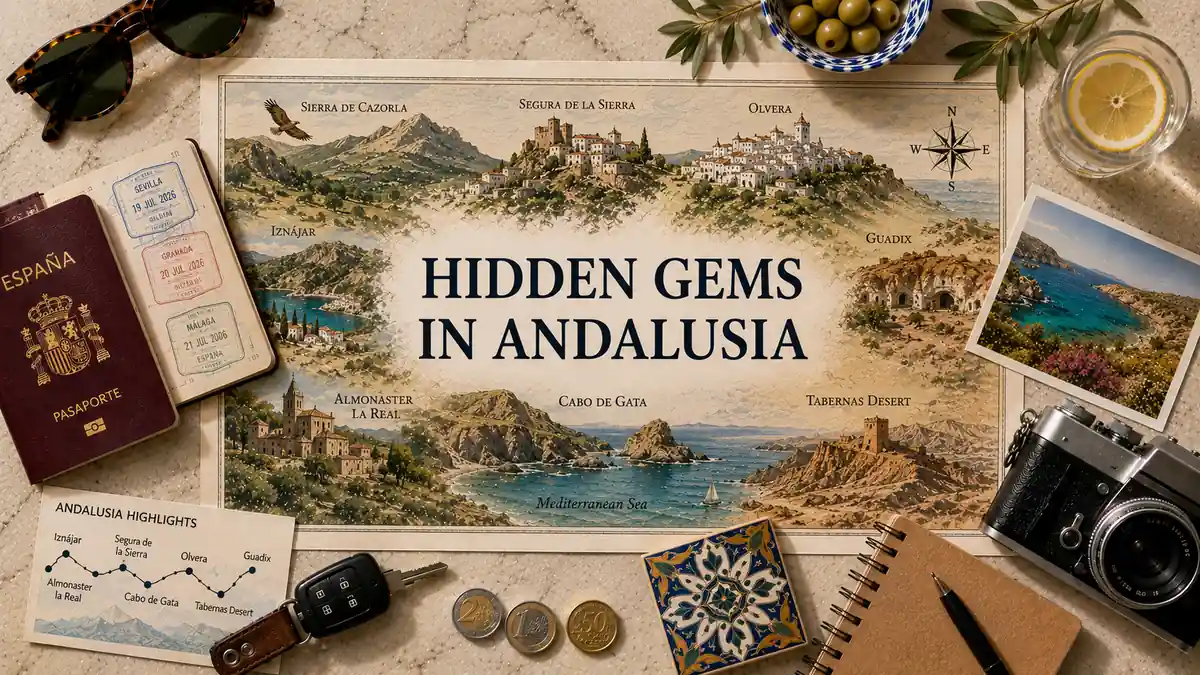
You already have Andalusia on the itinerary — probably Seville, Granada, and Málaga — and now you want places most visitors skip. The problem is that half the internet’s “hidden gems” lists have gone commodity. Setenil de las Bodegas, Frigiliana, and Ronda show up on every roundup, arrive by the coachload, and no longer count as hidden by any honest measure. This guide takes a stricter line. Every pick below is a genuinely lesser-known town, village, or wild corner, grouped by landscape so you can see where each fits. For each one you get the single reason it earns a slot and who it suits — not an adjective pile. The goal is simple: give you a shortlist you can add to a trip, or swap in for a city you were lukewarm about anyway.
Quick Answer
Andalusia’s best lesser-known destinations cluster in its quiet provinces — Jaén, Almería, and Huelva. Standouts include the white village of Olvera, the cave city of Guadix, and the wild coast of Cabo de Gata. Treat them as add-ons or substitutes for the famous circuit, and rent a car to reach them easily.
Trust Layer
Tripstou selection guide for travelers choosing between multiple places. Covers selection criteria, traveler fit, and trip value.
Produced with AI assistance and reviewed by Alex Perrut, working in tourism since 2015, for the Tripstou editorial team. See our editorial process for details.
Last factual review: July 18, 2026.
Official sources consulted: Spain.info, Turespaña.
Key Takeaways
- Olvera and Guadix stand out as the strongest hidden picks — a classic white village and a working cave city.
- Choose quiet white villages like Iznájar for slow wandering, or wild sites like Cabo de Gata for empty-landscape scenery.
- Andalusia’s least-touristed corners are Jaén, Huelva, and inland Almería — the quiet flank the tour circuits skip entirely.
- Rent a car — most hidden gems sit where public transport is sparse and hard to rely on.
- Treat these picks as add-ons to the famous circuit; none truly replaces Seville or Granada’s monuments.
- Visit arid picks like Tabernas and Cabo de Gata in spring or autumn — summer heat there is brutal.
Table of Contents
What Makes a Place Genuinely Hidden in Andalusia
A place is genuinely hidden in Andalusia when it stays off the standard circuit yet still rewards the detour. That means real obscurity plus a concrete reason to go — not just distance from a city. By this bar, Setenil, Frigiliana, and Ronda no longer qualify; they are semi-famous now, and busy for it.
Three tests separate a true hidden gem from a semi-famous one on this page:
- It rarely shows up on English-language “best of Andalusia” lists.
- It has one defining feature — a landscape, a monument, a way of life — that justifies the drive.
- It stays walkable and un-staged: no tour-bus car park, no souvenir gauntlet.
The semi-famous trap is worth naming plainly. Ronda and Frigiliana are beautiful; they are also on every coach route out of the Costa del Sol, which is exactly why they fell off this list. Fame is not permanent, though — a village that is quiet today can trend tomorrow, so treat every “hidden” label as a snapshot, not a guarantee.
The reliable signal of obscurity in Andalusia is not remoteness but province. A town an hour from Seville can be busier than a small city three hours east in Jaén, because the tour circuits follow the famous cities, not the map. If you want the whole country instead of one region, the hidden gems across the rest of Spain widen the net without repeating these picks.
Andalusia’s Least-Touristed White Villages
Olvera is the standout among Andalusia’s least-touristed white villages — a hilltop pueblo crowned by a castle. It rewards the climb with wide views and quiet streets, and almost none of the crowds that swamp the famous ones. The rest of the group — Iznájar, Almonaster la Real, Segura de la Sierra — trades fame for room to breathe.
Olvera
Olvera rises on a hill above olive country in Cádiz province, its white houses stacked under a Moorish castle and a large neoclassical church. It made the list because it delivers the classic white-village silhouette with a fraction of the foot traffic of the honeypots to the south.
What sets Olvera apart from the other villages here is its position on the Vía Verde de la Sierra, a former railway line converted into a walking-and-cycling greenway through tunnels and viaducts — a genuine reason to stay past lunch.
- Pick this if: you want a photogenic white village with a ready-made half-day walk or ride attached.
Iznájar
Iznájar sits on a promontory above a large reservoir in Córdoba province, which gives it something most white villages lack — a waterfront. The old town wraps a hilltop church and castle, while the lake below draws almost no international visitors.
Where the other picks are dry-country hill towns, Iznájar pairs the whitewashed streets with swimmable inland water and a small beach zone in summer, closer in feel to a lakeside village than a mountain pueblo.
- Pick this if: you want a white village where you can also swim on a hot afternoon.
Almonaster la Real
Almonaster la Real hides in the wooded Sierra de Aracena in Huelva province, one of Andalusia’s greenest and least-visited corners. It earns its slot for a rare survivor: a small rural mosque, its horseshoe arches intact, standing on the hill above the village.
No other pick here offers an intact caliphal-era mosque in a mountain-village setting, ringed by chestnut and cork-oak forest rather than dry olive slopes — the landscape alone marks Huelva’s sierra out from the rest of the region.
- Pick this if: you want deep-green sierra scenery and Moorish history without another crowd in sight.
Segura de la Sierra
Segura de la Sierra crowns a peak deep in eastern Jaén, at one of the highest village settings in Andalusia. It made the list for its castle-topped skyline and the sheer remoteness that keeps visitor numbers low.
What distinguishes Segura is altitude and isolation: it sits inside one of Spain’s largest protected natural parks, so the village comes wrapped in mountain wilderness instead of farmland — a wilder frame than any other white village here.
- Pick this if: you want a mountaintop village buried inside a national-scale nature reserve.
The white villages that stay quiet share one thing: none is on a coach route from the coast. Olvera and Iznájar are reachable enough to fill a morning; Almonaster and Segura ask for real driving commitment, which is precisely what keeps them empty. These villages reward slow wandering more than a checklist, but if a pick tempts you into hiking, festivals, or food, what to do across Andalusia covers the experiences in depth.
Underrated Small Cities Worth a Detour
Guadix is the strongest of Andalusia’s underrated small cities — thousands still live in its cave houses. These places hold a full day of sightseeing yet stay off the standard circuit, usually because none has a single blockbuster monument. What they offer instead is lived-in character and room to explore without a queue.
Guadix
Guadix spreads across a valley in Granada province, backed by eroded badlands where whole neighborhoods are carved underground. It made the list for the Barrio de las Cuevas — one of Europe’s largest inhabited cave quarters, still lived in, not staged for tourists.
Guadix is the only pick where the main draw is a way of living rather than a building: chimneys poke from grassy hillsides above homes cut straight into the rock.
- Pick this if: you want to see a working troglodyte quarter, not a museum reconstruction.
Priego de Córdoba
Priego de Córdoba sits at the foot of a sierra in southern Córdoba province, its old quarter dense with elaborate baroque churches and fountains. It earns a slot as one of Andalusia’s richest baroque ensembles that almost no international visitor reaches.
Where the other small cities trade on landscape or antiquity, Priego is about ornate stonework at close quarters: the Barrio de la Villa is a warren of whitewashed lanes opening onto a dramatic clifftop balcony over the countryside.
- Pick this if: you love intricate architecture and want it without a tour group between you and the facade.
Cabra
Cabra lies near the geographic centre of Andalusia in Córdoba province, a modest town most guidebooks skip entirely. It makes the list as a genuine local base among limestone hills, with a spring-fed source and a sanctuary perched above the town.
Cabra is the least monument-driven pick here, and that is the point: it offers ordinary Andalusian small-city life and easy access to the Sierras Subbéticas, a quiet limestone park of gorges and olive groves.
- Pick this if: you want an unpolished, everyday town as a base for nearby limestone-country walks.
Loja
Loja guards a river gorge between Granada and Málaga, a strategic old town that travelers race past on the motorway without stopping. It earns its place for a hilltop Moorish fortress, a maze of medieval streets, and waterfalls on its doorstep.
Loja stands out for its water: the Riofrío and nearby cascades give it a lush setting unusual among inland Andalusian towns, and its fortress quarter stays almost entirely local.
- Pick this if: you want an easy off-motorway stop between Granada and Málaga with a fortress and waterfalls.
Niebla
Niebla sits on the plain west of Seville in Huelva province, wrapped almost entirely by intact medieval walls of Moorish origin. It made the list for those ramparts — a near-complete circuit you can walk, rare in a region where many defences are ruins.
No other pick is so fully enclosed by its own fortifications: Niebla is essentially a walled town, its reddish gates and towers ringing the whole settlement among vineyards and citrus.
- Pick this if: you want to walk a complete medieval wall circuit far from any tourist crowd.
These small cities pay off in inverse proportion to their billing: the less a place is known for one famous sight, the more its everyday streets stay authentically local. Guadix and Niebla give you a headline feature; Cabra and Loja reward travelers happy to just be somewhere real.
Wild Landscapes and Quiet Coast Most Visitors Miss
Cabo de Gata is the wild corner most visitors miss — a volcanic coast of empty coves. Andalusia’s quietest landscapes stretch from that desert coastline to inland karst and true desert, all well away from the beach resorts. Each rewards a detour for scenery that never appears on the standard city circuit.
Cabo de Gata
Cabo de Gata occupies Almería’s southeastern tip, a protected natural park where volcanic cliffs drop to some of Spain’s most undeveloped beaches. It made the list because it is the mainland’s driest, emptiest stretch of Mediterranean — coves reachable only on foot, no high-rise skyline behind them.
Unlike the region’s built-up costas, Cabo de Gata has almost no resort development, so its beaches stay wild and its old fishing villages small. The flip side is heat and exposure: shade and services are thin, so summer midday visits ask for planning.
- Pick this if: you want undeveloped Mediterranean beaches and can handle a landscape with few facilities.
El Torcal
El Torcal rises just south of Antequera in Málaga province, a protected karst upland of limestone stacked into surreal, weathered towers. It earns its slot as one of Europe’s most striking karst landscapes, walkable on marked trails yet oddly overlooked by city-focused visitors.
What sets El Torcal apart is the rock itself: eroded limestone pillars that look stacked by hand, with ibex picking across them and long views to the coast on clear days. It works well as a half-day nature stop between Málaga and the interior.
- Pick this if: you want dramatic, easily walked rock scenery within reach of a major city.
Tabernas
Tabernas, inland from Almería, is mainland Europe’s only true desert — a badlands of dry ravines and ochre hills. It made the list for that rarity and for its film history: the arid basin doubled as the American West in classic spaghetti westerns, and film sets still stand.
No other pick is a genuine desert, and that shapes everything: sparse scrub, eroded gullies, and fierce summer heat that makes spring and autumn the sensible seasons to visit.
- Pick this if: you want a one-of-a-kind desert landscape and a dose of western-film nostalgia.
Río Tinto
The Río Tinto mining basin, in northern Huelva province, is a surreal landscape of blood-red water winding through scarred, mineral-stained hills. It made the list because nothing else in Andalusia looks like it — the acidic river runs deep red and orange, the product of ancient and industrial-era mining.
This is the only pick that trades on industrial and geological strangeness instead of pretty villages or beaches: the terraced open-cast pits and Mars-like river draw geologists and photographers, not tour buses.
- Pick this if: you are drawn to strange, otherworldly landscapes over conventional pretty scenery.
Andalusia’s wild sites split cleanly by season, not by scenery. The desert and dry coast — Tabernas and Cabo de Gata — punish summer visitors, while a karst upland like El Torcal stays comfortable when the lowlands bake. Plan the arid picks for spring or autumn and you roughly double the experience.
Where Andalusia Gets Quietest: Jaén, Almería, Huelva
Jaén is Andalusia’s quietest province, followed closely by Huelva and inland Almería. Together they form the region’s quiet flank, drawing a fraction of the visitors who fill the Seville–Granada–Málaga triangle. They share one trait — no single headline city — so the tour circuits skip them, which is exactly why the picks above cluster here.
Each quiet province suits a different traveler:
- Jaén — endless olive country, mountain nature parks (Cazorla, Segura), and Renaissance towns; best for slow, car-based exploring.
- Huelva — green sierra villages inland, wild Atlantic marshland and beaches on the coast; best for nature and forest scenery.
- Almería — desert, volcanic coast, and film-set badlands; best for stark, cinematic landscapes and empty beaches.
None of these provinces makes a natural first trip to Andalusia; they are what you add once the headline cities are behind you. Point yourself at the specific picks above instead of trying to “do” a whole province — the quiet flank rewards depth over coverage.
Hidden Picks That Beat — or Add To — the Famous Cities
No hidden pick truly replaces Seville or Granada, though Guadix comes closest as a substitute. Most of these places work best as add-ons — a spare day or two bolted onto the famous circuit. Few can carry a trip on their own. The exception is travelers who have already seen the big cities and now want somewhere quieter to slow down.
The substitute-or-add-on call comes down to what you would be giving up:
- As substitutes: Guadix stands in loosely for Granada’s Moorish-and-cave texture, and Priego de Córdoba offers the ornate-old-town feel some travelers chase in Córdoba — minus the Mezquita, which nothing replaces.
- As add-ons: the wild sites (Cabo de Gata, El Torcal, Tabernas) and the walled town of Niebla slot into a city trip as day or overnight detours without competing with the headline sights.
Be honest about the trade. The famous cities earn their fame — their monuments have no hidden equal, and Spain’s famous headline destinations are worth seeing at least once. Hidden gems buy you quiet and character, not blockbuster architecture.
Substitution works at the level of atmosphere, and stops at the level of landmarks. You can trade Granada’s cave-and-Moorish mood for Guadix, but the Alhambra itself has no understudy anywhere in Andalusia. If you are still assembling the trip and want to see how these picks fit around the classics, the full Andalusia planning guide handles routing and timing.
Frequently Asked Questions
Do you need a car to visit Andalusia’s hidden gems?
Yes, a car is strongly recommended for most of Andalusia’s hidden gems. Many sit in the quiet provinces of Jaén, Almería, and Huelva, where public transport is sparse and infrequent. Villages like Segura de la Sierra and natural sites like Cabo de Gata are difficult to reach and explore without your own wheels.
When is the best time to visit lesser-known Andalusia?
Spring and autumn are the best times to visit lesser-known Andalusia. Both bring mild temperatures ideal for walking hill villages and exploring open landscapes. Avoid high summer for the arid picks — Tabernas desert and Cabo de Gata turn punishingly hot — while the green sierras of Huelva stay comfortable year-round.
Can you visit Andalusia’s hidden gems as day trips from Seville or Málaga?
Some can, but many are too far for a comfortable day trip. Olvera, El Torcal, and Loja sit within reach of Málaga or Granada for a full-day excursion. The remote picks — Cabo de Gata, Segura de la Sierra, Río Tinto — reward an overnight stay over a rushed round trip.
Are Andalusia’s hidden villages worth it over the main cities?
For a first trip, no — see Seville, Granada, and Córdoba first. Their Moorish monuments have no hidden equal anywhere in the region. Andalusia’s lesser-known villages reward travelers who have already covered the headline cities and now want quiet, character, and space, or who have spare days to spend.
Do Andalusia’s hidden villages have anywhere to stay overnight?
Yes, most hold at least small guesthouses, rural hotels, or casas rurales, though choice is limited in the smallest villages. Larger picks like Guadix and Olvera offer more rooms, while remote spots may have only a handful. Book ahead in peak season, and treat nearby small cities as fallback bases.
Which Andalusian hidden gem is best for avoiding other tourists entirely?
Segura de la Sierra, Almonaster la Real, and the Río Tinto basin see the fewest visitors. All sit deep in Andalusia’s quiet provinces, far from any coach route or headline city. Their remoteness is exactly what keeps them empty, so expect thin services in exchange for near-total solitude.
Related Guides
- Full Andalusia planning guide — routing, timing, and how the region fits together.
- What to do across Andalusia — the experiences behind the places.
- Spain’s famous headline destinations — the classic circuit these picks add to.
- Hidden gems across the rest of Spain — underrated destinations beyond Andalusia.
Did this guide save you time or money? Tripstou is independent and reader-funded — if you'd like to give something back, you can support the site with a crypto contribution of any size.