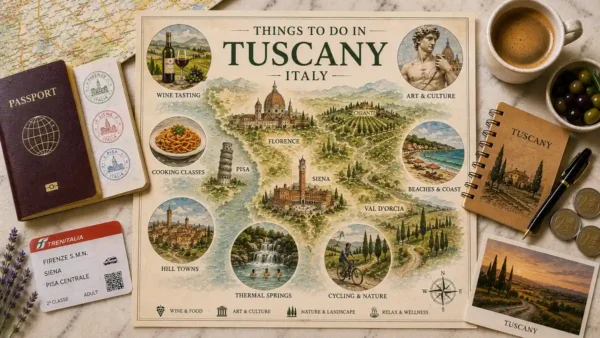
Tuscany is worth it for a first trip to Italy if you want Renaissance art cities and rolling countryside, with food and wine, in one compact region. Before you travel to Tuscany, settle trip length first: it decides how many bases you use and whether you need a car. The default that works for most first trips is Florence first, then one countryside base, with a car only for the countryside leg.
The page starts with that verdict, then walks through the four parts of the region, and then through days, bases and the car question.
Decide These First
- Start in Florence for the art and the rail connections, then move once to a base in Chianti or around Siena and the Val d’Orcia.
- Five to seven days fits Florence plus one countryside area without rushing; three or four days keeps you to cities on the train line.
- One base works for a trip under about a week, but once you add countryside, a second base beats driving out of Florence every morning.
- Trains cover the cities, while Chianti and the Val d’Orcia need a car, a regional bus or a tour, so rent a car for the countryside leg only.
- April to June and September to October give the easiest balance of weather, open places and crowds.
- Where you sleep and whether you drive decide most of the budget: city bases and trains keep it low, countryside villas and a rental car push it up.
Tuscany Is Worth It When You Want Art Cities and Countryside Together
Tuscany earns its reputation by putting world-class art cities and slow countryside within easy reach of each other. It suits a trip built on museums, landscape and long meals. It suits a beach-only holiday or a nightlife trip far less: the coast is a pleasant add-on here, not the reason to come.
The mix is unusually dense. Italia.it lists the historic centres of Florence, Siena and San Gimignano as UNESCO World Heritage sites, along with the cultural landscape of the Val d’Orcia and the Medici Villas. Few Italian regions pack that much protected heritage so close together.
The trip itself is a slow one. You pick a base, explore around it, and let lunch run long. Much of what people remember is food- and wine-led: a tasting at a Chianti estate, a soak in thermal baths, a cooking class. The full range of those experiences sits in our guide to things to do in Tuscany.
The Strongest First Trip: Florence, Then One Countryside Base
Most first-timers get the most out of Tuscany by starting in Florence and then moving to one base in Chianti or around Siena and the Val d’Orcia. Florence is the arrival point, the rail hub and the art capital; the second base gives you the countryside the trains never reach.
The art is why nearly every trip begins in Florence: the Duomo anchors the old centre, and the Uffizi holds the Renaissance paintings most visitors come for (reserve Uffizi entry). Michelangelo’s David stands in the Accademia, and the big museums run on timed entry, so book a timed ticket well before you arrive.
The second base is what turns a Florence trip into a Tuscany trip. Vineyard roads, hill towns and cypress-lined valleys are the part of the region public transport serves worst. Moving once costs you half a day of packing and driving. Staying put in Florence and commuting out every morning costs far more, because every countryside day then starts and ends with a long drive.
Tours and activities
Book skip-the-line tickets, day trips and local tours with free cancellation on most activities.
You can also browse everything on getyourguide.com.
Tripstou may earn a commission if you book through this link, at no extra cost to you.
Chianti, Val d’Orcia or the Coast: Which Part of Tuscany Fits You
Tuscany splits into four travel choices: the art-city corner around Florence, Pisa and Lucca; Chianti; Siena with the Val d’Orcia; and the coast with its islands. First-timers usually pair the first with one of the next two. The coast is the one to save for a longer or summer trip.
Florence, Pisa and Lucca: the art-city corner
The north-west corner is the easiest part of Tuscany to travel, because its cities sit on direct train lines from Florence. Florence is the natural base. Lucca, enclosed by its walls and noticeably calmer, works well if you would prefer a quieter evening stay and do not mind a train ride to the bigger museums. Pisa often fits as a short stop on the way in or out; our Pisa travel guide covers what deserves the time. You need no car anywhere in this corner, and having one is mostly a parking problem.
Chianti: vineyards between Florence and Siena
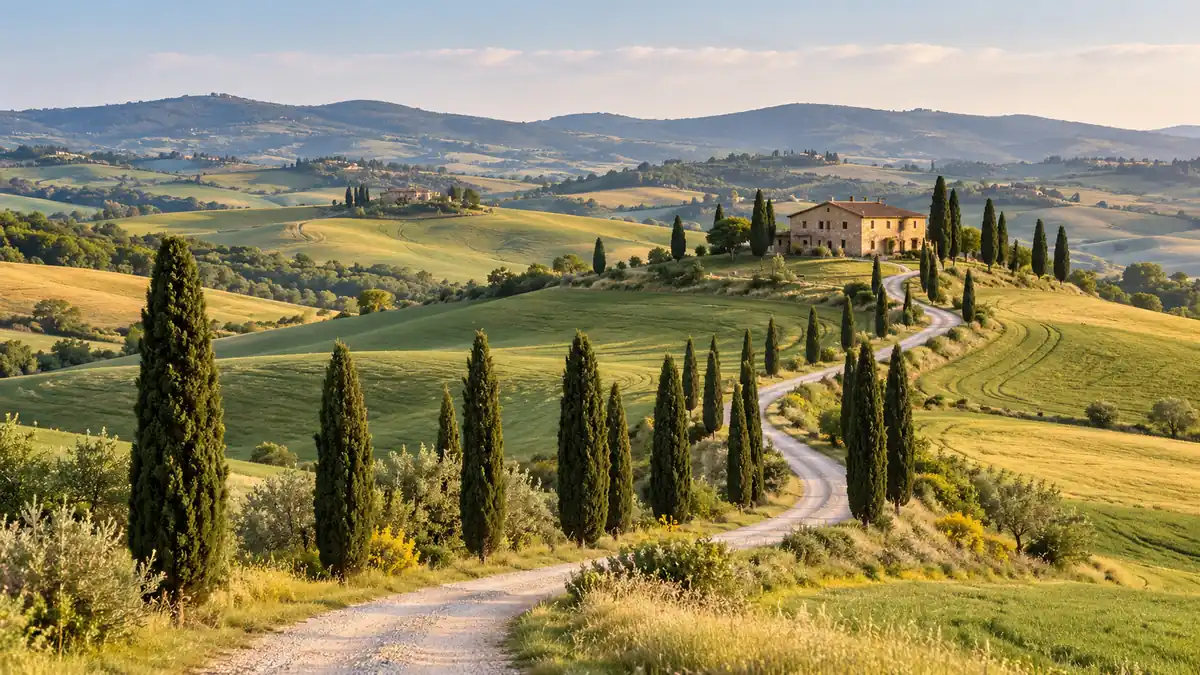
Chianti is the wine country that fills the hills between Florence and Siena, a landscape of vineyards, olive groves and small stone villages. Its anchor experience is simple: drive a winding road, stop at an estate for a tasting, eat lunch on a terrace. A village such as Greve in Chianti makes a good base, within reach of Florence for a day back in the city. Trains do not serve these villages, so plan on a car or an organised tour. Chianti rewards people who measure a good day in landscape and wine, not in sights ticked off.
Siena and the Val d’Orcia
- Siena is the city base for the south: a medieval centre listed by UNESCO. Its station sits outside the old town, so allow for the last stretch up into the centre when you arrive. Our guide to Siena covers the city itself.
- The Val d’Orcia is the Tuscany of postcards: rolling hills, cypress roads and hilltop Pienza, all inside a UNESCO-listed landscape. Pienza has no train, so the valley is car or bus country.
- Palio days fall on 2 July and 16 August, when Siena hosts its horse race. Rooms fill and the centre packs out, which is either the reason to come or a date to avoid.
The coast, the Maremma and Elba
The coast is an add-on for long or summer trips. The Maremma pairs its coastline with wild, thinly settled countryside. Elba is reached by ferry from Piombino. Many coastal places close out of season, so this corner suits a summer itinerary and makes little sense in winter.
Beyond these four areas, Arezzo, Volterra and the smaller hill towns reward a second visit, and the region’s quieter corners are gathered in our list of hidden gems in Tuscany.
How Many Days Do You Need in Tuscany?
Five to seven days is the sweet spot for a first trip to Tuscany: enough for Florence plus one countryside area without rushing. Three to four days covers Florence and one or two cities you can reach by train. Ten days or more lets you add the coast, Elba or a slower look at the south.
| Trip length | What it covers | Bases | Car? |
|---|---|---|---|
| 3–4 days | Florence plus Pisa, Lucca or Siena by train | One (Florence) | No |
| 5–7 days | Florence plus Chianti or Siena and the Val d’Orcia | Two | Countryside leg only, or bus and tours |
| 10+ days | Adds the coast, the Maremma or Elba, or a slower south | Two or three | Most of the trip |
The short tier works for a city break or a stop on a wider Italy trip. The middle tier is the one most first-timers should aim for. The long tier pays off for repeat visitors and anyone who wants the coast in summer. For day-by-day plans that slot Tuscany into a wider route, use our Italy itinerary.
One Base or Several in Tuscany?
Use one base for trips under about a week: Florence if you travel by train, Siena if you want to lean south. Once you add countryside, switch to two bases, one in a city and one in the hills, because Chianti and the Val d’Orcia are slow to reach every day from Florence.
The choice comes down to packing versus commuting. A single base means unpacking once but spending part of each countryside day in transit. Two bases cost one moving day but put the vineyards and hill towns on your doorstep. A third base only makes sense on a long trip that adds the coast.
Countryside stays tend to be agriturismi (working farms that rent rooms) or rural holiday rentals. Both assume you have a way to get around, which is the next decision.
Hotels and places to stay
Compare hotels, apartments and stays for your dates in one search.
Search hotels and stays on hotels.com →
Tripstou may earn a commission if you book through this link, at no extra cost to you.
Do You Need a Car in Tuscany?
You do not need a car for the cities: Florence, Pisa, Lucca, Siena and Arezzo all sit on direct trains. You do need one for Chianti and the Val d’Orcia, unless you rely on buses or tours. The best plan for most trips is to rent a car for the countryside leg only.
- Train: the easy way to move city to city from the Florence hub. It misses the hill towns entirely, since Volterra, San Gimignano, Monteriggioni and Pienza have no station.
- Regional bus: Autolinee Toscane runs the regional network and reaches many hill towns, with tickets sold through the at bus app. It works for a car-free trip, but journeys are slower and rural timetables are thin.
- Rental car: the freedom option for vineyards and back roads. Its cost is parking and the camera-enforced limited-traffic zones in historic centres, covered in the questions below.
- Organised tour: a wine-country day with someone else at the wheel, which is the only way everyone at a tasting gets to taste.
Taxis in Tuscany are taken at ranks or booked by phone; you cannot reliably hail one in the street.
Getting Into Tuscany: Pisa, Florence or the Train
Fly into Pisa or Florence, or arrive by train on the main line that crosses Tuscany between Rome and Naples to the south and Bologna and Milan to the north. Anyone coming from Rome or Venice usually arrives by rail, straight into Florence.
Pisa Galileo Galilei is the larger gateway, linked to Pisa’s main station by a quick shuttle train. Florence Airport (Amerigo Vespucci, also called Peretola) sits much closer to the city. A second rail line runs down the coast through the Pisa and Livorno side of the region. Livorno and Piombino are the main ports, and Piombino is where the Elba ferries leave.
Should Tuscany Be Its Own Trip or Part of a Rome and Venice Route?
Both work. As an add-on, Florence slots neatly between Rome and Venice on the main rail line, with a few countryside days on the side. As a standalone trip of a week or more, Tuscany suits anyone after slow countryside time, food and wine instead of city-hopping.
First-time visitors to Italy get a strong introduction here, since the art and the landscape are both on the classic list. Couples tend to love the hill-town evenings. Food-and-wine travelers can build a whole week around estates and trattorias. Families do well when they keep to one or two bases and resist moving every night. Anyone whose idea of a holiday is a beach first and everything else second will be happier in a coastal region further south.
For how Tuscany fits into the rest of the country, start with our Italy travel guide, and compare it with other regions in best places to visit in Italy.
Spring and Early Autumn Are the Easiest Times for Tuscany
April to June and September to October give Tuscany its best balance of weather, open places and manageable crowds. Summer is the busiest and hottest season. Winter is quiet, with some countryside and coastal places closed.
Early autumn adds the grape harvest, usually around September and October, though the timing shifts from year to year. Summer brings Siena’s Palio on 2 July and 16 August, which fills rooms in and around the city. Winter suits a city-focused trip to Florence far better than a countryside one. For a month-by-month view across the whole country, see our guide to the best time to visit Italy.
Can You Travel Tuscany on a Budget?
Yes, Tuscany works on a budget if you base yourself in train-connected cities, sleep in simple city rooms or modest agriturismi, and skip the rental car. Spending climbs fast with countryside villas, stays deep in Chianti or the Val d’Orcia, and driving.
Tight budget: city bases in Florence or Siena, trains and regional buses between them, and a rhythm of market picnics and trattoria lunches. The countryside comes as bus trips or a single tour day.
Comfortable middle: one city base plus one agriturismo, a rental car for the few countryside days, and the occasional estate tasting. This is the shape most first trips settle into.
High-end: a villa or wine-estate stay, a car or a private driver, and tastings booked ahead. Tuscany rewards this style generously, which is also why the countryside prices up faster than the cities.
Car rental is a real line item, not a rounding error: fuel, parking and the rental itself often decide whether a trip stays cheap. Figures by spend style are on our page about what an Italy trip costs.
Practical Questions Before You Book
Is 3 days enough for Tuscany?
Three days is enough for Florence plus one city on the train line, such as Siena, Pisa or Lucca, but not for the countryside as well. Chianti and the Val d’Orcia want their own base and a car or a tour, which a three-day trip cannot fit without rushing.
Which Tuscan towns can you reach by train?
From Florence, direct trains run to Pisa, Lucca, Siena, Arezzo, Prato, Livorno and Chiusi. Volterra, San Gimignano, Monteriggioni and Pienza have no station, so reaching them means a regional bus or a car.
How do you get from Pisa airport to Florence?
Take the PisaMover shuttle train from the airport to Pisa Centrale, then a regional train to Florence. The PisaMover ride takes about 5 minutes and runs every few minutes; trains from Pisa Centrale to Florence take between 50 minutes and 1 hour 20, with roughly one an hour.
What are ZTL zones and how do you avoid a fine?
ZTLs (zone a traffico limitato) are camera-enforced limited-traffic areas in historic centres, small hill towns and Chianti villages included, and you avoid a fine by parking outside the signed zone and walking in. Driving past the entry sign without a permit triggers a fine that reaches you later through the rental company.
How This Guide Was Put Together
This is a broad planner for shaping a first Tuscany trip (its areas, trip length, bases, car or train, and timing); it is not a Florence city guide, a day-by-day itinerary, a day-trips list or a hotel roundup.
Alex Perrut, working in tourism since 2015, went over this Tuscany planner for the Tripstou editorial team after it was written with AI assistance. How that review works is set out in our editorial process.
Official sources consulted: Italia.it, Visit Tuscany (trains), Visit Tuscany (getting around), Visit Tuscany (PisaMover), Visit Tuscany (Pisa airport to Florence).
Did this guide save you time or money? Tripstou is independent and reader-funded — if you'd like to give something back, you can support the site with a crypto contribution of any size.