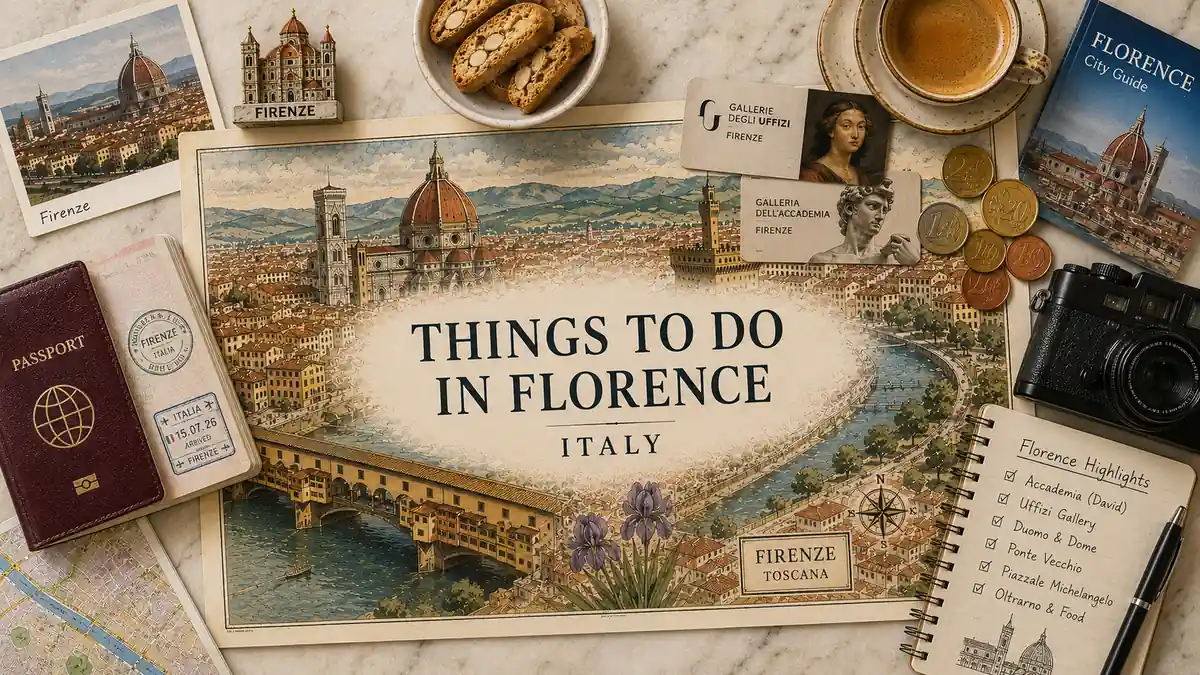
Florence packs an outsized share of the world’s greatest art and architecture into a centre you can cross on foot in half an hour. That density is the whole challenge: the problem is never finding something to do, it is choosing what actually earns your limited time. This guide skips the exhaustive catalogue and does the ranking for you. Every experience below is grouped by category and judged by payoff, with honest calls on what is unmissable, what is merely nice, and what most visitors can safely skip. Whether you have one packed day or a relaxed three, you will know where to point your attention first — and which timed sights to lock in before you arrive.
Quick Answer
See Michelangelo’s David at the Accademia and the Uffizi’s Renaissance masterpieces, take in the Duomo, and cross Ponte Vecchio. Florence is compact, so the job is choosing by payoff, not covering distance — art and landmarks anchor most trips. Book the timed big-three ahead and add a food or Oltrarno experience for depth.
Trust Layer
Tripstou selection guide for travelers choosing between multiple places. Covers selection criteria, traveler fit, and trip value.
Produced with AI assistance and reviewed by Alex Perrut, working in tourism since 2015, for the Tripstou editorial team. See our editorial process for details.
Last factual review: July 15, 2026.
Official sources consulted: italia.it, enit.it.
Key Takeaways
- Prioritize the two ticketed art stops — the Accademia’s David and the Uffizi — since they are what makes Florence unlike anywhere else.
- Florence’s centre is a 30-to-40-minute walking radius, so the landmarks link on foot for free while you spend on tickets.
- Book the timed big-three — Accademia, Uffizi, and the Duomo dome climb — ahead, since spontaneous entry is rarely possible.
- Skip the dome climb if stairs or booking put you off; Piazzale Michelangelo delivers Florence’s finest skyline for free.
- When time is short, protect the timed sights and let free landmarks, viewpoints, and food flex around your booked slots.
Table of Contents
What Are the Best Things to Do in Florence?
The best things to do in Florence are seeing Michelangelo’s David, touring the Uffizi, and standing under the Duomo. Six categories organize the rest — art, landmarks, viewpoints, food, unique experiences, and free things. Rank by payoff, not by coverage, and the compact centre does the work for you.
Start with the two ticketed art stops and the Duomo complex, because they are what makes Florence unlike anywhere else. Add landmarks and a viewpoint, both of which cost nothing and slot around your booked times. Then use whatever hours remain on food or the Oltrarno. That order holds whether you have one day or three.
Florence’s real advantage is density. The Duomo, Uffizi, Ponte Vecchio, and Piazza della Signoria all sit inside a 30-to-40-minute walking radius, so a single half-day on foot links the headline landmarks for free. You spend your budget on the two ticketed art experiences, not on getting between them — that is the lever a plain attraction list will not tell you about.
When time is short, protect the timed big-three and let everything else flex. The table below sets the priority order and flags what needs booking. For practical basics on getting around and visiting the city, see the Florence travel guide; if you want your picks arranged into a day-by-day route, the 2-day Florence itinerary handles the sequencing this page deliberately leaves out.
| Experience | What you see | Booking | Best payoff for |
|---|---|---|---|
| Accademia Gallery | Michelangelo’s original David | Reserve a timed slot ahead | Anyone visiting Florence once |
| Uffizi Gallery | Botticelli and the Renaissance canon | Reserve a timed slot ahead | Art and history lovers |
| Duomo dome climb | Frescoed interior and rooftop panorama | Timed reservation usually required | Those comfortable with stairs |
| Ponte Vecchio | Historic bridge and goldsmith shops | Free, no ticket needed | Every first-time visitor |
Must-See Art in Florence: the Uffizi, Accademia and David
Two art stops are non-negotiable in Florence: the Accademia’s David and the Uffizi’s Renaissance canon. Everything else in the city’s galleries is optional by comparison. See only two art experiences here and make them these — both reward the time and the wait.
The Accademia is a fast, focused visit; the Uffizi is a long, dense one. Ticket prices and opening hours shift, so treat any figure as a range and confirm on the official booking site before you go. What does not change is the payoff order below.
The Accademia is a quick visit built around one statue, while the Uffizi needs two to three hours. Pairing them in a single day works only if you book the Accademia early and the Uffizi later — do it the other way and you will be rushing the bigger collection to make a slot.
Accademia Gallery (David)
The Accademia exists, for most visitors, for one reason: Michelangelo’s David stands here, and photographs do not prepare you for the scale. The unfinished Prisoners lining the approach are a quiet bonus. It is a short visit, which is exactly why it pairs well with a busier afternoon elsewhere.
Pick this if: you want to stand in front of the David and don’t need a full museum morning.
Uffizi Gallery (Botticelli, Renaissance masters)
The Uffizi holds the deepest single collection of Renaissance painting anywhere, with Botticelli’s Birth of Venus and Primavera as the anchors. It rewards a slow two-to-three-hour visit. Go early or late to dodge the thickest crowds, and accept that you cannot see all of it — pick a few rooms and linger.
Pick this if: Botticelli and the Renaissance canon are the reason you came to Florence.
Bargello (sculpture alternative, lighter crowds)
The Bargello is Florence’s great sculpture museum and its best-value quiet alternative, with early Michelangelo and Donatello works and a fraction of the queues. It rarely tops a first-timer’s list, and that is the point. Slot it in on a second visit or a rainy afternoon.
Pick this if: you love sculpture but want to dodge the big-museum lines.
Tours and activities
Book skip-the-line tickets, day trips and local tours with free cancellation on most activities.
You can also browse everything on getyourguide.com.
Tripstou may earn a commission if you book through this link, at no extra cost to you.
Florence’s Landmark Sights: Ponte Vecchio, Piazza della Signoria and the Duomo Complex
Florence’s headline landmarks cost nothing to see from outside: the Duomo, Ponte Vecchio, and Piazza della Signoria. All three sit within a short walk of one another. Together they deliver the city’s defining images without a ticket — which is why a first stroll through the centre pays off right away.
These are the free anchor points of any Florence trip, and they stitch together into one easy loop. You can see all three in a morning and still have the afternoon for a museum. The vertical climb up the Duomo is a separate decision, handled in the next section.
Piazza del Duomo and the cathedral complex
The Piazza del Duomo delivers Florence’s most jaw-dropping exterior for free: the cathedral’s green-white-pink marble, Brunelleschi’s dome, and the Baptistery all crowd one square. The interior is comparatively plain, so the exterior is the real event. Circle the whole complex on foot before deciding whether to pay to go inside or up.
Pick this if: you want the city’s most spectacular sight without paying for a single ticket.
Ponte Vecchio
Ponte Vecchio is Florence’s iconic medieval bridge, lined with goldsmiths’ and jewellers’ shops that hang out over the Arno. It is busy and touristy, and still unmissable. Cross it once for the shops, then view it side-on from the next bridge along for the classic photo.
Pick this if: you want the classic Arno photo and a browse past the goldsmiths’ windows.
Piazza della Signoria and the Loggia dei Lanzi
Piazza della Signoria is an open-air sculpture gallery you can walk through at any hour, fronted by the Palazzo Vecchio and the statue-filled Loggia dei Lanzi. A replica David marks the spot where the original once stood. It is free, central, and a natural pause between the Uffizi and the Duomo.
Pick this if: you want a sculpture gallery you can wander through any time of day.
Can You Climb Florence’s Duomo, and Is It Worth It?
Yes, you can climb Florence’s Duomo, and the view from Brunelleschi’s dome is worth it for most visitors. The reward is a close-up of the frescoed interior and a rooftop panorama over the city. It suits anyone comfortable with a steep, enclosed staircase and a booked time slot.
The climb is physical and the stairs are narrow, so it is not for everyone — and a timed reservation is generally required, which rules out spontaneous visits. Don’t guess the rule; check the official ticket site for the current booking requirement before you plan your day. The three realistic options break down like this:
- Climb the dome — puts you inside Brunelleschi’s cupola beside the Last Judgement frescoes and out onto the highest terrace. Best for fit visitors who want the signature Florence experience and don’t mind booking a slot.
- Climb Giotto’s bell tower — a similar height and view with a shorter wait, and it puts the dome itself in your photos. Best for those who want the panorama with the cathedral in frame.
- Skip the climb — you still get Florence’s finest skyline for free from Piazzale Michelangelo. Best for anyone short on time, avoiding stairs, or unwilling to pre-book.
The dome and the bell tower give near-identical views, but only the bell tower gets the dome into your photo. Climb the tower if the shot matters more to you than standing inside the cupola itself — that one distinction settles the choice for most people.
The Best Viewpoints in Florence
Piazzale Michelangelo is Florence’s best-known viewpoint, delivering the classic skyline of the Duomo, towers, and river in one sweep. It is free, a walkable climb from the centre, and best near sunset. For the same panorama with fewer people, San Miniato al Monte sits just above it.
All of Florence’s great views are free or low-cost, which makes them the easiest high-payoff addition to any day. The three below cover every preference, from the postcard classic to the quiet alternative.
- Piazzale Michelangelo — the definitive Florence panorama, free and open at all hours. Pick this if: you want the postcard skyline and don’t mind sharing it at sunset.
- San Miniato al Monte — a beautiful Romanesque church a short climb higher, with the same view and a calmer crowd. Pick this if: you’ll walk a little farther for the same panorama with fewer people.
- Bardini and Boboli garden views — ticketed gardens that frame the skyline through terraces and greenery. Pick this if: you want the view set among gardens and are already paying to visit.
Food Experiences Worth Your Time in Florence
Three food experiences repay booking in Florence: Mercato Centrale for grazing, a Tuscan cooking class, and a Chianti wine tour. Each makes a meal into an activity, not a quick refuel. Mercato Centrale is the low-commitment entry point; the class and the wine tour are worth reserving a half-day for.
Prices and market hours vary by vendor and season, so treat any figure as a range and confirm current tour details when you book. The value question is less about cost and more about time, and the three options sit on a clear ladder from casual to committed.
Mercato Centrale
Mercato Centrale lets you graze Tuscan specialities — from lampredotto to fresh pasta — without committing to a sit-down meal. The upstairs food hall is the easy, all-day option; the ground-floor market is the raw-ingredient half. It is the lowest-effort way to eat well in Florence.
Pick this if: you want to sample Tuscan food fast without a full restaurant meal.
Tuscan cooking class
A Tuscan cooking class sends you home with a skill, not just a photo, and usually includes a market walk and a long lunch of what you cooked. Sessions run a few hours. It is the food experience with the highest personal payoff, especially for travellers who cook at home.
Pick this if: you want to take a skill home, not just a memory.
Chianti wine and food tour
A Chianti wine tour trades half a day in the city for vineyard visits, tastings, and a Tuscan country lunch. It is the biggest time commitment on this list, and the most scenic. Book ahead in high season, when the better small-group tours fill early.
Pick this if: you’ll swap half a day in Florence for vineyards and a country lunch.
A Chianti tour eats an entire half-day of city time. That makes it a natural fit on a three-day trip and a hard sell on a two-day one, where it would crowd out the sights you came for.
Unique Things to Do in Florence
Beyond the headline sights, Florence’s most memorable experiences are its Oltrarno artisan workshops and a Vespa or Tuscany day tour. These add texture a museum ticket cannot. The Oltrarno keeps the city’s craft traditions alive across the river, while a countryside tour trades gallery time for Tuscan hills.
These are the experiences that stop a Florence trip from feeling like a checklist of famous names. If your appetite for unique experiences runs past the city limits, save the region for its own trip — for tours and activities across the country, see the guide to the best things to do in Italy rather than turning this page into a countrywide round-up.
Oltrarno artisan workshops
The Oltrarno, on the south bank, is where Florence is still made by hand — leather, gold-leaf framing, bookbinding, and shoemaking in workshops that have run for generations. Wander Via Maggio and the side streets, or book a guided artisan walk. It is the antidote to the crowded north-bank sights.
Pick this if: you want to watch Florence still being made by hand.
Vespa or Tuscany day tour
A Vespa tour or organised Tuscany day trip gets you into the countryside — Chianti, San Gimignano, or the hills around the city — without renting a car or navigating yourself. Half- and full-day options both exist. It is the easiest way to add Tuscan scenery to a city-based trip.
Pick this if: you want the Tuscan countryside without renting a car.
Other offbeat picks
For a quieter layer of the city, the Boboli and Bardini gardens, a Brancacci Chapel fresco visit, or an evening aperitivo in a Santo Spirito bar all reward the detour. None is a must-see. Each is a good use of leftover time once the headline experiences are done.
Free Things to Do in Florence
Florence rewards free exploration more than most Italian cities: its greatest landmarks, piazzas, and viewpoints cost nothing. Walking the historic centre, admiring the Duomo’s marble exterior, and climbing to Piazzale Michelangelo are all free. The city’s beauty is largely outdoors, so a no-ticket day still feels full.
You could spend a rewarding day in Florence without paying for a single entry. Some churches charge for special areas while their main naves stay free, and museums occasionally run free-entry days that change over time — check locally instead of planning around them. The reliable free experiences are these:
- Walking the compact historic centre and crossing Ponte Vecchio.
- Taking in the Duomo, Baptistery, and Giotto’s tower from Piazza del Duomo.
- Standing among the statues in Piazza della Signoria and the Loggia dei Lanzi.
- Climbing to Piazzale Michelangelo or San Miniato al Monte for the skyline.
- Wandering the Oltrarno’s artisan streets and the Arno riverside at dusk.
Frequently Asked Questions
Do you need to book Uffizi and Accademia tickets in advance?
Yes, book the Uffizi and Accademia ahead — both use timed entry and sell out in peak season, and walk-up lines can swallow hours. Reserve a slot on the official site before you travel, put the Accademia early and the Uffizi later, and confirm current rules when you book.
How many days do you need in Florence?
Two to three days is enough to do Florence well. Two days covers the must-see art, landmarks, and a viewpoint; a third adds food experiences, the Oltrarno, or a Tuscan day trip without rushing. For a day-by-day plan, see the 2-day Florence itinerary or 3-day Florence itinerary.
Is the Firenze Card or museum pass worth it?
The Firenze Card pays off only if you visit several museums in a short window. For two or three headline sights, booking individual timed tickets is usually cheaper and simpler. Because coverage and pricing change, weigh it against your actual museum shortlist and check current terms before buying.
What is there to do in Florence when it rains?
Rainy days are ideal for Florence’s indoor art. Spend them in the Uffizi, the Accademia, or the quieter Bargello, then add a Tuscan cooking class or grazing at Mercato Centrale’s covered food hall. Church interiors and the Palazzo Vecchio also keep you dry while the weather passes.
Is Florence a walkable city?
Yes, Florence is highly walkable — the historic centre spans roughly a 30-to-40-minute walking radius, so you rarely need transport. The main landmarks, galleries, and river all connect on foot. The one uphill exception is Piazzale Michelangelo, a short but steep climb; otherwise flat streets link almost everything you’ll want to see.
Do you need a guided tour to see Florence’s museums?
No, you don’t need a guide to visit Florence’s museums — the Uffizi and Accademia are easy to navigate independently with a timed ticket. A guide or audio tour adds context to the Renaissance collections, which helps if the art is your main reason for coming. For most visitors, a self-guided visit is enough.
Related Guides
Keep planning your trip with these companion guides, from the full city overview to day-by-day routes and wider Italy inspiration:
- Florence travel guide — the practical basics for visiting the city, from getting around to when to go.
- 2 days in Florence itinerary — the experiences above arranged into a tight two-day route.
- 3 days in Florence itinerary — a relaxed three-day plan with room for food and the Oltrarno.
- The best things to do in Italy — experiences and activities across the whole country.
- The best places to visit in Italy — where to go if you’re planning beyond Florence.
Did this guide save you time or money? Tripstou is independent and reader-funded — if you'd like to give something back, you can support the site with a crypto contribution of any size.