Florence sits at the center of Tuscany’s rail network, which makes it one of the most efficient bases in Italy for day trips. From a single hotel, you can reach walled hill towns, a leaning tower, a Renaissance city ringed by intact walls, and the Ligurian coast — without repacking a bag. This guide covers Florence as a base and the surroundings you can reach from it, not the city’s own museums and squares. You’ll find the realistic day-trip set — Siena, San Gimignano, Pisa, Lucca, Chianti, Cinque Terre, Fiesole, and beyond — with clear worth-it or skip verdicts, how far each one is, and how to reach it by train, tour, or car. The goal is a decision-ready shortlist: which trips earn a place in your stay, which pair well together, and how many you can realistically fit.
Quick Answer
Florence is one of Italy’s best day-trip bases, with most of Tuscany’s highlights within easy reach. The main variable is access — some trips are a quick regional-train ride, while others need a tour or a full day. For a typical stay, Siena and a Pisa–Lucca pairing deliver the most value.
Trust Layer
Tripstou region guide for travelers planning a regional trip. Covers sub-areas, trip shape, base strategy, timing, and mobility tradeoffs.
Produced with AI assistance and reviewed by Alex Perrut, working in tourism since 2015, for the Tripstou editorial team. See our editorial process for details.
Last factual review: July 15, 2026.
Official sources consulted: italia.it, enit.it.
Key Takeaways
- Florence’s central rail position makes it one of Italy’s best day-trip bases, reaching hill towns, coast, and art cities.
- Siena and the Pisa–Lucca pairing deliver the highest value; Pisa alone rarely justifies more than a half-day.
- Nearly every top trip is reachable by train or bus — a car is a liability except in Chianti.
- Pisa and Lucca share one line and Siena and San Gimignano share one road, so each pairs cleanly into a single day.
- Chianti is the one trip where a guided tour or self-drive genuinely pays off over public transport.
- Plan roughly one day trip per two nights, and treat Cinque Terre as a long full-day outing.
Table of Contents
Is Florence a good base for exploring Tuscany?
Yes — Florence is one of Italy’s best day-trip bases. It sits on the country’s main north–south rail line, so a wide spread of Tuscan hill towns, coastal spots, and art cities is reachable by a single direct train. Few Italian cities pack this much variety around one base.
What makes Florence work as a base is geography more than size. It sits roughly halfway up the peninsula on the main fast line, with a dense web of regional routes fanning out into Tuscany. The geography does the work. You sleep in one place and let the trains move.
The base itself is the city you’d want to see anyway, so your day trips bookend time in Florence rather than replacing it. For everything inside the walls — the museums, the Duomo, the neighborhoods to stay in — see the Florence city guide; this page stays focused on what lies beyond them. To understand where Florence ranks among Italy’s regions, see best places in Italy, and the Italy travel guide covers the wider national picture.
One thing day-trippers underestimate: Florence’s value as a base drops sharply once your targets sit north of the Apennines. Venice and the Dolomites are technically reachable, but they burn most of a day each way and belong on a multi-city route, not a Florence day-trip list.
The best day trips from Florence — and which to skip
Siena, the Pisa–Lucca pair, San Gimignano, and Chianti are the day trips worth prioritizing from Florence. Cinque Terre is a longer coastal option. The common over-hype is treating every Tuscan town as essential — Pisa rewards a half-day at most, and distant spots eat more travel time than they return.
The table below sets the shortlist against distance, travel time, and a worth-it verdict so you can build a stay around the highest-value picks first.
Travel times are approximate and shift with schedule and season; verify current timetables before booking.
| Destination | Distance from Florence | Travel time (approx.) | Worth-it verdict |
|---|---|---|---|
| Siena | About 70 km to the south | Roughly 1.5 hours by bus or rail | Yes — the classic Tuscan day trip |
| Pisa | About 80 km to the west | Around 1 hour by regional train | Half-day only — pair it with Lucca |
| Lucca | About 80 km to the west | Roughly 1 to 1.5 hours by train | Yes — the easiest pairing with Pisa |
| San Gimignano | About 55 km to the southwest | 1.5 to 2 hours with one change | Yes — iconic but small, a half-day |
| Cinque Terre | About 150 km to the northwest | 2.5 to 3 hours each way | Doable but a long full-day trip |
The trap in Tuscany is the map. Towns that look close cluster in different directions, so two “nearby” spots can still mean two separate days. Pisa and Lucca share a line; Siena and San Gimignano share a road — pairs only work when they share the route out.
Siena
Siena is the essential Florence day trip — a medieval city built around one of Italy’s most dramatic public squares. The shell-shaped Piazza del Campo, the striped cathedral, and the tight Gothic lanes reward a full day of wandering on foot. It works as a self-contained day out or as the anchor for a Chianti drive on the way back. How far is Siena from Florence? About 70 kilometers south, roughly an hour and a half by direct bus, which is often smoother than the train because Siena’s station sits below the old town. Best for: first-timers who want the definitive Tuscan hill-city in a single day.
Cinque Terre
Cinque Terre is doable from Florence, but it’s the longest day on this list. The five cliff-side fishing villages sit on the Ligurian coast, reached by train with at least one change, and you spend a large share of the day in transit. Can you do Cinque Terre as a day trip from Florence? Yes — it runs roughly two and a half to three hours each way, so you get the villages, the coastal train hops, and little else. Trail access between villages varies with season and weather, and sections close after storms; check conditions and plan around the best time to visit Italy before committing a day to it. Best for: travelers happy to trade a long transit day for a dramatic coastline.
San Gimignano, Pisa, Lucca and the closer stops
These trips fill out a Florence stay once the headline destinations are booked. Each earns a place for a different traveler.
San Gimignano is the skyline town — a cluster of medieval stone towers rising from the vineyards, best seen as a half-day often combined with Siena on the same route. Best for: photographers chasing the iconic Tuscan hill-town silhouette.
Pisa is a genuine half-day. The Leaning Tower and the Field of Miracles are worth seeing once, but the rest of the city gives you little reason to linger, which is exactly why it pairs so well with Lucca down the line. Best for: travelers who want the famous photo without committing a whole day.
Lucca is the quiet counterweight to Pisa — an intact Renaissance city wall you can cycle in a loop, with a relaxed café culture inside. Best for: slower travelers who prefer atmosphere over headline sights.
Fiesole is the half-day escape right above the city, a short local bus up to Etruscan ruins and a panoramic view back over Florence. Best for: anyone with a spare afternoon and no appetite for a long journey.
Arezzo and Cortona are the deeper-Tuscany options — quieter, less touristed hill towns that reward return visitors more than first-timers. Best for: repeat travelers who have already ticked off the classics.
Day trips from Florence by train
Train is the easiest way to reach most day trips from Florence. Nearly everything runs from Firenze Santa Maria Novella, the central station, on either regional or high-speed services. For Tuscan towns you’ll usually take a regional train; the high-speed network mainly matters for reaching farther cities beyond day-trip range.
The two rail products behave differently, and knowing which you are on saves money and hassle:
- Regional trains cover most Tuscan day trips — Pisa, Lucca, and the closer towns. Fares are modest and fixed by distance, and you don’t reserve a seat; you buy a ticket and validate it before boarding. Best for the everyday hill-town hops.
- High-speed and intercity trains matter mainly for longer hauls and require a reserved seat tied to a specific departure. They are faster but pricier, and for day trips they only really come into play for reaching the coast or cities on the main line.
Exact times and fares move with schedule and demand, so treat any figure as a range and check the current timetable before you travel. As a rule, if a destination needs high-speed rail to be doable in a day, it sits near the edge of what a Florence day trip can sensibly cover.
Train and bus tickets
Compare routes, schedules and prices across rail and bus operators in one search, with mobile tickets on your phone.
New to Omio? Code NEW10 takes 10% off your first booking — or APPNEW10 if you book inside the Omio app. Both apply to bookings up to €80.
Search routes and compare prices on Omio →
Tripstou may earn a commission if you book through this link, at no extra cost to you.
Which day trips are doable without a car?
You can do almost all of them without a car. Nearly every top day trip from Florence — Siena, Pisa, Lucca, San Gimignano, Fiesole, even Cinque Terre — is reachable by train or bus from the center. The main exception is Chianti, where public transport is thin and a tour or car genuinely helps.
For the classic Tuscan itinerary, a car is often a liability. Florence has restricted-traffic zones with automatic fines, parking is scarce and expensive, and you would leave the car idle on the days you explore the city itself. Trains drop you in the center of most towns and let you skip all of that.
A car earns its keep only in the countryside between towns — the vineyards, farm stays, and villages that trains don’t serve. For everyone else, the rail-and-bus network covers the shortlist. Where a car does help, a guided tour usually solves the same problem without the driving.
Chianti wine country: tours vs doing it yourself
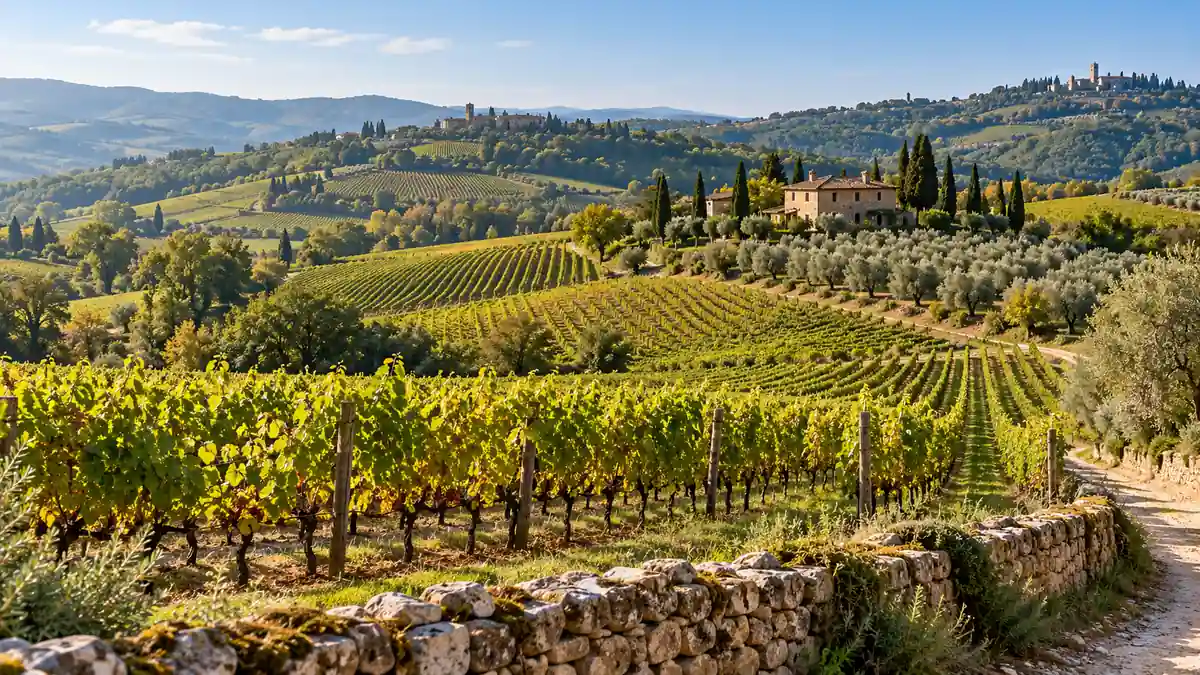
Chianti is the one trip where a tour or car pays off. The wine country between Florence and Siena is a landscape of scattered vineyards and small estates, and public transport barely reaches it. Your real choice is a guided tour, a self-drive day, or skipping Chianti in favor of a rail-friendly town.
Each option suits a different traveler, and the tradeoff is mostly about wine and driving:
- Guided tour — the easiest choice, with central pickup, a set route between two or three estates, and tastings included. You don’t drive, which matters because tasting and driving don’t mix. Best for travelers who want the wine without the logistics; prices vary widely by group size and inclusions, so compare a few.
- Self-drive — the most flexible option, letting you set your own pace and reach smaller estates off the tour circuit. It only works with a non-drinking driver in the group. Best for confident drivers traveling as a pair or group.
- Skip it — a legitimate choice when wine isn’t your focus. Siena or San Gimignano give you the same rolling landscape, reachable without a car. Best for travelers short on time or indifferent to tastings.
The honest test for Chianti: it’s a wine-and-scenery day, not a sightseeing one. If nobody in your group is excited to taste, the same countryside rolls past free from the train window on the way to Siena.
Tours and activities
Book skip-the-line tickets, day trips and local tours with free cancellation on most activities.
You can also browse everything on getyourguide.com.
Tripstou may earn a commission if you book through this link, at no extra cost to you.
How many day trips fit a Florence stay?
Most travelers realistically fit one day trip for every two nights in Florence. A three-to-four-night stay supports one or two trips alongside the city itself, while a week comfortably absorbs three or four. Pacing matters more than the raw count — back-to-back travel days blur together fast.
Match the number of trips to your stay length and your appetite for early starts:
- Three to four nights — one full day trip plus real time for Florence. Enough for Siena or the Pisa–Lucca pair, not both. Fits first-timers who want the city front and center.
- Five to six nights — two or three day trips with recovery time between them. Room for Siena, a Pisa–Lucca day, and a Chianti afternoon. Fits travelers who want range without rushing.
- A week or more — three to four trips, including a longer one like Cinque Terre. Fits slow travelers and repeat visitors reaching for Arezzo, Cortona, and the deeper hill towns.
Pairing is what stretches a stay. Pisa and Lucca sit on the same line and split cleanly into one day; Siena and San Gimignano share a road and combine just as well. If you find yourself wanting more than day trips — sleeping in different regions, chaining cities — you’ve outgrown a single base, and an Italy itinerary becomes the better planning tool.
The count that ruins a Florence trip is the ambitious one. Every travel day is a day you don’t spend in Florence, and the city is the reason most people came.
Frequently Asked Questions
Can you visit Pisa and Lucca in one day from Florence?
Yes, Pisa and Lucca combine easily into one day from Florence. Both sit west of the city on the same regional rail corridor, roughly an hour out, and a short hop links them. Give Pisa a half-day for the Leaning Tower, then spend the rest in walled Lucca.
Do you need to book regional trains from Florence in advance?
No, regional trains from Florence don’t require advance booking or seat reservations. You buy a ticket for the route, validate it before boarding, and take any regional service. Advance reservation only applies to high-speed and intercity trains, which matter mainly for longer hauls beyond the usual Tuscan day-trip range.
What is the closest town to Florence for a half-day trip?
Fiesole is the closest worthwhile half-day trip from Florence. A short local bus climbs to this hilltop town just above the city, where you’ll find Etruscan and Roman ruins and a sweeping panorama back over Florence. It’s the easiest escape when you have a spare afternoon and no appetite for travel.
What is the best single day trip from Florence if you only have one day?
Siena is the best single day trip from Florence if you only have one. About 70 kilometers south and reached by direct bus or rail, it delivers the definitive Tuscan hill city in one outing — the shell-shaped Piazza del Campo, the striped cathedral, and steep Gothic lanes made for wandering.
Can you take a day trip from Florence to Rome or Venice?
Not comfortably — Rome and Venice sit too far for a satisfying day trip from Florence. High-speed rail reaches each in well over an hour each way, so most of your day disappears in transit. Both reward an overnight and belong on a multi-city route, not a Florence day-trip list.
Related Guides
Keep planning your Tuscany trip with these guides:
- The Florence city guide — what to see, do, and where to stay inside the city itself.
- Best places in Italy — how Florence and Tuscany rank among the country’s regions.
- Italy travel guide — national context, when to go, and how to get around.
- Italy itinerary — multi-city routes for when one base isn’t enough.
- Best time to visit Italy — seasonal timing, including the Cinque Terre coast.
Did this guide save you time or money? Tripstou is independent and reader-funded — if you'd like to give something back, you can support the site with a crypto contribution of any size.