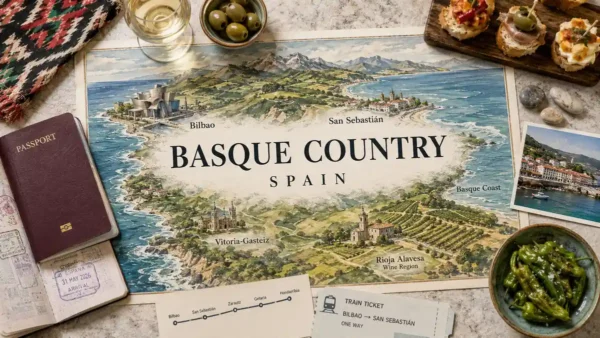
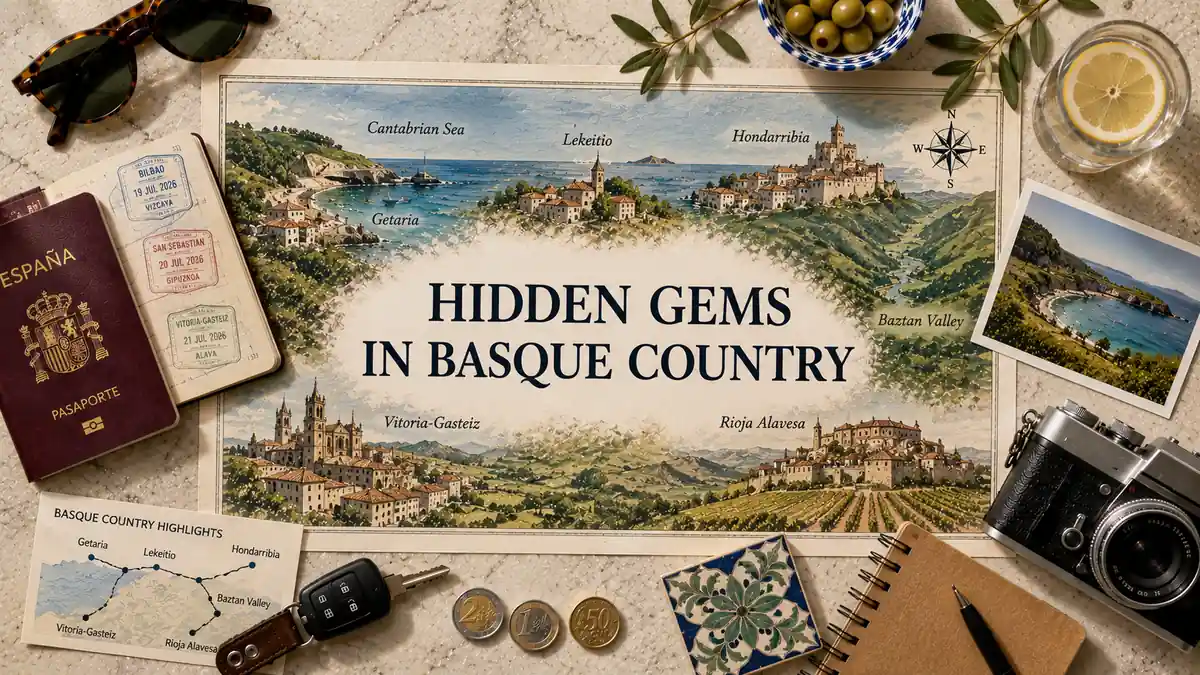
Almost everyone who visits the Basque Country lands in San Sebastián or Bilbao and stops there. The reward for going further is a region most travelers never see: working fishing harbours strung along a green coast, stone villages tucked into inland valleys, and a walled wine country on the southern edge. These are the real hidden gems — places with a genuine reason to visit, not just quieter versions of the famous names. This guide sorts them into three landscapes so you can build an off-the-beaten-path trip that fits your taste. The coast holds the region’s best-kept fishing villages. The inland mountains hide its prettiest, emptiest hamlets. And Rioja Alavesa offers hilltop wine towns most Rioja visitors overlook. Each pick below comes with why it is underrated, what makes it distinct, and who it suits — so you can skip the crowds without guessing.
Quick Answer
The best hidden gems in the Basque Country are coastal villages like Getaria and Lekeitio and the inland Baztan valley. The choice splits by landscape — coastal fishing villages, green mountain hamlets, or the walled wine towns of Rioja Alavesa. Choose the coast for seaside authenticity, the inland valleys for quiet villages, and Rioja Alavesa for wine.
Trust Layer
Tripstou selection guide for travelers choosing between multiple places. Covers selection criteria, traveler fit, and trip value.
Produced with AI assistance and reviewed by Alex Perrut, working in tourism since 2015, for the Tripstou editorial team. See our editorial process for details.
Last factual review: July 18, 2026.
Official sources consulted: spain.info, tourspain.es.
Key Takeaways
- Getaria on the coast is the strongest all-round hidden pick, pairing a working fishing harbour with txakoli wine and a design museum.
- For seaside authenticity choose the coast, for quiet stone villages the inland Baztan valley, and for wine Rioja Alavesa around Laguardia.
- Most of the best coastal and inland villages sit on dead-end roads, so a rental car unlocks far more than public transport.
- Inland carnival villages like Ituren and Zubieta only come alive on a handful of winter dates, so timing decides the experience.
- The Baztan hamlets and green-capital Vitoria-Gasteiz see the fewest visitors, making them the surest bets for avoiding crowds.
- The region is compact enough to combine a coastal village and an inland valley in one short trip without long drives.
Table of Contents
What counts as a hidden gem in the Basque Country?
Hidden Basque gems are the coastal villages, inland valleys, and wine towns most visitors skip for San Sebastián and Bilbao. What makes a place genuinely underrated is a distinct draw the famous cities can’t copy: a working harbour, a masked carnival, or a rock-cut cellar. Thinner crowds alone don’t qualify.
San Sebastián and Bilbao earn their fame — the pintxos bars, La Concha, the Guggenheim — and both belong on any first Basque trip; for those headline stops, see our roundup of the best places to visit in Spain. This page starts where the tour buses thin out. The picks that follow fall into three landscapes: the coast, the inland mountains, and Rioja Alavesa wine country. If you want to zoom out from the region, the wider list of hidden gems in Spain covers underrated spots nationwide.
The Basque hidden-gem map is unusually compact. You can pair a coast village and an inland valley in a single short trip, because the whole region is smaller than most first-timers expect — the landscapes change faster than the driving time suggests.
Hidden Gems on the Basque Coast
The Basque coast hides working fishing villages like Getaria, Lekeitio, and Elantxobe. These are harbours where boats still land the catch, not resort strips. The coast here runs greener and rockier than Spain’s Mediterranean shore, with pintxos, txakoli, and cliffs between the towns. Each village works for a living first and welcomes visitors second.
The coast rewards a car more than any other Basque landscape. The best villages sit on dead-end harbour roads that buses reach slowly and infrequently, so a rental turns a strung-out coastline into an easy day of village-hopping.
Getaria
Getaria is the coast’s txakoli capital, a tiny fishing village where whole fish grill over open coals right on the harbourfront. Its lightly sparkling white wine is poured from a height across the region, and the vines climb the hills directly behind the port. A mouse-shaped islet shelters the harbour and gives the town its silhouette. It was also the home port of the first sailor to circle the globe, and the birthplace of couturier Cristóbal Balenciaga, whose museum sits above the village.
- Pick this if: you want grilled fish and local wine in a genuine working port, with a design museum as a bonus.
Lekeitio
Lekeitio pairs a grand Gothic basilica with two working harbours and a tidal island you can walk to at low water. The basilica holds one of the most elaborate gilded altarpieces in the Basque Country. When the tide drops, a sandbar links the town beach to the island offshore. The town fills for its eccentric summer goose festival but stays low-key the rest of the year.
- Pick this if: you want a beach town with real monuments and a walkable island, away from the San Sebastián crush.
Mundaka
Mundaka is world-famous among surfers for one thing — a long left-hand wave that peels off the river mouth — yet the village itself stays sleepy. The break draws professionals when sand and swell align, but conditions are fickle and seasonal, so treat any surf trip as a gamble. Beyond the wave, Mundaka sits at the mouth of the Urdaibai estuary, a UNESCO biosphere reserve of marshland and birdlife.
- Pick this if: you surf, or you want an estuary village with a big reputation and a small footprint.
Elantxobe
Elantxobe is the most dramatic village on the coast, a cluster of houses stacked down a near-vertical cliff to a miniature harbour. The single street is so steep that a rotating platform turns vehicles around at the bottom. There is little to “do” here beyond the view and a drink by the port, and that is exactly the point. Leave the car up on top.
- Pick this if: you want the coast’s most photogenic hamlet and don’t need shops or nightlife.
Zumaia
Zumaia is the gateway to the flysch — dramatic striped rock formations where long-buried seabed stands on end along the shore. At low tide you can walk out across the rock shelves below the cliffs, an otherworldly landscape used as a location for major screen productions. Two beaches bracket the town, and a cliff path links Zumaia to Getaria for walkers.
- Pick this if: you like geology, coastal hikes, and beaches with a genuinely unusual backdrop.
Pasaia
Pasaia is a photogenic port village just minutes from San Sebastián yet almost entirely overlooked. Its colourful houses line a narrow, steep-sided bay, crossed by a tiny passenger boat between the two old quarters. The standout draw is Albaola, a living maritime museum where shipwrights are hand-building a full-size replica of a Basque whaling galleon using traditional methods. A scenic clifftop path leads out toward the open sea.
- Pick this if: you want a boat-and-harbour half-day within reach of the city, plus a genuinely unique museum.
Secret Inland and Mountain Villages
The Baztan valley hides the region’s prettiest, least-touristed stone villages, deep in the green mountains near the Navarrese border. Inland Basque Country trades sea views for beech forest, grazing sheep, and hamlets of whitewashed houses with red shutters. Crowds thin out fast here, and a few villages guard living traditions found almost nowhere else in Europe.
Reaching these hamlets usually means driving; public transport is thin, and the pretty ones sit off the main valley road. Distances are short, though, and the roads are scenic in their own right.
Inland picks live or die by timing. The masked carnivals and dove-netting seasons that make Ituren, Zubieta, and Etxalar special land on only a handful of dates — visit off-season and you get empty stone villages and little else going on.
Baztan valley — Elizondo
Elizondo is the hub of the Baztan valley, a riverside town of grand stone houses lining the water. It works as the natural base for exploring the valley, with more life and services than the surrounding hamlets. The town gained a wider following as the setting for a hugely popular Basque crime-novel trilogy and its film adaptations, which put the valley on the map for domestic travelers. Palatial homes built by returning emigrants give the centre unexpected grandeur.
- Pick this if: you want a scenic valley base with stone architecture and easy access to green day trips.
Ituren & Zubieta
Ituren and Zubieta are two tiny neighbouring villages famous for one of Europe’s oldest surviving carnivals. In late winter, costumed figures called joaldunak walk between the villages in sheepskins, tall conical hats, and heavy cowbells to drive out the spirits of winter. It is a genuinely ancient rural ritual, not a staged tourist show, and it draws photographers from across Spain. Outside carnival, both are quiet farming hamlets.
- Pick this if: you want to witness a raw, living folk tradition and don’t mind timing your trip around it.
Etxalar
Etxalar is a classic Navarrese mountain village of red-and-white houses set among wooded hills near the border. It is known for its palomeras — historic dove-netting towers on the passes above town, part of a centuries-old autumn hunting tradition. The village has won recognition as one of the tidiest and best-preserved in the area, with a striking hilltop church and old carved gravestones. It sees very few foreign visitors.
- Pick this if: you want an immaculate, authentic mountain village well off the standard route.
Axpe
Axpe sits in the Atxondo valley beneath Anboto, the dramatic limestone peak tied in Basque mythology to the mother-goddess Mari. The hamlet is tiny, green, and ringed by hiking trails into the surrounding massif. It also punches far above its size for food, home to a celebrated farmhouse restaurant that put the valley on the gastronomic map. The setting under the mountain is the main event.
- Pick this if: you want mountain hiking, mythology, and standout rural cooking in one small valley.
Hidden Basque Wine Villages in Rioja Alavesa
Laguardia and Rioja Alavesa are the Basque Country’s overlooked wine-village belt. This strip of walled hilltop towns sits on the region’s southern edge — the Basque slice of Rioja that most wine visitors miss for the busier Logroño side. The reward is medieval hill towns, underground cellars, and bold-name bodega architecture set against vineyards and mountains.
Rioja Alavesa pairs with the coast only in principle. It sits inland near Vitoria, a real drive from the fishing villages, so most travelers treat it as its own overnight rather than a coastal day trip.
Laguardia
Laguardia is a perfectly preserved walled hilltop town honeycombed with medieval wine cellars dug beneath its streets. Cars are kept out of the old centre, so you wander stone lanes on foot, and many houses still have their own rock-cut cellar below. The town looks out over a sea of vineyards toward the Cantabrian mountains, and several historic bodegas run tastings inside the walls. It stays walkable and human-scaled throughout.
- Pick this if: you want walled-town atmosphere and cellar tastings without the scale of the famous wine capitals.
Rioja Alavesa villages (Elciego & Samaniego)
Around Laguardia, smaller villages like Elciego and Samaniego put you deeper into bodega country. Elciego is home to one of Rioja’s most photographed wineries — a wave of titanium ribbons designed by a world-famous architect, rising straight out of the vines. Samaniego and neighbouring hamlets are quieter, working wine villages where you can taste at family bodegas. Together they make an easy loop by car through the vineyards.
- Pick this if: you want dramatic modern winery architecture and small-village tastings side by side.
Hondarribia and Vitoria-Gasteiz Are the Underrated Urban Picks
Hondarribia and Vitoria-Gasteiz are the Basque Country’s most underrated towns — the pick when you want a town over a village. Hondarribia is a walled border town with a candy-coloured fishermen’s quarter; Vitoria-Gasteiz is the region’s quietly green capital, routinely passed over between its glossier neighbours. Both reward a full day without the crowds.
These two split by mood and by map. Hondarribia is a half-day of colour best tacked onto the coast near San Sebastián, while Vitoria makes more sense as a stop between the coast and Rioja Alavesa inland.
Hondarribia
Hondarribia is a walled old town facing France across a bay, crowned by a hilltop castle now run as a hotel. Its showpiece is the Marina district — a row of former fishermen’s houses painted in vivid colours, their wooden balconies stacked with flowers. Inside the walls, cobbled streets climb past noble mansions to the main square and old fortifications. A short boat hop crosses the bay to France.
- Pick this if: you want colour, walls, and pintxos in a border town most itineraries skip.
Vitoria-Gasteiz
Vitoria-Gasteiz is the Basque Country’s political capital and its most underrated city, routinely passed over for San Sebastián and Bilbao. Its almond-shaped medieval core is one of the best-preserved old quarters in the north, wrapped in a ring of parks that earned the city a European environmental title. Wide arcaded squares, a gothic cathedral under long-term restoration, and a strong pintxos scene reward a slow day.
- Pick this if: you want a walkable, green, genuinely local city with no tourist crush.
Which hidden Basque gem is right for your trip?
Pick the coast for fishing-village atmosphere, the inland valleys for quiet villages, and Rioja Alavesa for wine. The right hidden gem depends on what you want — seaside authenticity, green solitude, or wine and walled towns — and on how much driving you’ll accept. Most travelers pair two nearby clusters instead of chasing all three.
- Best for avoiding crowds: the inland Baztan hamlets and green-capital Vitoria-Gasteiz see the fewest visitors.
- Best for food and wine: Getaria for grilled fish and txakoli, Rioja Alavesa for reds and cellars.
- Best for beaches: Lekeitio and Zumaia, with a walkable island and flysch cliffs respectively.
- Best for drama and photos: cliff-hanging Elantxobe and the striped rock of Zumaia.
- Best for living tradition: Ituren, Zubieta, and Etxalar in the mountains.
- Best for a town base: Hondarribia on the coast, Elizondo inland.
By area, the coastal villages chain together easily, the Baztan and border hamlets form an inland loop, and Rioja Alavesa stands on its own to the south. For what to actually do in each — pintxos crawls, surfing, txakoli tasting — see our guide to things to do in the Basque Country. For how many days you need, when to go, and how to get around, the full Basque Country travel guide handles the planning.
Frequently Asked Questions
What is the most underrated town in the Basque Country?
Vitoria-Gasteiz is the most underrated town in the Basque Country. The region’s green capital is routinely skipped for San Sebastián and Bilbao, yet it has one of the north’s best-preserved medieval quarters, a ring of parks, and a strong pintxos scene. On the coast, Hondarribia is the close runner-up.
Are there hidden beaches in the Basque Country?
Yes, the Basque coast hides quiet beaches beyond the busy city sands. Zumaia’s beaches sit beneath dramatic flysch rock cliffs, Lekeitio has a sandbar out to a tidal island, and small coves dot the coast between fishing villages. They stay calmer than San Sebastián’s La Concha, especially outside peak summer weekends.
Can you visit the Basque hidden gems without a car?
Partly, but a car helps for most of them. Larger towns like Hondarribia, Getaria, and Vitoria-Gasteiz are reachable by bus or train, and some coastal villages have seasonal services. The inland Baztan hamlets and dead-end harbour villages, though, are far easier with a rental, since public transport is thin and infrequent.
Which Basque village is best for txakoli wine?
Getaria is the best village for txakoli, the region’s lightly sparkling white wine. Vines climb the hills directly behind its fishing harbour, and the surrounding zone forms one of txakoli’s main growing areas. You can taste it poured from a height alongside fish grilled over coals right on the waterfront.
Are French Basque villages hidden gems too?
Yes, but they belong to a separate trip. Villages like Ainhoa, Espelette, and Sare sit across the border in the French Basque Country, with their own character and a different country’s logistics. This guide stays on the Spanish side, where the coast, Baztan valley, and Rioja Alavesa form one connected region.
Are these Basque hidden gems good for avoiding crowds?
Yes, most stay quiet even in summer, though timing sharpens the difference. The inland Baztan hamlets and Vitoria-Gasteiz see the fewest visitors year-round, while coastal villages fill on summer weekends and empty midweek. Come in the shoulder seasons and you often have the stone lanes almost to yourself.
Related Guides
- Basque Country travel guide — days needed, when to go, and how to get around the region.
- Best places to visit in Spain — the famous headline destinations, including San Sebastián and Bilbao.
- Things to do in the Basque Country — pintxos, surfing, and txakoli tasting how-tos.
- Hidden gems in Spain — underrated destinations across the whole country.
Did this guide save you time or money? Tripstou is independent and reader-funded — if you'd like to give something back, you can support the site with a crypto contribution of any size.