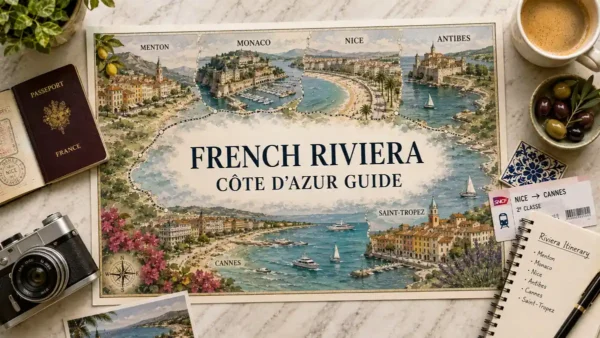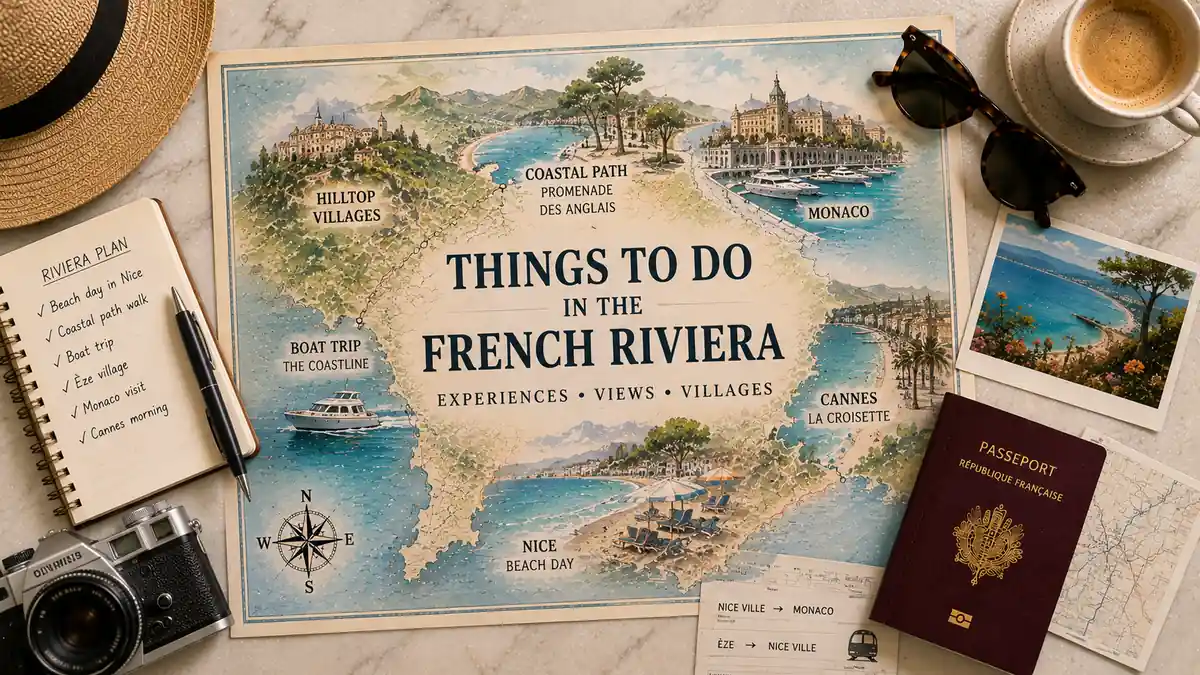
Most people arrive on the French Riviera with a picture in their head: white sand, superyachts, casino-town glamour. Part of that picture is wrong, and the part that is wrong costs travelers whole days. The beaches in the coast’s biggest city are pebble. The glamour is real but concentrated, and much of it is spectator sport. The best half-days on this coast are cheaper and simpler than the brochure suggests.
This page judges the coast’s marquee experiences one at a time — worth it, worth half a day, or safely skipped — and tells you when each is at its best. It also reads the coast the way it actually works, as a place you settle into once and explore in short outings. Six experiences, a verdict on each, and a picking rule at the end for travelers with three or four days.
Quick Answer
The French Riviera’s best experiences are pebble beaches, the coastal path, a boat trip, a hilltop village and Monaco. Timing decides more than the pick — the month and the hour make or break each one. Base in one coastal town and do all of it as half-day outings by train.
Trust Layer
Tripstou attraction guide for travelers deciding whether an experience is worth doing and how to do it well. Covers value, booking versions, timing, access, and traveler fit.
Produced with AI assistance and reviewed by Alex Perrut, working in tourism since 2015, for the Tripstou editorial team. See our editorial process for details.
Last factual review: August 22, 2026.
Official sources consulted: France.fr, Atout France.
Key Takeaways
- The coast rewards half-day outings from a single base: a beach, the coastal path, a boat, a village, Monaco.
- Nice’s beaches are pebble, so pack water shoes and a thick mat unless you are renting a lounger for the day.
- Free public beaches and paid concessions sit side by side, so decide on a lounger day by day, not in advance.
- Monaco splits travelers — half a day of spectacle or a clean skip; Cannes earns a morning, never a whole day.
- The coast works without a car, but Èze’s station sits at sea level — the hilltop village is bus-only.
- Take the beach early and the hilltop village late, and shoulder months beat high summer for every experience here.
Table of Contents
What Is There to Do on the French Riviera Besides the Beach?
The Riviera works as a set of short outings from one base, not a circuit of sights. Swim off the pebbles, walk the coastal path between towns, take a boat out, ride up to a hilltop village, and weigh Monaco and Cannes as half-days each.
Half-days work here for a simple reason. The coast is compact and linear. The towns sit in a line along the shore, strung together by a single railway, so an outing costs you a morning and gives you back the afternoon. That geography is why a Riviera trip is built around a base and then filled with outings, and why travelers who relocate every night spend their holiday packing.
Every item on that shortlist also comes in versions. The same view can be reached on foot, by train, by regional bus, by boat, or inside a guided day trip that decides the sequence for you. Which version you choose changes the day more than which experience you choose, and the section on doing the coast without a car resolves that choice in full.
Which towns deserve a stop is a separate question, and our French Riviera travel guide answers it properly — it is also the right starting point for the coast’s cities, its beaches and where to sleep. For where this stretch of coast sits among the country’s headline destinations, see our guide to the best places to visit in France.
Plan a Beach Day Around Pebbles and Paid Loungers
Nice’s beaches are pebble and shingle, and a good beach day starts by accepting that. The stones are smooth and large, the water is clear, and the sand you may be picturing sits elsewhere along the coast. Plan the day around footwear, a seat and the hour you arrive.
Pebbles change small, practical things, and they are the things that ruin an unprepared afternoon:
- Water shoes or sturdy sandals — the stones are hard underfoot at the waterline, where the swell keeps moving them.
- A thick mat or a rented lounger — a towel laid over shingle offers almost no padding.
- Less mess to manage — nothing blows into your bag, your food or your camera.
- An earlier arrival — the flat, comfortable patches are taken first, and they do not come back.
The pebbles are also the reason the water looks the way it does. Nothing stirs up in the shallows, so clarity holds through a busy afternoon on a beach that would have gone milky if it were sand.
Free public stretches and paid concessions sit side by side along the same shoreline, which turns the beach day into a decision. Nice alone counts roughly twenty public beaches against about fifteen run as concessions, according to the regional tourism board, so both options exist within a short walk almost anywhere in the city. Public beaches carry basic facilities, and bathing water on the main stretches holds Blue Flag status.
Renting a lounger with a drink is a several-tens-of-euros-per-person commitment for the day, and it buys shade, a flat surface, service and a toilet. Decide it day by day. Take it when you plan to stay from late morning to evening; leave it when you want two hours of swimming before doing something else, because a mat on the public shingle does that job for nothing.
Some beaches a short hop along the coast are sandy where Nice’s are not — Villefranche-sur-Mer is the stock example — though the swim itself changes less than people expect. Beaches also fill from mid-morning onward in high season, which is a timing problem with a timing solution, handled further down.
Is a Boat Trip on the French Riviera Worth It?
A boat trip is worth it for one specific reason: the Riviera was built to be seen from the water. The villas, the cliffs and the true shape of each bay only resolve from offshore. It suits anyone who wants the coast’s signature view without earning it on foot.
The tradeoffs deserve pricing in before you commit a half-day. Coastal boat services run summer only, they are weather-dependent, and a cancelled sailing takes a planned morning with it. You are also paying for a view that the coastal path gives away.
Skip the boat if you get seasick, if you are travelling with a small child who will spend the outing wanting to be somewhere else, or if your trip is short and already full. A boat trip and the coastal path are the paid and the free version of a single experience, so booking both on a three-day trip buys you the same coastline twice.
Walk the Coastal Path Between the Towns
The coastal path delivers the Riviera’s best views free, on foot, between the towns. Sections run along the shoreline where no road goes, linking one town’s harbour to the next around the headlands. Wear real shoes and start early, and it becomes the coast’s best-value half-day.
The path suits walkers, photographers and anyone visiting outside high summer. It asks for a moderate level of fitness, not an athletic one, and the reward arrives continuously — there is no summit and no viewpoint to queue for, just the sea on one side for as long as you keep going. Families manage the flatter shoreline stretches; the sections that climb around headlands are steps and rock underfoot.
The path’s real trick is that it pairs with the railway. Walk one direction only, then ride back from the town at the far end. Nobody needs to walk it twice.
The tradeoff is exposure. Much of the route is unshaded rock above the water, and in high summer the middle of the day turns a pleasant walk into an endurance test with no shade to retreat into. Shoulder-season walkers get identical views for half the effort, which is why this is the experience that most rewards coming outside July and August.
Is Monaco Worth a Day of Your Trip?
Monaco is worth half a day for travelers who enjoy spectacle, and safely skippable for those who don’t. It is a dense, vertical, immaculately maintained city-state where the interest lies in the improbability of the place itself. What it is not is a relaxed Riviera afternoon.
The real cost of Monaco is never the money; it is the slot. A half-day here is a half-day not spent on the path, on the water or up a village, and a three-day trip contains only six of them. Access, at least, costs you nothing in planning: Monaco sits on the coastal railway line, well under half an hour from Nice, so the visit needs no logistics beyond deciding to go.
Monaco rewards visitors who read it as a feat of engineering. The stacked levels, the tunnels, the lifts that work as public streets and the terraces cantilevered over the sea are the actual attraction, and they are more interesting than anything you can buy there.
Who Gets the Most Out of a Monaco Half-Day
Monaco suits travelers who like cities that probably should not exist. Anyone drawn to motor racing, to superyachts, to compressed vertical urbanism, or simply to the oddity of a sovereign state the size of a neighbourhood will get a genuinely good few hours out of it. Families often do better here than expected, because the harbour, the ramps and the public lifts are entertaining in their own right and the whole state is walkable.
Half a day is the right dose because the interest is visual and it lands fast. You arrive, you register the scale of what has been built into the cliff, you walk the harbour and the old town above it, and the experience is complete. There is no second act. Travelers who allow a full day usually spend the back half of it looking for lunch.
The Honest Case for Skipping Monaco
Skip Monaco if your Riviera is swimming, walking and eating slowly. Nothing in the city is aimed at that. Prices sit above the rest of the coast, the streets are engineered around cars and cruise arrivals, and the pleasure on offer is spectatorial — you are looking at other people’s money, and either that amuses you or it leaves you cold within an hour.
There is no penalty for leaving it out. Travelers with three days who already want a beach day, the coastal path and a hilltop village lose nothing by skipping Monaco, and they gain the thing this coast is short of on a brief trip: an unhurried afternoon. The verdict splits cleanly, and most people already know which side they are on.
Give Cannes Half a Day, Not the Whole Trip
Cannes outside its festival is a pleasant half-day, not a pilgrimage. The seafront is handsome, the old quarter above the port rewards the climb, and the view back across the bay is the best thing in town. Beyond that, it is a well-dressed place you finish quickly.
The half-day works best as a walk: the seafront, the climb to the old quarter above the port, the view back over the bay, lunch, then the train onward. That is a good use of a morning and a poor use of a day. Travelers who block out a full day here usually spend the second half repeating the first.
It earns the slot for travelers curious about the glamour end of the coast, and for anyone who wants a second town’s texture without a long journey. It is the first item to cut for travelers with three days who already hold a beach day, a village and the path. One caution before you book: the coast’s big set-piece events spike prices and fill the seafront, and Cannes feels that harder than anywhere else along here, so check whether one is running before you fix accommodation.
Are the Hilltop Villages Worth the Trip Up?
Yes, for the setting and the view — provided you time the trip around the coach crowds and the heat. The villages are small, steep and made of stone, and their value is atmospheric, which means a packed lane at noon destroys the thing you came for. Go early or go late.
Coaches arrive on a predictable rhythm, filling the villages from mid-morning to mid-afternoon and emptying them again before dinner. Outside that window the same lanes are a different experience entirely: a fraction of the people, cooler stone, and light that flatters the place instead of flattening it. Timing is not a refinement on this experience. It is the experience.
The climb is not incidental, either. Every one of these villages is an ascent — on foot from a bus stop or a car park, on cobbles, usually in full sun. Travelers with bad knees, a pushchair or a low tolerance for heat should take the visit at the cool end of the day and keep it to one village.
One village, visited at the right hour, beats three visited at midday. These places are variations on a single idea, and the second one adds far less than the first.
There is also an access catch that trips people up regularly: the most famous hilltop village on this coast is not where its railway station is. The next section explains exactly what that means for your day.
You Can Do the French Riviera Without a Car
The Riviera works without a car. A coastal train line runs the length of it, several services an hour link the towns, and buses cover the climbs the railway cannot. One famous exception catches people out, and it is worth knowing before you build a day around it.
Èze village is not on the railway. The name is the trap. The station called Èze-sur-Mer sits at sea level on the coastal line, while the hilltop village that everyone means by “Èze” stands high above it and is reached by bus. Travelers who buy a train ticket to Èze-sur-Mer expecting to step out into the medieval village step out onto a beach. Plan for the bus leg and the village is straightforward; assume the train delivers you there and the day breaks.
Each mode reaches a different part of the coast, and choosing between them is the practical version of choosing your day:
- Coastal TER train — runs roughly Cannes, Antibes, Nice, Villefranche, Èze-sur-Mer, Monaco and Menton to the Italian border, several an hour. Suits nearly every traveler, with most hops between neighbouring towns well under half an hour. Tradeoff: it serves the shoreline only, so anything above sea level needs a second leg.
- Regional Zou! buses — reach the hilltop villages and the inland stops the railway misses, cheap and simply priced. Suits anyone whose day includes a village. Tradeoff: slower and less frequent than the train, and stuck in the same coast traffic as everyone else in high season.
- Boat — seasonal coastal services, summer only, where the transport is itself the attraction. Suits travelers who want the offshore view built into the journey. Tradeoff: weather-dependent, so never the mode to rely on for being somewhere at a fixed time.
- Guided day trip — packages several stops into one day and decides the sequence for you. Suits very short trips and travelers who want a village and Monaco together without connections. Tradeoff: you arrive when the coaches arrive, which is the worst hour for the villages.
- Self-drive — reaches everything, including the inland roads and the villages the buses serve thinly. Suits longer stays based away from the coastal towns. Tradeoff: parking in the towns and below the villages is the entire problem, and most visitors never need it.
The car question on this coast is really a parking question. The train reaches the shoreline better than a car does, and the only thing a car genuinely adds is a climb that a bus already handles.
Train and bus tickets
Compare routes, schedules and prices across rail and bus operators in one search, with mobile tickets on your phone.
New to Omio? Code NEW10 takes 10% off your first booking — or APPNEW10 if you book inside the Omio app. Both apply to bookings up to €80.
Search routes and compare prices on Omio →
Tripstou may earn a commission if you book through this link, at no extra cost to you.
When the Riviera Is at Its Best: The Month and the Hour
Shoulder months beat high summer here, and on any given day the hour matters as much as the month. Late spring and early autumn deliver warm sea, open services and a coast you can actually move around in. In July and August the same experiences cost more effort for less pleasure.
High summer on this coast is hot, bright and full. Trains run busy, beaches fill by mid-morning, the villages absorb coach loads all day, and accommodation sits at its ceiling. None of that makes a trip bad. It makes every experience on this page harder to do well, which is why the hour you choose starts doing the work the month should have done.
The fix is sequencing. Take the pebbles early, before the shoreline fills and while the water is still flat. Walk the coastal path in the first hours of light, when the rock is cool and the exposure does not matter. Save the hilltop village for late afternoon, once the coaches have gone. Put Monaco or Cannes in the middle of the day.
Midday belongs to the towns, because a town gives you shade, cafés and indoor space, and a beach or a clifftop path gives you none of the three.
Spring belongs to the villages. The hills are green, the ascent is comfortable, and the coach season has not reached full volume — the climb that punishes you in August is a pleasure then. Autumn belongs to the water, which holds summer’s warmth well after the crowds have gone home. One caution applies whenever you come: the coast’s big set-piece events spike prices and fill every train along the shore, so check before you lock your dates in.
How to Choose With Three or Four Days
Anchor on the two experiences that match how you like to travel, then let timing place the rest. Most travelers with three or four days fit a beach day, one hilltop village and either the coastal path or a boat comfortably. Monaco and Cannes compete for whatever is left over.
Walkers and swimmers should anchor on the coastal path and a pebble beach day, then add a village late in the afternoon. The boat becomes optional for this group, because the path has already delivered the view. Travelers who came for the coast’s spectacle should anchor on Monaco and a boat trip and use a village for contrast, with Cannes as the item to drop first. Families usually anchor on a beach day and a boat trip — both absorb a whole morning without negotiation — and take one village at the cool end of the day.
Two experiences a day is the realistic ceiling here. Distance has nothing to do with it. The good hour for each one sits at opposite ends of the day, so a third item always lands in the midday slot where it works worst.
| Experience | How long it takes | Best time of day | Who it suits | Booking needed |
|---|---|---|---|---|
| A pebble beach day | Half a day at minimum, easily a full one | Early morning, before the shoreline fills | Swimmers and anyone travelling with children | No, unless you want a lounger |
| Walking the coastal path | A morning, walking in one direction only | First hours of light, before the heat | Walkers and shoulder-season visitors | No booking of any kind required |
| Taking a boat out | Half a day including getting to the harbour | Morning, once the weather looks settled | Travelers who want the coast from offshore | Yes, and summer services only |
| Riding up to a hilltop village | Half a day including the bus connection | Late afternoon, after the coaches leave | Travelers who value setting over sights | No, but check the bus connection |
| A Monaco half-day | Half a day is the right dose | Middle of the day, when shade matters | Travelers drawn to spectacle and engineering | Not needed for a walking visit |
| A Cannes half-day | A morning, with lunch included | Midday, between two better-timed outings | Curious travelers with a spare half-day | No, though events affect accommodation |
Chaining these outings into a route with overnight stops is a different job from choosing them, and our France itinerary handles order, pacing and where each night should fall. If the Riviera is one leg of a wider trip, our roundup of things to do in France sets these six experiences against the country’s other signatures so you can see what the coast is competing with.
Tours and activities
Book skip-the-line tickets, day trips and local tours with free cancellation on most activities.
You can also browse everything on getyourguide.com.
Tripstou may earn a commission if you book through this link, at no extra cost to you.
Frequently Asked Questions
How many days do you need on the French Riviera?
Three to four days covers the coast’s main experiences comfortably. Each one is a half-day: a beach day, the coastal path, a boat trip, a hilltop village, a Monaco visit. Two days is enough for a taste, and five gives you slack for weather and a slow morning.
Is Saint-Tropez worth the trip?
Only if you have days to spare. Saint-Tropez sits well off the coastal railway, so reaching it eats most of a day by road or seasonal boat — far more than any other outing here. Travelers with three or four days usually spend the time better on the experiences closer to base.
Can you make your own perfume in Grasse?
Yes. Grasse’s perfume houses run blending workshops where you compose a scent and take the bottle home. It is an inland detour rather than a coastal outing, so it costs you a half-day, and it suits travelers who want something to do that is not a view.
What is there to do on the French Riviera with kids?
A beach day and a boat trip carry a family day here, and the flat shoreline stretches of the coastal path work with children. Bring water shoes — pebbles are hard on small feet. Keep hilltop villages to one, late in the day, since the climbs and the heat land hardest on kids.
Do you need to book French Riviera attractions in advance?
Mostly no. The beaches, the coastal path, the villages and a Monaco walk need no ticket at all. A boat trip is the exception, because summer sailings fill and weather cancels them. Accommodation is the real booking pressure in high season, especially when a big coastal event is running.
Related Guides
- French Riviera travel guide — which towns to stop in, where to base yourself, and how the coast fits together.
- Best places to visit in France — where this coast ranks among the country’s headline destinations.
- France itinerary ideas — how to chain the Riviera into a working route with overnight stops.
- Best experiences in France — the national picture these six Riviera experiences belong to.
Did this guide save you time or money? Tripstou is independent and reader-funded — if you'd like to give something back, you can support the site with a crypto contribution of any size.