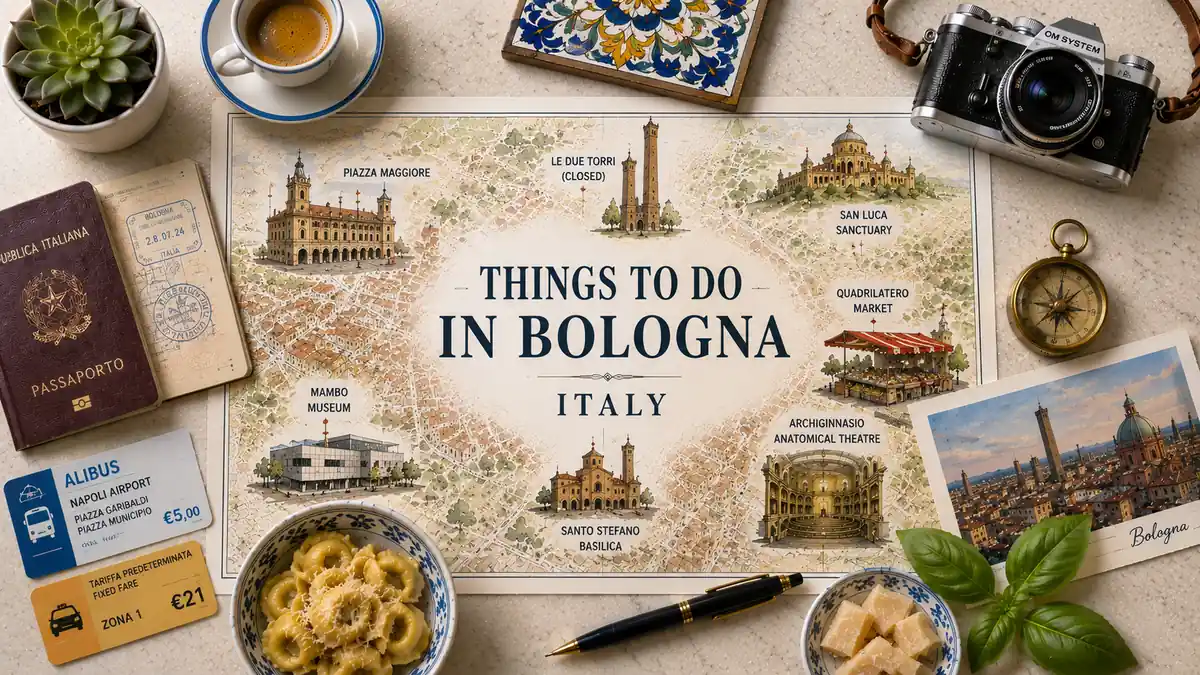
Bologna’s list of things to do is shorter than Rome’s or Florence’s, and far more heavily weighted toward eating. That is not a weakness. It means a compressed visit can cover the genuinely good things properly instead of sprinting between them — provided you know which ones those are.
The complication is that a lot of published advice here is out of date. The activity most guides still open with, climbing the Torre degli Asinelli, is no longer possible. Whole roundups still send readers to attractions that have shut for good.
What follows is a judged shortlist, not a survey: the experiences in Bologna that repay the time they cost, what each one actually gives you, who it suits, and where it makes more sense to skip. Food comes first, because in Bologna it should.
Quick Answer
Eat first: a guided food tour, a tortellini-and-tagliatelle cooking class, and grazing the Quadrilatero are Bologna’s standout experiences. The tower climb is closed, so the porticoes, the Archiginnasio anatomical theatre and Santo Stefano carry the sightseeing. Book food experiences ahead; motor enthusiasts should add the Ducati or Lamborghini museum.
Trust Layer
Tripstou selection guide for travelers choosing between multiple places. Covers selection criteria, traveler fit, and trip value.
Produced with AI assistance and reviewed by Alex Perrut, working in tourism since 2015, for the Tripstou editorial team. See our editorial process for details.
Last factual review: July 28, 2026.
Official sources consulted: Italia.it, ENIT.
Key Takeaways
- Food experiences outrank everything else in Bologna: a guided Quadrilatero tour or a hands-on pasta class delivers the city’s defining appeal.
- Walking the porticoes costs nothing and is the one experience that shows how Bologna actually works day to day.
- The Asinelli Tower climb is closed, so take the panoramic view from the Clock Tower or the San Luca hilltop instead.
- The Archiginnasio’s anatomical theatre is the strongest indoor hour in Bologna; Santo Stefano rewards only visitors willing to slow down.
- Book small-group food tours and cooking classes ahead; the porticoes, markets and most interiors are walk-in by nature.
- The Ducati and Lamborghini museums are a genuine highlight for motor enthusiasts and a weak use of a short trip otherwise.
Table of Contents
The best things to do in Bologna, ranked by payoff
Food experiences pay off the most in Bologna, followed by portico walking, the anatomical theatre and Santo Stefano. That order reflects what the city does better than anywhere else in Italy: eating, and walking sheltered streets. Everything else on this page is an add-on for a specific kind of traveler.
The ranking logic is easy to state and rarely applied: prioritize the things that are hard to replicate elsewhere in Italy. Almost every Italian city has a strong church, a museum and a viewpoint. Only Bologna has a food culture dense enough to fill a morning inside four streets, and only Bologna lets you cross most of the historic core under continuous arcades. Those two go first. The anatomical theatre earns third place on sheer strangeness, and Santo Stefano earns fourth on atmosphere.
Below that line, the picks turn conditional. The Ducati and Lamborghini museums are a highlight for one type of visitor and dead weight for everyone else. The panoramic view has changed shape since the tower climb closed, and the honest answer is now a smaller, cheaper ticket. If you are still weighing this city against other stops, the best places to visit in Italy comparison handles that decision; for orientation and the wider practical picture, the Bologna travel guide is the parent page.
Rough time commitments below are relative, not schedules.
| Experience | What it delivers | Who it suits most | Rough time commitment |
|---|---|---|---|
| Guided Quadrilatero food tour | Regional specialties explained while you eat them | First-timers with one food slot | Half a morning or afternoon |
| Tortellini and tagliatelle class | Hand-rolled egg pasta, made and then eaten | Repeat visitors and hands-on travelers | Most of a morning |
| Quadrilatero and market grazing | Free browsing, counters, cheese and cured meat | Independent travelers who avoid booking | An hour, easily longer |
| Portico walking, old town and San Luca | Covered streets, city rhythm, hilltop panorama | Walkers, photographers and slow travelers | An hour, or half a day uphill |
| The Archiginnasio anatomical theatre | A carved wooden dissection room, genuinely strange | Culture-led visitors short on time | About an hour, often less |
| Santo Stefano seven churches | Linked chapels and courtyards, unusually quiet | Atmosphere seekers with an unhurried hour | About an hour, unhurried |
How to order these across a stay is a sequencing question, and this page deliberately leaves it alone. Bologna’s shortlist is genuinely short, and that is its advantage: you can do all of it well in a two- or three-day visit, which is not true of Florence or Rome.
Food experiences are the reason to come to Bologna
A guided food tour through the Quadrilatero is the strongest food experience in Bologna. Food is not one section of this city’s appeal; it is the appeal. Four formats cover it: a guided tour, a hands-on cooking class, grazing the markets, and simply seeking out the defining dishes on your own.
Bologna is the capital of Emilia-Romagna and has carried the nickname “La Grassa” — the fat one — for a very long time, and unlike most food nicknames this one is load-bearing. The city sits at the heart of a region that produces Parmigiano-Reggiano, prosciutto di Parma, balsamic vinegar and mortadella, and it eats accordingly. Travelers who want the wider national picture will find it in our roundup of things to do in Italy. Inside Bologna, food is the centre of gravity and everything else arranges itself around it.
A guided food tour through the Quadrilatero
A food tour is worth it in Bologna in a way it is not in most Italian cities. The Quadrilatero is a dense grid of specialist shops — a mortadella counter, a fresh pasta window, a cheese room — and walking it alone means guessing which door matters. A guide gets you tasting from several of them in one pass, with the regional logic explained as you go: how the cheese ages, why the cured meat is sliced that thin, what separates a good ragù from a competent one. You also skip the ordering problem, which is the real barrier for a first-timer with no Italian.
Pick this if: you have one food slot in the trip and want the whole regional cast introduced in a single walk.
A cooking class making tortellini and tagliatelle
A cooking class beats a food tour for anyone who has already eaten their way around Italy. The Bologna version is specific: you make egg pasta by hand, roll it out, and shape tortellini and tagliatelle — the two forms this city is actually known for — then sit down and eat what you made. It is slower and pricier than a tour, and it commits a substantial block of the day. What it buys is a skill you keep and an understanding of why the pasta here tastes different, which no amount of tasting delivers. Classes tend to be small, which makes them the most sociable thing on this page.
Pick this if: you would rather leave Bologna able to make the pasta than able to describe it.
Grazing the Quadrilatero and the covered markets
Grazing the markets is the free, no-booking version of a food tour, with one honest limit. The Quadrilatero and the covered markets are working shopping streets first, so the format is browse, buy something small, and stand up to eat it. Done well, it is the most atmospheric hour in the city. Done as a substitute for lunch, it disappoints: this is snacking and looking, not a sit-down meal, and the good counters get crowded at the obvious hours. Go in planning to buy one small thing at three places.
Pick this if: you refuse to pre-book anything and want the food scene on your own timing.
The dishes worth building your meals around
Three dishes carry Bologna: tagliatelle al ragù, tortellini in brodo, and mortadella. Tagliatelle al ragù is the city’s defining plate, a slow meat sauce clinging to fresh egg pasta. Tortellini in brodo is the cold-weather classic — tiny stuffed parcels in clear broth — and it is a far quieter dish than most visitors expect. Mortadella, sliced thin and eaten standing up with a glass of local white, is worth seeking in the shops more than on a menu. Ragù belongs on tagliatelle here, never on spaghetti, and ordering spaghetti bolognese is the fastest way to be handed the tourist menu.
Pick this if: you would sooner spend the money on three excellent plates than on any guided experience.
Walking the porticoes is Bologna’s best free experience
Portico walking gives you Bologna’s daily life under cover, and it costs nothing. Kilometers of arcaded walkway link the historic core, so the city stays walkable in rain and midsummer heat alike. Two versions exist, and they are not interchangeable: the flat wander through town, and the long uphill portico that climbs to San Luca.
The porticoes are the reason Bologna reads differently from other Italian cities on foot. Life happens under them — bikes, bookshops, students, osteria doorways — which means walking is not the gap between activities here. It is one of them. Save the indoor sights for the clear day and walk the arcades when it rains; Bologna is one of the few Italian cities where bad weather barely costs you anything.
The city-centre portico walk
Walking the porticoes in the old town works best with no destination at all. The arcades run continuously enough that you can cross most of the historic core without leaving cover, and the pleasure is in the rhythm rather than any single stop. The one detail worth hunting is the small shuttered window on Via Piella that opens onto a canal — evidence of the waterways Bologna built over, and the closest thing the city has to a hidden view. An hour is enough to feel the point of this, and it costs nothing at all.
Pick this if: you want to understand how Bologna actually works before you start visiting things.
The portico climb up to San Luca
The San Luca climb pays off if you like walking uphill, and not otherwise. A covered portico runs from the edge of the old town all the way to the Sanctuary of the Madonna di San Luca, so the entire ascent stays arcaded and shaded. The reward at the top is the widest panorama in Bologna — the city on one side, the first Apennine ridges on the other — plus a church that is more atmospheric than grand. The climb is steady and long, and it will eat a serious chunk of the day. Anyone who dislikes hills, or is short on time, can take the view from the Clock Tower instead and lose very little.
Pick this if: you would happily trade an indoor attraction for a long uphill walk with a payoff at the end.
What is the best panoramic view in Bologna?
The Clock Tower in Piazza Maggiore is the best panoramic view you can actually climb in Bologna. It puts you above the red rooftops in the middle of the city, which is the view most visitors came for. The Asinelli Tower climb is closed and cannot be booked at present.
Both towers, Asinelli and Garisenda, have been closed to the public since movement was detected in the Garisenda foundations, and no reopening date has been published. Guides and roundups that still tell you to climb the Asinelli are simply stale. That leaves two working answers:
- The Clock Tower (Torre dell’Orologio) — a rooftop-level view over Piazza Maggiore and the skyline, for a modest ticket of around €10.
- The San Luca hilltop — the widest view of the city and the hills behind it, earned by the uphill portico walk described above.
The Two Towers work better as a view than as a viewpoint, and the Clock Tower is where you get that view. The reasoning holds either way: even if the Asinelli reopens, the thing you most want to look at in Bologna is the leaning pair themselves, and you cannot see them while standing on top of one.
Which cultural visits repay the time they cost?
The Archiginnasio’s anatomical theatre repays the hour more completely than anything else indoors in Bologna. It is a carved wooden dissection room inside the historic seat of Europe’s oldest university. Santo Stefano, the linked complex of small churches, is the second visit worth making, and the quieter of the two.
Both are short, both are central, and both give you something a photograph does not. Between them they cover Bologna’s two cultural strands: the university city and the medieval religious one. Neither needs a full morning.
Standing in the Archiginnasio’s anatomical theatre
The anatomical theatre is the most memorable interior in Bologna, and it takes under an hour. The room is a small amphitheatre panelled entirely in carved wood, with tiered benches ringing a central marble slab and a canopy carried by two skinless wooden figures. It was built for public dissections at the University of Bologna, the oldest university in Europe, and it still reads as a theatre — teaching staged as performance. The surrounding Archiginnasio corridors are plastered with the painted coats of arms of generations of students, and that accumulation is what makes the scale of the institution land.
Pick this if: you want one interior that is genuinely unlike anything else you will see in Italy.
Walking the seven churches of Santo Stefano
Santo Stefano rewards visitors who slow down and gives nothing to visitors who do not. Seven small churches, chapels and courtyards open into one another around a quiet brick cloister, so the visit becomes a sequence of moods — dim, then bright, then dim again — instead of one large interior. The individual pieces are modest. The accumulation is the experience. It will land flat for anyone collecting highlights, and it needs roughly an hour of unhurried attention to give anything back. Come early, while the courtyard is still empty.
Pick this if: you have an unhurried hour and prefer atmosphere to spectacle.
Ducati and Lamborghini museums are for motor enthusiasts
The Ducati and Lamborghini museums are worth a half-day if you genuinely care about engines, and a poor trade otherwise. Both are compact company museums built around the machines themselves — race bikes, prototypes, production models — with each brand’s own history told in sequence. Neither one converts a non-enthusiast into an enthusiast.
The two do different jobs. Ducati leans on the racing story and the engineering that made the bikes distinctive, which is why riders and motorsport followers get the most from it. Lamborghini leans on the road cars and the founder’s tractor-to-supercar origin, with the loudest hardware on display and less depth in the telling. These collections are told as company history and assume you already arrive knowing the model names.
- Ducati — the racing narrative and the engineering detail. Strongest for riders and motorsport followers.
- Lamborghini — the design-object experience. Strongest for anyone who wants to stand next to the cars.
Pick this if: engines are already a reason you travel, and Bologna is getting more than a flying visit.
What to book ahead and what to just walk into
Book the small-group experiences and walk into everything else. Food tours and cooking classes run on fixed departures with limited seats, so they fill; the porticoes, the markets and most church interiors have no capacity problem at all. That split covers almost every decision on this page.
Laid out as a ladder, the choice between guided and independent looks like this:
- Small-group food tour — suits first-timers who want the region explained. Trade-off: a fixed departure time that the rest of the day has to accommodate.
- Cooking class — suits hands-on travelers and repeat visitors. Trade-off: the largest time and money commitment on this page.
- Independent market grazing — suits travelers who dislike fixed times. Trade-off: nobody tells you what you are eating or why it matters.
- Independent portico and church walking — suits everyone, at any hour. Trade-off: none worth naming, which is exactly why none of it needs a ticket.
- Motor museums — suits enthusiasts only. Trade-off: a planned outing, never a spontaneous one.
Booking pressure concentrates in the busiest summer and holiday weeks, when small-group departures go earliest. Treat that as a tendency, not a guarantee. If only one thing gets booked in advance, make it the cooking class: it commits the largest block of your time, so everything flexible has to fit around it. How these experiences fall across a stay is a sequencing job this page leaves alone — the 2-day Bologna itinerary and the 3-day Bologna itinerary resolve the order and the pacing.
Tours and activities
Book skip-the-line tickets, day trips and local tours with free cancellation on most activities.
You can also browse everything on getyourguide.com.
Tripstou may earn a commission if you book through this link, at no extra cost to you.
Frequently Asked Questions
Can you climb the Two Towers in Bologna right now?
No. Both towers, Asinelli and Garisenda, have been closed to the public since movement was detected in the Garisenda foundations, and no reopening date has been published. Take the panoramic view from the Clock Tower in Piazza Maggiore instead, or from the San Luca hilltop.
Is Bologna worth visiting?
Yes, if you care about food. Bologna delivers Italy’s densest eating culture, kilometers of covered arcades, and a compact centre you can cover without rushing. Travelers hunting famous monuments or major art collections will find it thinner than Florence or Rome, and are better served elsewhere in Italy.
Do you need to book Bologna food tours and cooking classes in advance?
Yes. Small-group food tours and cooking classes hold limited seats and run on fixed departures, so the well-reviewed ones close out before the date. Aim to book once your dates are fixed, not after you arrive. Porticoes, markets and church interiors never need advance booking.
Is FICO Eataly World still open?
No, FICO Eataly World closed permanently. A different attraction, Grand Tour Italia, later opened on the same site, so roundups still listing FICO are out of date. Nothing about that site is essential to a first visit built around Bologna’s historic core.
What are the best things to do in Bologna with kids?
Portico walking and market grazing work best with children, because both are free, unstructured and easy to abandon halfway. The motor museums land well with older kids who like machines. Skip the long San Luca climb and Santo Stefano, which reward a patience younger visitors rarely have.
What should you skip in Bologna?
Skip the tower climb, closed anyway, and skip the motor museums unless engines already interest you. Treat market grazing as snacking, not a substitute for lunch. And never order spaghetti bolognese; ragù belongs on tagliatelle here, and asking marks you instantly as a tourist.
Related Guides
Bologna’s experiences resolve here; the planning, the sequencing and the wider Italian context live on these pages.
- Bologna travel guide — the parent guide for orientation and practical planning.
- 2-day Bologna itinerary — how to order these experiences across a short stay.
- 3-day Bologna itinerary — the same job with room for San Luca and the museums.
- Things to do in Italy — the national view of experiences worth planning around.
- Best places to visit in Italy — where Bologna sits among Italian destinations.
Did this guide save you time or money? Tripstou is independent and reader-funded — if you'd like to give something back, you can support the site with a crypto contribution of any size.