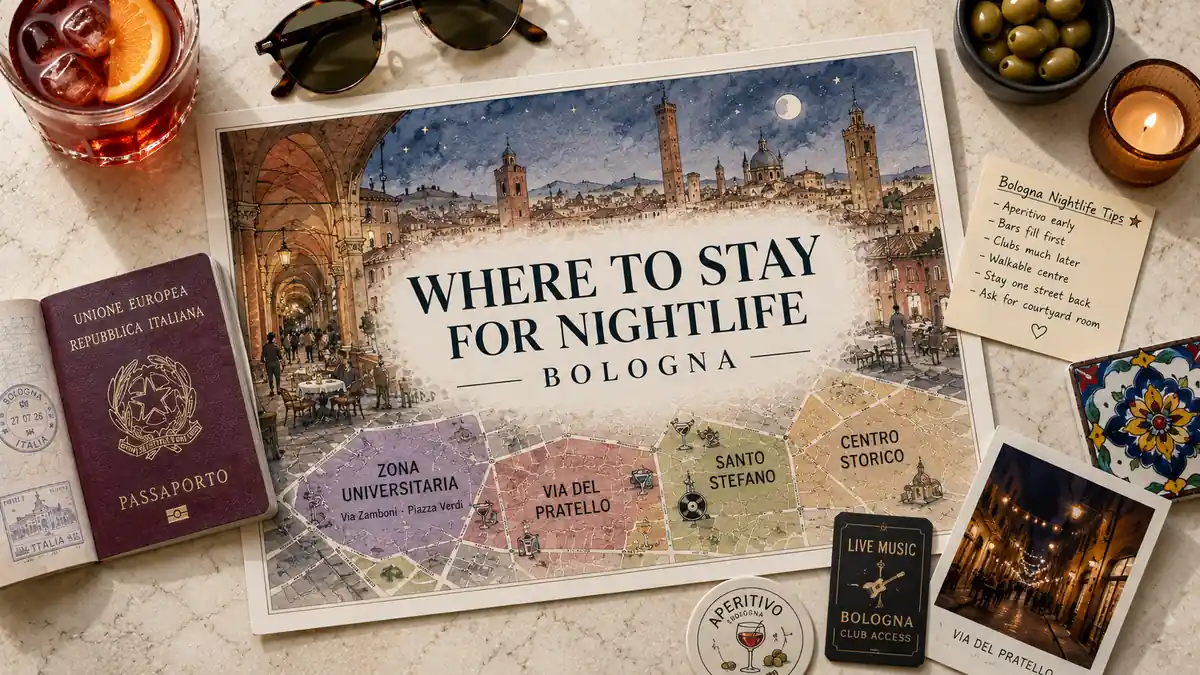
Choosing a Bologna base for nightlife comes down to one tension: the best streets to drink on are the worst streets to sleep on. Bologna’s night is dense and cheap by Italian standards, concentrated in a few named zones — the university quarter around Via Zamboni, the bar corridor of Via del Pratello, and the aperitivo pockets inside the old centre — and each one produces a different kind of evening. This guide gives a verdict on each realistic base, says who it suits, and states plainly what it costs you in sleep. One thing worth knowing before you compare: Bologna’s centre is small and almost entirely arcaded, so walking between nightlife zones is quicker and less weather-dependent than in most Italian cities. “Close enough to the action” covers more ground here than you expect, which means proximity is rarely the thing you need to optimise for.
Quick Answer
Zona Universitaria, around Via Zamboni and Piazza Verdi, is the best Bologna base if nightlife comes first. It is also the hardest base to sleep in: noise is the price of proximity. Santo Stefano or a quieter centre street keeps the bar streets a short walk away without the volume.
Trust Layer
Tripstou stay guide for travelers choosing where to base. Covers area atmosphere, budget, convenience, noise, and traveler fit.
Produced with AI assistance and reviewed by Alex Perrut, working in tourism since 2015, for the Tripstou editorial team. See our editorial process for details.
Last factual review: July 27, 2026.
Official sources consulted: italia.it, enit.it.
Key Takeaways
- Zona Universitaria delivers the densest, cheapest night in Bologna, and the worst sleep — noise is the price of that doorstep.
- Bologna’s centre is compact and arcaded, so quiet is the scarce resource — proximity to the bar streets costs almost nothing.
- Via del Pratello suits craft beer and live music with a resident crowd; book one street back to sleep through it.
- Santo Stefano or a calm centre street keeps the bar zones a short walk away without the volume — the mixed-group answer.
- Ask for a courtyard-facing room before you change neighbourhoods; aspect fixes more noise than distance does in Bologna’s old palazzo hotels.
- Bologna’s big clubs sit outside the old walls, so club proximity is a weak reason to move your base outward.
Table of Contents
Which Bologna area has the best nightlife?
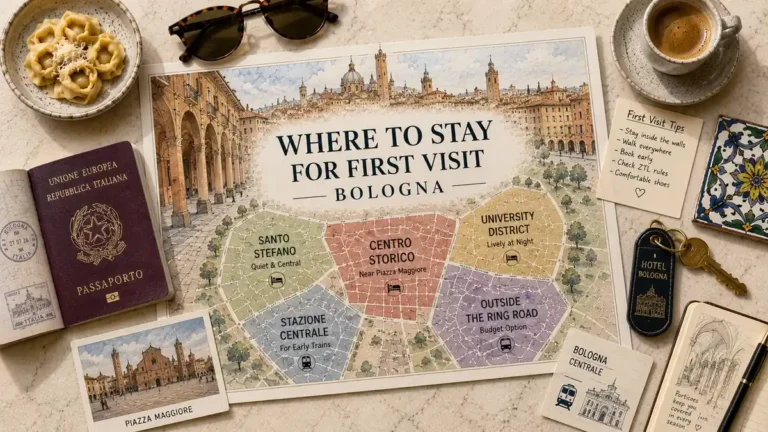
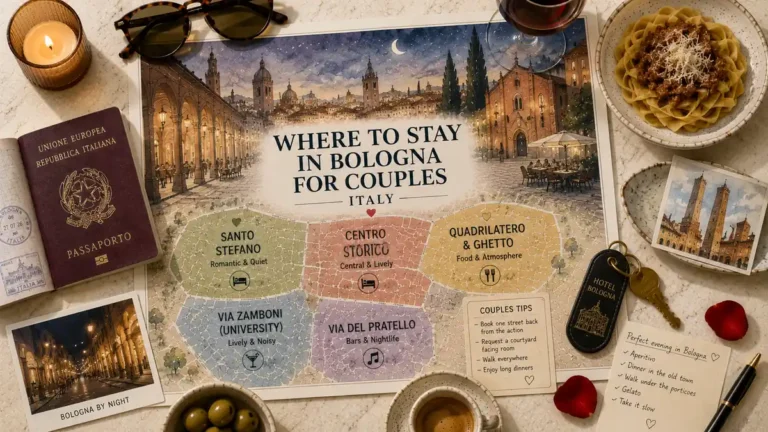
Zona Universitaria has the densest nightlife, but the centre and Via del Pratello win on different nights. Zamboni and Piazza Verdi carry the student volume; Pratello draws craft beer and live music; the centre holds the wine-bar evening. Bologna’s core is small enough that all three stay walkable from one base.
| Base | Style of night out | How loud to sleep in | Relative price positioning |
|---|---|---|---|
| Zona Universitaria | Student bars and drinking on Piazza Verdi | Loudest of all, especially at weekends | Budget — the cheapest beds and drinks |
| Via del Pratello | Craft beer, live music, a local crowd | Loud along the street itself, calm one block off | Budget to mid-range, gentler than the core |
| Historic centre | Aperitivo and polished wine bars, early evenings | Varies sharply street by street | Mid-range to high-end, the priciest streets |
| Santo Stefano | Restrained wine bars and civilised dinners | Quietest of the four main bases | Mid-range to high-end, without the noise |
| Bolognina and station area | Closest to the larger club venues | Quiet residentially, functional near the station | Budget, the softest rates in the city |
Walkability is what keeps several bases viable at once. The historic core is compact and almost entirely arcaded, so moving between nightlife zones is quick and stays dry in bad weather. From most central rooms you can reach two of the three drinking zones on foot without planning anything. For general area logic beyond the nightlife filter, the full Bologna area breakdown covers every traveller type.
One seasonal caveat belongs here. Bologna is a university city, so the student night thins during term breaks — most visibly in August — while venues stay open and summer outdoor programming picks up part of the slack.
The porticoes make every walk short and covered, so proximity is cheap in Bologna and quiet is the scarce resource. Choose for sleep.
Zona Universitaria is the loudest — and cheapest — nightlife base
Zona Universitaria puts you inside the student night, on Via Zamboni and around Piazza Verdi. The crowd is young, largely local students, and the drinking is cheap, loud and spills into the street. You sleep badly here on weekend nights, and that is the whole trade.
The atmosphere is student-run and unpolished. Piazza Verdi fills with young drinkers on the steps and the pavement, the Zamboni bars spill outward, and the sound carries between the buildings. Weekends are the peak. Midweek in term time is still busy. It is sociable, cheap and not remotely refined.
Convenience is the reason people book here. You leave the room, you are in a bar, and you walk back whenever you like — no taxi, no planning, no last-order anxiety. The Quadrilatero’s aperitivo lanes sit a short walk west, and Pratello is reachable on foot across the core.
On price this is the most budget-friendly of the main nightlife bases. Hostels and simple guesthouses concentrate around the university, drinks are priced for a student market, and that combination is what makes the quarter the default answer for anyone doing Bologna nightlife on a budget. Rooms are basic more often than not.
For the quarter’s full character beyond the night — daytime feel, food, what it is like to actually live in — read the full Zona Universitaria area guide. If your real decision is this quarter against the old core, the centre versus Zona Universitaria comparison resolves it head to head.
- Best for: budget travellers and under-30s who want the night on their doorstep and do not mind noise.
The trade is sharper here than on a normal bar street because Piazza Verdi is an open square: the sound has nowhere to go but up the facades, so booking a high floor helps far less than it would on a narrow lane.
Via del Pratello suits craft beer, live music and a local crowd
Via del Pratello is the best base for craft beer, live music and a local crowd. The street works as one long bar corridor, with an older and less transient crowd than Piazza Verdi. It stays lively late, so the specific room matters more than the postcode.
Pratello’s night is horizontal. It runs as a single street of small bars, osterie and music rooms, drawing people who live in Bologna and are out for a beer and a band. The energy comes from the corridor itself, not from a square filling up, which makes it feel more neighbourhood than campus.
The street sits just west of the historic core, an easy arcaded walk from Piazza Maggiore. Everything on Pratello is on Pratello, and that is the appeal: pick one street, stay on it, walk home. Getting back to a centre or Santo Stefano base afterwards is straightforward on foot.
Price positioning is budget to mid-range. It reads gentler than the polished centre streets and a touch above the student quarter, with small independent guesthouses and apartments more common than hotels.
Is it noisy to sleep on? Yes, and honestly so. The bars sit at street level along a narrow corridor, so a street-facing room hears the night until it ends. A room one block off, or an internal room on Pratello itself, buys you the same walk with a fraction of the sound.
- Best for: drinkers who want a local, non-touristy night built on craft beer and live music instead of student volume.
The historic centre buys walkability without a bar under your window
The historic centre is the most flexible nightlife base in Bologna. Everything is walkable — the Quadrilatero’s aperitivo lanes, the Ghetto Ebraico’s wine bars, Zamboni and Pratello on either side — and you can pick a loud street or a calm one a block back. It suits travellers who want polished evenings without committing to one scene.
Evenings here are aperitivo-led and comparatively refined. The old market lanes of the Quadrilatero and the quiet grid of the Ghetto Ebraico hold wine bars and small aperitivo spots that fill early and stay busy without turning rowdy. This is the base for a good drink and a proper dinner, and a nightcap on the way home.
Nothing is far. From a central room you can reach Zamboni in one direction and Pratello in the other on foot, under porticoes most of the way, which makes the centre the only base that keeps all three nightlife zones genuinely in play. The daytime city is on your doorstep too.
On price the centre is the high-end option among the nightlife bases, with the streets ringing Piazza Maggiore costing the most. For where the upper end of central lodging actually sits, see luxury hotels in Bologna. For the district’s wider character, read the full historic centre area guide.
- Best for: travellers who want polished wine bars and everything walkable, with a choice of quieter streets one block back.
The centre’s real advantage is that its loud and quiet lanes are interleaved: a room one street back from the Quadrilatero rarely costs more than one on it, and sleeps like a different city.
Santo Stefano is the quiet base you can still walk home to
Santo Stefano lets you sleep properly and still walk home from the bars. Nights here are calm — residential streets, a beautiful piazza, a handful of restrained wine bars — while Zamboni and the Quadrilatero stay a short walk away. What you give up is spontaneity, not access.
The evenings are low-volume by design. Via Santo Stefano and the streets around the basilica complex hold understated wine bars and restaurants that empty at a civilised hour, and the residential fabric keeps street noise down. This is where you stay when a night out is a plan.
The bar zones stay in reach. The Quadrilatero and the university quarter are a short arcaded walk, so you can go out properly and still get home on foot. What you lose is the pull of the street — nothing drags you out of the door, and a nightcap means going back out rather than downstairs.
Price sits mid-range to high-end, quietly. The area is desirable and residential, so it seldom undercuts the centre, and the value shows up in sleep quality, not in the rate.
For the district’s full character, read the full Santo Stefano area guide. If you are weighing it directly against the old core, the centre versus Santo Stefano comparison settles that choice.
- Best for: light sleepers and mixed-bedtime groups who want quiet nights within a short walk of the action.
Santo Stefano is the base that keeps a split group together: the early sleeper gets a residential street and the late one still gets a walk home that never needs transport.
Other Bologna bases worth knowing
A few outer Bologna bases have a nightlife case, mostly on price or club proximity. Bolognina, the station area and the fair district all put you within reach of the bigger venues or a cheaper room, but none of them beats a walkable centre base for an ordinary night out.
- Bolognina — north of the station, residential and genuinely local, with a small independent bar and music scene and the softest room rates in the city. You cross the railway to reach the centre, which keeps it a value pick and not a main base.
- Station area — useful for the larger venues out this way and for early departures, with plenty of mid-range chain rooms. Nightlife on the doorstep is thin and the streets feel functional after dark, so it earns its mention on convenience alone.
- Fair district — built around the exhibition quarter, so rates swing with the trade-fair calendar. It is quiet, business-oriented and well away from the bar streets; book it only if a fair or a price anomaly puts you there.
None of these displaces the four main bases for a nightlife trip. If you are still building the rest of the trip around the stay decision, the full Bologna travel guide covers the city beyond where you sleep.
Are Bologna’s clubs in the centre or outside it?
Bologna’s bars and aperitivo are in the centre; the bigger clubs sit outside it. Link Project lies west of the historic core, and Estragon sits over near Bologna Centrale. For base choice, that means a central room covers most nights, and club nights involve a trip out either way.
The split matters for one reason: it decides whether a club night is a walk or a journey. Bars, aperitivo and live music are dense inside the old walls, so a central base handles the great majority of evenings with no transport at all. The large club spaces are a separate errand from any base you pick.
That makes club proximity a weak reason to move your base outward. Programming at the bigger venues runs irregularly and varies night to night, so building a whole stay around it rarely pays. Entry conditions at Italian club venues are not uniform either, which is one more argument for treating a club night as a separate plan and not a base criterion.
How to sleep near the nightlife without hearing it
In a centre this compact, you can buy quiet without buying distance. The room matters more than the neighbourhood: a courtyard-facing room on a bar street often sleeps better than a street-facing room two blocks away. Choose the aspect first, then the address.
Bologna’s noise is street-level and corridor-shaped, so it falls away fast once you are off the bar spine or above it. That is why the room-choice levers below are worth more than moving your whole base outward. Ask for them explicitly when you book.
- Courtyard-facing or internal room — usually the most effective fix; suits light sleepers who still want a bar-street address, at the cost of a view.
- Upper floor — free to request and reliable on narrow streets; less effective facing an open square, where sound rises up the facades.
- One street back from a bar corridor — keeps the walk trivial and takes you off the loud spine; you lose the doorstep convenience.
- Never directly above a bar — the one option to rule out outright; extraction fans and closing-up noise outlast the crowd itself.
- Double glazing, confirmed with the property — older centre buildings often still have single panes, and listings rarely say so.
For a mixed group with different bedtimes, base on the quiet side and walk to the noise. A calm centre street or Santo Stefano lets the late half stay out as long as they like while the early half sleeps, with nobody needing transport. Basing on Zamboni or Pratello simply inverts the problem.
Bologna’s centre is full of old palazzo hotels built around internal courtyards, so the courtyard-facing request works here far more often than in cities built on solid street-facing blocks. Ask for it by name.
Hotels and places to stay
Compare hotels, apartments and stays for your dates in one search.
Search hotels and stays on hotels.com →
Tripstou may earn a commission if you book through this link, at no extra cost to you.
Best Bologna nightlife base by traveler type
The right base depends on the kind of night you want and how well you need to sleep. Match those two variables and the choice resolves quickly — there are only four serious bases in Bologna, and each one owns a distinct kind of traveller.
- First night out in Bologna → historic centre — you can sample all three nightlife zones on foot without committing to any of them.
- Student-budget traveller → Zona Universitaria — the cheapest beds and the cheapest drinks sit on the same streets.
- Craft-beer and live-music crowd → Via del Pratello — one street delivers the entire night, with a resident crowd instead of a student one.
- Wine-bar couple after a polished evening → the Quadrilatero and Ghetto Ebraico pockets — aperitivo-led venues and a short, well-lit walk home.
- Light sleeper who still wants to go out → Santo Stefano — calm residential streets with the bar zones a short walk away.
- Mixed-bedtime group → a quiet centre street one block off the Quadrilatero — the late half walks to the noise, the early half sleeps through it.
Book the base for whoever in the group sleeps worst. The good sleepers lose a short covered walk; the bad sleeper otherwise loses the trip.
Frequently Asked Questions
What time does nightlife start in Bologna?
Bologna’s night starts with aperitivo in the early evening, usually well before dinner. Bars fill first, restaurants later, and the drinking crowd on Via Zamboni and Via del Pratello builds through the late evening. Clubs are the last stop and stay quiet until much later, so an early arrival sees little.
What time do bars close in Bologna?
Bologna’s bars close late, and later still at weekends. Centre bars generally wind down in the small hours on weeknights and run noticeably longer on Friday and Saturday, while the larger club venues go later again. Closing times vary by venue and by street, so treat any single figure as approximate.
Do you need a membership card to get into Bologna clubs?
Sometimes. A number of Italian music and club venues operate as private associations, which means the door asks for a membership card and you sign up on arrival. It is not universal and it does not apply to ordinary bars or aperitivo spots. Check the venue’s own page before going.
Is Zona Universitaria too loud to sleep in?
On Piazza Verdi itself, yes, especially at weekends in term time. A few streets back from the square the quarter already sleeps far better while keeping the same short walk. Ask which way the room faces before booking, because an internal or courtyard room changes the answer completely.
Is Bologna nightlife dead in August?
No, but it changes shape. The student crowd largely leaves, so Piazza Verdi and Via Zamboni lose their usual density while venues stay open and summer outdoor programming takes up some slack. If you are visiting then, the university quarter is a weaker base and the centre is the safer pick.
How walkable is Bologna at night from the centre?
Very. The historic core is small and covered by porticoes, so Via del Pratello, the Quadrilatero and Via Zamboni all sit within an easy walk of each other and of most central rooms. The exception is the larger club venues outside the old walls, which are a journey.
Related Guides
- Where to Stay in Bologna — the master area guide covering every traveller type, not just nightlife.
- Zona Universitaria area guide — full detail on Bologna’s loudest and cheapest nightlife base.
- Historic centre area guide — the flexible, walkable base explained in depth.
- Santo Stefano area guide — the quiet counterpoint district in full.
- Luxury hotels in Bologna — where the upper-end central properties actually sit.
- Bologna travel guide — city context beyond where you sleep.
Did this guide save you time or money? Tripstou is independent and reader-funded — if you'd like to give something back, you can support the site with a crypto contribution of any size.