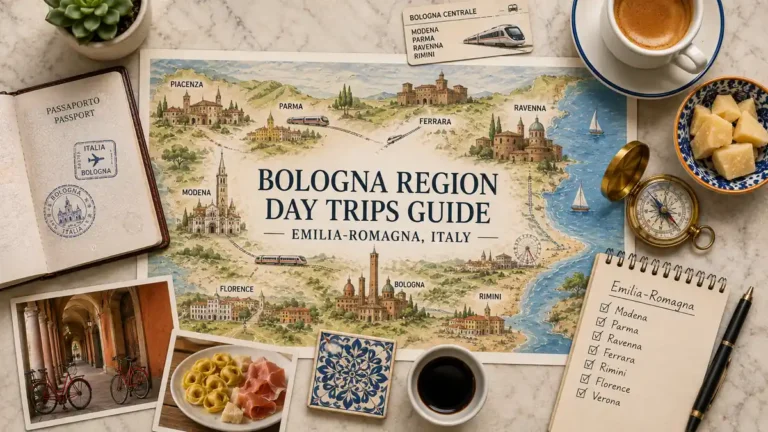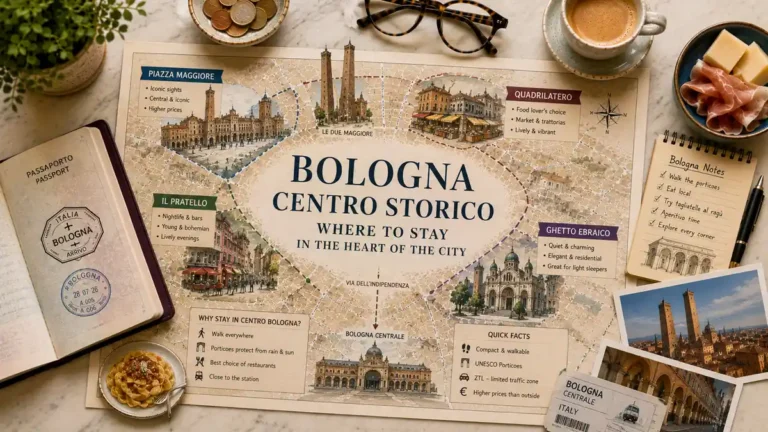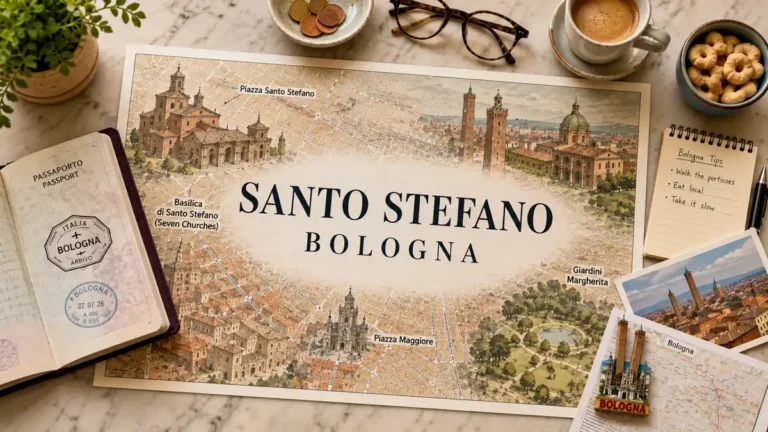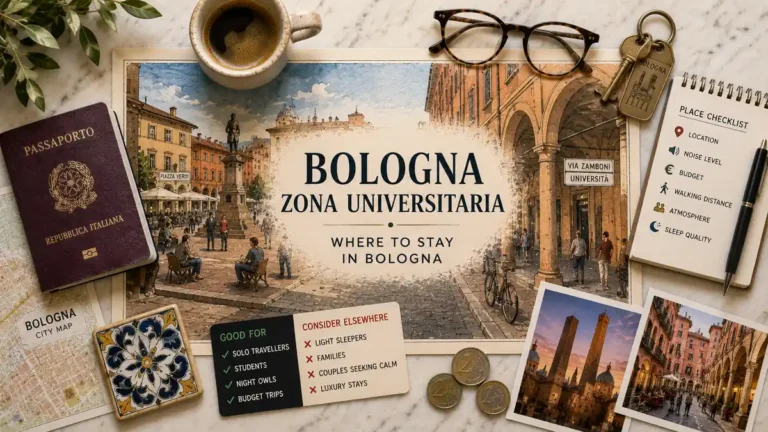
Bologna’s historic centre is small, covered and almost entirely walkable, which is exactly why a three-day trip needs a plan that a two-day trip does not. Two days already cover the famous core: Piazza Maggiore, the Quadrilatero, the Archiginnasio, the porticoes and the Due Torri seen from the street. That makes the third day the only real question in a 72-hour trip, and most itineraries answer it with a menu of eight possible day trips instead of a decision.
This guide commits to one route and one branch. You get a Day 1 / Day 2 / Day 3 shape built around a single central base, the unhurried pace that three days buys over two, a recommended day trip with the reason behind it, and a straight answer on the Two Towers before you build a morning around them.
Quick Answer
Day 1 covers Bologna’s centre core, Day 2 San Luca and the university quarter, Day 3 forks. The choice is a train out to Modena, the recommended default, or a slow Bologna day of museums and markets. It suits travellers on one central base who want an unhurried pace and use day three deliberately.
Trust Layer
Tripstou itinerary guide for travelers planning a route. Covers pacing, stop count, stop order, base logic, and trip length.
Produced with AI assistance and reviewed by Alex Perrut, working in tourism since 2015, for the Tripstou editorial team. See our editorial process for details.
Last factual review: July 28, 2026.
Official sources consulted: Italia.it, ENIT.
Key Takeaways
- Day 1 walks the centre core, Day 2 climbs to San Luca and the university quarter, Day 3 forks.
- Three days is not too many for Bologna, but only if day three is planned instead of left open.
- Take Modena as the default day trip: the shortest hop, and a genuinely different Emilia-Romagna identity in one day.
- Book one central hotel for all three nights, close enough to the station that day three’s early train stays painless.
- The Asinelli climb is closed, so see the Due Torri from the street and take the Clock Tower for the view.
- Give one of the three days a deliberate food anchor — a market lunch, a food tour or a cooking class.
Table of Contents
Is 3 Days in Bologna Too Many?
Three days in Bologna is not too many, provided the third day is used deliberately. The historic centre fills two comfortable days on foot. The third day buys something the first two cannot: either a second Emilia-Romagna town by train, or the museums, markets and long lunches that a 48-hour visit skips.
Trip length changes what Bologna gives back, and the tiers are unusually clean here:
- Two days — the compressed core. You see Piazza Maggiore, the Quadrilatero, the Archiginnasio, Santo Stefano and San Luca, but the days run back to back with no slack. Fits weekenders and anyone slotting Bologna between Florence and Venice.
- Three days — the same core unhurried, plus one deliberate extra day. Lunches stop being a problem to solve, and day three adds either a second town or real museum time. Fits first-time visitors who want the region, not only the city.
- Four days — the core, a day trip and a slow city day, without choosing between the last two. Fits food-led travellers and anyone who came to Emilia-Romagna for Emilia-Romagna.
What three days does not buy is regional breadth. One town, once. Emilia-Romagna has enough day-trip candidates to fill a week, and trying to fit two of them into a 72-hour trip costs you the city you came for. Arrival logistics, getting around and the broader orientation sit outside this route entirely — the Bologna travel guide handles those.
Bologna punishes an undecided third day more than most short city trips do. The centre is small enough that a day left open quietly becomes a slower repeat of day one, which is pleasant and completely forgettable.
The Recommended 3-Day Bologna Route at a Glance
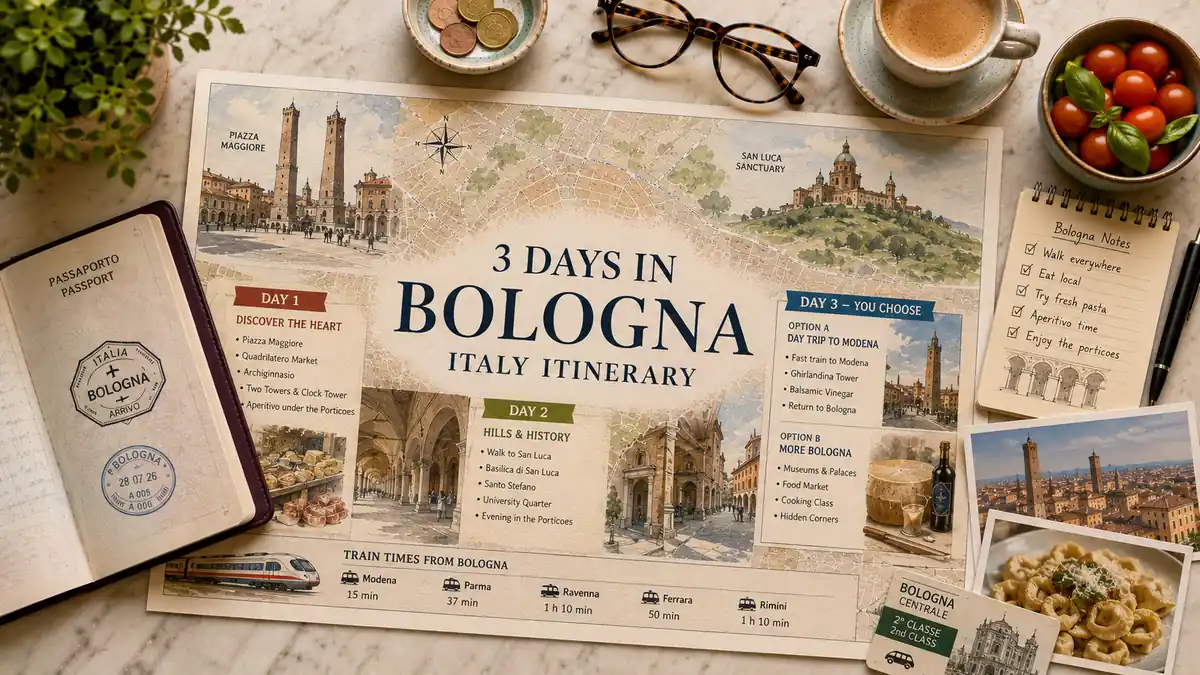
The route runs centre core, then San Luca and the quieter east, then one decided extra day. Day 1 stays inside the medieval core, Day 2 climbs to the sanctuary and drifts through the university quarter, and Day 3 either leaves the city by train or slows down inside it. One base throughout.
- Day 1: Piazza Maggiore, the Quadrilatero and the Archiginnasio — the civic and market core.
- Day 2: Portico di San Luca, Santo Stefano and Via Zamboni — the view and the quieter side.
- Day 3: a day trip by train, or a slow Bologna day — the fork this trip turns on.
Pacing only — the day blocks below carry the reasoning.
| Day | Morning | Afternoon | Evening |
|---|---|---|---|
| Day 1 — the centre core | Piazza Maggiore, San Petronio, Palazzo d’Accursio | Quadrilatero lunch, then the Archiginnasio | Porticoed streets and an unhurried aperitivo |
| Day 2 — the view and the east | The covered portico up to San Luca | Santo Stefano, then the university quarter | Dinner on the student side of the centre |
| Day 3 — the fork | Early train out, or a museum anchor | Long lunch in the town, or the porticoes | Back in Bologna for a final dinner |
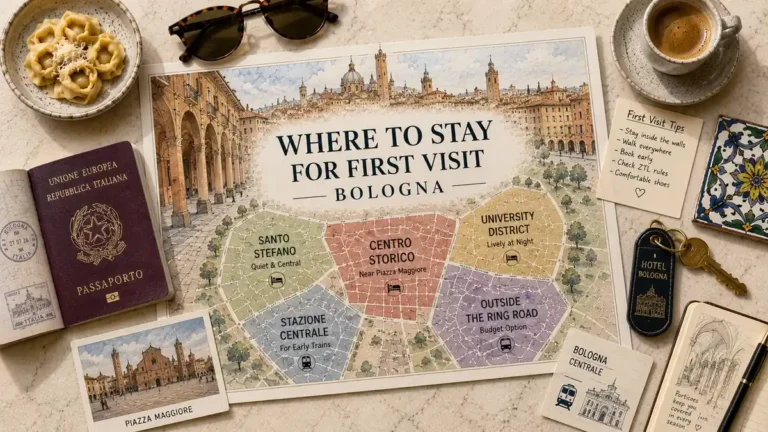
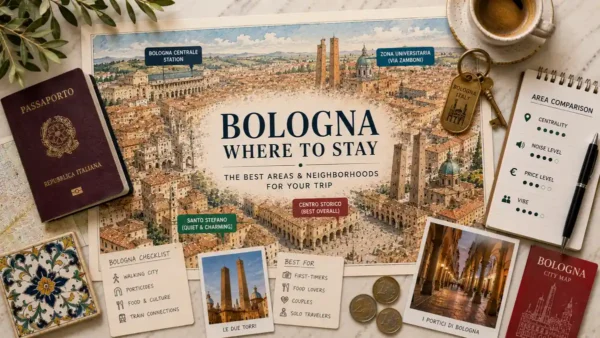
One hotel for all three nights is the right call, and it should sit inside the centre. The city is too small to reward moving. Changing base adds cost and packing time while saving nothing, and the walking loops all start from the same handful of streets. The one variable worth weighting is the walk to the station: day three is the only morning with a clock on it, and a base that turns an early train into a long cross-town haul is the difference between a calm route and a rushed one. Area-by-area selection is a separate decision — where to stay in Bologna resolves it properly.
Hotels and places to stay
Compare hotels, apartments and stays for your dates in one search.
Search hotels and stays on hotels.com →
Tripstou may earn a commission if you book through this link, at no extra cost to you.
Day 1: Piazza Maggiore, the Quadrilatero, and the Archiginnasio
Day 1 walks the civic and market core as one tight loop, with lunch built into it. The centre comes first because everything else on the route makes more sense once you have stood in Piazza Maggiore. At a three-day pace the loop takes a full day without hurrying, and the meal sits inside it.
This is night one of three in the same central base, so nothing needs to be carried and nothing needs to be rushed. The morning belongs to Piazza Maggiore, San Petronio and Palazzo d’Accursio — the civic set piece Bologna organises itself around, and the orientation point every later walk radiates from. Give it longer than feels necessary. On a two-day trip this is a photo stop; on a three-day trip it is where the city starts making sense.
Midday moves into the Quadrilatero, the tangle of market lanes east of the square, and this is where the extra day earns its keep. Instead of grazing between sights, sit down for a proper lunch. The stalls and shops keep their own rhythms and traditionally wind down in the afternoon, so treat the late morning as the window to look and the early afternoon as the window to eat. You will walk past the Due Torri here — they anchor the eastern end of the centre at street level, and that is exactly how this route uses them.
The afternoon is the Archiginnasio and its Anatomical Theatre, the old university seat with the carved wooden dissection room upstairs. It is small and popular, so go early in the afternoon and expect the room itself to take less time than the courtyards below it. Attraction-level detail on any of these stops lives in things to do in Bologna — this block is about the order, not the write-up.
The day closes under the porticoes with an aperitivo somewhere between the Archiginnasio and Piazza Maggiore, which puts dinner within a short covered walk of your base. Rain does not change the plan. That is the practical gift of a portico city, and it matters more on a three-day trip than a two-day one, because you have no spare day to reshuffle around weather.
Day 2: San Luca, Santo Stefano, and the University Quarter
Day 2 trades density for perspective, starting with the covered portico up to San Luca. The morning is one long uphill walk under arcades to a sanctuary above the city. The afternoon comes back down into Santo Stefano and the university quarter, at the pace that 48 hours never allows.
Second of three nights, same central base, so the day is a loop out and back with nothing to pack. The morning anchor is the Portico di San Luca and the Santuario della Madonna di San Luca on the Colle della Guardia — the arcade that gives Bologna’s UNESCO-listed porticoes their signature image, and the only place in the route where you look back down at the city. It is the one leg with a genuine physical cost, and it takes a real chunk of the morning whichever way you go up.
How Do You Get to San Luca From the City Centre?
You either walk the covered portico uphill or take the tourist train that runs up from the centre. Both reach the same sanctuary. They buy very different mornings.
- Walk the portico — the full experience, and the reason San Luca is on the route at all. Suits reasonably fit walkers who want the arcade itself, not only the view at the top. The tradeoff: it is a steady, continuous climb and it costs you most of a morning.
- Take the tourist train — the easy option, and the sensible one in heat, rain or with tired legs. Suits families, shorter stays and anyone saving energy for the afternoon. The tradeoff: you give up most of the portico, which is the part that makes the trip up distinctive.
A reasonable middle path exists: ride up, walk down. Timetables, frequencies and fares change, so check them locally on the morning and do not build the day around a schedule you read weeks earlier.
The afternoon comes back into the centre for Santo Stefano, the Seven Churches complex, which rewards being visited with no clock on it — a stitched-together set of chapels and courtyards you wander instead of tour. From there it is a short walk into Via Zamboni and the university quarter, where the tone shifts from monumental to student, with San Domenico or Palazzo Poggi as an optional third stop if the afternoon still has energy in it. Museum opening days vary and Monday closures are common in Italy, so confirm before you build an afternoon around an interior.
The day closes in the university quarter, which is where Bologna’s evenings are liveliest and least polished. Dinner here, then a covered walk back. Day 3 is the one that needs a decision made before you go to bed.
Day 3 Is a Decision: Take a Day Trip or Slow Down in Bologna
Leave Bologna on day three if you want a second Emilia-Romagna identity in the trip. Stay if the centre still has doors you have not opened and you would rather eat than commute. A day trip adds a place, a slow day adds depth, and three days only fits one of them.
Each branch has a real price. A day trip spends two travel legs and a chunk of the middle of the day, and returns a whole town you would otherwise never see. A slow Bologna day spends nothing on transport and returns depth — a museum you actually finish, a market lunch, an afternoon that goes nowhere in particular — but adds no new place to the trip. Bologna is the rail hub of Emilia-Romagna, so the logistics do not decide this for you: Modena, Parma, Ferrara and Ravenna are all day-trippable from the same station, which leaves the fork as a preference question.
The branch travellers regret is the one they never chose. An undecided day three defaults to staying, and a defaulted slow day is not the same thing as a chosen one — it usually turns into a second lap of the centre with a nicer lunch. Decide on Day 2’s evening, not on Day 3’s breakfast.
Which Day Trip From Bologna Is Worth Your Third Day?
Modena is the one to take if you only take one. It is a short hop, its centre is small enough to absorb in a single unhurried day, and it delivers a genuinely different Emilia-Romagna identity — balsamic vinegar and Motor Valley — without asking you to spend the day in transit. That combination is rare. It is the default because it costs the least day and changes the trip the most.
- Modena — choose this if you want the shortest possible hop and the region’s food and motoring identity in one easy day.
- Parma — choose this if prosciutto and Parmigiano are the specific reason Emilia-Romagna was on your list.
- Ferrara — choose this if you want a flat, cyclable Renaissance town with Este Castle and UNESCO-listed walls.
- Ravenna — choose this if Byzantine mosaics are worth giving up a larger share of the day to reach.
Getting there splits the four cleanly: Modena and Ferrara are the short hops that leave the day mostly intact, while Parma and Ravenna cost you more of it in each direction. That travel cost, not the towns themselves, is what should decide the pick on a 72-hour trip.
The shape of the day is the same whichever town wins. Take an early train out, commit to one anchor sight instead of a checklist, build in a long lunch — it is the point of the region, not an interruption of it — and come back to Bologna in time for dinner in the city. Do not stack a second town on the way home.
What Does a Slow Third Day in Bologna Look Like?
A slow third day is one museum anchor, a market lunch and an afternoon with no destination. It is not a day off from the route; it is the version of Bologna that a compressed two-day trip cannot show you, spent entirely on foot inside a centre you already know how to navigate.
Start with the Pinacoteca Nazionale in the morning, near the university quarter you walked through on Day 2, and give it enough time to be worth entering. One museum is enough. Palazzo Poggi is the natural second stop in the same neighbourhood if the morning stretches, and MAMbo is the alternative for travellers who would take contemporary art over Bolognese painting. Lunch belongs at Mercato delle Erbe, the covered market where eating is the point and where a slow third day stops feeling like an unstructured one. Market and shop timings follow local habits, so check what is open on the day before committing to it.
The afternoon is deliberately soft: the porticoes on the way south and Giardini Margherita, the city’s main park, where Bologna stops performing for visitors entirely. The one substitution worth making is a cooking class, which becomes the day’s single anchor in place of the museum — a half-day in a kitchen learning tortellini or ragù replaces the morning and part of the afternoon, and leaves the porticoes as the wind-down. Whichever version you take, this branch has to be planned the way the day trip is planned, or it collapses back into wandering.
Train and bus tickets
Compare routes, schedules and prices across rail and bus operators in one search, with mobile tickets on your phone.
New to Omio? Code NEW10 takes 10% off your first booking — or APPNEW10 if you book inside the Omio app. Both apply to bookings up to €80.
Search routes and compare prices on Omio →
Tripstou may earn a commission if you book through this link, at no extra cost to you.
The Asinelli Tower Is Closed — Where to Get the View Instead
The Asinelli Tower is closed to climbers, with no announced reopening. The Due Torri are still worth walking to — they anchor the eastern end of the medieval centre at street level and cost you nothing but a short detour. For a view over Piazza Maggiore and the rooftops, climb the Clock Tower instead.
The towers already sit in the Day 1 loop, between the Quadrilatero and the Archiginnasio. Street level is the whole visit. Plenty of itineraries still route a morning around the Asinelli climb; treat that as out of date and reallocate the time to lunch.
The Clock Tower on Piazza Maggiore, inside Palazzo d’Accursio, is the panoramic alternative, and it works well precisely because it looks out over the square from just above it. Entry is around €5 — check before you go.
Where Food Fits Across Three Days in Bologna
Food is route structure in Bologna, not a break between sights. One of the three days should carry a deliberate food anchor — a market lunch, a food tour or a cooking class — and the other two should place meals where they keep the walking working.
Day 1’s main meal belongs in or around the Quadrilatero at midday, because it is the one loop where the food and the sightseeing occupy the same streets. Day 2 wants the opposite: a light start, something quick after coming down from San Luca, and a proper dinner in the university quarter when the walking is done. Day 3 depends on the branch — a long lunch in the day-trip town, or Mercato delle Erbe if you stayed. Eat where you already are. Crossing the city for a restaurant undoes the pacing the route is built on.
For the deliberate anchor, three formats do the job differently:
- A long market lunch — the lightest option, and the easiest to slot into any of the three days. Suits travellers who want the food without giving up route time. The tradeoff: it adds nothing you could not stumble into.
- A food tour — the guided version, useful for understanding why the region tastes the way it does. Suits first-timers to Emilia-Romagna. The tradeoff: it eats a half-day, so it competes directly with a morning of sightseeing.
- A cooking class — the deepest option and the one you remember. Suits travellers taking the slow-day branch. The tradeoff: it effectively becomes the whole third day, so it rules out the day trip.
Classes, tours and the better tables fill up, so booking ahead is a sensible habit rather than a strict rule. Eating well in Bologna does not require spending heavily — the city’s best meals are frequently its plainest — and how that lands across a three-day budget belongs in what a Bologna trip costs.
Tours and activities
Book skip-the-line tickets, day trips and local tours with free cancellation on most activities.
You can also browse everything on getyourguide.com.
Tripstou may earn a commission if you book through this link, at no extra cost to you.
How to Adapt This Route With More or Fewer Days
The route flexes by two rules: what gets cut first, and what gets added first. Cut day three entirely when the trip shrinks to 48 hours, and compress Day 2 around San Luca and the university quarter. Add a fourth day by taking both branches of day three instead of a second day trip.
Cut first, at 48 hours:
- Day three goes whole, and the day trip goes with it. Do not keep a half-day version of it — the travel legs stay the same length however long you spend in the town.
- Day 2 compresses to San Luca in the morning and the university quarter in the afternoon, with Santo Stefano kept and the optional third stop dropped.
- That compressed version is exactly the 2 days in Bologna route, which is the better page to follow if 48 hours is what you have.
Add first, at four days:
- Take both branches: one day trip and one slow Bologna day. This is the highest-value addition to the route, because it removes the only forced choice in it.
- Do not add a second day trip. Two towns plus Bologna in four days puts you back into the same compressed pace three days was meant to escape.
- If Bologna is one stop inside a longer trip, the extra day is usually better spent elsewhere on the map — the Italy itinerary covers where it fits best.
Adding days to Bologna returns less than adding days almost anywhere else in Italy, and that is a compliment to the route, not a criticism of the city. The centre is genuinely finishable. Once the fork on day three is resolved, extra time is better invested in the region or the rest of the country.
Frequently Asked Questions
Is Bologna Worth 3 Days?
Bologna rewards three days if food and walking are why you travel. The centre is compact, covered and unusually good at eating, and the region around it is reachable by train. Travellers chasing famous monuments or big-name museums will find Florence or Rome a better fit.
Can You Do Two Day Trips From Bologna in Three Days?
No — two day trips inside three days leaves Bologna itself with a single day. You would see two Emilia-Romagna towns and almost none of the city you booked. Even a fourth day is better spent on a slow Bologna day than on a second town.
Is Bologna Walkable, or Do You Need Public Transport?
Bologna’s centre is walkable end to end, and this route stays on foot inside it. Porticoes cover most of the walking, so rain rarely changes the plan. Public transport matters twice: the climb to San Luca, and the station on day three if you take a day trip.
What Is the Best View in Bologna Now That the Tower Is Closed?
The Clock Tower on Piazza Maggiore is the centre’s panoramic replacement, looking out over the square and the rooftops. The other view worth planning for is San Luca, where the hilltop sanctuary looks back across the city. One is a short detour inside Day 1; the other is Day 2’s morning.
Do You Need to Book Bologna’s Sights and Food Experiences in Advance?
Book the experiences, not the sights. Cooking classes, food tours and guided visits run on small group sizes and fill up, especially in peak season. Most of this route is walking and public squares that need nothing arranged. The Anatomical Theatre is small and popular, so arrive early in the afternoon.
What Is the Best Time of Year for a 3-Day Bologna Trip?
Spring and early autumn suit this route best, because it is built on walking and one uphill climb. Summer brings real heat to the San Luca portico, and August thins out the family-run food places the route depends on. Winter is cold and foggy but the porticoes keep you dry.
Related Guides
- Bologna travel guide — arrival, orientation and everything this route deliberately leaves out.
- 2 days in Bologna — the compressed version of this route for a 48-hour trip.
- Things to do in Bologna — attraction-level depth for every stop named above.
- Where to stay in Bologna — choosing the single central base this route depends on.
- What a Bologna trip costs — budgeting three days, including the Bologna Welcome Card question.
- Italy itinerary — where Bologna fits inside a longer route through the country.
Did this guide save you time or money? Tripstou is independent and reader-funded — if you'd like to give something back, you can support the site with a crypto contribution of any size.