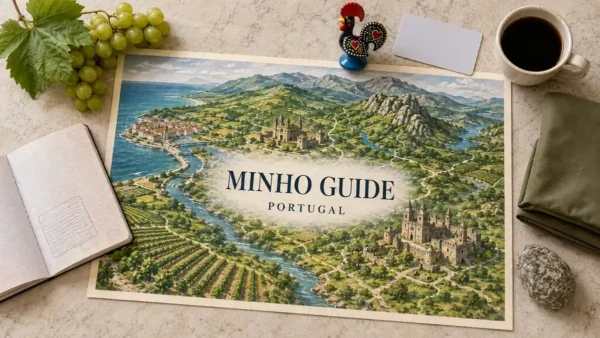

You have a few days near Porto and a region to the north that most guides turn into a list of towns. The Minho works differently. It rewards four kinds of experience — baroque and medieval heritage, Vinho Verde, mountain-and-water in Peneda-Gerês, and a living festival tradition — and a short trip rarely holds all four. Porto is the gateway most travelers start from, and it sits south of the Minho, outside the region proper. Six experiences carry the region; everything else is scenery you enjoy on the way between them. This page resolves what to do with the days you have. Each featured experience gets a verdict, the version worth booking, an honest time cost, and whether you reserve ahead or simply turn up. It does not rank towns, and it does not plan your days for you.
Quick Answer
The Minho earns one to three days for four experiences: baroque Braga, medieval Guimarães, Vinho Verde quintas and Peneda-Gerês. Your base and days decide: from Porto, the heritage pair fits one day; Gerês and a quinta want more. Book the quinta tasting ahead, treat Gerês water as seasonal, and plan around a romaria in late June or August.
Trust Layer
Tripstou attraction guide for travelers deciding whether an experience is worth doing and how to do it well. Covers value, booking versions, timing, access, and traveler fit.
Produced with AI assistance and reviewed by Alex Perrut, working in tourism since 2015, for the Tripstou editorial team. See our editorial process for details.
Last factual review: September 12, 2026.
Official sources consulted: Visit Portugal, Turismo de Portugal.
Key Takeaways
- The Minho earns one to three days: heritage fills the first, Gerês or a Vinho Verde quinta fills the second.
- From Porto, one day holds one heritage experience and a long lunch; a Braga night unlocks Gerês and the quintas.
- At Bom Jesus, ride the funicular up and walk the baroque stairway down, because the terraces read better on the descent.
- Reserve only two things — a quinta tasting and a guided Gerês day; every other experience here is walk-up, though romaria rooms go early.
- Peneda-Gerês consumes a whole day whichever version you choose, so never bolt it onto a heritage town.
- Gerês water is seasonal and romarias are month-fixed, so check the park’s access rules and the festival programme first.
Table of Contents
The Minho Is Built Around Four Experiences, Not a List of Towns
The Minho is known for four things, and all four are experiences, not places. Baroque and medieval heritage, Vinho Verde, the mountain-and-water landscape of Peneda-Gerês, and a living romaria tradition. No other Portuguese region packs all four into so small a space.
The region announces itself visually before it announces itself culturally: deep green fields, grey granite in every wall and doorway, and vines trained high on pergolas along the field edges. That concentration is exactly what makes the Minho a choosing problem. Four families. Most travelers have two days.
Read the four against your own trip and they separate fast. Heritage is the easiest to fit and the least weather-dependent. Vinho Verde is the one that rewards a reservation. Gerês is the one that consumes an entire day. Romarias are the one you cannot schedule at all — they land in their month and you work around them.
Where the region sits, when to come and how to move between its towns are orientation questions, and our Minho travel guide handles them at the depth they deserve. This page is the regional child of the national set, so if you are still assembling a country-wide shortlist, start with the broader survey of things to do in Portugal and come back here for the Minho detail.
Bom Jesus do Monte: Climb the Stairway or Take the Funicular?
Climb the stairway if you can manage a long flight of steps; ride the funicular if you cannot. The funicular is not a shortcut — it is a nineteenth-century water-counterweight railway, described by the sanctuary as the oldest of its kind still running. Both routes end at the same baroque staircase and sanctuary above Braga.
Worth it for: travelers who want one unmissable baroque set piece and can spare half a morning in Braga.
- Climb up, walk down. Suits walkers who want the full architectural sequence, with the chapels and fountains revealing themselves in the order the designers intended. Tradeoff: a sustained climb on stone steps, and legs that will remember it.
- Funicular up, walk down. Suits most visitors. You get the ride itself and the staircase views, taken in the easier direction. Tradeoff: you meet the stairway’s design backwards.
- Funicular both ways. Suits families with small children, anyone with knee or mobility limits, and travelers arriving late in the day. Tradeoff: the staircase stays mostly a view from the carriage window.
Riding up and walking down gives you both halves of Bom Jesus without the climb, and the staircase genuinely reads better descending than ascending — the terraces open up in front of you instead of above you.
- Time cost: half a morning for the sanctuary, the terrace and the descent. Make it a half-day if you add lunch and Braga’s centre.
- Booking: none. The funicular is walk-up, tickets are sold at the station, and the fare is a few euros each way. Check the sanctuary’s current rates before you travel.
- Access: the basílica is open through the day with shorter hours in winter, and a small fee opens the bell-tower viewpoint, which closes during services.
Effort is the real variable here, not interest. Children handle the funicular happily and the staircase less so, and the terrace at the top is flat, shaded and forgiving once you arrive by either route.
Is Guimarães Castle Worth Visiting?
Guimarães Castle is worth seeing, but it is the historic centre below that justifies the trip. The castle is a compact granite shell with walls to walk and a famous origin story attached. The UNESCO-listed streets and squares below it carry most of the experience.
Worth it for: travelers drawn to where Portugal began who want a medieval centre they can finish on foot in one go.
Guimarães is where Portugal takes its origin story, and the town has built its identity on that claim. This matters for your visit in one practical way. The castle is a symbol first and a monument second. Expect ramparts, a keep and a long view; furnished rooms and a museum route are not what is on offer, and travelers who arrive expecting an interior leave flat.
- Skip the castle interior if your day is short and you would trade it for an unhurried lunch in the centre — the walls and the approach carry most of the impression anyway.
- Skip Guimarães entirely if you have one day and already chose Braga with Bom Jesus. Doing both properly in a single day from Porto is a stretch that shortchanges each.
The castle is the postcard and the square below is the reason people stay an extra hour, so budget your time the opposite way round from what the photographs suggest. Half a day covers the centre and the castle at a walking pace, which is the pace the cobbles enforce. Children manage it well; wheeled luggage and strollers do not.
Vinho Verde Tasting: Drop-In Bar or Booked Quinta Visit
Yes, you can taste Vinho Verde at the source, and the booked quinta visit beats the drop-in bar. A quinta puts you among pergola-trained vines with the people who made the wine. A town wine bar gets you the glass without the vineyard, and needs no reservation.
Worth it for: wine travelers willing to reserve a slot in advance and arrange a driver for the afternoon.
A tasting here means dry, light, young whites — Alvarinho, Loureiro and Arinto are the names to watch — often with a faint spritz that makes them read fresher than their weight suggests. The vines are the distinguishing sight: traditionally trained high on pergolas above the working ground, sometimes over head height, a system you will not see across most of European wine country. The Minho pours these whites young; the Douro’s fortified-wine ritual is a different visit entirely.
- Drop-in tasting in town. Suits travelers passing through with no plan — a wine bar or shop in any Minho town will pour by the glass. Tradeoff: you taste the wine and never see where it grows.
- Booked quinta visit. Suits anyone with a free half-day and a designated driver. You walk the vineyard, stand under the pergolas and taste with the producer. Tradeoff: estates are rural and the slot must be reserved.
- Guided wine-route day. Suits travelers with no car and no wish to drive after tasting, since an operator strings two or three estates together. Tradeoff: a full day committed at the group’s pace.
Reserve. Quintas are working farms with small teams, and walk-ups are the exception — one estate visit fills a half-day once you count the drive, and a wine-route day fills the whole of it.
The pergola is the actual reason to go in person. Vinho Verde is one of the few European regions where the fruit hangs above your head instead of at your waist, and no tasting-room explanation lands the way standing underneath one does.
Tours and activities
Book skip-the-line tickets, day trips and local tours with free cancellation on most activities.
You can also browse everything on getyourguide.com.
Tripstou may earn a commission if you book through this link, at no extra cost to you.
Waterfalls and Hikes in Peneda-Gerês: Self-Drive or Guided?
Take a guided day in Peneda-Gerês if you have one day or no car; self-drive if you have both. Portugal’s only national park delivers granite ridges, waterfalls, natural pools and marked trails. Braga is the practical gateway, and the park takes a full day from either base.
Worth it for: walkers who would trade a second town for a full day on a trail and in cold water.
- Self-drive plus a marked trail. Suits confident drivers with a whole day free, because you choose the trailhead, start early and stop where you like. Tradeoff: narrow mountain roads, slow going, and parking that fills in warm months.
- Guided hike. Suits travelers without a car and anyone walking unfamiliar mountain terrain for the first time, since the guide handles route, transfers and park rules. Tradeoff: a fixed full-day format at a group pace.
- 4×4 or waterfall tour. Suits families and anyone who wants the landscape without a long walk — viewpoints, short stops and a swim. Tradeoff: you see a great deal and walk very little.
Gerês is the one Minho experience you cannot compress. Bom Jesus fits a morning and Guimarães fits an afternoon, but the park takes the whole day whichever version you choose, and travelers who try to bolt it onto something else end up doing neither properly.
- Water is seasonal. Flow is strongest outside high summer and the pools are a warm-weather experience, so do not build a swimming day out of season.
- Some zones are restricted and the rules differ by area. Check the park’s official access rules before you commit to a trailhead.
- Bring proper shoes, sun cover and more water than feels necessary. Villages inside the park are trailheads and walk endpoints, not resupply stops.
Effort scales with the version you pick. The 4×4 format works for small children, and the marked trails suit teenagers and adults with walking legs under them.
The Minho’s Romarias Are Festivals Worth Planning a Trip Around
A romaria is a multi-day religious and popular festival with a procession at its heart. Gold filigree, regional costume, street music, fireworks and feasting build around that core over several days. Braga’s São João in late June and Viana do Castelo’s Nossa Senhora da Agonia in August are the flagships.
Worth it for: travelers whose dates already fall in late June or August and who would happily build a whole trip around a crowd.
The distinction from a generic town festival matters when you are deciding whether to travel for one. A romaria has a religious spine — a saint, a procession, a sanctuary — and the secular programme grew outward from it across generations. Towns take it seriously. Costume, jewellery and the order of the procession are inherited, and what you watch is a working tradition, not a heritage performance staged for visitors.
- São João, Braga (late June). The city’s own feast, spread across several days and nights: processions, street dancing, fairground stalls and a strong late-night element. Braga is loud, full and awake for the duration.
- Nossa Senhora da Agonia, Viana do Castelo (August). The set piece for costume and gold, with a seafront town given over for the best part of a week to processions, decorated streets and filigree worn in public.
Crowds and accommodation pressure are the price. Rooms in the host town go early, the centre is slow to move through after dark, and travelers who want quiet should deliberately pick different dates. Children do well at the daytime procession and poorly at the late-night programme.
The month is fixed and the exact days are not, which makes a romaria the only Minho experience you plan around instead of slotting in. Organisers publish the programme each season, so confirm it on the official festival page before you lock travel dates.
Eating in the Minho: The Dishes Worth Building a Meal Around
Eating in the Minho is an experience in its own right, and lunch is where it happens. The regional kitchen is rustic and generous — slow-cooked pork, greens, river fish, bread and broth. Vinho Verde is the local pour, and it is built for exactly this food.
Worth it for: travelers who would rank a two-hour lunch above a second monument on the same day.
- The long tasca lunch. A family-run dining room with a short menu and a jug of house white. This is the most reliable good meal in the region and the one visitors most often skip in favour of a sight.
- A meal at the quinta. Some estates serve food alongside the tasting, which turns a wine visit into the whole afternoon. Arrange it when you reserve the tasting; it is rarely available on the day.
- Festival and market eating. During a romaria the food moves outdoors to grills, stalls and shared tables. Different pace, different atmosphere, no reservation required.
Pair simply. The region’s whites are light, dry and faintly spritzy, which is precisely why they stand up to pork and salt-heavy cooking without any effort from the drinker.
Lunch is the main meal here, and traditional kitchens keep traditional hours — the good ones close between services. A Minho day planned around dinner eats measurably worse than one planned around midday, which is the opposite of how most travelers arrange a sightseeing schedule.
Can You Visit the Minho as a Day Trip from Porto?
Yes, for the heritage — one day from Porto covers Braga with Bom Jesus, or Guimarães. No, for anything more ambitious: adding Gerês or a quinta to that same day breaks it. A night in Braga unlocks the rest of the region without a long return drive each evening.
- Bom Jesus plus Braga’s centre. The easiest day out of Porto and the one with the least ground to cover. Suits first-timers and anyone without a car. Costs you: the full afternoon, so nothing else fits.
- Guimarães centre plus the castle. A compact walking day around a UNESCO core with one monument attached. Suits travelers who want history at a slow pace. Costs you: a whole day for one town, which is the honest price of doing it properly.
- Braga base plus Gerês or a quinta. The pairing that only works from inside the region. Sleep in Braga, and either the park or a wine estate becomes a realistic full day. Costs you: a night away from Porto.
One day from Porto holds one heritage experience and a good lunch. Two is a stretch. Three leaves you with photographs and no memory of the place. The Minho punishes day-tripping harder than most Portuguese regions because its four experiences pull in genuinely different directions — the heritage towns sit closest to Porto, the wine estates sit out in the valleys, and the park runs up against the Spanish border.
Basing yourself, timing the visit and moving between these experiences are orientation questions this page deliberately leaves alone; our Minho travel guide answers them properly. If the Minho is one leg of a longer route through the country, sequencing it against the centre and the south belongs to our Portugal itinerary planning.
Train and bus tickets
Compare routes, schedules and prices across rail and bus operators in one search, with mobile tickets on your phone.
New to Omio? Code NEW10 takes 10% off your first booking — or APPNEW10 if you book inside the Omio app. Both apply to bookings up to €80.
Search routes and compare prices on Omio →
Tripstou may earn a commission if you book through this link, at no extra cost to you.
Which Minho Experiences Deserve Your Days (and Which to Book Ahead)
With one day, take the heritage pair; with two, add a quinta or Gerês. If a romaria falls inside your window, build the trip around it and fit the rest afterwards. Two of the six experiences here need a reservation; the rest you can walk into.
| Experience | Worth it for | Time cost | Best season | Book ahead? |
|---|---|---|---|---|
| Bom Jesus do Monte | First-timers wanting one baroque set piece | Half a morning, plus travel | Year-round; clear days are best | No, tickets are sold on site |
| Guimarães Castle and centre | Travelers drawn to where Portugal began | Half a day on foot | Year-round; spring and autumn kindest | No booking needed for the centre |
| Vinho Verde quinta visit | Wine travelers with a driver or guide | Half a day with the drive | Spring through to early autumn | Yes, reserve your slot ahead |
| Peneda-Gerês | Walkers who want a full day outdoors | A full day, with no shortcuts | Late spring and early autumn | Recommended if you want a guide |
| A romaria in Braga or Viana | Travelers who plan around a crowd | Several days, evenings included | Late June or August only | Book accommodation well ahead |
| A long Minho lunch | Travelers who rate eating as sightseeing | Two unhurried hours at midday | Year-round, and best at midday | No, though good rooms fill early |
- Reserve: a quinta tasting, and a guided Gerês day if you want one. Both run on small-group capacity and both sell out in warm months.
- Walk up: Bom Jesus, its funicular and the basílica, plus Guimarães Castle and its historic centre. None of these needs planning beyond showing up early.
- Book the room early: during a romaria the festival itself is free, and beds in the host town are the scarce resource.
- Check before you go: the park’s official access rules, and the current festival programme published by the organisers.
The Minho rewards fixing one thing and improvising around it. The quinta tasting is the only experience here that disappears if you turn up unannounced; a guided Gerês day needs booking only if you want the guide. Pin the wine, and the rest of the region stays an open day.
If you are still deciding which Portuguese regions make the trip at all, our guide to the best places to visit in Portugal resolves that layer before this one does.
Frequently Asked Questions
Is the Minho good for hiking?
Yes. Peneda-Gerês, Portugal’s only national park, is the reason: marked trails run through granite ridges, waterfall valleys and natural pools, and that is where the region’s serious walking happens. Routes range from short loops to demanding full-day hikes. Spring and early autumn are kindest; high summer is hot.
What can you do in the Minho with kids?
Ride the Bom Jesus funicular, walk the ramparts at Guimarães Castle, take a 4×4 or waterfall tour in Peneda-Gerês, and catch a romaria’s daytime procession. Skip the baroque stairway climb, long mountain trails and late-night festival programmes, which is where family days come apart.
Is Porto part of the Minho?
No. Porto sits south of the Minho and belongs to a different corner of northern Portugal. The Minho is the green, granite country above it, running north towards the Spanish border and inland to Peneda-Gerês. Porto is the gateway most visitors travel from, not part of the region itself.
How far is the Minho from Porto?
Close enough to day-trip, but not uniformly. Braga and Guimarães sit at the near edge of the region and work comfortably as a day out from Porto. Peneda-Gerês and the Vinho Verde quintas sit deeper inland, and the drive eats enough of the day to make a Braga base worthwhile.
Can you kayak or canoe on the Rio Lima?
Yes. The Lima valley runs river activities including kayaking and canoeing, arranged locally and concentrated in the warmer months when conditions allow. Treat it as something you book ahead, not a turn-up-and-paddle option, and confirm the season with the operator before you build a day around it.
How much time do the Minho’s main experiences take?
Think in half-days. Bom Jesus takes half a morning, Guimarães half a day, a quinta visit half a day once you count the drive, and a long Minho lunch two hours. Peneda-Gerês is the exception and takes all of it, which is why it stacks with nothing else.
Related Guides
- Minho travel guide — where the region sits, when to go, how to move around it and where to base yourself.
- Things to do in Portugal — the national experience set this page sits inside as a regional child.
- Best places to visit in Portugal — for readers still choosing which regions earn a slot in the trip.
- Portugal itinerary — how to sequence the Minho against the rest of the country across more than one day.
Did this guide save you time or money? Tripstou is independent and reader-funded — if you'd like to give something back, you can support the site with a crypto contribution of any size.