
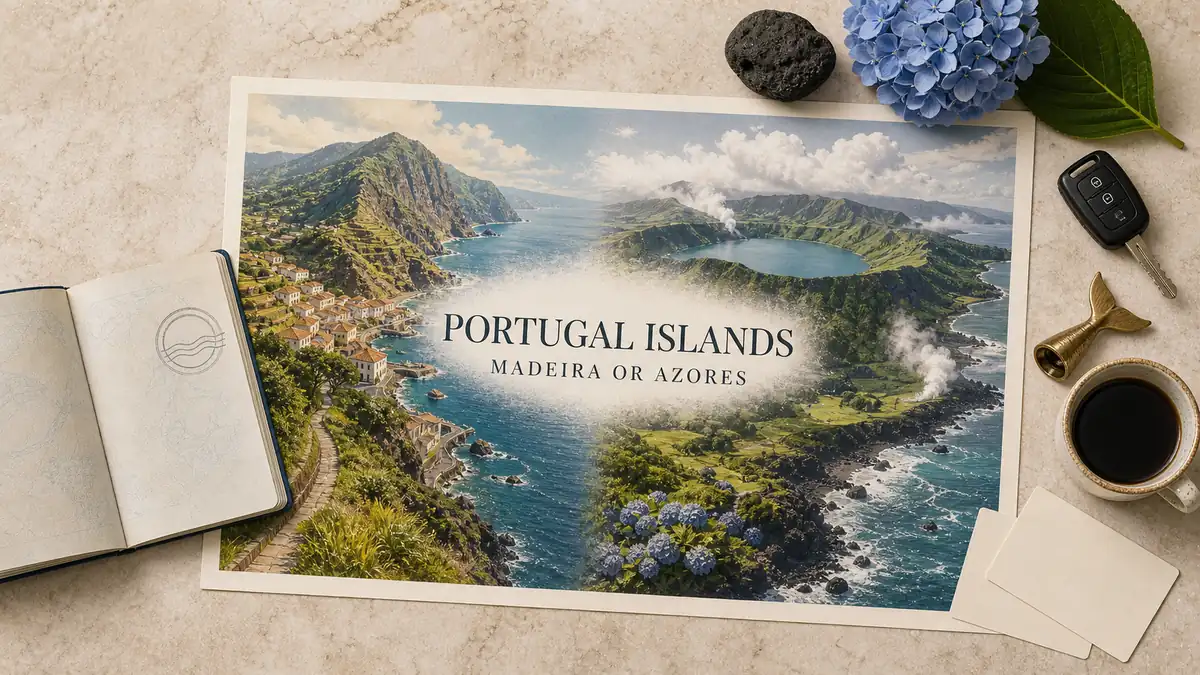
Portugal’s islands mean two Atlantic archipelagos: Madeira and the Azores. Both are autonomous regions of Portugal, and both sit far out in the ocean — hours by plane from Lisbon, never a coastal day trip. That is where the similarity ends. Madeira is one mountainous island built for visitors, mild and unusually stable by European standards, with a capital, a real road network and direct flights from much of Europe. The Azores are nine inhabited islands scattered across the mid-Atlantic: greener, emptier, wilder and far less predictable. Choosing between them is the actual question behind “Portugal islands”, and this page resolves it. You get the verdict first, then the comparison axes — landscape, hiking, beaches, weather, cost, food and access — with a winner named on each. After that: which Azorean island to start on, how long each archipelago needs, whether combining both is realistic, and when mainland Portugal is simply the better trip.
Quick Answer
Choose Madeira if you want the easier trip: warmer, more developed, and far more reliable weather. The choice turns on predictability against wildness — Madeira delivers comfort and dependable conditions, while the Azores deliver raw volcanic landscape and quiet. Pick the Azores, starting on São Miguel, if empty trails and dramatic nature matter more than convenience.
Trust Layer
Tripstou selection guide for travelers choosing between multiple places. Covers selection criteria, traveler fit, and trip value.
Produced with AI assistance and reviewed by Alex Perrut, working in tourism since 2015, for the Tripstou editorial team. See our editorial process for details.
Last factual review: August 28, 2026.
Official sources consulted: Visit Portugal, Turismo de Portugal.
Key Takeaways
- Madeira suits most travelers: one island delivering mountains, marked trails, mild weather and real infrastructure without a connecting flight.
- Choose the Azores if empty trails and raw volcanic landscape outweigh comfort, and start on São Miguel.
- The core trade-off is weather certainty against wildness — short trips punish the Azores’ unpredictable skies hardest.
- Neither archipelago is a beach destination; travelers who want warm sand and swimming should book the Algarve instead.
- Give each archipelago roughly a week and commit to one; combining both costs two days of pure transit.
- Decide the island question before booking mainland nights, because flight-locked island days cannot flex the way mainland days do.
Table of Contents
How Many Islands Does Portugal Have?
Portugal has eleven inhabited islands, split across two Atlantic archipelagos. The Azores account for nine of them, scattered across the mid-Atlantic. The Madeira archipelago holds the other two — Madeira itself and smaller Porto Santo — roughly 900–1,000 km southwest of the mainland, out towards northwest Africa.
The Madeira group also includes the uninhabited Desertas and Selvagens, protected nature reserves rather than places you visit on a normal trip. The Azores stretch much further west, deep into the Atlantic, which is why the two groups feel nothing alike despite sharing a flag.
Distance is the fact that shapes every decision on this page. Neither archipelago is reachable by road, rail or short ferry from the mainland, so visiting either one means a dedicated flight and a dedicated block of days. You cannot bolt an island onto a Lisbon weekend. Both are autonomous regions of Portugal, inside the EU and the Schengen area, so entry works exactly as it does when planning mainland Portugal — same currency, same rules, same language.
The practical consequence: the islands compete with the mainland for your days, they do not extend it. That framing drives everything below.
Madeira or the Azores: Which Should You Choose?
Madeira is the right choice for most travelers, and the Azores for a specific type. Madeira gives you developed infrastructure, dependable weather and dramatic mountains in one compact package. The Azores trade that reliability for wilder volcanic landscape, far fewer people, and a slower, moodier trip.
The split is cleaner than most travel choices, because the two archipelagos are not competing on the same axis. Madeira optimises for certainty. The Azores optimise for wildness. Once you know which of those you are actually buying, the decision stops being difficult.
- First-time island visitors, families, walkers who want marked trails and a warm base: Madeira.
- Nature-first travelers, photographers, whale watchers, anyone allergic to crowds: the Azores.
- Short trips of under a week: Madeira, because there is no inter-island leg to absorb.
- Repeat visitors who already know Portugal well: the Azores, as the genuinely different trip.
Madeira — pick this if: you want one island to deliver mountains, walking, mild conditions and a proper town, without gambling your itinerary on the sky.
The Azores — pick this if: you would trade unsettled skies for craters, hot springs and trails you have largely to yourself.
| Axis | Madeira | The Azores |
|---|---|---|
| Landscape | Steep mountains and cliffs on one island | Volcanic craters, lakes and pasture across nine |
| Weather reliability | Mild and comparatively stable through the year | Changeable, often several moods in a day |
| Hiking | Dense marked network, easy to walk daily | Wilder routes, fewer of them per island |
| Beaches and swimming | Limited natural sand; Porto Santo is the exception | Black sand and rock pools, cooler water |
| Cost direction | Higher on the ground, more competition on flights | Generally cheaper locally, pricier to reach |
| Ease of arrival | Widest choice of direct European routes | Usually one connection more from most of Europe |
One thing the table cannot show: on a five-day Azores trip, a single washed-out day costs you a fifth of the holiday, and there is no dry side of the country to escape to. Madeira’s south coast gives you that escape valve almost daily. Short trip, high weather risk — that is the pairing to avoid.
Once you have chosen, the depth lives elsewhere. Our Madeira guide covers what to actually do there — levada walks, viewpoints, where to base yourself — and the Azores guide handles per-island coverage and island-hopping mechanics. This page ends at the choice; those two pages start at the plan.
Landscape, Hiking and Beaches: Where Each Archipelago Wins
Madeira wins for hiking; the Azores win for raw, varied volcanic landscape. Madeira’s mountains come with engineered access — levada paths and marked trails threading the interior. The Azores spread their drama across nine islands of crater lakes, hot springs and cliffs, but you cover far less of it per trip.
Landscape and Character
The Azores have the stronger landscape, and Madeira has the stronger single view. Madeira rises out of the ocean almost vertically: a green wall of ridges, terraced slopes and cliff roads compressed into one island you can cross in an afternoon. The character is cultivated — gardens, banana terraces, engineered viewpoints, a mountain island shaped by two centuries of visitors.
The Azores read as raw geology. Crater lakes, steaming fumaroles, lava fields and Atlantic pasture, spread thin across islands that mostly feel agricultural and lived-in, not touristed. Pico, on its own island, is Portugal’s highest point and gives the archipelago a genuine mountain anchor. The trade-off is dilution: the best Azorean landscapes sit on different islands, so no single week shows you all of them.
Hiking
Madeira is the better hiking destination for most walkers. The trail network is dense, waymarked and walkable daily from one base, which suits travelers who want to hike without planning logistics around each route. The Azores offer wilder, quieter walking with better solitude, and suit experienced hikers who accept mud, wind and fewer options per island. If your holiday is built around walking every day, Madeira returns more trail per day. If it is built around walking somewhere nobody else is, the Azores win.
Beaches and Swimming
Neither archipelago is a beach destination, and travelers who came for beaches should go to the mainland. Madeira’s coast is mostly cliff and pebble, with Porto Santo’s long sand beach as the real exception and a short hop away. The Azores offer black-sand bays, natural rock pools and warm-spring swimming — atmospheric, but cool water and few classic sunbathing beaches.
Book the mainland instead if sand and warm swimming are the actual priority. The Algarve is where Portugal’s beach trip lives, with Lagos as the pick for dramatic cliff coves and a walkable old town, and Albufeira as the pick for resort infrastructure and family logistics. Choosing an island for beaches is the most common mismatch on this decision.
Tours and activities
Book skip-the-line tickets, day trips and local tours with free cancellation on most activities.
You can also browse everything on getyourguide.com.
Tripstou may earn a commission if you book through this link, at no extra cost to you.
Weather, Cost, Food and Getting There: The Practical Trade-Offs
Madeira is the easier arrival with the more dependable weather. The Azores ask for one more flight leg and accept unsettled conditions as part of the deal. In exchange, they generally stretch a budget further once you are on the ground, especially outside peak season.
Weather and When to Go
Madeira has the more reliable climate of the two, with mild conditions across a long season and a drier south coast. The Azores are famously changeable — locals describe four seasons in a day, and that is not marketing. Summer is the calmest stretch in both, but neither archipelago has a guaranteed window, and Atlantic weather can turn on any date. Plan for layers and waterproofs in both, and check what to pack for island weather before assuming a mainland summer wardrobe will work.
Cost
The Azores are generally the cheaper archipelago once you land, and Madeira is generally the cheaper one to reach. Madeira’s tourism maturity pushes accommodation and restaurant prices up, while the Azores stay closer to mainland levels. Flights invert that: Madeira’s larger route network creates more competition, while Azores fares often depend on fewer options. Treat both as directions, not guarantees, and price your own dates before deciding on cost grounds alone.
Food
Madeira has the more developed food scene; the Azores have the better raw ingredients. Madeira offers a wider range of restaurants, a real wine tradition and a capital with genuine variety. The Azores lean on dairy, beef, fresh fish and volcanic-cooked stews — simpler, more local, fewer choices per town. Eaters who want range pick Madeira. Eaters who want provenance pick the Azores.
Getting There and Around
Madeira is the simpler arrival. Funchal’s airport (FNC) carries the widest choice of direct European routes, and Funchal works as Madeira’s natural base. The Azores are usually entered through Ponta Delgada (PDL) on São Miguel, which adds a connection for most travelers. From the mainland, departures generally run through Lisbon or Porto as the gateway cities. Within the Azores, regional flights and ferries connect the islands, with ferry service seasonal — confirm both before committing to a multi-island plan.
Which Azores Island Should You Visit First?
Start with São Miguel. It is the largest Azorean island, the main international gateway through Ponta Delgada, and the one place that carries almost every Azorean signature in a single trip. Crater lakes, hot springs, whale watching and green pasture all sit within driving distance.
São Miguel is also the lowest-risk first Azorean trip: the most accommodation, the most rental cars, the most alternatives when weather closes a viewpoint. The other islands work better as second visits, once you know whether the archipelago suits you.
- Pico — for climbing Portugal’s highest peak and walking old volcanic vineyards.
- Faial — for the sailing-harbour atmosphere of Horta and its lunar caldera.
- Terceira — for the most historic town and the strongest local festival culture.
- Flores — for the greenest, most remote waterfall landscape in the group.
Picking a remote island first is the classic Azores error: it maximises scenery and minimises fallback. Full per-island detail and hopping mechanics sit in the Azores guide linked above.
How Long Do You Need — and Can You Do Both?
Give each archipelago about a week, and pick one. Madeira works on roughly five to seven days because everything sits on one island. The Azores need at least a week if you want more than São Miguel, and combining both archipelagos on a normal holiday usually costs more than it returns.
The reason is structural. Madeira and the Azores are not near each other — they sit on opposite ends of Portugal’s Atlantic reach, and moving between them means another flight, another car, another accommodation change and another day lost to transit. On a ten-day trip that is roughly two days of pure movement for two half-experiences. Doing both makes sense beyond two weeks, or when one archipelago is a deliberate short add-on instead of an equal half.
Islands also reshape a wider Portugal trip more than travelers expect. On a 7-day Portugal itinerary there is no room for an island at all — the flight overhead eats the trip. A 10-day Portugal itinerary can carry Lisbon plus Madeira if you accept cutting the north. Only a 14-day Portugal itinerary comfortably holds mainland highlights and one archipelago at proper depth.
Settle the island question before booking any mainland nights. The island block is the rigid piece of the trip. Mainland days flex; flight-locked island days do not.
Should You Pick the Islands or Mainland Portugal?
Choose mainland Portugal for a first trip, unless nature is the whole point. The mainland delivers cities, food, wine, beaches and historic towns within short train and road hops. The islands deliver one thing extremely well — landscape — and ask for a dedicated flight plus a full week to justify it.
Put differently: the islands are a second Portugal trip disguised as a first one. Travelers who have never seen Lisbon or Porto usually get more from the mainland’s variety, while travelers who already know those cities get the bigger jump from an archipelago. The islands also concentrate risk. One bad weather week and the trip’s single attraction is gone, where the mainland always has a museum, a town or a meal to fall back on.
If landscape is what pulled you towards the islands, the mainland has closer answers than most people check. The Douro Valley gives terraced river scenery and wine estates on a two-hour hop from Porto. The Alentejo offers empty plains, walled towns and the slowest pace in the country. Sintra packs palaces and misty forest into a day trip from Lisbon. The Minho holds the green north, national park hiking and the country’s oldest towns. The Silver Coast lines up surf beaches and monastery towns without Algarve prices. Any of these costs you a drive, not a flight — and that difference is the real argument.
Frequently Asked Questions
Do you need a car in Madeira or the Azores?
Yes, on both. Viewpoints, trailheads and crater lakes sit far from town centres, and public transport is built for residents, not visitors. Madeira’s roads are steep and heavily tunnelled, which intimidates some drivers; Azorean driving is gentler, but the distances between sights are longer and the fallback options thinner.
Is Porto Santo worth visiting?
Yes, if you want the sand Madeira lacks. Porto Santo is the Madeira archipelago’s second inhabited island and holds a long golden beach, which makes it the natural add-on for a swimming day or two. Skip it if hiking and mountain scenery are the reason you came.
Can you island hop in the Azores by ferry?
Yes, ferries connect Azorean islands, but service is seasonal and weather-dependent, so it cannot anchor a fixed itinerary. Regional flights are the reliable backbone for moving between islands, especially outside the warmer months. Treat a ferry leg as a bonus if it works out, and plan so that a cancelled sailing never strands your trip.
Is Madeira or the Azores better for whale watching?
The Azores, clearly. They are one of Europe’s leading whale-watching regions, with sightings a normal part of an Azorean trip and operators running from several islands. Madeira also offers boat trips and dolphin sightings, but whale watching there is an activity, not a defining reason to go.
Is Madeira or the Azores better for families?
Madeira, for most families. Shorter transfers, more hotels with pools, more restaurant choice and gentler walking options make it the lower-friction trip with children. The Azores suit older kids who enjoy boats, craters and long drives, but weather disruption hits family plans harder than adult ones.
Related Guides
Once you have picked an archipelago, these guides take over the parts this page deliberately stops short of — what to do, where to base yourself, and how the islands fit a wider Portugal trip.
- Madeira guide — what to do, where to stay, and how to plan a week on the island.
- Azores guide — per-island coverage and the mechanics of hopping between them.
- Funchal guide — Madeira’s capital and the base most trips run from.
- Portugal guide — the country-level planner if the mainland is still in play.
- 14-day Portugal itinerary — the trip length where mainland and islands genuinely fit together.
Did this guide save you time or money? Tripstou is independent and reader-funded — if you'd like to give something back, you can support the site with a crypto contribution of any size.