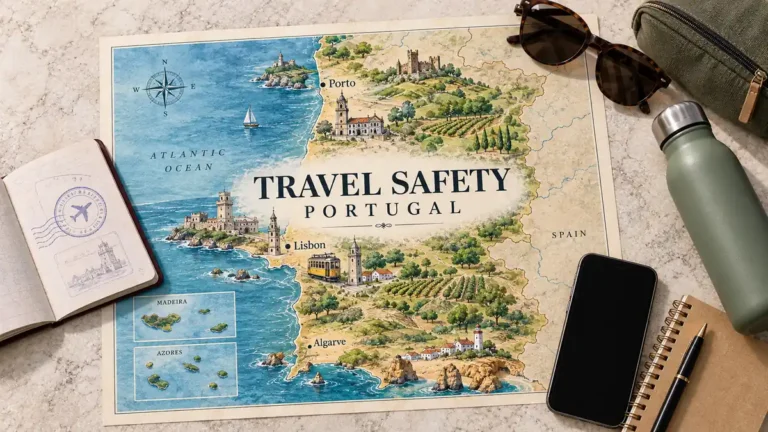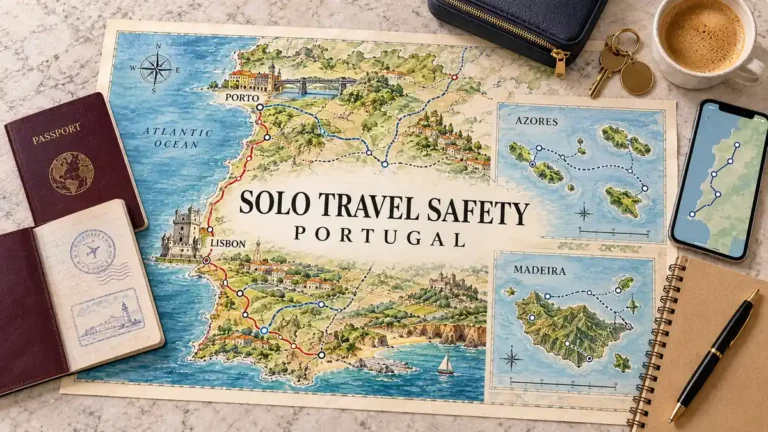

Portugal has five genuinely different beach coasts, and picking the wrong one quietly costs you the trip you wanted. The Algarve’s limestone coves, the Lisbon coast’s train-reachable sand, the Silver Coast’s surf breaks, the Alentejo’s empty wild shore and the volcanic islands of Madeira and the Azores are not variations on one theme. They suit different travelers, and their water temperatures are nowhere near each other. A family with small children and a first-time surfer should not book the same stretch of coast. This guide names the beaches worth planning a trip around, groups them by the coast they belong to, and explains what each coast is actually good at. It also answers the question most beach lists skip entirely: where the sea is warm enough to swim in, and how much colder it gets as you go north.
Quick Answer
The Algarve has Portugal’s best all-round beaches: warm, sheltered limestone coves with the calmest water in the country. The trade is warm water and crowds in the south against wilder scenery, serious surf and a colder sea on the west and north coasts. Choose Madeira or the Azores instead for volcanic drama and natural pools.
Trust Layer
Tripstou selection guide for travelers choosing between multiple places. Covers selection criteria, traveler fit, and trip value.
Produced with AI assistance and reviewed by Alex Perrut, working in tourism since 2015, for the Tripstou editorial team. See our editorial process for details.
Last factual review: August 28, 2026.
Official sources consulted: Visit Portugal, Turismo de Portugal.
Key Takeaways
- The Algarve holds Portugal’s warmest, calmest water, sheltered by limestone cliffs, and pays for it with the country’s heaviest crowds.
- Portugal’s coast that photographs best rarely swims best, so decide what you will actually do in the water first.
- Match traveler to coast: families to the sheltered Algarve, beginner surfers to Ericeira, crowd-avoiders to the Alentejo’s unpaved shore.
- Atlantic upwelling keeps northern and central beaches several degrees colder than the Algarve on the very same summer day.
- Madeira and the Azores replace long sand with black volcanic beaches and lava pools that demand confident, deep-water swimming.
- September and October keep Algarve water warm while the summer crowds thin, the best trade this coastline offers.
Table of Contents
Which Part of Portugal Has the Best Beaches?
The Algarve has Portugal’s warmest and most sheltered beaches; the west coast and the islands win on drama. Portugal’s coast splits into five environments — Algarve coves, the Lisbon coast, the Silver Coast, the Alentejo and the volcanic islands. The rest of this page helps you choose between them.
| Coast | Character | Water | Best for |
|---|---|---|---|
| The Algarve | Sheltered limestone coves and ochre cliffs | Warmest and calmest water on the mainland | Swimming, families, a first beach trip |
| Lisbon coast and Sintra | Resort sand beside raw cliff-backed Atlantic | Cool and open, sheltered only in places | Beach days without renting a car |
| Silver Coast and the north | Long open sand, surf towns, working ports | Cold and exposed, frequently big swell | Surfing, cliff walks, space in August |
| The Alentejo | Undeveloped shore, dunes, small fishing villages | Cold and open, few sheltered corners | Solitude during the busiest summer weeks |
| Madeira and the Azores | Black volcanic sand and lava-rock pools | Mild but deep, little shallow entry | Dramatic settings and natural swimming pools |
The five coasts differ in character before they differ in quality. The Algarve is a swimming coast, engineered by geology: cliffs break the Atlantic swell and the sea behaves. The Lisbon coast is the convenience coast, close enough to reach on a train and be back for dinner. The Silver Coast and the north are surf and spectacle. The Alentejo is emptiness. The islands are scenery of a kind the mainland cannot produce at all.
Distance is rarely the constraint here. All five mainland environments sit within a day’s drive of each other, so the real error is booking a coast whose water does not match what you actually plan to do in it — a decision most beach roundups never ask you to make. If you are still assembling the wider trip, the Portugal travel guide covers how these regions connect.
Algarve or West Coast: Warm Coves or Wild Atlantic?
Choose the Algarve to swim; choose the west coast to surf, hike and escape the crowds. The south’s sheltered coves hold the country’s warmest water and its heaviest summer footfall. The Atlantic-facing west trades comfortable swimming for cliffs, wind, space and Portugal’s best waves.
The trade-off runs on three axes. Water: the south is swimmable for months, the west is a wetsuit proposition for most of the year. Scenery: the west coast is more dramatic almost everywhere, with higher cliffs, bigger surf and longer uninterrupted sand. Access: the Algarve has the airport, the resorts and the paved car parks, while the best west-coast beaches often ask for a dirt track and a walk down.
Most travelers overweight the scenery and underweight the water. The west coast is a looking coast; the Algarve is a swimming coast. Anyone who insists on both inside one short trip usually gets a diluted version of each, because the driving eats the beach days. Pick the job first, then the beach.
The Algarve: Portugal’s Warmest, Busiest Beach Coast
The Algarve is Portugal’s best coast for warm-water swimming, and its most crowded. Limestone cliffs shelter dozens of small coves from the Atlantic swell, keeping the water calmer and several degrees warmer than anywhere else on the mainland. The cost is company: this is the country’s most developed holiday coast.
The coast has two distinct halves. West of Faro, the cliffs turn to honeycombed limestone and the beaches become coves — small, walled, photogenic, and quick to fill. East of Faro, the geology relaxes into sandbars and lagoon islands. Benagil Cave sits in the cove stretch and is the region’s most photographed sea cave; access is now by licensed boat or guided tour only, with no swimming and no self-guided entry. Those rules have changed more than once, so confirm the current arrangement with an operator before planning around it.
Cove size decides your day here more than a beach’s reputation does. The small famous coves are full by mid-morning in July and August, while the long cliff-backed strands absorb the same number of people without ever feeling crowded. Three picks below cover the coast’s headline beaches; for beach-by-beach coverage of the whole region, including the smaller coves and the eastern island beaches, see the dedicated guide to the best beaches in the Algarve. Regional context, towns and getting around sit in the Algarve travel guide.
Praia da Marinha (Lagoa)
Praia da Marinha is the image most people have in mind when they picture Portugal: a compact arc of sand framed by pale limestone arches and stacks. It made the list because it is the most complete version of the Algarve cove — the rock formations, the clear shallow water and the clifftop approach all in one place. What separates it from the other picks is the view from above, since the walk along the clifftop path is as good as the beach itself. It is small, and it knows it.
Pick this if: you want the one Algarve view you have already seen in photographs, and you will arrive before the tour boats do.
Praia da Falésia (Albufeira)
Praia da Falésia is a long, wide strip of sand running below a wall of ochre and rust-coloured cliffs near Olhos de Água. It earns its place as the antidote to the cove problem: there is enough beach here to walk for an hour and still find space to yourself in high season. The colour is the distinguishing feature — the cliffs shift from cream to deep orange along the length, and no other Algarve beach reads that way. The town base for it is Albufeira.
Pick this if: you want to walk for an hour beside the water without running out of beach.
Praia da Dona Ana and Praia do Camilo (Lagos)
Dona Ana and Camilo are the twin coves on the edge of Lagos, both reached on foot or by a short taxi from town. They make the list as the easiest good coves in the Algarve to visit without a car, which is rarer than it sounds. Dona Ana is the wider and more swimmable of the two; Camilo is smaller, steeper and reached by a long wooden staircase, with rock formations that reward the descent. Together they let you stay in a real town and still swim in cove water. Lagos is the base.
Pick this if: you want swimmable coves within walking distance of dinner and a town to come back to.
Tours and activities
Book skip-the-line tickets, day trips and local tours with free cancellation on most activities.
You can also browse everything on getyourguide.com.
Tripstou may earn a commission if you book through this link, at no extra cost to you.
Best Beaches Near Lisbon and Sintra’s Wild Coast
Lisbon is the only Portuguese city with genuinely good beaches a short train ride away. The Cascais line runs along a sheltered stretch of resort sand, while the Sintra coast just north of it opens onto raw, cliff-backed Atlantic. Both are day-trippable, and they feel nothing alike.
The Cascais-line beaches are the practical option: urban, serviced, easy to reach without a car, and calm enough for a swim on most summer days. They are not wilderness, and nobody should book a trip around them. What they buy is a beach afternoon inserted into a city stay with no logistics. Head north-west into the Sintra coast and the character flips — bigger surf, colder water, cliffs, wind, and beaches that require a drive and a descent on foot.
That split is the useful thing to know before you go. Beach convenience and beach drama sit twenty minutes apart here, which is unusual in Portugal. Plan the city side with the Lisbon travel guide, and the wild coast with the Sintra guide, which also covers the hill town most visitors pair with it.
Praia da Ursa (Sintra)
Praia da Ursa is a small wild beach below the cliffs of the Sintra coast, reached only by a steep unmaintained path down from the clifftop. It made the list because it is the most dramatic mainland beach an ordinary visitor can still reach on a day trip from a capital city. The distinguishing feature is the rock stacks standing in the surf directly off the sand, which give the beach its name and its scale. There are no facilities and no lifeguards, and the descent is genuinely steep.
Pick this if: you are fit, travelling light, and value the descent as much as the sand at the bottom.
The Silver Coast and the North: Surf, Cliffs and Cold Water
The Silver Coast and the north are for surf and scenery, not warm-water swimming. Going north of Lisbon you trade sea temperature for long open sand, working fishing towns, cliff walks and room to breathe in August. Wetsuits are normal here, and the waves are the reason people come.
This is the most consistently underrated part of the Portuguese coast. The beaches are enormous, the towns still function outside tourism, and the crowd density in peak summer is a fraction of the Algarve’s. The water is the price of admission. Beyond Porto, the Minho coast turns wilder again — pine-backed dunes, cold clean water, and beaches that empty out entirely once the schools go back.
Two picks below define the coast’s two personalities: the wave spectacle and the surf town. The wider region is covered in the Silver Coast guide, while the northern city base and the coast around it sit in the Porto guide and the Minho guide, the latter useful mainly for the green far north beyond the beaches themselves.
Praia do Norte (Nazaré)
Praia do Norte is the beach where an underwater canyon focuses Atlantic swell into the giant waves Nazaré is famous for. It earns a place on this list as a spectacle, not a swim: on a big day, the clifftop fort above the beach is one of the most extraordinary viewpoints in Europe. What makes it distinct is that the drama is reliable and watchable from land, which is true of no other beach in Portugal. Treat the water as off-limits and enjoy it from the headland instead.
Pick this if: you came to watch the Atlantic at its most violent from solid ground.
Ericeira
Ericeira is a whitewashed clifftop fishing town north of Lisbon with a string of beaches below it, and it is Europe’s only World Surfing Reserve. It made the list because it concentrates a dozen different breaks within a few kilometres, from beginner-friendly sand bottoms to serious reef. The distinguishing feature is the town itself — small, walkable, still a working fishing port, and organised around surfing in a way no Algarve resort is. Non-surfers get a good coastal town with cold water and excellent seafood.
Pick this if: you are learning to surf and want a town built entirely around that.
The Alentejo: Portugal’s Emptiest Mainland Coast
The Alentejo coast is mainland Portugal’s emptiest: long sand, few towns, and real effort required to reach it. Protected land has kept development off most of this shoreline, so beaches arrive as gaps in the cliffs at the end of unpaved tracks. The reward is solitude in the middle of high summer.
Nowhere else on the mainland gives you this much coast with this little on it. Between the Setúbal peninsula and the Algarve border, the shore runs for well over a hundred kilometres past a handful of villages and almost nothing else. The water is Atlantic-cold and often rough, the wind is real, and services thin out fast. Bring what you need with you.
Access is this coast’s crowd filter, and it is a fragile one — the beaches here stay empty for exactly as long as the road to them stays bad. Two picks below cover the two ends of the region, and the wider area, including its inland towns, is covered in the Alentejo guide.
Comporta and Tróia
Comporta and Tróia sit on the sandy spit at the southern edge of the Setúbal peninsula, offering kilometres of flat white sand backed by dunes, rice fields and pine. They make the list as the most accessible empty sand in the country, close enough to Lisbon for a long day out. What distinguishes them is the tone — low-rise, barefoot and deliberately understated, with beach shacks in place of resorts. It is the one stretch of this coast where you can be comfortable without giving up the emptiness.
Pick this if: you want kilometres of empty sand and barefoot beach shacks within a day trip of Lisbon.
Porto Covo and the wild coast south
Porto Covo is a small whitewashed fishing village that acts as the gateway to the undeveloped coast running south towards the Algarve. It earns its place as the practical base for the wildest mainland beaches Portugal has: a series of small sandy coves set between dark rock headlands, most of them quiet even in August. The distinguishing feature is the scale of the drop in development — from here south, the coastline is essentially a protected park with villages at long intervals. Expect cold water and strong currents.
Pick this if: you measure a good beach day by how few other people you saw.
Madeira and the Azores: Volcanic Sand and Natural Pools
Go to the islands for volcanic drama and natural pools, not for long golden beaches. Madeira and the Azores are young volcanic coastlines: black sand, lava-rock pools filled and flushed by the tide, and cliffs dropping straight into deep water. Classic broad sand is the one thing they lack.
Madeira solved that shortage by importing golden sand to build the beaches at Calheta and Machico, which tells you how scarce the natural version is. Everywhere else, swimming happens from black-sand pockets, lava pools and engineered sea platforms instead of a long open shore. The Azores follow the same logic across nine islands, with even less sand and even more rock.
The islands reward swimmers who are comfortable with depth. Natural pools and ladders into deep water replace the shallow wade-in entry that families with small children depend on, and that one detail decides whether the islands suit your group. Plan Madeira with the Madeira guide and its capital with the Funchal guide; the archipelago further west is covered in the Azores guide.
Seixal (Madeira)
Seixal is a village on Madeira’s north coast with a black volcanic sand beach set beneath green cliffs and waterfalls. It made the list as the clearest expression of what island beaches offer that the mainland cannot: dark sand, deep blue water and near-vertical forested slopes in the same view. What makes it distinct is the natural pool complex beside the beach, where lava rock holds calm seawater a few metres from open Atlantic swell. The north coast is wetter and wilder than Madeira’s south.
Pick this if: you want black sand and green cliffs in a single frame.
Porto Santo
Porto Santo is the small island north-east of Madeira, and it holds a single long beach of pale golden sand running most of the island’s south coast. It earns its place as the archipelago’s one conventional beach destination — the only place in the region where you can walk kilometres of soft sand into shallow warm water. The distinguishing feature is the contrast with Madeira itself: flat, dry and open where the main island is steep and green. Reaching it means a ferry or a short flight.
Pick this if: you want a long conventional sand beach and will take a boat to get one.
The Azores’ volcanic shores
The Azores’ coastline is a sequence of black sand pockets, lava-rock bathing areas and tidal pools carved into the shore of nine green islands. It belongs on this list as the wildest swimming environment in Portugal, where the setting does the work that sand does elsewhere. The distinguishing feature is how the swimming is organised — pools built into the rock, ladders into clear deep water, and geothermal warmth in a few spots. There is very little conventional beach, and the weather turns quickly.
Pick this if: you swim confidently and prefer a tidal rock pool to a stretch of sand.
How Warm Is the Sea in Portugal?
Only the Algarve reliably reaches comfortable summer swimming temperatures; the north stays markedly colder on the same day. Southern water sits around 20–23 °C in summer, while Atlantic upwelling can leave northern and central beaches some 6–7 °C cooler. Wind and upwelling shift those figures week to week, so the gap widens and narrows.
The gap comes from upwelling — cold deep water drawn to the surface along the exposed Atlantic coast — and it does not disappear at the height of summer. The Algarve escapes it because its coves face south and sit behind sheltering cliffs. In practice the swim season runs broadly from June to October in the south, with September and October staying warm while the crowds thin out.
Those late-season weeks are where the north–south gap matters most. In September the Algarve still swims comfortably, while the Silver Coast has already become a wetsuit coast for anything longer than a quick dip. If your trip lands outside high summer, that pushes the decision south more firmly than anything else on this page.
Which Coast Suits Families, and Which Suits Surfers?
Families belong on the sheltered Algarve, beginner surfers on the west coast, and crowd-avoiders in the Alentejo. Each coast is genuinely better at one job than the others, so matching traveler type to coast resolves most of the planning in one decision. The list below makes each match explicit.
- Families with young children — the central Algarve. Sheltered coves, calm shallow water, lifeguards and facilities within walking distance. The trade-off is peak-season density and the highest prices on the coast.
- Beginner surfers — Ericeira and the Silver Coast. Sand-bottom breaks, surf schools and board hire built into the towns. The trade-off is cold water year-round and days when the swell is simply too big to learn in.
- Crowd-avoiders — the Alentejo coast. Genuinely empty sand in August, with villages in place of resorts. The trade-off is a car, rough access tracks and few services when you arrive.
- Photographers — the Sintra coast and Madeira’s north. Cliffs, rock stacks, black sand and dramatic light. The trade-off is that most of these beaches are far better to look at than to swim in.
- Committed swimmers — the western Algarve coves. The warmest, calmest water and the longest swim season in the country. The trade-off is small beaches that fill early and stay full through the middle of the day.
One pattern runs through all five. The coast that photographs best is almost never the coast that swims best in Portugal, and travelers who accept that early stop trying to build a trip that satisfies both.
Frequently Asked Questions
What is the most beautiful beach in Portugal?
Praia da Marinha in Lagoa takes that title on most rankings, thanks to its limestone arches and clear shallow water. Beauty is genuinely contested here, though: Praia da Ursa near Sintra and the black-sand coves of Madeira’s north coast win on drama instead of postcard perfection.
Can you still swim into Benagil Cave?
No. Swimming into Benagil Cave is banned, and so is self-guided kayak or paddleboard entry. The only legal way in is a licensed boat trip or a guided kayak or SUP tour, and landing on the sand inside the cave is prohibited. Rules have changed repeatedly, so confirm with your operator.
Are Portuguese beaches safe to swim in?
Yes, at supervised beaches during the lifeguard season, provided you read the flags. Green means safe, yellow means wade but do not swim, and red means stay out. Atlantic currents and shore break are strong on the west coast, and many wild beaches have no lifeguard at all.
Do you need a car to reach the best beaches in Portugal?
Not for all of them. Lisbon’s Cascais-line beaches and the Lagos coves at Dona Ana and Camilo are reachable by train, bus or a short walk. Everything wild — the Alentejo coast, the Sintra clifftops, most of the Silver Coast — realistically needs your own vehicle.
Which month has the warmest sea in Portugal?
Late summer and early autumn. Sea temperature lags air temperature by weeks, so Portuguese water peaks around September rather than in July, and stays swimmable into October in the Algarve and Madeira. The north warms on the same curve but from a much lower starting point.
Which beaches in Portugal are least crowded?
The Alentejo coast between Comporta and the Algarve border, especially the stretch south of Porto Covo, where unpaved access tracks keep numbers down through August. North of Porto, the Minho beaches empty out completely once schools go back, and remote western Algarve coves thin sharply after summer.
Related Guides
Once you have chosen a coast, these guides handle the parts this page deliberately leaves out — fitting beaches into a route, and what to bring.
- 7-day Portugal itinerary — how a first trip fits a single coast without wasting days on the road.
- 10-day Portugal itinerary — the length at which two beach regions start to make sense together.
- 14-day Portugal itinerary — enough time to pair the south coast with the wilder west or the islands.
- Portugal packing list — what the Atlantic coast demands that a Mediterranean beach trip does not.
- Douro Valley guide — the inland counterweight if you are heading north beyond Porto.
Did this guide save you time or money? Tripstou is independent and reader-funded — if you'd like to give something back, you can support the site with a crypto contribution of any size.