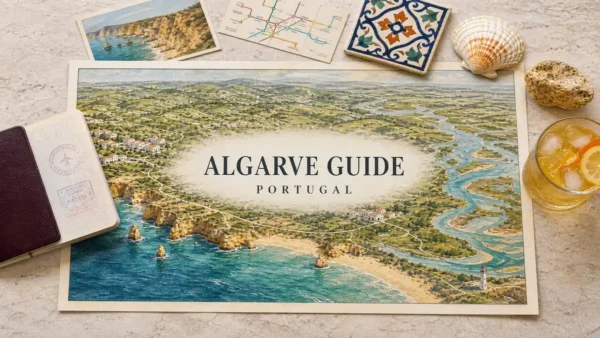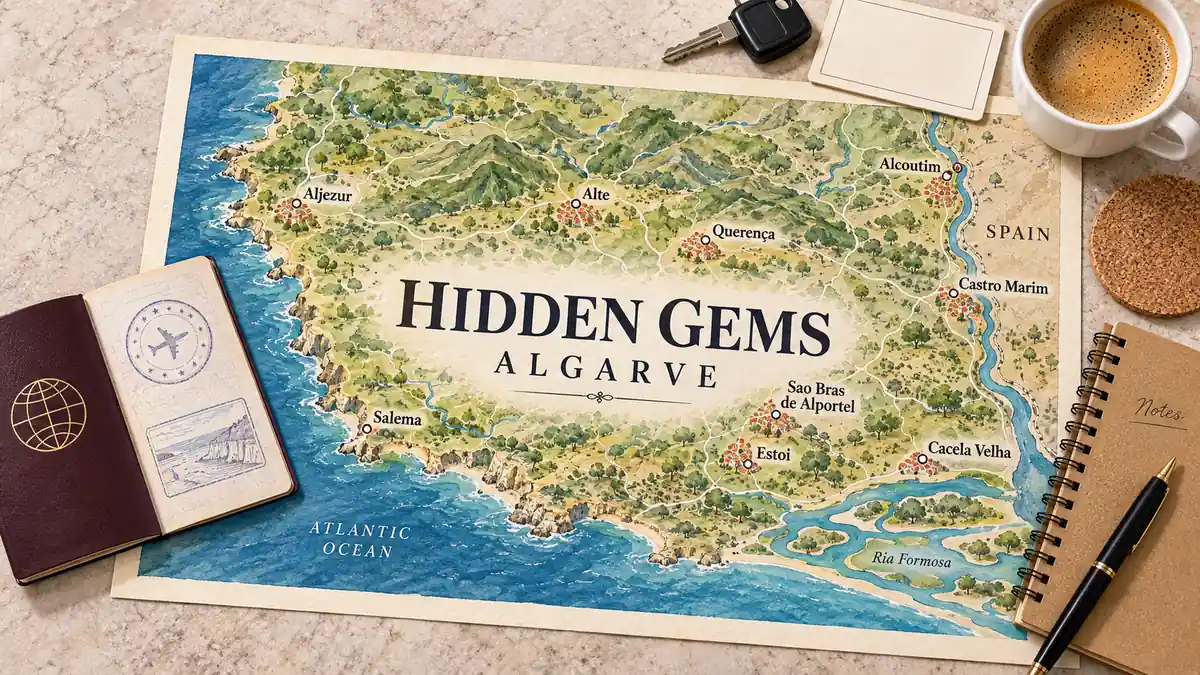
Most lists of hidden gems in the Algarve are not about hidden places at all. They recycle the same sea caves, famous beaches and beach-town cafés, and at least one pick with no public access. This one is narrower. The quiet Algarve is its villages and small towns, and it has a clear geography: the wild west coast, the hills behind Loulé and Faro, and the Guadiana border strip facing Spain. The tradeoff comes first, because it shapes every choice. Most of these places are much easier with a car, and the inland villages are at their best in spring and autumn. The nine picks sit in three geographic groups, and each closes on a one-line “Pick this if” test. A final section matches the picks to your base and your trip style.
Quick Answer
The Algarve’s best hidden gems are quiet villages and small towns, led by Aljezur, Alte, Cacela Velha and Alcoutim. They sit on the far west coast, in the inland hills or along the Guadiana, and nearly all are easier by car. Choose by base: Lagos for the west, Loulé or Faro inland, Tavira for the east.
Trust Layer
Tripstou selection guide for travelers choosing between multiple places. Covers selection criteria, traveler fit, and trip value.
Produced with AI assistance and reviewed by Alex Perrut, working in tourism since 2015, for the Tripstou editorial team. See our editorial process for details.
Last factual review: September 11, 2026.
Official sources consulted: Visit Portugal, Turismo de Portugal.
Key Takeaways
- Choose by base first — Lagos for the west-coast picks, Loulé or Faro for the hills, Tavira for the Guadiana strip — then by trip style.
- Only two picks earn a night of their own: Aljezur (a market town below a Moorish-origin castle) and Alcoutim (a river town facing Spain).
- Match the pick to the day you want: Alcoutim or Salema for walking, Estoi’s Milreu villa for history, Alte for shade, Cacela Velha for views.
- The price of quiet is a car, since the inland hills and the Guadiana strip are much easier to explore with one.
- Without a car, pick the gem nearest your base: Estoi’s Roman villa from Faro or Cacela Velha’s lagoon view from Tavira.
- Visit the inland villages in spring or autumn; high summer brings hard heat to the hills and low water to Alte’s springs and waterfall.
Table of Contents
What counts as a hidden gem in the Algarve?
A hidden gem in the Algarve is a lived-in village or small town beyond the resort belt, not a beach. Those places cluster in three zones: the wild west coast, the hills behind Loulé and Faro, and the Guadiana border strip. The Albufeira–Lagos stretch is built for visitors; these edges are still built around residents.
Most English-language lists fail that definition in three ways. Beaches and rock arches belong on a beach list. Cafés and bars are not destinations. Famous towns are not hidden, however pretty they are.
Every pick on this page passed three tests:
- Lesser-known: a place most first Algarve trips never reach.
- Lived-in: a village or town with a life of its own, beyond anything built for visitors.
- Sourced beyond the listicles: Portuguese press and local sources, which keep pointing at the interior and the border villages.
Hidden has a cost, and it is worth naming early. Most picks are much easier with a car. Evenings are quiet, and several villages turn sleepy out of season. Nothing here is organised around visitors, which is both the appeal and the inconvenience.
The list suits second-time visitors, slow travelers, confident drivers and anyone tired of the resort belt. First-timers with a week and no car should start with the famous towns — Tavira, Lagos, Faro and the rest — ranked on the best places to visit in Portugal page. The Algarve’s signature sights (Benagil, the cliff walk and the inland day through Silves and Monchique) sit with the other things to do in the Algarve. For the West, Central and East split and where to base yourself, start with the Algarve travel guide.
The wild west coast keeps the Algarve’s fishing-village feel
Aljezur and Salema are the west-coast picks, and both sit inside a protected natural park. The Southwest Alentejo and Vicentina Coast Natural Park kept development low while the south coast filled up. Choose Aljezur for a night in a real town, Salema for a fishing-village bay.
The natural park explains why this stretch still feels like the old Algarve: villages kept their scale. This is the only group where hidden does not mean giving up the open Atlantic — every other pick trades it for hills, a lagoon or a river. Aljezur is also the west-coast pick promised on our list of hidden gems in Portugal. Both work from a Lagos base.
Aljezur
Aljezur is a west-coast market town inside the Southwest Alentejo and Vicentina Coast Natural Park, and its castle is the strongest reason to stop. The ruins of a hilltop castle of Moorish origin crown the old town, which runs along the Ribeira de Aljezur below. From the top, the view opens over the town and its valley.
No other pick pairs a working town with a coast, which makes Aljezur a base in its own right. It sits well away from the south-coast resorts, and the west coast’s surf beaches form its backdrop. Nightlife is not part of the deal. It suits surfers and walkers best.
Pick this if: you want a west-coast base with a real town behind the surf beaches.
Salema
Salema is a small fishing village on a bay in the western Algarve, and its size is the whole point. It sits inside the same natural park and has stayed less developed than its neighbouring coastal villages. A short cliff walk east leads to Boca do Rio (a small beach and freshwater lagoon at a river mouth), with remains of a Roman villa nearby.
It is the one coastal pick where the village is the reason to come and the beach is just its setting. The whole place is a bay, a cluster of houses and a path along the cliffs. Silence is the price. Salema goes quiet after dark, and anyone wanting bars should look elsewhere.
Pick this if: you want a fishing-village bay, a cliff walk and nothing at all to do after dinner.
The hills behind Loulé and Faro hold the Algarve’s quietest villages
Alte, Querença, São Brás de Alportel and Estoi are the inland picks, where daily life still outweighs tourism. They sit in the barrocal, the limestone hill country between the coast and the Serra do Caldeirão. Spring and autumn suit them far better than high summer, when the heat builds and the springs run low.
Portuguese sources treat the interior parishes of Loulé — Alte, Querença, Salir, Benafim, Ameixial and Tôr — as the quieter Algarve. Two of them earn full picks here; São Brás de Alportel and Estoi complete the set. All four suit a Loulé or Faro base. Season matters more than which village: a spring visit to any of the four beats a high-summer visit to the best of them. The inland day through Silves and Monchique is a separate trip, covered in our Algarve things-to-do guide.
Alte
Alte is a small whitewashed village in the Loulé interior, built around water. Its two springs (Fonte Grande and Fonte Pequena) sit in a shaded leisure area. A short trail leads to the Queda do Vigário waterfall on the Alte stream, the other half of the reason to come.
It is the only pick where shade and water are the draw. Between a shaded spring and a waterfall pool that locals have long used on hot days, Alte is the gentlest inland stop for families. The catch is the season. In high summer the flow can drop low, so treat the waterfall as a bonus.
Pick this if: you want shade, springs and a short trail on a hot inland day, with children or without.
Querença
Querença is a village between the barrocal and the serra, surrounded by springs, and its appeal is how little happens there. It is one of the interior Loulé parishes that Portuguese sources single out as the quieter Algarve. Behind the village, the hills of the Serra do Caldeirão begin to rise.
No other pick on this page asks so little of a visitor. There is no headline sight, only the village square, a walk out towards the springs and the view up into the hills. Slow travelers get the most from it. Anyone hunting for sights will leave underwhelmed.
Pick this if: you want the emptiest village on this list and are happy with a walk, a square and the hills.
São Brás de Alportel
São Brás de Alportel is a small inland town at the edge of the hills, and its costume museum is the draw. The Museu do Traje, run by the local Santa Casa da Misericórdia, occupies a former cork merchant’s residence. Its ethnographic section gives cork special emphasis, so the building and the collection tell the same story.
This is the pick about the working Algarve. Cork shaped life in these hills long before the coast turned to tourism, and no other stop on this page explains that economy. It makes a good escape when the coast is at its busiest. The town itself is modest, so the museum carries most of the visit.
Pick this if: you are curious about how the inland Algarve actually made its living.
Estoi
Estoi is on this list for the Roman ruins of Milreu, just west of the village in the Faro municipality. Milreu was a Roman villa inhabited from the first century and later enlarged into a luxurious residence. It is now a National Monument managed by Património Cultural, with a reception and interpretation centre, and it is open to visitors.
Milreu gives Estoi the one major Roman site on this page, and it sits most naturally beside a Faro stay. The interpretation centre puts the ruins in context. Exposure is the drawback. An open-air site offers little shelter from the summer sun, which makes Milreu a better spring or autumn visit.
Pick this if: you are based in Faro and want Roman history without turning the day into a long inland drive.
The Guadiana border strip is the Algarve’s least-visited corner
Cacela Velha, Castro Marim and Alcoutim make the Guadiana border strip the Algarve’s least-visited corner. Cacela Velha looks over the Ria Formosa, Castro Marim sits among salt marshes and Alcoutim faces Spain across the river. Together they are the strongest reason to base yourself in Tavira.
The strip runs from the eastern end of the lagoon north along the Guadiana, and it grows quieter the further it gets from the sea. Castro Marim and Alcoutim fit together as one day on the river. Cacela Velha makes a short outing from Tavira. Only one of the three looks at the sea at all, and that is exactly what keeps this corner off the beach-day circuit.
Cacela Velha
Cacela Velha is a tiny fortified village on a low cliff above the eastern end of the Ria Formosa, and the view is everything. A church and a few whitewashed streets crown the cliff. Below and beyond them, the lagoon stretches out towards the barrier sandbanks that separate it from the open sea.
It is the pick that works as a viewpoint first: the Ria Formosa seen from a village, with no boat needed. It is also the easiest eastern stop to fit into a Tavira stay. Size works against it. The village is only a handful of streets, so it fills a short visit.
Pick this if: you want the lagoon view and the photograph without getting on a boat.
Castro Marim
Castro Marim earns its place with two fortifications — a castle and a seventeenth-century fort — set among salt marshes. The nearby nature reserve is an important bird habitat, with birdlife that includes flamingos at times. Traditional salt production continues in the marshes, so the landscape around the walls is still a working one.
Fortifications and wetland meet here and nowhere else on this list. The walls give the history; the marshes give the birds. None of the birdlife is guaranteed, and the flamingos come and go, so treat any sighting as luck. It suits travelers split between birdwatching and history.
Pick this if: you want castle, fort and marsh birdlife in one stop on your way up the river.
Alcoutim
Alcoutim is a small riverside town on the Guadiana, facing Sanlúcar de Guadiana in Spain across the border. Its castle and river views are the reason to linger. The town is also the start of the Via Algarviana, a long-distance trail that crosses the region to the far west.
It is the pick furthest from the coast and the only trailhead on this page: a river town, with no sea in sight. Along with Aljezur, it is one of two picks worth a night. The distance cuts both ways: it keeps the town quiet, and it makes getting here a commitment that is hard to manage without a car.
Pick this if: you want the Algarve furthest from the beach, with Spain across the water and a trail to walk.
Which Algarve hidden gem fits your trip?
Choose by base first: west picks from Lagos, inland picks from Loulé or Faro, eastern picks from Tavira. Then choose by what you want from the day: a walk, a Roman site, shade, a view or a night away from the coast. Base comes first because the nearest good pick beats the best distant one.
The table matches each kind of traveler to a first pick and a runner-up, with the main thing each choice costs.
| Traveler type | First pick | Runner-up | What you give up |
|---|---|---|---|
| Walkers and long-distance hikers | Alcoutim, at the start of the Via Algarviana | Salema, for the short cliff walk east | The beach at Alcoutim, evening life at Salema |
| Roman and medieval history fans | Estoi, for the Roman villa at Milreu | Castro Marim, for its castle and fort | Shelter from the sun on summer visits |
| Shade and springs on hot days | Alte, for its springs and waterfall trail | Querença, a quiet village ringed by springs | Reliable water, which can run low in summer |
| Lagoon and valley views | Cacela Velha, above the eastern Ria Formosa | Aljezur, from its castle over town and valley | Much to do once the view is seen |
| Worth a night of its own | Aljezur, a working town near the coast | Alcoutim, a river town at a trailhead | Nightlife and resort facilities in both towns |
| The working Algarve of cork and salt | São Brás de Alportel, for the museum’s cork section | Castro Marim, for its traditional salt production | Postcard scenery, since the story is the draw |
A car decides how many of these places you can see. Most are much easier by car, especially inland and along the Guadiana. Without one, choose the picks nearest your base and accept fewer of them; for most travelers that means Estoi from Faro or Cacela Velha from Tavira. The wider question of whether to rent a car in the Algarve is settled in the regional guide.
Timing matters most inland. Spring and autumn are the right seasons for the hill villages, while high summer brings hard heat to the barrocal and low water to the springs of Alte and Querença. The coastal and border picks are more forgiving in the hottest months.
Only two picks earn a night of their own. Aljezur has a real town behind the coast; Alcoutim has the river, the castle and the trailhead. The other seven work best as detours from your base.
Frequently Asked Questions
Do you need a car to see the Algarve’s hidden gems?
For most of them, yes. A car is what lets you reach the inland and Guadiana picks and pair them, such as Castro Marim and Alcoutim on one day along the river. Without one, the list shrinks to the picks nearest your base, and a single village per outing is the realistic pace.
Can you visit Pego do Inferno?
No. Pego do Inferno, a waterfall in the Tavira municipality, still appears on many hidden-gem lists, but it has had no official public access since fires destroyed its walkways and paths. The approaches cross private land, and it should not be planned around. That is why it is not a pick on this page.
Is Ferragudo still a hidden gem?
Not really. Ferragudo is a pretty fishing village, but it sits in the central resort belt and appears on most Algarve hidden-gems lists. For the same fishing-village feel with fewer visitors, Salema on the west coast is the closest match, and Cacela Velha is the eastern alternative above the Ria Formosa.
Are the Algarve’s inland villages worth visiting in summer?
They are, with adjustments. High summer brings hard heat to the hills and low water to the springs, so Alte’s waterfall may be a trickle and the Roman ruins at Milreu offer little shade. Pair an inland morning with an afternoon on the coast, and make São Brás de Alportel’s museum the indoor stop.
Is the eastern Algarve less touristy than the west?
Its far east is. The Guadiana border strip is the Algarve’s least-visited corner, but the far west inside the natural park — around Aljezur and Salema — is quiet too. The real divide runs between the Albufeira–Lagos resort belt and the region’s edges, not between east and west.
Which Algarve hidden gems suit a trip with children?
Alte suits children best, with a shaded spring area and a short trail to a waterfall pool. In high summer, though, the water can run low. Castro Marim adds a castle, a fort and marsh birdlife, and Cacela Velha is small enough for short attention spans. Quiet evenings suit younger children better than teenagers.
Related Guides
- Algarve travel guide — regions, bases and the car decision for the whole coast.
- Things to do in the Algarve — Benagil, the cliff walk and the Silves–Monchique inland day.
- Best places to visit in Portugal — the famous towns, Algarve included, for a first trip.
- Hidden gems in Portugal — quiet villages and regions beyond the Algarve.
Did this guide save you time or money? Tripstou is independent and reader-funded — if you'd like to give something back, you can support the site with a crypto contribution of any size.