Build a Milos stay around the Kleftiko boat trip: for a first visit it comes ahead of Sarakiniko and the sea caves, and it is the one experience that needs a second decision, because boat type and departure port shape the day (comfort or cave access, transit or swim time). Book the boat early in your stay, see Sarakiniko early or late, and keep the ancient sites and mining heritage for midday.
Milos has more headline experiences than a two- or three-day stay can hold. The Kleftiko boat trip, the white rock of Sarakiniko, a sea-cave swim, the fishing hamlets, an ancient hillside and an abandoned sulfur mine all compete for the same few days.
This page does the selecting. It picks the experiences that earn a day on Milos, says who each one suits and where it falls short, and settles the boat-trip choice with a simple ladder. It covers what to do on the island, not where to sleep or which beach to rank first. Short on time? Read the two boat-trip sections first. Everything else fits around them.
The Kleftiko Boat Trip Is the One Milos Experience Not to Skip
The Kleftiko boat trip is the one experience that justifies the journey to Milos. It shows the island’s most striking coast — white rock arches, sea caves and clear water — which no road reaches. Skip it only in rough seas, with strong seasickness, or on a one-day stay ending with a morning ferry.
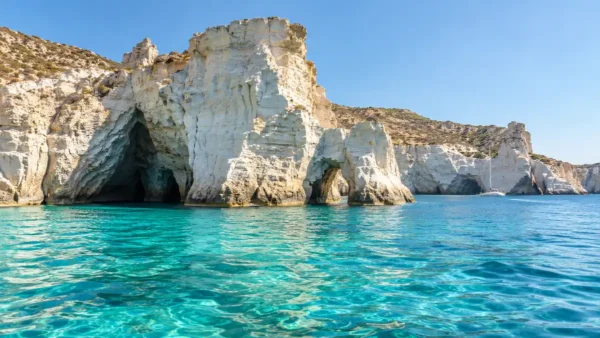
The day centres on Kleftiko, a cove on the south-west coast where pale rock stacks and arches rise straight out of turquoise water. Boats anchor inside, and you swim through the arches and into small caves. Most tours also stop at Sykia, a sea cave whose collapsed roof lets light fall onto the water below. Full-day runs usually add a swim stop on the Poliegos side, the uninhabited island opposite.
First-time visitors who want the coastline seen from the water, with swim stops built in, get the most from it. Two things count against it:
- It takes a whole day for one experience. On a two-day stay, that is half your time.
- It depends on the weather. Strong wind can delay or cancel departures, so the day is never guaranteed.
Sea kayaking is the calm-sea alternative to a motorised tour. Small guided groups paddle the same coastline at water level, slower and quieter, and it suits confident swimmers with some stamina. A guided sea-kayak trip is also the other way into Sykia on a calm day, since Sykia is a sea cave reached from the water, not a walk-in visit. On land, a hiking route to Kleftiko exists, but it is long, rough and exposed to the sun, so it is not a casual option. Set against the wider list of things to do in Greece, the Kleftiko day ranks with the country’s headline sea experiences, which is why it anchors most Milos trips.
The swim stops carry the trip’s value, not the sightseeing. A tour that shows Kleftiko from the deck and moves on has missed the point. Ask how long the boat anchors there before you book.
Tours and activities
Book skip-the-line tickets, day trips and local tours with free cancellation on most activities.
You can also browse everything on getyourguide.com.
Tripstou may earn a commission if you book through this link, at no extra cost to you.
Which Milos Boat Tour Should You Book?
For most first-timers, the right Milos boat tour is a full-day trip that includes Kleftiko. Choose the boat by how much you value cave access against comfort, and the departure port by where you are staying. Those two choices decide whether the day feels like a cruise or a swim safari.
Boat type
- Catamaran or larger sailing boat — suits families, couples and anyone who wants shade, space and a meal on board. Trade-off: it cannot enter the narrow caves, and groups are larger.
- Speedboat or RIB — suits swimmers who want more sea time and cave entries. Trade-off: a hard, bumpy ride in any swell, with little or no shade.
- Private charter — suits groups who want to set the pace and choose the stops. Trade-off: a small group carries the whole cost, so it only pays off when the boat is full.
Departure port
- Adamas — suits anyone without a vehicle, since the main port is easy to reach from any base. Trade-off: a longer transit around the island before the first swim.
- South-coast departure — suits travelers who want the most swim time near Kleftiko. Trade-off: you need a vehicle to reach the departure point.
Length
- Half day — suits a two-day stay, with the trip focused on Kleftiko. Trade-off: little or no time for Sykia and a second swim stop.
- Full day — suits most first visits, adding Sykia cave and the Poliegos side. Trade-off: it fills the whole day, and sun exposure adds up.
Departure port matters more on a half-day tour than on a full one. From Adamas, a short trip spends much of its clock in transit around the island. So a half day works best from the south coast.
Tours run on a seasonal schedule. The Milos guide covers when the boats run and how the weather shapes the season.
Do You Need to Book a Milos Boat Trip in Advance?
Yes, in the peak summer weeks, book before you arrive. Speedboats and small sailing boats carry few passengers, so the version you want can sell out, and booking ahead lets you fix the trip on an early day. Outside the peak, a day or two ahead is often enough, though the choice of boat and port narrows.
When Is the Best Time of Day to Visit Sarakiniko?
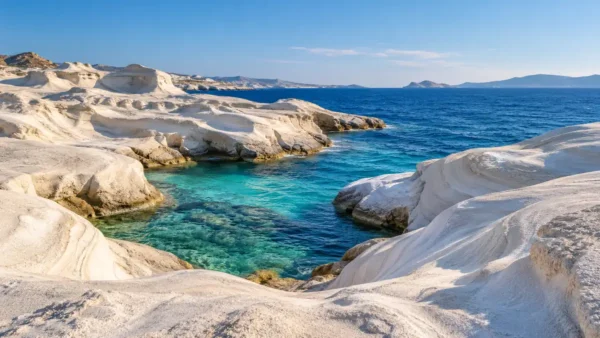
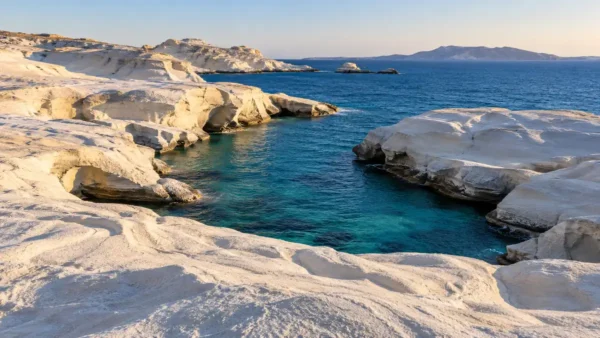
Visit Sarakiniko at sunrise or in the late afternoon. Those two windows give you softer light, cooler rock and far fewer people. At midday in high summer the white volcanic stone reflects heat and glare, and the coves fill with day-trippers, which turns the island’s most photographed landscape into its least comfortable one.
Sunrise delivers the lunar landscape at its emptiest. The curves and ledges of pale rock stand clear of people, and the low light picks out every ripple in the stone. Photographers should come then.
Late afternoon is the better swimming window. The sea has had the day to warm, the light turns golden on the rock, and the narrow inlet is calm enough for a slow swim on still days.
Early risers and photographers who want the white rock without crowds get the best of it. Come prepared for two drawbacks:
- There is no shade and almost nothing in the way of facilities. Bring a hat and water.
- The rock is hard and uneven underfoot. Water shoes make the ledges easier.
Non-photographers still get something here: no other stop on Milos shows the island’s volcanic rock so plainly, and a short visit is enough. It is a short drive from the north-coast villages.
Because it needs no booking, Sarakiniko fits the hours the boat trip leaves free — an early morning before a half-day tour, or the late afternoon of a land day.
Papafragas Is the Sea-Cave Swim You Can Do Without a Boat
Papafragas gives you the sea-cave feeling with no tour booked. The narrow inlet between high rock walls is reachable on foot from the coast road, and it rewards confident swimmers on a calm day. Skip it when the sea is choppy, if you do not swim well, or with small children.
The inlet runs between pale rock walls to a tiny beach, then opens through a gap in the cliff to the open sea. Swimming along that channel is the experience. The beach itself barely matters.
The descent is steep and unmarked. Wear shoes with grip, carry little, and take it slowly on the way back up.
This is the stop for confident swimmers who want a cave-and-channel swim on their own schedule. It is a short stop, not a half-day on its own. It is weather-sensitive: a north wind pushes swell into the inlet, and there are no facilities.
Pair it with Sarakiniko. Both sit on the north coast, and together they make one easy half-day.
Papafragas is the fix for travelers who chose the catamaran. It delivers the swim-through-rock moment that larger boats cannot reach, without a second tour.
Klima, Mandrakia and Plaka: The Village Experiences Worth an Evening
The Milos villages are an evening experience, not a daytime tour. Walk the syrmata fishing hamlets of Klima, Firopotamos and Mandrakia in the late afternoon, climb to Plaka’s castle for sunset, and end with seafood in Pollonia. Midday visits miss the light and the life that make these places worth the drive.
The Syrmata Villages Are a Late-Afternoon Walk, Not a Beach Stop
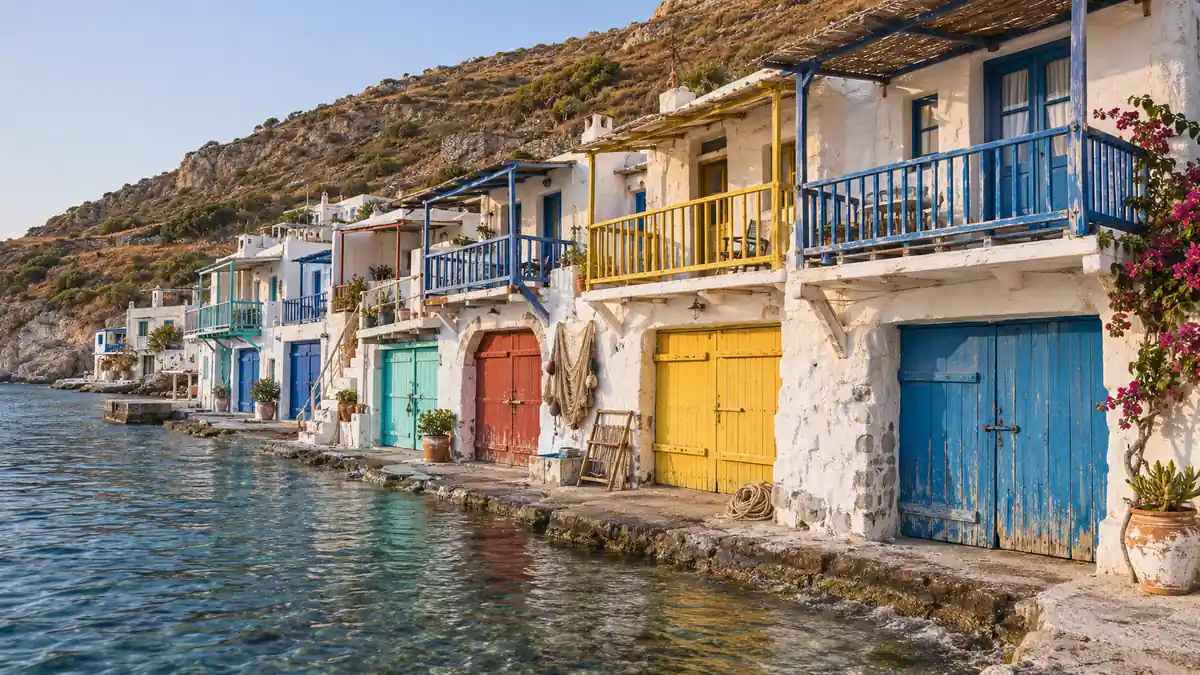
Syrmata are boathouses cut into the shoreline, with the boat kept at water level and living space above behind a painted door. Klima has the best-known row, brightly coloured and set right at the sea’s edge. Firopotamos and Mandrakia are smaller and quieter, each with a tiny harbour for a slow wander. Go when the sun is low. The colours on the doors glow, and the heat has gone out of the lanes.
It pays off most for travelers who enjoy slow walks and village detail over big views. The trade-off: Klima’s syrmata are private homes. Photograph from the lane, keep off the terraces and steps, and expect little to do beyond the walk itself.
Plaka Castle Sunset Is Worth the Climb
The castle hill above Plaka is the classic sunset viewpoint on Milos. A stepped path climbs from the village lanes to the chapel at the top, with the bay and the western half of the island spread below. Arrive well before the light drops. The best spots on the top go early, and the walk down in the dusk is easier with daylight to spare.
Couples, and anyone who wants one big-view sunset on the trip, should make the climb. The catch here is the crowd: the climb is steep and busy at sunset in peak weeks. Afterwards, seafood in Pollonia means a drive from Plaka across the island, so settle who drives before the wine arrives.
Are the Catacombs of Milos Worth Visiting?
Yes, the Catacombs of Milos are worth a short visit when you bundle them with the two sites beside them. The early-Christian burial galleries, the ancient theatre and the marked Venus de Milo find site fill half a day in Trypiti. Travelers who only want beaches can skip the cluster without regret.
The catacombs are an early-Christian underground cemetery cut into the hillside near Trypiti. Their galleries total about 200 metres, lined with arched tomb niches. The visit is short and partly guided, at the site’s pace.
Entry costs €10, or €5 reduced. Opening runs from morning to mid-afternoon, and the site closes one weekday. Confirm the day before.
The ancient theatre is an open hillside site nearby, with views down over the bay. Close to it, a marked spot shows where the Venus de Milo was found. The statue itself stands in the Louvre.
History-minded travelers and anyone escaping the midday sun get the most from the cluster. Bring a hat for the theatre, which is exposed, with little shade.
The catacombs are the one Milos stop that gets better in the heat. Underground and cool, they fill the hours when Sarakiniko and the beaches are at their worst.
The Mining Museum and Paliorema Explain Why Milos Looks the Way It Does
Mining heritage is the experience that explains why Milos looks the way it does. The small Mining Museum in Adamas is worth an hour for anyone curious about the island’s colours and coves. The abandoned sulfur mine at Paliorema earns a half-day only for fans of industrial ruins who have a vehicle.
Milos is volcanic, and its rock has been worked since antiquity, from obsidian to sulfur and modern industrial minerals. The museum lays out that story through minerals, tools and photographs. Afterwards the quarried slopes and coloured cliffs you pass from the boat make sense.
The museum closes from November to March, except for educational programmes. In high season it opens daily with an evening session; in shoulder months hours are limited. Check before going.
Paliorema is a different kind of visit. The abandoned sulfur works sit in a remote cove, reached by a rough track, exposed to sun and wind, with no facilities. You need a vehicle. View the ruins from outside the structures.
The museum suits curious travelers who want the story behind the landscape. Skip Paliorema if you have no vehicle or only two days. The museum alone carries the story.
See the museum before the boat trip, not after. The coloured cliffs and cut rock you pass on the way to Kleftiko read differently once you know Milos is an old mining island.
Book the Boat Early in Your Stay, Then Fit the Rest Around It
Book the boat trip for the first or second full day of your stay. If wind cancels it, you still have days left to rebook. Everything else then slots around it: Sarakiniko and Papafragas at the edges of the day, the Trypiti sites and museum in the hot hours, the villages at sunset.
- Never the last day. A wind cancellation then means no boat trip at all.
- Wind is the main risk. The meltemi, the strong summer north wind, can delay or cancel departures. Most operators then offer another date or a refund; read the cancellation terms before you pay, since they differ between operators.
- Pack for no shade. Water shoes, a hat, sun protection and water cover Sarakiniko, Papafragas and the boat’s swim stops.
- Vehicle needed. South-coast departures and Paliorema are hard to reach without one.
Pick by trip length first, then by the kind of traveler you are:
- 2 days: the boat trip, one north-coast half-day for Sarakiniko and Papafragas, and one village sunset. The 2-day Milos itinerary puts them in order.
- 3 days: add the Trypiti ancient cluster and the Mining Museum, or a second sea day by kayak. The 3-day Milos itinerary sequences them.
- Families: a catamaran trip and Sarakiniko in the late afternoon. Ask the operator about child life jackets before booking.
- Strong swimmers: a speedboat from the south coast and Papafragas on a calm day.
- Heat-sensitive travelers and non-swimmers: the villages, the catacombs and the museum.
The land experiences are the ones that can move. If the boat is rescheduled, the Trypiti morning and the museum become the swap day, so keep them unbooked and flexible.
Milos usually works as one stop in a longer route. The Greece itinerary shows where the island fits in a wider trip, and the guide to the best places in Greece compares it with the other islands and cities.
How the Milos Picks Were Checked
This page judges which Milos experiences earn a day, from the Kleftiko boat trip to the Trypiti catacombs, and how to book and time them; it is not a guide to the whole island, a day-by-day itinerary, a ranking of Milos beaches or a list of lesser-known spots.
These Milos verdicts, from the boat ladder to the Sarakiniko timing, began as text written with AI assistance; Alex Perrut, working in tourism since 2015, then checked them for the Tripstou editorial team. The sequence is laid out in our editorial process.
Official sources consulted: Visit Greece, Greek Ministry of Tourism, Hellenic Ministry of Culture, Milos Mining Museum.
Did this guide save you time or money? Tripstou is independent and reader-funded — if you'd like to give something back, you can support the site with a crypto contribution of any size.