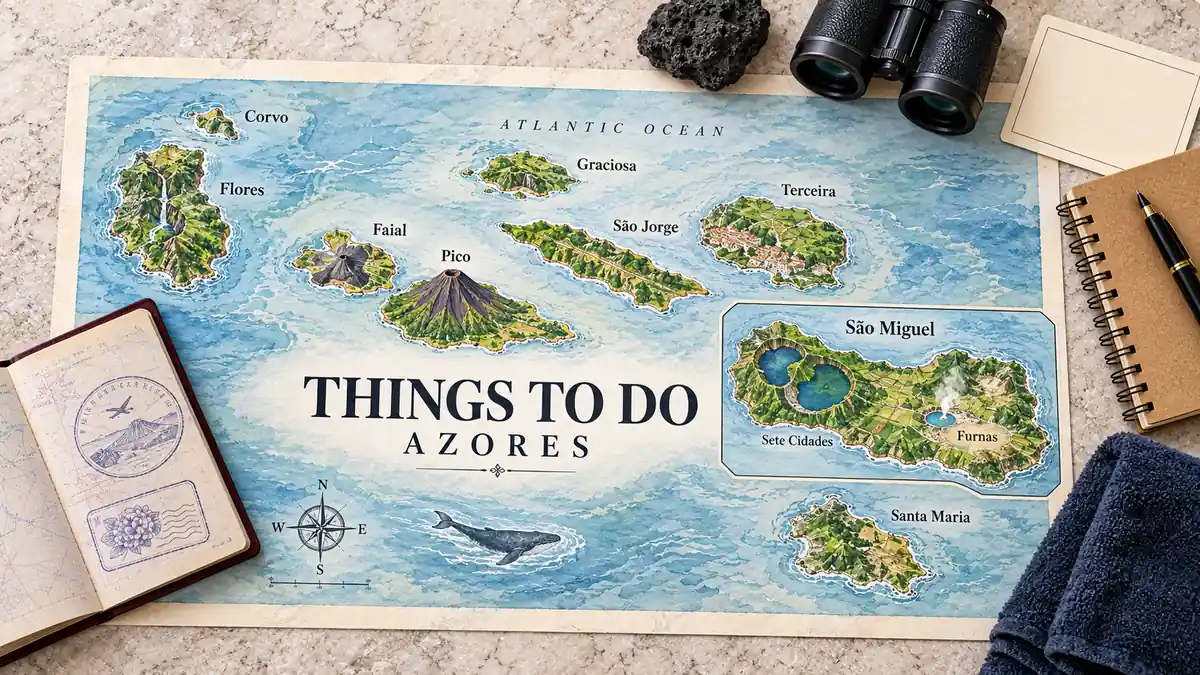
You have already chosen the Azores. The open question is which experiences deserve your days, and in this archipelago every answer arrives with an island and, often, a month attached.
The set is small: a whale boat, a crater walk, a summit, a geothermal valley, a canyon and a volcanic coastline. This page judges six of them. Each gets a verdict, the traveler it suits, the version to book and the tradeoff that decides it — plus the one island it belongs to and the window when it works.
What this page does not do: choose your island, count your days or rank places. Those are separate decisions with their own guides. Weather runs through everything here, so the last two sections deal with what to do when the forecast turns and what to lock before you land.
Quick Answer
The Azores experiences worth the trip are whale watching, the Sete Cidades crater walk and Furnas hot springs. Add a Pico summit or a canyoning descent if you want effort; whales peak in spring, canyoning runs late spring to autumn. Book the boat, the canyon and your pool slot before you arrive; walk the craters independently.
Trust Layer
Tripstou attraction guide for travelers deciding whether an experience is worth doing and how to do it well. Covers value, booking versions, timing, access, and traveler fit.
Produced with AI assistance and reviewed by Alex Perrut, working in tourism since 2015, for the Tripstou editorial team. See our editorial process for details.
Last factual review: September 12, 2026.
Official sources consulted: Visit Portugal, Turismo de Portugal.
Key Takeaways
- The six experiences that define the Azores are the ones impossible elsewhere; generic outdoor sport belongs on any island’s activity list.
- Book a whale boat for the chance, not the promise — spring brings the big migratory species, dolphins show up year-round.
- Sete Cidades delivers the archipelago’s defining view at normal fitness; Mount Pico is the only climb that demands real hill experience.
- Operators are mandatory for boats, canyons and dives; the crater walks, viewpoints and thermal pools are yours to do alone.
- Weather cancels boats, canyons and summits, so schedule them early in your stay and keep a spare day in reserve.
- Book your Furnas pool slot online before you land, and check official trail status the morning you plan to walk.
Table of Contents
Six Experiences That Define an Azores Trip, and Which Deserve Your Days
Six experiences define an Azores trip: whale watching, the Sete Cidades crater walk, Furnas, Pico, canyoning and Capelinhos. The first three are the ones most travelers should protect their days for. Pico and canyoning are the effort picks, and Capelinhos only pays off if Faial is already on your route.
| Experience | Island | Best window | Guided or booked? |
|---|---|---|---|
| Whale and dolphin watching | São Miguel, Pico, Faial and Terceira all have operator bases | Spring for the migratory whales; residents year-round | Guided boat, booked ahead |
| Sete Cidades crater walk | São Miguel, at the island’s western end | Year-round, clearest above the cloud line | Independent, on waymarked PR trails |
| The Mount Pico summit climb | Pico, starting from the mountain house | Settled forecast only, whatever the month | Check the mountain house rules first |
| Furnas thermal pools and fumaroles | São Miguel, in the Furnas valley | Year-round, and better in cool or wet weather | Pool slot booked online before arrival |
| Canyoning through volcanic ravines | São Miguel for beginner routes, Flores for the hardest | Late spring to autumn, river levels permitting | Fully guided, booked in advance |
| Capelinhos volcano and its coastline | Faial, at the island’s western tip | Year-round; the centre works in rain | Independent visit, no tour required |
Golf, horse riding and biking fill most Azores activity lists because ten items look more generous than six. The six above are different. Each one is either impossible elsewhere or clearly worse: a caldera you walk the rim of, a meal cooked in volcanic ground, an open-Atlantic whale boat, a descent through a waterfall ravine. Generic outdoor sport travels anywhere. These do not.
Every experience below names its island, and that is as far as this page goes on geography. Which island or islands to base on, how many days the archipelago deserves and how to move between them are the questions our Azores travel guide exists to answer. And if you are still weighing the islands against the mainland, they sit among the country’s most distinctive destinations in our guide to the best places to visit in Portugal.
Is whale watching in the Azores worth it?
Whale watching in the Azores is worth it if you go for the chance, not a guarantee. Several dolphin and whale species live in these waters year-round, and the large migratory whales concentrate in spring. The honest case for skipping is a weak stomach: these are small boats on the open Atlantic.
Worth it for: travelers who accept a probability, not a promise, and can handle an open Atlantic boat.
When is the best time of year for whale watching in the Azores?
Spring is the best time, roughly March to May. That is when the large migratory baleen whales — blue, fin and sei — move through the archipelago on their way north, and it is the only window in which seeing one is a realistic hope. Encounters can run into early June.
Outside spring the trip changes shape; it does not disappear. Resident sperm whales and several dolphin species — common, bottlenose, Atlantic spotted and Risso’s — are in these waters all year, so a summer or autumn boat is still a wildlife morning, just a different one.
Treat every month as a probability. Operators read the sea each morning and work with spotters watching from land, but nobody controls what surfaces.
Which Azores island is best for whale watching?
No single island is best for whale watching in the Azores. Operators sail from São Miguel, Pico, Faial and Terceira, and all four sit beside the same deep Atlantic water that makes the archipelago a whale-watching destination at all. What you might see is set by the month, not by the harbour you leave from.
So the decision is easy: sail from the island you are already on. Crossing to another island for a boat trip costs you a travel day and gains you nothing you could not have had from your own port.
What does vary is how a trip runs — boat size, sea exposure, how far out it goes. Read the description before you book, and ignore the island’s reputation.
Expect a morning at sea, not a documentary. Boats spend most of the time searching, the sightings are brief, and the dolphins are usually the reliable part. Dress for cold and spray even in summer; the wind on open water is nothing like the wind on shore.
The travelers who come back disappointed are almost always the ones who booked a single boat on a single morning. The ones who enjoy it treat the dolphins as the trip and the whales as the bonus.
Motion sickness is the real filter. If you know you are susceptible, take something before boarding and not after, sit low and central, and keep your eyes on the horizon. Young children manage the shorter, sheltered trips better than the long offshore ones.
Tours and activities
Book skip-the-line tickets, day trips and local tours with free cancellation on most activities.
You can also browse everything on getyourguide.com.
Tripstou may earn a commission if you book through this link, at no extra cost to you.
The Best Hikes in the Azores for a Normal Fitness Level, and Where Pico Sits
The Sete Cidades crater rim is the Azores hike to do if you walk only one. It delivers the archipelago’s defining view — twin lakes in a single volcanic caldera — to anyone with normal fitness. Mount Pico is the one serious climb here, and it belongs to fit hikers with a spare day for weather.
The Sete Cidades crater-lake walk is the essential Azores hike
Worth it for: anyone with normal fitness who wants the Azores’ defining view on foot.
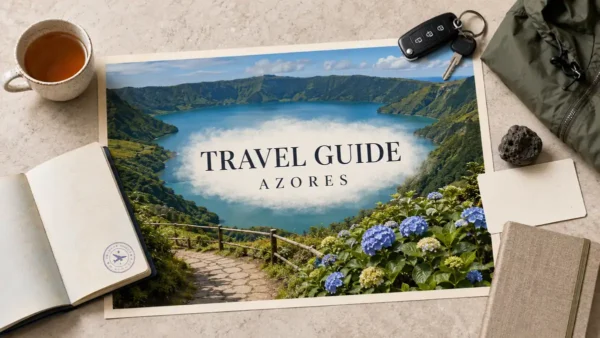
Sete Cidades is a twin crater-lake system at the western end of São Miguel: Lagoa Azul and Lagoa Verde, blue and green, side by side inside one caldera. Vista do Rei is the classic viewpoint. The walking is rim walking — grassy, undulating, mostly gentle — on official PR routes with red-and-yellow waymarks.
The tradeoff is cloud. The lakes sit high, the rim sits higher, and the view can vanish and return within the hour. Sections of these trails also close for landslide risk without much notice, so check official trail status before you set out and keep the lakeside road as a fallback.
If the rim is in cloud, wait before you drive away. The lake below is often clear when the viewpoint is not.
How hard is climbing Mount Pico?
Worth it for: fit hikers who want one hard summit day and will build in a weather spare.
Climbing Mount Pico is hard. It is Portugal’s highest point, a dormant volcano rising to roughly 2,350 m on Pico island, and the ascent is a full, steep day on loose volcanic rock with very little flat ground to recover on. There is no easy version and no cable car.
Weather is the second difficulty. The summit makes its own cloud, wind picks up fast, and visibility can close in while you are still on the cone. Check the mountain house rules before you go — access on Pico is managed, and what is required of climbers is set there, not by a guidebook.
Keep a spare day. A clouded summit is a wasted climb, and the forecast decides late.
Furnas hot springs are worth it if you pick the right pool and book your slot
Furnas is worth a day for almost everyone, and the only real choice is which pool. It is the easiest way to feel the volcanic side of São Miguel: warm mineral water, steaming ground and a meal cooked in it. Book your slot before you arrive. That one step decides how the day goes.
Worth it for: wet days, tired legs and anyone who wants the volcanic side of the islands without effort.
- Poça da Dona Beija — the classic evening soak, and the safe pick for a first visit. It suits travelers who want warm water, low effort and an easy end to a driving day. Tradeoff: it is the most popular pool on the island, so the slot rule bites hardest here.
- Terra Nostra garden pool — the pick if you want the garden as much as the water, set inside a botanical park you can walk before or after. Tradeoff: the iron-rich water stains light swimwear, so bring something dark you do not mind sacrificing.
- Caldeira Velha — natural pools in forest beside a waterfall, on the road towards Lagoa do Fogo, for travelers who want the setting to be wilder. Tradeoff: less soaking comfort, more scenery, and a smaller space that fills quickly.
The valley works best as one sequence instead of three separate errands. Start with the fumaroles — the steaming, sulphurous ground at the lake shore and in the village itself — then take the cozido das Furnas, the stew buried in volcanic earth and lifted out around midday, as the middle of the day. Finish in the water when your legs have stopped working. Arrange the meal through wherever you plan to eat, and book your pool slot online before you arrive; each pool charges a small per-person fee.
Let the lunch set the day’s order. The cozido comes out of the ground on the ground’s schedule and waits for nobody, while the water is still warm at dusk.
Canyoning is the adventure activity worth booking in the Azores
Canyoning is the one adventure sport the Azores do better than mainland Portugal. You descend a green volcanic ravine by abseiling down waterfalls, sliding over rock and jumping into pools. Beginners are welcome: guides run short, low-drop routes and supply everything you wear. Swimming confidence is the real requirement.
Worth it for: active travelers who want an adventure day the mainland cannot reproduce.
São Miguel is where beginner routes are easiest to find, with short descents and modest drops built for first-timers. Flores carries the hardest canyons in the archipelago and is where experienced descenders go. São Jorge adds coastal ravines. If you are choosing between islands for other reasons, book on the island you are already on — every canyoning island runs an entry-level route.
On canyoning, the operator’s route choice matters more than the island. A gentle beginner descent and a full technical day share a name and almost nothing else, so read what a route actually involves before you pay for it.
The season runs late spring to autumn. Winter and early spring are restricted by river conditions, and even in season a heavy rain spell can close a canyon at short notice. That is the second reason to hold a spare day.
Skip it if:
- You are not a confident swimmer — every route puts you in moving water repeatedly, and a buoyancy aid is not the same as being comfortable.
- You have a genuine fear of heights — abseiling down a waterfall is the core of the activity, not an optional extra you can walk around.
- You are travelling in winter — the operating window closes, and a booking you cannot take is worse than an experience you never planned.
Children can join where an operator’s route allows it, which is a question for the operator and not for a guide like this one. Everyone else needs only a swimsuit and a towel; wetsuit, helmet, harness and rope work all come with the booking.
Do you need a guided tour in the Azores, or can you do it yourself?
You need an operator for anything on or in the water, and for canyoning. You do not need one for the crater walks, the viewpoints or the thermal pools. Most Azores trips therefore mix two or three booked experiences with independent days around them. A car makes the independent half possible.
- Operator-only — whale and dolphin boats, canyoning, diving. This tier is everyone who wants those experiences; there is no self-guided version of any of them. Tradeoff: fixed departure slots and weather cancellations you have no control over.
- Guide optional — Mount Pico and the longer coastal trails. Confident hikers with navigation experience go independent; first-timers and anyone unsure of the terrain go guided. Tradeoff: you trade cost and a fixed group pace against owning the route-finding and the weather judgement yourself. On Pico, check the mountain house rules before assuming either version is available.
- Independent — Sete Cidades and the other waymarked PR trails, the viewpoints, the Furnas pools and fumaroles. This tier suits everyone, whatever their fitness. Tradeoff: the trail-status check and the pool-slot booking become your job, and nobody will remind you.
The mix sets the rhythm of the trip. Booked experiences take mornings, because that is when boats sail and canyons run; independent days take whatever the afternoon weather allows. Two or three fixed points across a stay is usually the comfortable ceiling.
The independent tier is only genuinely independent if you have a car. Without one, viewpoints and trailheads quietly turn back into tours, and the guided tier stops being a choice. Whether to hire one, and how driving works across the islands, belongs to the parent guide linked above.
What to do in the Azores when it rains
Rain rarely cancels an Azores day — it reassigns it. Move Furnas forward: the thermal pools, the fumaroles and the cozido lunch all work better in poor weather than in sun. Push the whale boat and the summit to a drier day you have kept spare. Coastal viewpoints often clear first.
Rain-proof, and often improved by rain:
- The Furnas thermal pools — warm water in cool, wet air is better than warm water in full sun.
- The fumaroles at the lake shore and in the village — steam against grey sky, and a short stop either way.
- The cozido das Furnas lunch — indoors, slow, and the natural anchor of a washed-out day.
- The Capelinhos interpretation centre, if you are already on Faial.
Rain-sensitive, and worth moving:
- Whale and dolphin boats — called off by sea state more often than by rain itself.
- Canyoning — river levels rise fast after heavy rain, and operators cancel on water, not on comfort.
- Mount Pico — cloud and wind remove both the view and the margin for error.
- Crater viewpoints — Vista do Rei inside a cloud shows you nothing at all.
Booking order fixes this; optimism does not. Put the weather-dependent experiences early in your stay so a cancellation still has days left to land in; a boat cancelled on your last morning is simply a boat you did not do.
A clouded crater does not mean a clouded coast. Weather on one Azorean island can differ end to end within a short drive, and the high interior holds cloud long after the shoreline has cleared. Check the sky in the direction you are heading, not the one directly above you, and be willing to swap the plan at the trailhead.
What to Book Before You Arrive, and What to Leave Open
Lock the whale boat, the canyoning descent and your Furnas pool slot before you land. Leave the crater walks, the viewpoints and the Pico day open so the weather can decide them. Booked experiences run on fixed slots. The free ones run on whatever the forecast gives you.
Book before you arrive:
- The whale and dolphin boat — departures are fixed and the calm mornings fill first.
- The canyoning descent — fully guided, gear-dependent and capacity-limited, so walk-ups rarely work.
- Your Furnas pool slot — booked online, and the most popular pool goes before the others.
Decide on the day:
- The Sete Cidades walk — needs a same-morning look at the cloud line and at official trail status.
- Viewpoints and coastal drives — the part of the trip a bad forecast cannot take from you.
- Mount Pico — only worth starting on a settled forecast, which you will not have in advance.
The booking order is really the itinerary. Fix the weather-dependent experiences into the first half of the stay and everything else arranges itself around them.
Then pick by traveler type. A first-timer with a few days should take whale watching, Sete Cidades and a Furnas day and stop there; that is the archipelago’s core and it fits without rushing. An active traveler adds canyoning or the Pico climb, but rarely both in the same short stay. Weather-cautious travelers and families should front-load Furnas and the crater viewpoints and keep the boat for the calmest sea in the forecast.
If the Azores are one stop in a longer trip, the sequencing question — where the islands sit against Lisbon, Porto and the south — is answered in our Portugal itinerary. And if you are still deciding how much of your time the archipelago deserves, weigh these six against the national set of things to do in Portugal.
Frequently Asked Questions
Do you need to book the Azores thermal pools in advance?
Yes — treat online pre-booking as a requirement. Slots for the most popular pools go before you land, and arriving without one is how a planned soak becomes a drive home. Book the pool nearest your base, so a weather-driven change of plan still leaves it within reach.
Is the cozido das Furnas worth trying?
Yes, as an experience more than a meal. The cozido is a slow stew of meats and vegetables buried in the volcanic ground for hours, and it comes out earthy, heavy and gentle in flavour. Order it in advance wherever you plan to eat, and keep the evening meal light.
Is the Capelinhos volcano on Faial worth visiting?
Yes, if Faial is already on your route. The eruption that created this coastline enlarged the island itself, leaving grey, ash-covered ground that looks like nowhere else in the archipelago, with an interpretation centre alongside it. On its own, though, it does not justify an inter-island crossing.
Is scuba diving in the Azores worth it?
Yes, for certified divers who want open-Atlantic marine life: volcanic rock formations and pelagic species you will not meet on a mainland shore dive. Dives are guided from a boat, so book them like the whale trip. Snorkelling is the weaker option — cool water, and swell that is rarely flat.
Can you kayak, paddleboard or surf in the Azores?
Yes, but none of them should displace the six core experiences. Flat-water paddling works best on the crater lakes and in sheltered bays, where a calm morning is easy to find. Surfing is for experienced boarders — the beaches are exposed Atlantic, and conditions change with the swell, not the calendar.
Are whale sightings guaranteed in the Azores?
No. No operator can promise a species, and even in peak spring weeks a boat can come back having seen very little. Spring raises the odds for the large migratory whales; it never converts them into a certainty. Read any sighting wording as a probability, and book the trip early in your stay.
Related Guides
- Azores Travel Guide — which island or islands to base on, how long to stay and how to move between them.
- Best Places to Visit in Portugal — where the archipelago sits among the country’s destinations.
- Portugal Itinerary — how to fit the Azores into a wider route around the country.
- Things to Do in Portugal — the national set of experiences, from the mainland to the islands.
Did this guide save you time or money? Tripstou is independent and reader-funded — if you'd like to give something back, you can support the site with a crypto contribution of any size.