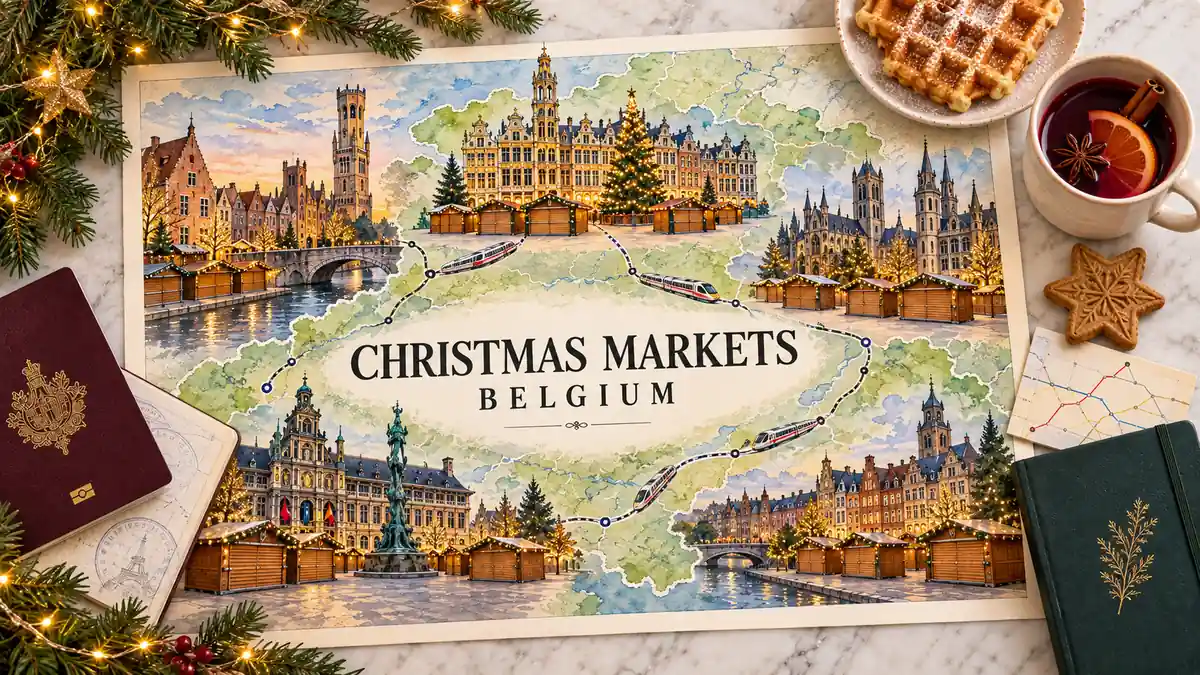
Belgium puts five Christmas markets with very different characters inside a small country, each within about an hour of Brussels by train. That changes the planning question. Going is easy; the real decision is which market to sleep near and which ones to reach by train. Brussels brings scale and evening spectacle. Bruges brings the setting. Ghent offers a medieval centre with a more local crowd, Antwerp spreads its market across a shopping city, and Liège keeps the oldest tradition with a Walloon folk flavour. This guide covers what each market is like, who it suits, how the season runs in general terms and how to fit more than one into a single winter trip without changing hotels.
Quick Answer
Brussels has Belgium’s biggest Christmas market and Bruges its most atmospheric; most winter trips anchor on one. Choose Brussels for scale and evening spectacle, Bruges for the setting; Ghent, Antwerp and Liège suit other tastes within about an hour by train. With one base and three nights or more, two or three markets fit one trip.
Trust Layer
Tripstou selection guide for travelers choosing between multiple places. Covers selection criteria, traveler fit, and trip value.
Produced with AI assistance and reviewed by Alex Perrut, working in tourism since 2015, for the Tripstou editorial team. See our editorial process for details.
Last factual review: September 29, 2026.
Official sources consulted: Belgian federal government portal, FPS Foreign Affairs, City of Brussels, Liège Village de Noël.
Key Takeaways
- Brussels’ Winter Wonders is Belgium’s largest Christmas market, a walkable route of central squares that suits first-time visitors with only one or two nights.
- Bruges wins on setting: two squares inside the medieval centre, with the Markt for atmosphere and Simon Stevinplein for artisan stalls.
- Ghent gives a medieval backdrop with a more local crowd, but its market opens later in the season than those in Brussels and Bruges.
- Liège’s market closes before New Year, unlike the Flemish markets, so schedule it early and confirm it is still open late in the year.
- One Brussels base covers all five markets, each about an hour or less by direct train, so three nights fit two or three markets.
- Mid-December is the safest window to find all five markets open, and weekday late afternoons bring the lights with the thinnest crowds.
Table of Contents
Which Belgian Christmas markets are worth planning a trip around?
Five Christmas markets are worth planning a winter trip around: Brussels, Bruges, Ghent, Antwerp and Liège. Each made the list for a different reason (scale, setting, local feel, variety or tradition), so the choice rests on character over size. Pick the market whose character fits your trip, then add the others by train.
The table sorts the five by what defines them. Stall numbers are the weakest guide here. A smaller market in the right setting often makes the better evening, and every city below sits within reach of a single Brussels base.
| Market | Character | Season pattern | Train from Brussels | Suits travelers who want |
|---|---|---|---|---|
| Brussels | Largest market, spread across several central squares | Opens late November, runs into early January | The base city, no train needed | Scale and evening spectacle within walking distance |
| Bruges | Two squares inside the medieval centre, strongest setting | Opens late November; Winter Glow runs into February | About an hour by direct train | A postcard setting over the number of stalls |
| Ghent | Wooden huts through the medieval core, more locals | Opens later, in early December, into January | About half an hour by train | A medieval backdrop with fewer tourists around |
| Antwerp | Several squares woven into a big shopping city | Opens later, in early December, into January | Under an hour by train | Shopping and variety spread across a large centre |
| Liège | Oldest market, French-speaking, food-led folk character | Runs through December, closes before New Year | About an hour by train | Folk tradition, stall food and an earlier trip |
Smaller markets such as Leuven, Durbuy and Hasselt are covered in the FAQ below as add-ons for repeat visitors.
Brussels is the biggest and most spectacular market
Brussels’ Winter Wonders is the country’s largest Christmas market, spread across several squares from the Grand-Place to Sainte-Catherine. It leads the list because no other Belgian market combines this scale with evening spectacle, and the whole route sits within walking distance in the historic centre. First-time visitors get the most market per night here.
The market goes by Plaisirs d’Hiver in French and Winterpret in Dutch. Its stalls run through the Grand-Place, the Bourse, Place de la Monnaie, Sainte-Catherine, the Marché aux Poissons (Vismarkt) and Place De Brouckère, with more than 200 chalets along the way. The Grand-Place hosts a sound-and-light show, and a Ferris wheel and an ice rink sit further along the route.
Movement is what sets Brussels apart. You walk through a whole city centre from one square to the next, so the market works as an evening route instead of a single fair. The route is long enough to split over two evenings, which makes Brussels the only market here where a second night shows you something new.
The tradeoff is density. Weekend evenings pack the Grand-Place, and the feel is less intimate than in Bruges. For the city beyond the market (neighbourhoods, museums and getting around), see our Brussels guide.
Pick this if: you want the largest market and evening spectacle within a walk of your hotel.
Bruges is the most atmospheric setting
Bruges has the most atmospheric Christmas market in Belgium, set on the Markt and Simon Stevinplein inside the medieval centre. It is smaller than Brussels, yet the setting does work no stall count can match: canals, gabled façades and a compact core. Travelers who care about the backdrop more than the size should build around Bruges.
The two squares split the market by style. The Markt carries the traditional stalls, while Simon Stevinplein focuses on artisans and short-supply-chain produce. Both sit inside the wider Winter Glow (Wintergloed) programme, which adds an ice rink, a winter bar and other seasonal attractions and runs longer than the stalls themselves.
Here the backdrop does the work. Simon Stevinplein is the square to shop and the Markt is the square to stand in; split your evening that way and the small size stops mattering.
The limitation is size under pressure. Bruges is small and heavily visited at weekends, so a weekday evening pays off more here than in Brussels. For planning the rest of Bruges beyond the stalls, see our Bruges guide.
Pick this if: the setting matters more to you than the number of stalls.
Ghent is the local-feel alternative with a medieval backdrop
Ghent’s Christmas market runs from Sint-Baafsplein to the Korenmarkt through the medieval core, with a more local crowd. It suits travelers who find Bruges too visited: the backdrop is just as historic, and a large student population keeps the city full of residents. Its evenings stay lively well beyond the market itself.
More than 150 wooden huts run from Sint-Baafsplein along the Botermarkt and Klein Turkije to the Korenmarkt. The route adds an ice rink, a carousel and a Ferris wheel. The centre sits inside a Low Emission Zone, so drivers should check their vehicle’s rules before arriving.
Ghent is the student city on this list, and it shows after dark. The bars and cafés around the market fill with locals. Ghent also sits between Brussels and Bruges on the same rail line, which makes it the market you can add on the way without planning a separate trip.
Timing is Ghent’s catch. It opens later in the season than Brussels and Bruges, so a trip in the last days of November may arrive before the huts are up.
Pick this if: you want a medieval backdrop with more locals than tourists.
Antwerp spreads its market across the whole city centre
Antwerp’s Winter in Antwerpen fills several squares, from the Groenplaats rink to the tree on the Grote Markt. It suits travelers who like variety and shopping, because the market spreads through a large, busy city centre instead of sitting on one square. It is the least compact market here, and the most varied.
The covered ice rink stands on the Groenplaats, and the Christmas tree rises in front of the town hall on the Grote Markt. Between the squares, the market threads through the streets of Belgium’s big shopping city, so stalls, shops and cafés blend into one long outing.
Antwerp is the market for a city break with the season as a backdrop. Treat it as an afternoon market: the shopping streets that give it variety belong to daylight, which frees your evenings for Brussels’ show or Ghent’s bars.
What Antwerp gives up is cohesion. The squares are spread out, the centre reads less like an old town than Bruges or Ghent, and the market opens later in the season than Brussels. Short visits feel scattered.
Pick this if: you want a market woven into a big shopping city rather than a postcard square.
Liège is the oldest market and the most Walloon in character
Liège’s Village de Noël, on Place du Marché and Place Saint-Lambert, is Belgium’s oldest Christmas market and its most folk-flavoured. The market bills itself that way, and it trades on tradition over spectacle: French-speaking, food-led and Walloon in character. Its one catch is structural, because it closes before New Year.
Around 200 chalets fill Place du Marché, Place Saint-Lambert and Place de la Cathédrale. Food leads here. Peket, the local juniper spirit, is the signature drink, and boûkète, a buckwheat pancake, is the Liège speciality to look for. For what these dishes are and where else to eat them, see our Belgian food guide.
Liège is the one market on this list worth planning around a meal. Go hungry, eat at the stalls and skip the dinner booking; the chalets are the attraction, so an early visit sees as much as a late one.
The structural fact matters more than any stall. Liège closes before New Year, unlike the Flemish markets that run into January. Put it early in the plan, and if your trip starts in the last days of the year, confirm it is still open before building a day around it.
Pick this if: you want the folk tradition and your trip falls before Christmas week ends.
Brussels or Bruges: which Christmas market is better?
Brussels is better for scale and spectacle; Bruges is better for setting and a slower evening. First-time visitors with one or two nights usually get more from Brussels, while couples and anyone who values atmosphere over variety should choose Bruges. They sit about an hour apart by train, so many trips do both.
Three conditions settle the choice:
- Trip length: a short trip favours Brussels, where one evening covers a whole route of squares; a longer stay leaves room for Bruges at its own pace.
- Who you travel with: couples and slow travelers suit Bruges; families and groups get more attractions from Brussels.
- Route or square: choose Brussels for a walk through a city centre, Bruges for two squares in a medieval core.
Doing both is the easy answer. Base in Brussels, spend one evening in Bruges and return by train; the reverse works too, with Bruges as the quieter base. The real split is timing: Brussels’ show and lights justify staying late, while Bruges repays arriving in daylight and staying through dusk.
When are Belgian Christmas markets open?
Belgian Christmas markets open between late November and early December, and most run into the first days of January. Brussels and Bruges open first, Ghent and Antwerp a little later, and Liège closes before New Year. The official city page for each market publishes each year’s dates and hours.
Three exceptions shape the plan:
- Ghent and Antwerp open later in the season than Brussels and Bruges, so an end-of-November trip may reach them before the stalls are up.
- Liège closes before New Year, unlike the Flemish markets.
- Bruges keeps its Winter Glow programme running beyond the stalls, into February.
Holiday days run on reduced or special hours. Expect changes on 24 and 25 December and on 31 December and 1 January; check the official city page, which publishes each year’s dates and hours.
Weekends and evenings are busiest everywhere. Weekday late afternoons are the quietest window, with the lights on and room to move. Mid-December is the safest window to see all five: Ghent and Antwerp are open by then, and Liège’s close is still weeks away.
How to see several markets on one trip from one base
Base in Brussels and every market on this page is about an hour away or less by direct train. Belgium is small and well connected by rail, so one hotel covers all five markets without packing and repacking. Three nights or more fit two or three markets comfortably, with one market each evening.
From Brussels, the train takes about half an hour to Ghent, under an hour to Antwerp and about an hour to Bruges or Liège. These pairings work:
- Brussels and Bruges: the classic pair, with spectacle one night and setting the next.
- Brussels, Ghent and Antwerp: the Flemish arc, with both add-ons under an hour from the base.
- Liège: the day that must fall before New Year, so schedule it early in the trip.
Ghent works as a quieter base. It sits between Bruges and Brussels on the same line, which keeps both within easy reach while you sleep somewhere calmer. Sleep in the city whose market you want at night, and reach Antwerp by day: its shopping-led market needs no late train home.
Trains are busiest on weekend evenings, when market crowds head home at the same time. Travel back a little before the rush. For the wider trip plan, from regions to how the cities connect, see our Belgium travel guide.
Frequently Asked Questions
Are Belgian Christmas markets open on Christmas Day?
Most Belgian Christmas markets run over Christmas, though 24 and 25 December bring reduced or special hours. Each city sets its own holiday schedule and publishes it on its official page, so check there before building a Christmas Day evening around a market. For the fullest experience, plan the visit for an ordinary day instead.
Are Belgian Christmas markets still open between Christmas and New Year?
Yes, most are: Brussels, Bruges, Ghent and Antwerp run through the week between Christmas and New Year and into the first days of January. Liège is the exception, because its Village de Noël closes before New Year, so confirm it is still open before planning a late-December day there. Expect special hours on 31 December and 1 January.
Is Bruges or Ghent better for a Christmas market?
Bruges is better for setting, Ghent for a local crowd and livelier evenings. Bruges splits its market between a traditional square and an artisan one inside a postcard centre; Ghent runs huts through an equally medieval core full of students. Ghent opens later in the season, so an end-of-November trip favours Bruges.
Which is the oldest Christmas market in Belgium?
Liège’s Village de Noël presents itself as Belgium’s oldest Christmas market. Age shows in the character more than the size: it is French-speaking, food-led and Walloon, where Brussels leans on spectacle. Travelers who want that older folk tradition should plan Liège as a day from a Brussels base, placed early in the trip.
What should you eat and drink at Belgian Christmas markets?
Most Belgian Christmas markets sell waffles, speculoos and mulled wine, and many stalls pour jenever, the juniper spirit. Liège has the strongest food identity: its jenever is called peket, and boûkète, a buckwheat pancake, is the dish to find there. On a market evening, eat at the stalls. Our Belgian food guide explains each dish in depth.
Are the smaller Christmas markets in Leuven, Durbuy and Hasselt worth adding?
Yes, as add-ons for repeat visitors, not as the anchor of a first trip. Leuven, Durbuy and Hasselt run smaller markets that suit a second winter in Belgium, once Brussels and Bruges are done. On a first trip, the five markets above give more per evening, so add a smaller one only with a spare day.
Related Guides
- Belgium travel guide: plan the wider trip, from regions to how the cities connect.
- Brussels guide: the city beyond Winter Wonders, for your base or a longer stay.
- Bruges guide: sights and planning for the rest of Bruges beyond the market squares.
- Belgian food guide: the dishes and drinks behind the market stalls, from waffles to peket.
Did this guide save you time or money? Tripstou is independent and reader-funded — if you'd like to give something back, you can support the site with a crypto contribution of any size.