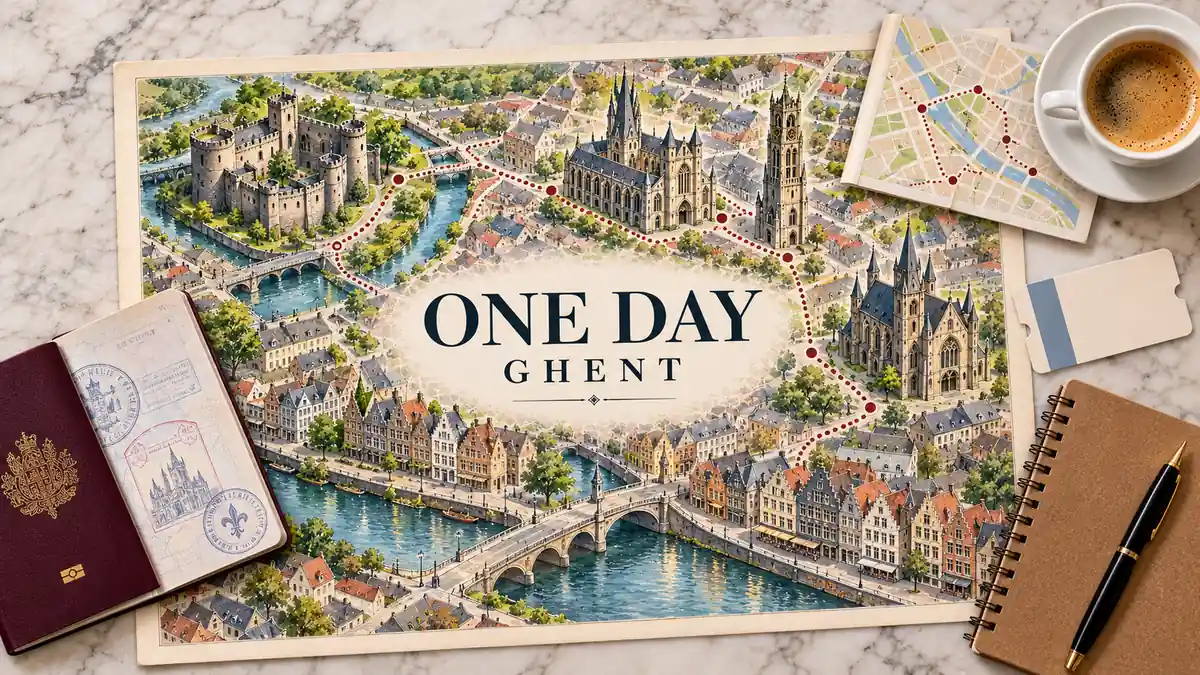
One day in Ghent is an ordering problem. The medieval core is compact enough to walk end to end in a single loop, so the real question is not what to see but in which order. The Ghent Altarpiece visitor centre, the Gravensteen and the Belfry each stop admitting visitors well before the day ends. The Graslei and Korenlei quays, meanwhile, look their best only at golden hour. Get the order wrong and you reach the castle gate after last admission, or stand on the water at noon under flat light.
Most travelers arrive by train from Brussels as a day trip. This guide gives the order and the reason behind it, the pacing of each block, the arrival from Gent-Sint-Pieters, which stops are optional, and whether the evening is worth a night in the city.
Quick Answer
One day covers Ghent’s medieval core on foot if you take the Altarpiece first and the quays last. The order runs cathedral and Belfry in the morning, Gravensteen and Patershol in the afternoon, then Graslei and Korenlei at golden hour. It suits a train day trip from Brussels; stay the night to see the quays lit after dark.
Trust Layer
Tripstou itinerary guide for travelers planning a route. Covers pacing, stop count, stop order, base logic, and trip length.
Produced with AI assistance and reviewed by Alex Perrut, working in tourism since 2015, for the Tripstou editorial team. See our editorial process for details.
Last factual review: September 30, 2026.
Official sources consulted: Belgian Federal Government tourism portal, Belgian Federal Public Service Foreign Affairs, St Bavo’s Cathedral, Historische Huizen Gent.
Key Takeaways
- One day covers Ghent’s medieval core on foot in a single loop, but the museums and a slow evening need a night.
- Book the first Altarpiece slot at St Bavo’s, because the visitor centre stops admitting mid-afternoon and the whole route hangs on it.
- Reach the Gravensteen straight after lunch: its last admission comes well before closing, and it is the first stop cut when time runs short.
- End on the Graslei and Korenlei at golden hour, standing on one quay to see the guild houses across the water.
- On a Sunday the Altarpiece opens only in the afternoon, so swap the anchors: castle in the morning, cathedral after lunch.
- Buy the train ticket before boarding, then take the tram to Korenmarkt or walk about 30 minutes from Gent-Sint-Pieters.
Table of Contents
Is One Day Enough in Ghent?
One day is enough for Ghent’s medieval core if you walk it as a single loop and skip the museums. It suits a train day trip from Brussels or a first visit at city-break pace. The tradeoff is depth: the museums and a slow evening on the quays need a night in the city.
A day trip works for most first visits. Leave Brussels on a morning train and the whole loop fits before the journey home. The case for staying is the evening: the guild houses on the Graslei and Korenlei are lit after dark, and Patershol’s small restaurants settle into their dinner rhythm once the day-trippers have gone. The case for leaving is the return train, which pulls you off the quays just as the light turns.
Ghent rewards an overnight more than most Belgian day trips, because its best hour arrives exactly when day-trippers start walking back to the station.
This page assumes Ghent is already chosen. For where Ghent sits among the country’s other destinations, see our guide to the best places to visit in Belgium. If Bruges is the alternative you are weighing, our Bruges guide covers that city on its own terms.
The Best Order for One Day in Ghent: Altarpiece First, Quays Last
Start at St Bavo’s for the Altarpiece at opening, then climb the Belfry before lunch. Take the Gravensteen and Patershol in the afternoon and finish on the Graslei at golden hour. The order follows the admission windows: the Altarpiece and castle stop admitting well before closing, and the loop ends where the evening light is best.
The three towers — St Bavo’s, the Belfry and St Nicholas’ Church — stand a few minutes’ walk from each other, so the morning costs almost no walking time. Sundays change the order. The Altarpiece opens only in the afternoon on Sundays, so swap the morning and afternoon anchors: castle first, cathedral after lunch, quays unchanged.
The route at a glance:
- Morning: St Bavo’s Cathedral and the Ghent Altarpiece — the one timed ticket, at opening
- Late morning: Belfry and St Nicholas’ Church — the three towers in a row
- Midday: St Michael’s Bridge, Korenmarkt and Groentenmarkt — the view and a quick lunch
- Afternoon: Gravensteen — the castle before its last admission
- Late afternoon: Patershol, with Vrijdagmarkt or the graffiti street if time allows — the quiet lanes
- Evening: Graslei and Korenlei — golden hour on the quays, dinner nearby
Starting at the Gravensteen, as many one-day routes do, burns the quietest Altarpiece hour on a castle you can still enter until mid-afternoon.
How to Get from Gent-Sint-Pieters to the Centre
Gent-Sint-Pieters sits outside the medieval core, so take a tram to Korenmarkt or walk about 30 minutes. The tram drops you at the start of the loop, a short walk from St Bavo’s. The walk lands at the same point and suits a clear morning with time in hand.
Most travelers come by train from Brussels, a journey that averages 36 minutes on SNCB services. Domestic Belgian trains no longer sell tickets on board, so buy through the SNCB app, website, a station machine or a ticket office before boarding. Buy the return at the same time. At the end of the day, the same tram or the same walk takes you back to the station.
If you are still weighing Ghent against the other day trips from Brussels, settle that choice first; this route starts once Ghent is decided.
Train and bus tickets
Compare routes, schedules and prices across rail and bus operators in one search, with mobile tickets on your phone.
New to Omio? Code NEW10 takes 10% off your first booking — or APPNEW10 if you book inside the Omio app. Both apply to bookings up to €80.
Search routes and compare prices on Omio →
Tripstou may earn a commission if you book through this link, at no extra cost to you.
Morning: The Ghent Altarpiece at Opening, Then the Belfry
Be at St Bavo’s when the Altarpiece visitor centre opens, then walk to the Belfry and St Nicholas’ Church. The Altarpiece is the day’s only timed ticket and is quietest at opening. The Belfry sits a short walk away and is best before the midday crowds, and the three towers line up along one street.
This block covers the cathedral square and the stretch toward Korenmarkt, roughly the first three hours of the day. Its role is to bank the anchor sight while the rooms are calm, then collect the towers in a row. The onward move is on foot. St Michael’s Bridge comes first for the view, then Korenmarkt and Groentenmarkt for lunch.
How to see the Ghent Altarpiece (Mystic Lamb)
St Bavo’s Cathedral is free to enter; the Ghent Altarpiece is seen through the visitor centre on a paid ticket. The centre opens Monday to Saturday 10:00–17:00 and Sunday 13:00–17:00, with last entry at 16:00. The augmented-reality tour takes about 60 minutes. Book the first slot of the day. It is the one booking the whole route depends on.
Belfry and St Nicholas’ Church before lunch
The Belfry is the morning’s climb, and the view from the top takes in the cathedral tower and St Nicholas’ Church. Go before lunch. St Nicholas’ Church is a walk-by on the way west, worth a short look inside. St Michael’s Bridge then frames all three towers and turns the route toward lunch at Groentenmarkt, beside the Great Butcher’s Hall, with frites or a cuberdon as the snack.
Spend the first hour on the Altarpiece, not the Belfry: the painting is viewed at close range, where a queue ahead of you matters, while the view from the Belfry looks the same an hour later.
Tours and activities
Book skip-the-line tickets, day trips and local tours with free cancellation on most activities.
You can also browse everything on getyourguide.com.
Tripstou may earn a commission if you book through this link, at no extra cost to you.
Afternoon: Gravensteen Before Last Admission, Then Patershol
Walk from Groentenmarkt to the Gravensteen straight after lunch, then drift into the lanes of Patershol. The castle is the afternoon’s one deadline because admission stops well before closing, so arrive by mid-afternoon. Patershol has no clock at all and sits right beside the castle, which makes it the natural wind-down.
This block covers the castle quarter and runs most of the afternoon. The Gravensteen is the second anchor; Patershol is the decompression after it. The onward move is on foot back toward the quays, with optional detours through Vrijdagmarkt or Werregarenstraat. A short boat tour from the Graslei and Korenlei quays also fits here, for travelers who want to sit down before the evening.
Gravensteen: how long to allow and whether to book
Allow a good hour or more for the Gravensteen. The castle opens daily 10:00–18:00, with last admission at 16:40. Booking ahead is advised but not mandatory. A timed ticket protects the afternoon if lunch runs long, and it removes the one queue that can push the rest of the day toward dark.
Patershol and the optional detours
Patershol is Ghent’s quiet medieval quarter of narrow brick lanes, low houses and small restaurants. It needs no ticket and no plan. The two detours below are optional and earn one short stop each:
- Vrijdagmarkt — the large market square east of Patershol, lined with guild houses.
- Werregarenstraat — the graffiti street off Hoogpoort, where the walls are painted over again and again.
The Gravensteen decides whether the day runs late: an overrunning lunch eats into the castle window while the quays can wait, so book the castle and keep lunch light.
Evening: Graslei and Korenlei at Golden Hour
Finish on the Graslei and Korenlei quays as the light drops, with St Michael’s Bridge above them. The guild-house façades along the water are the reason most people come to Ghent, and evening light warms them. The bridge frames all three towers at once, and dinner is a short walk away.
This block covers the quays for the last hour of light. Its role is the finale of the day, and it is also the strongest reason to stay the night. Dinner sits in Patershol or along the quays. Order waterzooi. The creamy Ghent stew is the local dish, and it suits the end of a day on foot. The onward move is the tram or the walk back to Gent-Sint-Pieters for the return train, or a night in Ghent to see the quays lit after dark.
Graslei and Korenlei face each other across the Leie, so stand on one quay to see the other: walking along either one puts you too close to its own façades to take them in.
How to Adapt This Route with Fewer Hours or More Days
With half a day, keep the Altarpiece, the Belfry and the quays and drop the Gravensteen. With a second day, add STAM and a slow Patershol evening. The Altarpiece and the quays are the irreducible core; the castle is the first cut because it costs the most time and its deadline pins the whole afternoon.
Cut first when time shrinks:
- The Gravensteen — the longest visit, with a fixed last admission that shapes the afternoon.
- The Patershol detours — Vrijdagmarkt and Werregarenstraat go before the lanes themselves.
- The Belfry climb — the view from St Michael’s Bridge covers the towers without it.
Add first when time grows:
- The short canal boat tour — a seated view of the quays from the water.
- A museum morning on the second day, with the Altarpiece already done.
- A night in Ghent — the quays lit after dark and an unhurried dinner in Patershol.
Sundays follow their own order. The Altarpiece opens only in the afternoon, so do the Gravensteen in the morning, the cathedral after lunch, and keep the quays for the evening.
| Time in Ghent | What stays | What changes | Best for |
|---|---|---|---|
| Half a day | Altarpiece, Belfry and the quays at golden hour | Gravensteen and the Patershol detours are cut | Travelers passing through on a longer rail route |
| One full day | The whole loop from cathedral to quays | Detours and the boat tour only if time allows | A train day trip from Brussels |
| Overnight | The whole loop at an easier pace | Adds the lit quays, dinner and a museum morning | Travelers who want Ghent’s evening as well as its sights |
Half a day in Ghent works better from lunchtime onward than in the morning: the Altarpiece still admits you until mid-afternoon, and the quays keep their best light for the end of the day.
Bruges and Ghent on the same day is possible, but it halves both cities; our Belgium itinerary handles that combination and longer routes. If Bruges is the next stop, the Bruges guide covers that leg.
Frequently Asked Questions
Is a Ghent canal boat tour worth it on a one-day visit?
Yes, if you want to sit down between the castle and the evening. A short boat tour leaves from the Graslei and Korenlei quays and shows the guild houses from water level. Skip it when the Gravensteen runs late, because the quays at golden hour matter more to the day than the boat.
Is Ghent walkable without public transport?
Yes. Every stop on the route, from St Bavo’s to the Gravensteen and the quays, sits inside a compact medieval core that you cover on foot. The only stretch where transport helps is between Gent-Sint-Pieters and the centre, and even that is walkable on a dry morning. Wear shoes that handle cobblestones.
What food should you try on one day in Ghent?
Try waterzooi, the creamy Ghent stew, at dinner, and keep lunch light with frites near Groentenmarkt. Cuberdons, the cone-shaped purple sweets, make the easy snack between the Belfry and the castle. A light lunch matters on this route, because a long sit-down meal eats into the Gravensteen’s afternoon window.
Is Ghent or Bruges better for a day trip?
Pick Ghent for a livelier university city with fewer day-trip crowds and a real evening. Pick Bruges for a smaller, more uniformly medieval centre that fills up faster during the day. Both work as a day out from Brussels. If Bruges wins, our Bruges guide plans that city on its own terms.
Which tickets should you book before one day in Ghent?
Book two things ahead: the train ticket, bought before boarding, and the first Altarpiece slot. That slot at St Bavo’s is the one visit the whole route depends on. A timed Gravensteen ticket is advised but not required, and it protects the afternoon if lunch runs long. The cathedral itself and Patershol need no ticket.
What should you change if it rains during one day in Ghent?
Keep the order. The two anchors, the Altarpiece visitor centre and the Gravensteen, are largely indoor visits, so rain changes the edges of the day more than its shape. Drop the boat tour and the graffiti street, shorten the Patershol stroll, and take the tram back to Gent-Sint-Pieters instead of walking.
Related Guides
- Best places to visit in Belgium — where Ghent sits among Belgium’s destinations.
- Belgium itinerary — a longer Belgium route, including Bruges and Ghent together.
- Day trips from Brussels — how Ghent compares with the other easy rail outings.
- Bruges guide — the neighbouring canal city, planned on its own.
Did this guide save you time or money? Tripstou is independent and reader-funded — if you'd like to give something back, you can support the site with a crypto contribution of any size.