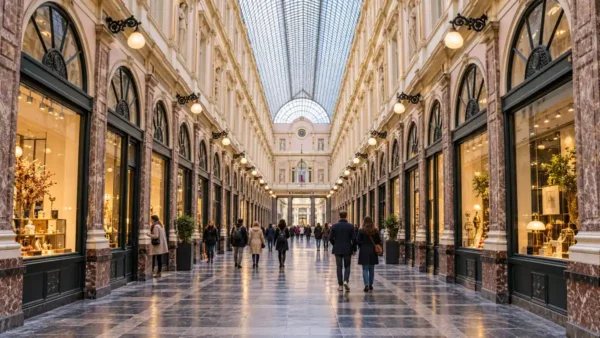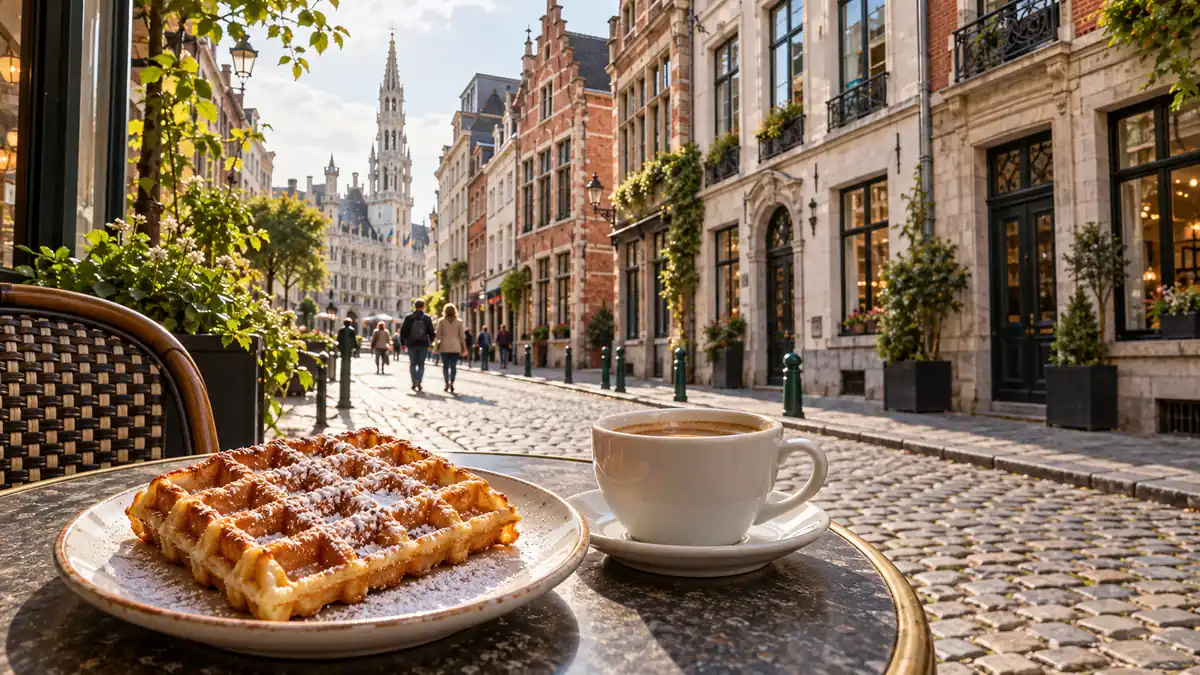
The Belgian food to eat first is frites with mayonnaise, moules-frites, beer-braised stoofvlees, a Liège waffle, pralines and a Trappist beer. Region shapes the version you meet: Flemish stews and North Sea shrimp up north, Liège waffles and boulets in Wallonia, everything in Brussels. Buy frites at a frietkot, waffles from a street cart, and start beer with a blonde or dubbel.
Most visitors arrive already knowing that Belgian food means frites, waffles, chocolate and beer. The catch is that the tourist version of each is the weakest one: reheated waffles buried in cream, boxed chocolate from souvenir windows, fries eaten without the sauce locals would choose. This guide covers the full canon and the ordering logic that gets you the real version. It explains which waffle to eat on the street and which to eat at a table, what goes on a cone of frites, which beer to order first, and where each dish actually comes from. Belgian food splits four ways: Flemish stews and sweets in Flanders, hearty Walloon cooking around Liège, a bit of everything in Brussels, and North Sea shellfish on the coast. The savoury dishes come first, then frites, waffles, chocolate, beer and sweets, and finally a guide to where and when each one is at its best.
Scope, Review and Sources
This page answers one question for Belgium: what to eat and drink there, and how to order the real version of each dish. It is not a Belgium travel guide or an itinerary, and it lists no restaurants, bars or prices.
Our editorial process covers how this menu guide went from a draft written with AI assistance to a final read by Alex Perrut, working in tourism since 2015, for the Tripstou editorial team.
Official sources consulted: Belgian Federal Government tourism portal, Belgian Federal Public Service Foreign Affairs.
On This Page
What Is Belgian Food, and Is There a National Dish?
Belgian food is French-style cooking served in Flemish portions, built on frites, beer-braised meat and North Sea seafood. Beer goes into the pot as often as the glass, and potatoes sit at the centre of most plates. Belgium has no officially declared national dish, though moules-frites is the one most often given the title.
The cooking changes with the language border and the coastline. Four food regions are worth knowing before you read a menu:
- Flanders: slow beer stews, creamy waterzooi, eel in green herb sauce and white asparagus in spring.
- Wallonia: heartier, meat-led cooking, with Liège meatballs, the Liège waffle and apple-and-pear syrup.
- Brussels: the national canon in one city, from brasserie classics to pralines and frites.
- The coast: grey North Sea shrimp, mussels and shrimp croquettes.
Menus in Belgium often print a dish under its Dutch name, its French name, or both. Stoofvlees and carbonnade flamande are the same stew, for example. The table in the next section pairs the names that confuse visitors most. For the practical side of the trip — when to go, how to move between cities, what it costs — see the Belgium travel guide.
Is moules-frites the national dish of Belgium?
Moules-frites is the dish most often called Belgium’s national dish, but it holds no official status. It is simply the plate visitors and locals name first: a pot of mussels steamed with celery, onion and often white wine or beer, served with a side of frites.
Frites are the real common thread. They come with mussels, with steak, with stew and on their own in a paper cone. If one food unites Flanders, Wallonia and Brussels, it is the twice-fried potato, not the mussel.
The Savoury Belgian Dishes Worth Ordering First
Start with stoofvlees, waterzooi and shrimp croquettes: the three dishes that appear on almost every Belgian brasserie menu. Add moules-frites, stoemp, vol-au-vent and chicons au gratin to complete the core canon. Regional plates such as paling in ‘t groen and boulets à la liégeoise reward travelers who eat beyond Brussels.
Dutch and French names for the dishes visitors most often confuse on bilingual menus.
| Dish | What it is | Dutch / French name | Where it is typical |
|---|---|---|---|
| Stoofvlees | Beef braised slowly in brown beer | Stoofvlees / carbonnade flamande | Flanders, and brasserie menus across the country |
| Waterzooi | Creamy Ghent stew of chicken or fish | Gentse waterzooi / waterzooi à la gantoise | Ghent first, now served widely in Flanders |
| Stoemp | Potatoes mashed with vegetables, served with sausage | Stoemp in both languages, a Brussels word | Brussels brasseries and Flemish home cooking |
| Shrimp croquettes | Fried croquettes filled with grey North Sea shrimp | Garnaalkroketten / croquettes aux crevettes grises | The coast and brasseries throughout Flanders and Brussels |
| Chicons au gratin | Endive wrapped in ham under cheese sauce | Witloof in de oven / chicons au gratin | Home-style kitchens nationwide, a winter classic |
| Liège meatballs | Meatballs in a sirop de Liège sauce | Luikse balletjes / boulets à la liégeoise | Liège and the rest of Wallonia |
Stews and braises: stoofvlees / carbonnade flamande, waterzooi, vol-au-vent
Stoofvlees is the Flemish beef stew: beef braised in brown beer until it falls apart, often sweetened with a slice of bread spread with mustard. It is served with frites, and the gravy doubles as a frites sauce. Waterzooi is the creamy Ghent stew, made with chicken or fish and vegetables in a thickened broth. It is the lighter choice. Vol-au-vent is a puff-pastry case with chicken in cream sauce, sometimes with small meatballs and mushrooms, and usually comes with frites as well.
Sides that are really mains: stoemp and moules-frites
Stoemp is mash with vegetables — carrots, leeks, spinach or sprouts — and it arrives as a full plate with a sausage or bacon on top. Moules-frites is a whole pot of mussels with a portion of frites, sized as a main course. Both are filling. Neither needs a starter.
Starters and snacks: garnaalkroketten, chicons au gratin, filet américain
Shrimp croquettes are the classic Belgian starter: grey North Sea shrimp in a creamy filling, breaded and fried, served with lemon and fried parsley. Chicons au gratin is endive wrapped in ham under cheese sauce, eaten as a starter or a light main. Filet américain is seasoned raw beef spread. Despite the name, it is a Belgian brasserie staple, served with frites or on a baguette.
Regional plates: paling in ‘t groen, boulets à la liégeoise
Paling in ‘t groen is eel in green herb sauce, a Flemish dish from the Scheldt river country around Antwerp and Ghent. It is an acquired taste and a real one. Boulets à la liégeoise are meatballs in a sirop de Liège sauce, sweet and sour at once, and the plate to order in Liège with a side of frites.
Brown beer is the thread running through these plates. The same dark ale you drink in a café is what gives stoofvlees its depth, so read a stew menu and a beer menu in the same brasserie together.
Can vegetarians eat well in Belgium?
Vegetarians can eat well in Belgium, although the traditional canon leans on meat and seafood. Frites, stoemp without the sausage, cheese, waffles, pralines and the sweets are easy wins, and chicons au gratin can sometimes be ordered without ham. Skip stoofvleessaus on your frites: it is beef-stew gravy, not a vegetarian sauce.
How Do You Order Frites at a Belgian Frietkot?
At a frietkot you order a cone by size, name one sauce, and eat standing up; mayonnaise is the default. Belgian frites are twice-fried, so they stay crisp under a thick sauce. Many locals treat a large cone as a full meal in itself, eaten with the little fork tucked into the side.
The frietkot (friterie in French) is a street institution in every Belgian town. The script is short:
- Size first: small, medium or large. A small is a snack; a large is lunch.
- One sauce: named at the counter and spooned on top or served alongside.
- Optional extra: a fried meat snack from the same fryer, if you want a full meal.
Frites eaten at a restaurant are a side, set down next to mussels or steak. Frites from a frietkot are the dish. That difference changes how they are cooked: the first frying softens the potato, the second one crisps it to order.
Are French fries actually Belgian?
Belgium claims fries as its own, but their origin is contested between Belgium and France, and no record settles it. What is not in dispute is the culture: Belgium made the twice-fried frite a standalone meal, sold from the frietkot in every town, and counts frietkot culture as part of its heritage.
What sauce do Belgians put on fries?
Belgians put mayonnaise on fries more than anything else, and it is the default at every frietkot. After that comes a family of house sauces, most of them mayonnaise-based:
- Mayonnaise: thick and rich, the local standard.
- Andalouse: mayonnaise with tomato and peppers, mildly spicy.
- Samurai: mayonnaise with chilli, noticeably hot.
- Tartare: mayonnaise with pickles, capers and herbs.
- Stoofvleessaus: beer-stew gravy spooned over the frites, sometimes with meat.
Mayonnaise clings to a twice-fried frite without soaking it, which is why it won the frietkot. Taste the plain mayonnaise version on your first cone, and save the spicier house sauces for the next stop.
Brussels Waffle or Liège Waffle: Which Should You Try?
Try the Liège waffle plain from a street cart first; save the lighter Brussels waffle for a sit-down plate. The Liège waffle is dense and sweet on its own, with caramelised pearl sugar, so it needs no topping. The Brussels waffle is crisp and airy, built to carry icing sugar or fruit at a café table.
The two share a name and little else:
- Liège waffle: smaller and rounded, made from a dense brioche-like dough studded with pearl sugar that caramelises on the iron. A handheld street snack, eaten warm while walking.
- Brussels waffle: rectangular, light and crisp, made from a yeast batter and dusted with icing sugar. Served on a plate and eaten with a knife and fork.
A waffle buried under cream, chocolate and strawberries is usually hiding a tired, reheated base. The Liège waffle worth queuing for smells of caramel from a few metres away and needs nothing on top.
Liège waffles are sold from carts and bakeries across the whole country, not only in Liège. Brussels waffles belong to cafés and tearooms, where they are made to order. Pick by setting. Walking means Liège; sitting means Brussels.
What Chocolate Should You Buy in Belgium?
Buy pralines by the piece from a chocolatier’s counter; that is where Belgian chocolate is actually good. The praline (a filled chocolate) is a Brussels invention, and fresh fillings are what separate a real chocolatier from a souvenir shop. Boxed bars travel better, but they rarely show what Belgian chocolate makers do best.
Three formats sit on most counters, and each suits a different use:
- Pralines: a chocolate shell around a filling of ganache, cream or nut paste. The reason to buy chocolate in Belgium; eat them within days.
- Truffles: soft ganache rolled in cocoa, even more perishable. Best eaten the day you buy them.
- Bars and tablets: the easiest gift to carry home. Good, but available abroad too.
A real chocolatier serves from behind a counter. You point, they fill a ballotin box piece by piece, and the fillings are made in-house. A tourist-grade window stacks sealed boxes and bars, often with long shelf lives. The first is worth the detour. The second is a souvenir.
Buy the pralines you plan to take home on your last day. Fresh-cream fillings are at their best within days, while bars can be bought at any point in the trip. Keep chocolate cool and out of direct sun, and pack it in hand luggage when the weather is warm.
Which Belgian Beers Should You Try First?
Start with a blonde or dubbel, then a tripel, then one gueuze or kriek; most taste lighter than they are. Belgian beer culture is UNESCO-listed, and the menu runs from sweet dark ales to sour lambics. Pace yourself and order small where you can, because a tripel hides its strength behind a light, fruity flavour.
Belgian brewing counts as heritage as much as drink, and the UNESCO-listed beer culture shows up in how beer is poured, glassed and cooked with. The same brown ale that fills your glass braises the stoofvlees on the next table. This section stays at the level a first trip needs.
Trappist and abbey beers: what the label actually means
A Trappist beer is brewed within a Trappist monastery under the monks’ supervision. Only a handful of Belgian abbeys hold the label, and the official Trappist logo on the bottle confirms it. An abbey beer is a different thing: the same broad styles, often brewed commercially under licence or simply named after an abbey. Both can be excellent. The word “abbey” describes a style of beer; only the Trappist logo tells you monks were involved.
Reading a Belgian beer menu: blonde, dubbel, tripel, witbier, saison, gueuze, kriek
Most Belgian menus sort beer by style, and seven styles cover the ground:
- Blonde: golden, soft and gently sweet. The easy first order.
- Dubbel: dark and malty, with caramel and dried-fruit notes.
- Tripel: pale, strong and spicy-fruity. Drinks far lighter than it is.
- Witbier: cloudy wheat beer with orange peel and coriander, light and refreshing.
- Saison: dry, peppery farmhouse ale from Wallonia.
- Gueuze: a blend of young and old lambic, sour and sparkling.
- Kriek: lambic fermented with sour cherries, tart and fruity.
Strength is the trap. Blondes, dubbels and especially tripels are much stronger than a standard lager, and the sweetness masks it.
How to order beer in Belgium
Order by name if you know the beer, or by style if you do not; staff in a Belgian café are used to recommending. Each beer is served in its own branded glass, shaped for that beer. Expect it. A café pours a long list of bottled and draught beers from many breweries, while a brewery tap pours its own range, often including beers that rarely leave the premises. Start at a café for breadth.
What do Belgians drink besides beer?
Besides beer, Belgians drink jenever, a juniper-flavoured grain spirit with deep Flemish roots, served chilled in a small glass. Coffee is the everyday drink, usually with a speculoos biscuit on the saucer. In winter, mulled wine and hot chocolate join the list. Jenever is the one to try, in small sips.
Belgian Sweets Beyond the Waffle: Speculoos, Cuberdon and Dame Blanche
After waffles and pralines, the sweets to try are speculoos, cuberdon, dame blanche and a slice of rijstevlaai. Each is tied to a place or a café habit, from Ghent’s cone-shaped cuberdon to the dame blanche on almost every brasserie dessert card. Pain à la grecque and sirop de Liège round out the list.
Speculoos is a thin, crunchy biscuit spiced with cinnamon and caramelised brown sugar. Belgian cafés often serve one with coffee, and the same flavour comes as a spread for bread. It is traditionally tied to Saint Nicholas celebrations in early winter.
Cuberdon is a cone-shaped purple sweet with a firm crust and a runny raspberry-flavoured centre. Ghent calls it a “neuzeke”, a little nose. The crust hardens and the centre sets within a few weeks, so cuberdons are the one Belgian sweet better eaten in Ghent than carried home.
Dame blanche is vanilla ice cream with hot chocolate sauce poured over at the table, usually with whipped cream. It is the default brasserie dessert. Simple, and very good.
Rijstevlaai is a rice pudding tart in a sweet pastry base, typical of Limburg and found in bakeries across Flanders.
Pain à la grecque is a Brussels speciality despite the name: a long, crunchy sugar-crusted bread biscuit sold by Brussels bakeries.
Sirop de Liège is a thick, dark syrup of apples and pears. Liège spreads it on bread, serves it with cheese, and uses it in the sauce for boulets.
Where in Belgium Should You Eat Each Speciality, and When?
Eat waterzooi in Ghent, boulets and Liège waffles in Liège, grey shrimp on the coast, and everything else in Brussels. Brussels gathers the national canon in one city, while the regional plates taste best where they began. Timing matters for mussels, which are at their best from early autumn.
What to eat in Brussels
Brussels is the place to eat the whole canon in one stay. Frites come from the city’s frietkots, pralines from chocolatier counters, and the plated Brussels waffle from its cafés and tearooms. Brasseries cover stoemp, vol-au-vent and moules-frites. For a quick lunch, filet américain on a baguette is a Brussels habit. The streets immediately around the Grand Place serve the most tourist-focused menus; a few streets away, the same dishes are cooked for locals. For guided food tours, chocolate workshops and tastings, see the things to do in Brussels.
Ghent, Liège and the coast
Ghent is the home of waterzooi and cuberdon, and its menus lean Flemish: stoofvlees, paling in ‘t groen and a long beer list. Order the waterzooi here first.
Liège is the city for boulets à la liégeoise and the Liège waffle at its source. Sirop de Liège appears on bread, with cheese and in the boulets sauce. Walloon cooking here is heartier and meat-led.
The coast is where grey North Sea shrimp are freshest, in croquettes, stuffed into tomatoes or peeled and eaten plain. Mussels feature on almost every seafront menu. Eat shellfish here if you eat it anywhere.
When seasonal dishes are at their best
Mussels are traditionally a dish of the colder, R-months half of the year. They are available year-round, but they are best from early autumn. Grey shrimp are a matter of place more than season: they are freshest on the coast, close to where they are landed. White asparagus is the spring dish, served Flemish-style with egg and butter sauce.
Ordering mussels on a tourist street in midsummer combines the two weakest choices on this page: shellfish out of its best season and a menu built for passing trade. Winter brings its own food moment, with waffles, hot snacks and mulled drinks at Belgium’s Christmas markets. For when to go and how to get between cities, see the guide to planning your Belgium trip.
Tours and activities
Book skip-the-line tickets, day trips and local tours with free cancellation on most activities.
You can also browse everything on getyourguide.com.
Tripstou may earn a commission if you book through this link, at no extra cost to you.
Before You Order
- Bilingual menus print the same dish under Dutch and French names, so stoofvlees and carbonnade flamande are one beer-braised beef stew, not two.
- At a frietkot, order the cone by size and name one sauce: mayonnaise is the default, and a large cone counts as lunch.
- Eat the Liège waffle plain from a street cart and keep the lighter Brussels waffle for a café table, because a waffle buried under cream is usually hiding a reheated base.
- Buy pralines by the piece at a chocolatier’s counter, and leave the ones you take home for your last day, since fresh-cream fillings are at their best within days.
- Open a Belgian beer list with a blonde or dubbel before moving to a tripel, which drinks far lighter than its strength.
- Order waterzooi in Ghent, boulets à la liégeoise in Liège and grey shrimp on the coast, and leave the rest of the canon to Brussels.
- Mussels are available year-round but best from early autumn, so a midsummer pot on a tourist street is the weakest way to eat them.
Did this guide save you time or money? Tripstou is independent and reader-funded — if you'd like to give something back, you can support the site with a crypto contribution of any size.