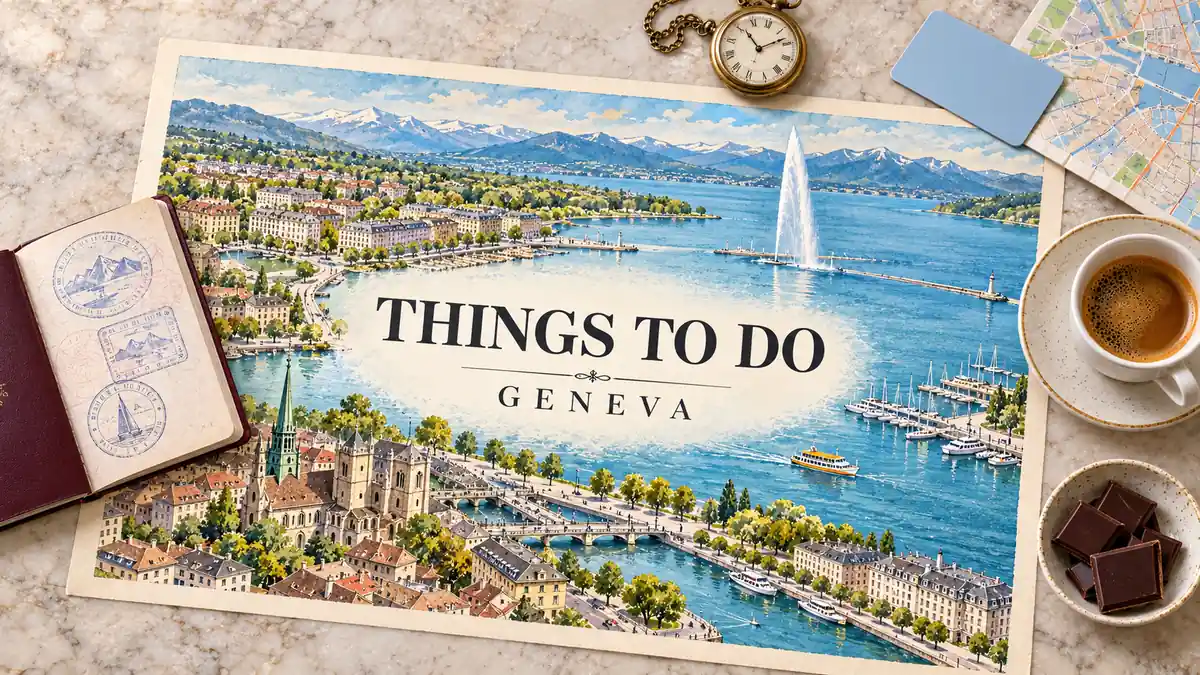
Geneva is compact, and its sights split cleanly into three parts: the lakefront, the Old Town on the Left Bank, and the diplomatic quarter on the Right Bank. CERN and Mont Salève sit just outside, close enough to add, far enough to cost real time. That layout decides everything. A first-time visitor can walk most of the centre in a day without a ticket, while a few headline experiences only work if you book them before you arrive. This page picks the sights and experiences that deserve a slot, grouped by area, and says plainly which are free and which need a booking. It then shows how they fit into half a day, one day or two, and which short trips out of the city are worth the extra hours. Each pick carries one condition that tells you whether it belongs on your list.
Quick Answer
The best things to do in Geneva are the lakefront around the Jet d’Eau, the Old Town and International Geneva. The lakefront and Old Town are free on foot, while the Palais des Nations and CERN need booking ahead. One day covers the centre; a second adds CERN, Mont Salève or Annecy.
Trust Layer
Tripstou selection guide for travelers choosing between multiple places. Covers selection criteria, traveler fit, and trip value.
Produced with AI assistance and reviewed by Alex Perrut, working in tourism since 2015, for the Tripstou editorial team. See our editorial process for details.
Last factual review: October 2, 2026.
Official sources consulted: Switzerland Tourism, State Secretariat for Economic Affairs (SECO), CERN visitor service, United Nations Geneva.
Key Takeaways
- Geneva’s lakefront and Old Town fill a first day, both free to walk, with the cathedral tower climb as the main paid extra.
- International Geneva is the city’s distinctive half-day: the Palais des Nations interior is seen only on a guided tour booked in advance.
- CERN is free to visit, but online registration up to a month ahead guarantees entry, and the Science Gateway is closed on Mondays.
- CERN and Mont Salève, just outside Geneva, each take about half a day, so add them once the lakefront and Old Town are covered.
- For a slower afternoon, Carouge offers an Italianate town of courtyards and artisan shops a short tram ride from central Geneva.
- Guests of accommodation in Geneva get a free, personal digital Geneva Transport Card covering trams, buses and Mouettes boats for the whole stay.
Table of Contents
The best things to do in Geneva fall into four areas
Geneva’s best sights group into the lakefront, the Old Town, International Geneva, and two trips out of the centre. Most of the centre is free to walk, with no ticket and no plan needed. Only CERN and the Palais des Nations interior must be booked ahead, so both need a fixed slot in your day.
The shortlist keeps what Geneva does better than anywhere nearby, plus the sights first-time visitors would regret missing. Generic shopping streets and the long tail of small museums are left out. Every pick below carries a reason, a distinct angle and one condition for who it suits.
The free-versus-booked split shapes the whole visit:
- Free to wander: the Jet d’Eau and Jardin Anglais, the Old Town squares, Parc des Bastions and the Reformation Wall, the Broken Chair and the Botanical Garden.
- Needs a booking: the Palais des Nations guided tour, reserved in advance with a passport, and CERN, which is free but runs on registration.
Guests of accommodation in Geneva get a free, personal digital Geneva Transport Card for UNIRESO public transport — TPG buses and trams, trains inside the zone and the Mouettes boats — for the whole stay, usable from the airport. That card redraws the map. With every tram and Mouette covered, CERN, Carouge and the Right Bank stop feeling far and become an easy ride. Passes, money and getting around the rest of the country are covered in our Switzerland travel guide.
| Sight | Area | Free or paid | Booking needed |
|---|---|---|---|
| Jet d’Eau and Jardin Anglais | Lakefront on the Left Bank | Free to see from the shore | No booking, just walk up |
| Old Town squares and Parc des Bastions | Old Town on the Left Bank | Free to walk and explore | No booking, just walk up |
| St Pierre Cathedral tower | Top of the Old Town hill | Paid climb up the tower | No advance booking for the climb |
| Palais des Nations interior | International Geneva on the Right Bank | Paid, by guided tour only | Book ahead and bring a passport |
| CERN Science Gateway | Meyrin, a tram ride out | Free of charge for every visitor | Registration required, best done online |
| Red Cross Museum | International Geneva on the Right Bank | Paid entry to the exhibition | No advance booking for standard visits |
The lakefront: Jet d’Eau, Bains des Pâquis and the lake boats
Geneva’s lakefront is free to walk and holds the Jet d’Eau, the Flower Clock and the city’s favourite swimming spot. Every first visit starts here. The Jet d’Eau, about 140 m high, is the landmark; the Bains des Pâquis are the local side; and the yellow Mouettes boats are the simplest way onto the water.
The two shores face each other across the harbour, so the walk is a loop around the water with the fountain always in view. Bridges link the banks. A Mouette crossing turns the loop into a shortcut and lets you start on whichever side your morning begins.
Jet d’Eau and the Jardin Anglais
The Jet d’Eau is Geneva’s emblem, a plume of lake water thrown about 140 m into the air from a jetty on the Left Bank. You can walk the jetty almost to its base, and on a breezy day the spray reaches you. Just along the shore, the Jardin Anglais holds the Flower Clock, a working clock face planted in flowers. The best views of the fountain come from across the water at the Bains des Pâquis or from above, at the cathedral tower. It does not run in every weather.
Pick this if: you have a single hour and want the image that says Geneva.
Bains des Pâquis
The Bains des Pâquis are Geneva’s lake baths, a pier and bathing platform on the Right Bank where locals swim through the warm months. The pier also frames the best straight-on view of the Jet d’Eau. In winter the place changes character: the swimmers thin out, the sauna steams, and the buvette turns to fondue, which makes it as much a social spot as a beach. Nothing else on the lakefront feels this local. Come for the atmosphere even if you never get wet.
Pick this if: you want to see how Genevans actually use their lake.
A lake trip by Mouette or cruise
The yellow Mouettes are Geneva’s small lake shuttles, crossing the harbour between the two banks as part of the public transport network. That means the Geneva Transport Card covers them. They are the quickest way to see the city from the water. Longer lake cruises, including historic paddle steamers, head out along the shore and suit a slow afternoon in good weather. A Mouette crossing fits between other stops; a cruise becomes the afternoon.
Pick this if: you want the skyline from the water without giving up half a day.
Tours and activities
Book skip-the-line tickets, day trips and local tours with free cancellation on most activities.
You can also browse everything on getyourguide.com.
Tripstou may earn a commission if you book through this link, at no extra cost to you.
The Old Town rewards a slow half-day on foot
Geneva’s Old Town is best on foot in half a day, from St Pierre Cathedral down to Parc des Bastions. It is the second half of a first day. The cathedral tower gives the view, Bourg-de-Four is the oldest square, and the Reformation Wall lines the park, all walkable and free except the tower climb.
The Old Town sits on a hill above the lake, so the walk works best from the top down. Start at the cathedral and the climb happens once. Everything after it runs downhill, in this order:
- St Pierre Cathedral and its tower, at the top of the hill.
- Place du Bourg-de-Four and Maison Tavel, a few steps away.
- Parc des Bastions and the Reformation Wall, at the foot of the old ramparts.
- Plainpalais and its market, on the open plain beyond the park.
St Pierre Cathedral and its tower
St Pierre Cathedral crowns the Old Town, and its tower is the reason it makes this list. The climb up the narrow stairs ends at the best viewpoint in the centre, with the roofs of the Old Town below and the lake, the Jet d’Eau and, on clear days, the Alps beyond. The tower climb is paid. The interior is notably plain, a legacy of the Reformation, which makes the contrast with the view from the top even stronger.
Pick this if: you want the whole city laid out below you before you explore it.
Place du Bourg-de-Four and Maison Tavel
Place du Bourg-de-Four is Geneva’s oldest square, sloping and lined with café terraces around a central fountain, just below the cathedral. It is the natural coffee stop halfway through the Old Town. A short walk away, Maison Tavel is the oldest house in the city and now holds the museum of Geneva’s urban history, including a large relief model of the old walled town. Together they show how small and dense medieval Geneva was.
Pick this if: you like reading a city’s past through its streets and buildings.
Parc des Bastions, the Reformation Wall and Plainpalais market
Parc des Bastions is a free, tree-lined park at the foot of the Old Town, and the Reformation Wall runs along one side. Its giant stone figures of Calvin and his fellow reformers are the Old Town’s most striking monument. Locals gather around the giant chess boards, which give the park its everyday life. Just beyond, the open plain of Plainpalais hosts Geneva’s flea and food markets, the best browsing in the centre.
Pick this if: you want free sights and street life with no ticket desk anywhere.
International Geneva: the Palais des Nations and the Red Cross Museum
International Geneva is the city’s most distinctive half-day, and the UN tour must be booked ahead with a passport. No other Swiss city has a diplomatic quarter on this scale. The Palais des Nations interior is seen only on a guided tour, the Broken Chair is free, and the Red Cross Museum is the strongest museum in Geneva.
The quarter sits on the Right Bank, north of the main station, and its sights cluster within walking distance of Place des Nations. Plan it as one block. Book the UN tour first and build the half-day around its slot: the Red Cross Museum and the Botanical Garden bend to fit, and the tour time never does.
Palais des Nations and the Broken Chair
The Palais des Nations is the European headquarters of the United Nations, and its assembly halls and council chambers make the most memorable interior in Geneva. The rules are strict:
- The interior is visited only on a guided tour booked in advance.
- Every visitor carries a valid passport; an EU or European national ID card is also accepted.
- Arrive about 30 minutes early for security.
Outside, the Broken Chair on Place des Nations is free to see: a giant wooden chair with one broken leg, and the quarter’s best-known image.
Pick this if: you want to stand inside the rooms where world diplomacy happens.
International Red Cross and Red Crescent Museum
The International Red Cross and Red Crescent Museum sits across the road from the Palais des Nations and is the museum to choose if you only choose one. It tells the story of humanitarian action through personal testimony and immersive rooms, built around people more than objects. That makes it absorbing even for non-museum people. It is also the obvious wet-afternoon pick in the diplomatic quarter, and it pairs naturally with the UN tour.
Pick this if: you want one museum visit that stays with you after you leave.
Conservatory and Botanical Garden
Geneva’s Conservatory and Botanical Garden is a free garden and research collection on the lakeside edge of the UN quarter. Its glasshouses, rock garden and open lawns make it the calmest stop on the Right Bank, and children have room to run between the beds. It works as the slow counterweight to the security lines and guided rooms of the Palais des Nations. It needs no booking and no fixed slot. Wander in for twenty minutes or stay the morning.
Pick this if: you are travelling with children or want a quiet green hour between visits.
CERN is the one trip out of the centre that needs planning
CERN is free to visit and worth a half-day, but register online up to a month ahead to guarantee entry. It is a tram ride from the centre, and registering ahead decides whether you get in. On-site registration depends on availability, and the Science Gateway is closed on Mondays.
CERN is the European laboratory for particle physics and the home of the Large Hadron Collider. Its Science Gateway is the visitor centre built to explain that work to non-scientists, through exhibitions and hands-on spaces. It made the list because nowhere else lets a casual visitor get this close to frontier physics. What sets it apart from Geneva’s museums is that it is a working research site.
The entry rules are short:
- Visits are free of charge, and registration is required.
- Online registration is recommended up to one month ahead and guarantees entry.
- On-site registration is possible, subject to availability.
- The Science Gateway is closed on Mondays.
The tram out is covered by the Geneva Transport Card. Distance is never the obstacle at CERN; arriving unregistered is.
Pick this if: you want to see where frontier physics actually happens.
Which Geneva museums are worth your time?
The Geneva museums worth a slot are the Red Cross Museum, Patek Philippe Museum and Museum of Art and History. Pick the Red Cross Museum first. Choose Patek Philippe for watchmaking and craft, and Art and History for a broad classic collection; on a short stay, most other museums can be skipped.
The Red Cross Museum is profiled with International Geneva above, because it sits beside the Palais des Nations and belongs to that half-day. The other two are on the Left Bank.
Rain reshuffles the day. A wet day in Geneva works best as museums plus CERN: the Red Cross Museum and CERN fill the Right Bank side, while Patek Philippe and Art and History cover the Left Bank near the Old Town cafés. Save the cathedral tower and the lakefront for the first clear spell.
Patek Philippe Museum
The Patek Philippe Museum is Geneva’s showcase of watchmaking, with timepieces, automata and enamel work spread across several floors, from early pocket watches to the brand’s own pieces. It best explains why Geneva’s name carries such weight in fine watches. Even visitors indifferent to luxury brands tend to stay longer than planned, because the handwork is so fine. It stands in Plainpalais, so it pairs well with the market and the Old Town. Anyone indifferent to watches should skip it.
Pick this if: you care more about precision craft than paintings.
Museum of Art and History (MAH)
The Museum of Art and History is Geneva’s broadest museum, covering archaeology, applied arts and painting under one roof near the Old Town. Its best-known work is Konrad Witz’s altarpiece of the miraculous draught of fishes, painted with Lake Geneva as its setting. The breadth makes it a dependable rainy-day pick, a short walk from the cathedral. The tradeoff is focus. It is a general collection and will not rival the great art museums of larger capitals.
Pick this if: you want classic art and antiquities on a wet day near the Old Town.
One day or two in Geneva: how to group the sights
One day in Geneva covers the lakefront and the Old Town; two days add International Geneva and CERN. A half day is enough for the lakefront alone. Use the second day for a short trip out instead if mountains and lake towns appeal more than science and diplomacy.
These are groupings by area, not a timed route:
- Half a day: the lakefront loop — the Jet d’Eau, the Jardin Anglais, a Mouette crossing and the Bains des Pâquis. It suits a stopover between trains.
- One day: the lakefront plus the Old Town, from the cathedral tower down to Parc des Bastions. It suits first-time visitors passing through on a wider Swiss trip.
- Two days: the first day as above, then International Geneva and CERN, both booked ahead. It suits travelers who want the side of Geneva no other Swiss city has.
- Three days: add one trip out — Carouge, Mont Salève or Annecy. It suits slower travelers using Geneva as a base.
Put CERN and the UN tour on the same day. Both lie on the Right Bank side of the city and both need a booked slot, so pairing them means you plan around fixed times once. If Geneva is one stop on a longer route, our Switzerland itinerary shows how it fits with the rest of the country.
Short trips out of Geneva worth adding
The short trips worth adding from Geneva are Carouge, Mont Salève, Annecy, and the lake towards Lausanne and Montreux. Carouge sits on the city’s edge, Salève just over the French border, and Chamonix is the mountain day. Each suits a different traveler, and each costs at least half a day, so add one once the centre is covered.
Mont Salève, Annecy and Chamonix are in France. Lausanne, Montreux and Lavaux stay in Switzerland along the lake. Pick one and do it properly:
- Carouge: an Italianate town built by the Kingdom of Sardinia, a short tram ride from the centre, with low houses, courtyards and artisan shops. Suits a slow afternoon of cafés and browsing; the tradeoff is that it has no headline sight.
- Mont Salève: a cable car that departs just over the French border and lifts you to a balcony view over the city, the lake and, on clear days, Mont Blanc. Suits a clear-weather half day; the tradeoff is that cloud removes the reason to go.
- Annecy: about an hour by road, a lakeside old town of canals and pastel houses. Suits travelers who want a second, prettier lake; the tradeoff is a full day for one town.
- Lausanne, Montreux and Lavaux: Lausanne is under an hour by train and Montreux a little over an hour, with the Lavaux vineyard terraces between them above the lake. Suits wine and lake-view lovers; the tradeoff is that these are destinations in their own right, covered among the best places to visit in Switzerland.
- Chamonix and Mont Blanc: a little over an hour by road into the French Alps. Suits a high-mountain day; the tradeoff is the biggest time cost on this list.
On a short stay, Salève is the mountain trip that fits. It looks straight across at Mont Blanc for a half-day’s effort, while Chamonix asks for the whole day.
Train and bus tickets
Compare routes, schedules and prices across rail and bus operators in one search, with mobile tickets on your phone.
New to Omio? Code NEW10 takes 10% off your first booking — or APPNEW10 if you book inside the Omio app. Both apply to bookings up to €80.
Search routes and compare prices on Omio →
Tripstou may earn a commission if you book through this link, at no extra cost to you.
Frequently Asked Questions
Is Geneva worth visiting?
Yes, Geneva is worth one or two days, built on the lakefront, the Old Town and International Geneva. Its diplomatic quarter and CERN are found nowhere else in Switzerland. The tradeoffs are high prices and a quieter evening scene than larger cities, so longer stays suit travelers using it as a base for trips out.
Can you visit CERN without registering online?
Yes, CERN accepts on-site registration, but only subject to availability, so turning up unregistered can mean no entry. Online registration, recommended up to one month ahead, is what guarantees a place. Visits are free of charge either way, and the Science Gateway is closed on Mondays, so a Monday plan needs another half-day sight.
What can you do in Geneva when it rains?
Museums and CERN carry a rainy day in Geneva. Pair the Red Cross Museum with CERN on the Right Bank side, or Patek Philippe with the Museum of Art and History on the Left Bank. The Old Town cafés around Bourg-de-Four make a dry stop between them. Keep the lakefront and cathedral tower for clearer weather.
Is public transport free in Geneva for tourists?
Public transport in Geneva is free for tourists staying in Geneva accommodation, through the Geneva Transport Card. The card is personal and digital, valid for the whole stay and usable from the airport, covering TPG buses and trams, trains inside the zone and the Mouettes boats. Day-trippers sleeping outside Geneva are not covered and buy standard tickets.
What can you see at the UN in Geneva without a tour?
Without a tour, you can see the Broken Chair and the Palais des Nations from outside on Place des Nations. The Red Cross Museum stands across the road and the Botanical Garden sits on the lakeside edge of the quarter, so the area still fills a half-day. Only the Palais interior needs a guided tour booked in advance.
Is Geneva good for families with children?
Geneva works well for families because its best family stops are mostly free and close together. The Botanical Garden gives children room to run, Parc des Bastions has giant chess boards, and a Mouette crossing turns the lake into a short boat ride. CERN’s hands-on spaces suit children curious about science.
Related Guides
- Best places to visit in Switzerland — choosing where else to go in Switzerland after Geneva.
- Switzerland itinerary — fitting Geneva into a multi-day Swiss route.
- Switzerland travel guide — the country overview and practicalities for planning the trip.
Did this guide save you time or money? Tripstou is independent and reader-funded — if you'd like to give something back, you can support the site with a crypto contribution of any size.