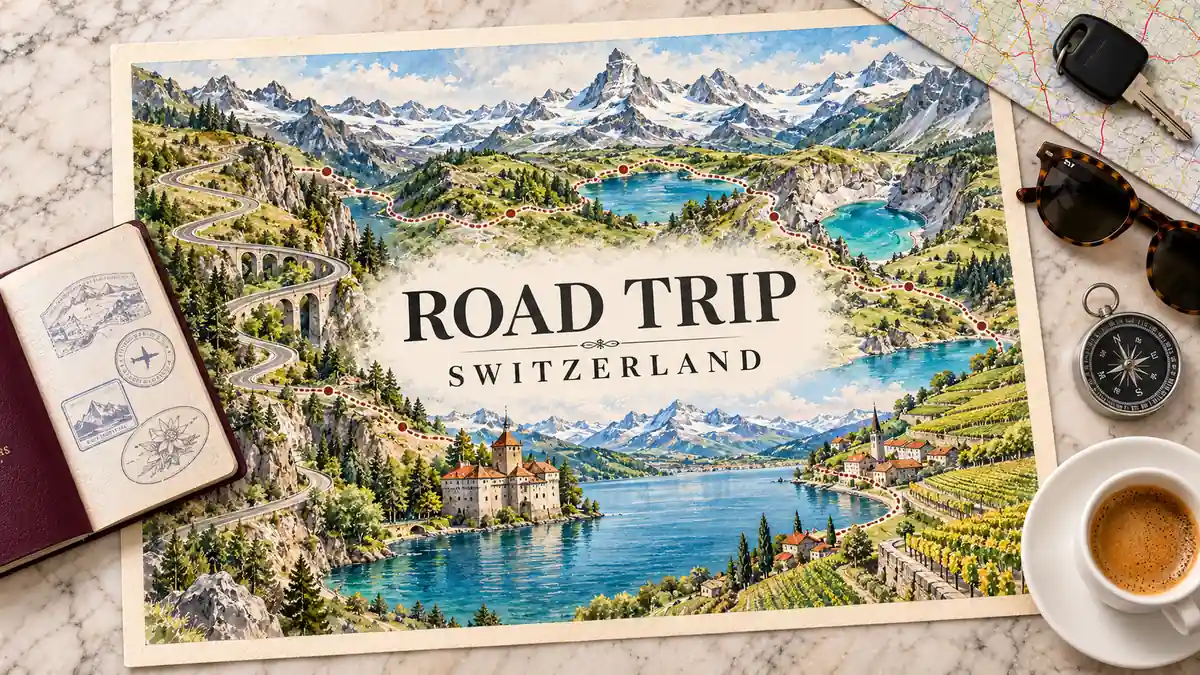
Switzerland is one of the few countries where the train is good enough that driving needs a reason. This route is that reason. A car earns its place on the high mountain passes, on the vineyard and farm back roads, and in the villages the rail map skips. The shape is simple: a ten-day clockwise loop from Zurich, with the Furka and Grimsel passes in the middle and Lake Geneva as the flat finish. It suits travelers who want the Alps at their own pace and are comfortable on narrow mountain roads. Two honest limits shape it. The car stops at Täsch, because Zermatt is car-free. And the high passes close for winter, so the full loop is a warm-season trip. Everything below follows that one route, leg by leg.
Quick Answer
Switzerland’s ideal road trip is a 10-day clockwise Zurich loop: Lucerne, the Oberland, Furka Pass, Zermatt, Lake Geneva. The passes set the season: the full route runs roughly late May or June to October, otherwise a lowland loop. The car wins on mountain roads; park at Täsch for Zermatt, and take trains for a city-heavy trip.
Trust Layer
Tripstou itinerary guide for travelers planning a route. Covers pacing, stop count, stop order, base logic, and trip length.
Produced with AI assistance and reviewed by Alex Perrut, working in tourism since 2015, for the Tripstou editorial team. See our editorial process for details.
Last factual review: October 2, 2026.
Official sources consulted: Switzerland Tourism, State Secretariat for Economic Affairs (SECO), Zermatt Tourism, Federal Office for Customs and Border Security (BAZG).
Key Takeaways
- Ten days fits the full clockwise loop from Zurich across four bases and nine nights, moving every two or three nights.
- The Grimsel and Furka pass day is the reason to rent a car; plan two to three hours of driving inside a full day.
- The high passes typically open from late May or June to October, so outside that window the route becomes a lowland loop.
- Zermatt is car-free: park at Täsch, 5 km short of the village, and ride the shuttle train that runs every 20 minutes.
- Every Swiss motorway needs the CHF 40 annual vignette, while the scenic pass roads on this loop cost nothing extra to drive.
- With only seven days, cut the Lake Geneva leg first: it is the least car-dependent part, and the shore is easy by train.
Table of Contents
Ten days is the right length for a Switzerland road trip loop
Ten days is the sweet spot for the full Swiss loop; seven works only by dropping a region. Ten days buys four bases at two or three nights each, with pass days held to two or three hours behind the wheel. Fourteen days adds Ticino or the Engadin without rushing the core.
- 7 days: Lucerne, the Bernese Oberland, the passes and Zermatt, then back to Zurich. It suits travelers who came for the mountains and can live without the lakes.
- 10 days: the full loop, with Lake Geneva, the Lavaux terraces and a Bern stop on the way home. This is the right length for a first Swiss road trip.
- 14 days: the loop plus Ticino or the Engadin. It fits travelers who want a second pass day and a different side of the country.
Pass roads are slower than any map suggests. Hairpins, roadworks, slow coaches and constant viewpoint stops stretch a short distance into a full day. That is why the loop moves roughly every two or three nights and never asks for two pass days in a row.
A loop also keeps the rental simple. You collect and return the car in Zurich, which avoids the one-way fee many rental firms add when the car ends elsewhere; confirm the terms with the rental company. The trade-off is a return drive on the last day. It is mostly motorway.
Count pass days, not kilometres. The loop looks short on paper, yet one Grimsel and Furka afternoon uses more time and attention than any motorway day on the route. If this is your first visit, the Switzerland guide covers the wider planning before you commit to a car.
The Recommended Switzerland Road Trip Route from Zurich
Drive the loop clockwise from Zurich: Lucerne, the Bernese Oberland, the passes, Zermatt, Lake Geneva, Bern. Lucerne gives an easy first drive, the Oberland and passes come once you are used to mountain roads, and the lake leg and Bern finish on flatter ground before the car goes back in Zurich.
Route at a glance:
- Days 1–2: Lucerne — the easy warm-up
- Days 3–5: Bernese Oberland — the valley base
- Day 6: Grimsel and Furka — the pass day
- Days 7–8: Zermatt via Täsch — park the car
- Days 9–10: Lake Geneva, Lavaux and Bern — the flat finish
Each stop earns its place for a different reason. If you want to swap a base, the guide to the best places to visit in Switzerland explains what each one is for. Travelers without a car can follow the rail version of this loop instead. The order below stays fixed.
Days 1–2: Lucerne — the easy warm-up
Lucerne is the first base, for two nights. It is a short motorway run from Zurich, which makes it the gentlest possible first drive in an unfamiliar car. Park once and leave the car there. The old town, the Chapel Bridge and the lakefront are all walkable.
Lucerne sits first because it eases you in. The second day can stay low on the lake or go up Pilatus or Rigi for a first look at the Alps without any mountain driving. On Day 3, take the road over the Brünig Pass, a low and easy climb, down to Lake Brienz and Interlaken.
Days 3–5: Bernese Oberland — the valley base
The Bernese Oberland is the three-night base, in Interlaken or Lauterbrunnen. Interlaken has more beds and easier roads in every direction. Lauterbrunnen puts you inside the valley itself, under its cliffs and waterfalls. Both work.
This is the Alps proper, and it sits mid-route because you now have two days of Swiss roads behind you. Drive to Grindelwald one day and walk the Lauterbrunnen valley the next. The Jungfrau summit area is a rail-only climb, so leave the car below for that outing. On Day 6, head east past Lake Brienz to Meiringen and Innertkirchen, where the Grimsel road begins.
Day 6: Grimsel and Furka — the pass day
Day 6 is the pass day, with no night of its own: it starts in the Oberland and ends in Täsch. Plan two to three hours of actual driving inside a full day on the road. The stops take longer than the wheels.
This leg is the reason to have a car. The Grimsel Pass climbs to 2,164 m past dammed lakes, then drops to Gletsch. From there, drive up the Furka side to the Rhône Glacier viewpoints and the 2,429 m summit, then turn back. Both passes are seasonal, as the section below explains. Onward, follow the Rhône valley down through the Goms to Visp and up the Matter valley to Täsch.
Days 7–8: Zermatt via Täsch — park the car
Täsch or Zermatt is the base for two nights, starting on the evening of Day 6. The car stays at Täsch for the whole stay, and the shuttle train covers the last stretch. The Zermatt section below has the mechanics.
The Matterhorn is this leg’s whole purpose, and it sits after the passes so the hardest driving is done before you arrive. Give Day 7 to the mountain: the Gornergrat railway and the village itself fill it easily. On Day 8, collect the car at Täsch and drive west down the Rhône valley, picking up the motorway towards Lake Geneva for an easy run after a week of climbs.
Days 9–10: Lake Geneva, Lavaux and Bern — the flat finish
The Montreux area on Lake Geneva is the last base, for two nights from the evening of Day 8. Day 10 treats Bern as a stop on the drive home. The loop closes in Zurich without a final overnight move.
This flat finish is where the car earns its keep again. Spend Day 9 on the narrow roads through the Lavaux vineyard terraces and stop at Château de Chillon on the shore. On Day 10, take the motorway north to Bern for a few hours in the arcaded old town, then continue to Zurich to return the car.
Is it better to drive or take the train in Switzerland?
Drive if your route crosses the passes; take the train if it is mostly cities. The car wins on Furka and Grimsel, the Lavaux and Emmental back roads and for groups sharing costs. The train wins in cities, into Zermatt and up the Jungfrau lines, where a car cannot follow.
| Leg | By car | By train | Better choice |
|---|---|---|---|
| Lucerne | Short motorway run, but old-town parking is paid and scarce | Frequent direct trains arrive beside the old town | Close call; the car mostly stays parked here |
| Bernese Oberland | Free to roam the valleys and reach trailheads early | Only rail climbs to the Jungfrau summit area | Car for the valleys, train for the summit |
| Grimsel and Furka | Your own stops at every viewpoint and hairpin | Rail runs through tunnels and misses the open pass roads | Car, clearly; this leg is the reason to drive |
| Zermatt | Private cars stop at Täsch, 5 km short | Shuttle train covers the final stretch into the village | Train for the last stretch, with no exceptions |
| Lake Geneva and Lavaux | Narrow vineyard roads and village stops on your schedule | Lakeside line links the shore towns frequently | Car for Lavaux, train for the lakeside towns |
Groups and families tip the balance further towards the car. One rental shared by four people competes well with four rail fares, while a solo traveler usually does better by train. The guide to what a Switzerland trip costs sets out fuel, rental and parking against rail.
Cities are the weak spot for drivers. Old towns are compact, parking is paid and limited, and the trains arrive in the centre. If most of your list is cities, the Switzerland itinerary by train runs the same country without the car.
Zermatt and the Jungfrau summit are the two places on this loop where the car turns into luggage. Plan those as rail days, even though you drove to reach them.
Renting a car
DiscoverCars searches local and international rental companies at once and shows each supplier’s rating, fuel policy and deposit before you book.
Compare rental cars on DiscoverCars →
Tripstou may earn a commission if you book through this link, at no extra cost to you.
When Are the Swiss Mountain Passes Open?
The passes on this route are typically open from late May or June to October. Furka and Grimsel, and Susten nearby, close for winter, and the high-Alpine middle of this loop depends on them. Check live pass status before you set off, because snow or rockfall can close a road at short notice.
The Furka and Grimsel drive is the scenic centrepiece of the loop. Grimsel tops out at 2,164 m and Furka at 2,429 m, with the Rhône Glacier viewpoints between the two. Travelers with a spare half-day can add the Nufenen Pass, at 2,478 m, as a detour from the Goms valley. It is the highest of the three.
Opening is never fixed in advance. Snow clearance depends on the winter just gone, and a summer storm or rockfall can shut a pass for hours or days. Look again on the morning you drive.
Outside the season, the loop still works as a lowland version. Skip the passes, link the Oberland, Lake Geneva and Bern by motorway, and reach Zermatt by driving up the Rhône valley to Täsch. You lose the drive that justifies the car. You keep the lakes and the Matterhorn.
Mountain roads ask for care more than skill. Use a low gear on long descents to spare the brakes. Uphill traffic generally has priority on narrow sections, and yellow PostBuses take precedence on marked postal routes.
Keep one Oberland morning unplanned. If the Grimsel is shut on Day 6, that spare slot lets you wait for it to reopen, and the alternative is a long motorway detour that skips the reason you rented the car.
Can you drive to Zermatt?
No: Zermatt is car-free, so you park at Täsch and take the 12-minute shuttle train. Private cars stop at Täsch, 5 km before the village, where Matterhorn Terminal Täsch offers 2,100 covered spaces. Shuttles leave every 20 minutes, so the car-free rule costs little time on a two-night stay.
The rule is enforced. Driving beyond Täsch without authorisation leads to a fine, and the road gives you nowhere useful to go anyway. Pack a small bag for the shuttle and leave the rest in the boot.
You can sleep in Täsch or in Zermatt. Täsch keeps you beside the car and makes the Day 8 departure quick. Zermatt puts the Gornergrat railway, the lifts and the evening views a walk from your door.
Parking at the terminal is paid. The figures sit in the guide to fuel, rental and parking costs, alongside the rest of the driving budget.
Sleeping in Täsch only pays off on a tight schedule. For a full Matterhorn day, a bed in Zermatt gives you the first trains up the mountain without a shuttle ride before breakfast.
Driving Rules That Change a Switzerland Road Trip
Buy the CHF 40 motorway vignette before your first motorway; it is sold only in an annual version. Beyond it, few rules change the trip: limits of 120, 100, 80 and 50 km/h, headlights on by day, a parking disc for blue zones, and the car stopping at Täsch for car-free Zermatt.
- Motorway vignette: CHF 40, annual only, as a windscreen sticker or an e-vignette registered to the number plate. Each one runs 14 months, from 1 December before the year it carries to 31 January after it. Buy it through the federal online shop (via.admin.ch), at post offices, petrol stations and garages, or at the border. Swiss rentals usually include one; confirm with the rental company. Driving a motorway without it means a fine plus the vignette itself.
- Speed limits: 120 km/h on motorways, 100 km/h on expressways, 80 km/h outside built-up areas and 50 km/h in built-up areas.
- Lights and lanes: traffic drives on the right, and headlights stay on during the day.
- Blue-zone parking: set a parking disc behind the windscreen; check the car has one before you leave the rental desk.
- In the car: carry a warning triangle within reach. In winter, cars need tyres suited to the conditions, and chains can be required where signs say so.
- Rental and licence: check whether your licence needs an International Driving Permit, and confirm minimum age and cross-border terms with the rental company.
The vignette is the rule visitors miss most. It is easy to cross the border onto a motorway before seeing a vendor. Buy the e-vignette before you arrive if your car is not Swiss-registered.
The vignette covers motorways only, so the pass roads on this loop cost nothing extra to drive. The toll sits on the fast roads, not the scenic ones. For money, cards and other day-to-day questions, see the Switzerland travel tips.
How to Adapt This Route with Fewer or More Days
With seven days, drop the Lake Geneva leg first; with more days, add Ticino. The lake leg is the least car-dependent part of the loop, so cutting it costs the fewest driving highlights. Extra days go best to Ticino over the Gotthard or San Bernardino, or to the Engadin in the east.
Cut first, with fewer days:
- Lake Geneva and Lavaux: the 7-day version runs Zurich, Lucerne, the Oberland, the passes and Zermatt, then back down the Rhône valley and north via Bern to Zurich. The lake shore is easy to see by train on another trip.
- One Oberland night: seven days also means trimming the valley base to two nights. Keep the pass day whole.
Add first, with more days:
- Ticino: another pass and a different Switzerland, Italian-speaking and lake-bound. The Nufenen links it neatly to the Goms valley on the pass day.
- The Engadin: the eastern loop, high valleys and a further run of passes, for travelers adding four days or more.
A one-way shape also works. Driving Zurich to Geneva saves the return day but usually adds a drop-off charge; confirm the one-way surcharge with the rental company. To choose between extensions, the guide to the best places to visit in Switzerland profiles each region.
Lavaux is the leg to cut, even though it is the prettiest drive after the passes. A train along the shore shows you most of it. No train shows you the Grimsel.
Frequently Asked Questions
Is driving in Switzerland difficult?
No, driving in Switzerland is not difficult on motorways and valley roads, which are well marked and well kept. The challenge is the pass roads: narrow hairpins, long descents and coaches on bends. They reward patience over skill. Use a low gear downhill, give way to PostBuses on postal roads, and stop only at viewpoints and lay-bys.
What is the speed limit on Swiss mountain pass roads?
Pass roads follow the 80 km/h limit for roads outside built-up areas, unless signs show a lower one. Villages on the way drop to 50 km/h. In practice you will rarely reach 80. Hairpins, oncoming coaches and narrow sections keep real speeds far lower, which is why a short pass distance can fill most of a day.
Is October too late for a Switzerland road trip?
October is usually still workable, because the high passes typically stay open into that month. It is also the riskiest end of the season: early snow can close Furka or Grimsel at short notice. Check live pass status each morning and keep the lowland route, by motorway and the Rhône valley, ready as a fallback.
Do you need an International Driving Permit for Switzerland?
Some licences need an International Driving Permit in Switzerland and many do not, so check yours before you travel. Ask the rental company which documents it requires when you book, because the desk checks them at pickup. An IDP is a translation of your licence, so carry both together.
Can you do a Switzerland road trip in winter?
Yes, as a lowland loop, because the Furka and Grimsel passes close for winter. Lucerne, the Oberland, Lake Geneva and Bern all stay reachable on main roads, and Zermatt still works via Täsch. Cars need tyres suited to the conditions and chains where signs require them. Plan shorter driving days for the short daylight.
Can you take a Swiss rental car into neighbouring countries?
Often yes, but cross-border driving depends on the rental contract, and terms vary between companies. Declare any planned crossing when you book and confirm the conditions in writing. This loop never needs it: every stop, including the Ticino and Engadin extensions, sits inside Switzerland, so the car can stay on Swiss roads throughout.
Related Guides
- Switzerland guide — the country overview for planning a first trip.
- Switzerland itinerary by train — the rail version of this loop, for city-heavy trips.
- What a Switzerland trip costs — fuel, rental, parking and daily budget in one place.
- Best places to visit in Switzerland — what each stop is for, if you want to swap a base.
- Switzerland travel tips — money, cards and practicalities before you go.
Did this guide save you time or money? Tripstou is independent and reader-funded — if you'd like to give something back, you can support the site with a crypto contribution of any size.