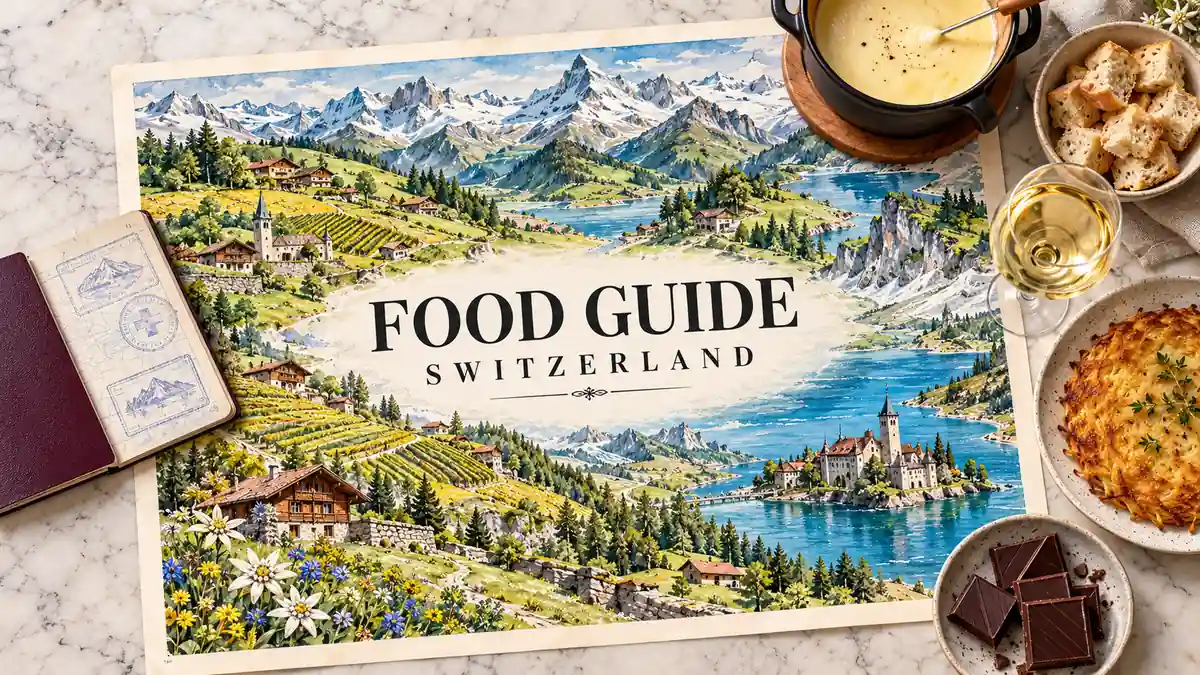
You already know Switzerland means fondue and chocolate. The harder part is the menu in front of you: written in German, French or Italian, full of dish names that never made it into English, and different again on the other side of a language border. This guide explains each traditional dish in plain English, says what it contains and how it reaches the table, and organises Swiss food by language region so you know which dish is native where you are standing.
It also covers the restaurant habits that surprise first-time visitors — service already included in the price, a pace that never rushes you out, and a bill that only arrives when you ask for it. By the end, you will know what to order in Zurich, Geneva, Zermatt or Lugano, and how to eat it the local way.
Quick Answer
Swiss food is Alpine cooking built on cheese, potatoes and cured meat; fondue, raclette and rösti lead. The language region changes what is native: Ticino eats polenta and risotto, Graubünden capuns and Bündnerfleisch, Romandy fondue and Valais raclette. Order the regional dish wherever you are; service is included in prices, so tipping means rounding up.
Trust Layer
Tripstou planning guide for travelers resolving one travel decision. Covers the main variable, traveler context, and practical tradeoffs.
Produced with AI assistance and reviewed by Alex Perrut, working in tourism since 2015, for the Tripstou editorial team. See our editorial process for details.
Last factual review: October 2, 2026.
Official sources consulted: Switzerland Tourism, State Secretariat for Economic Affairs (SECO).
Key Takeaways
- Fondue, raclette and rösti lead Swiss food, but Zürcher Geschnetzeltes, Älplermagronen and capuns are the classics that show how locals eat.
- The language region decides the native dish: order fondue in Romandy, raclette in the Valais, rösti in German-speaking areas and capuns in Graubünden.
- Ticino is the exception to the cheese rule: south of the Alps, polenta, risotto and osso buco replace fondue, with local Merlot poured alongside.
- Fondue and raclette are cold-season food; in the Valais in autumn, the brisolée chestnut plate is the seasonal order worth choosing over raclette.
- Service is included in Swiss menu prices, so tipping means rounding up, and the bill arrives only when you ask for it.
- Eating out is one of the larger daily costs in Switzerland; mix bakery breakfasts and supermarket-deli lunches with one proper fondue or raclette dinner.
Table of Contents
What is traditional Swiss food?
Traditional Swiss food is Alpine mountain cooking built on cheese, potatoes, bread and cured meat. It grew out of farm and dairy life in the mountains, where food had to keep through winter. German, French and Italian neighbours then shaped it region by region, but melted cheese remains the thread that runs through most famous dishes.
Each large language region brings its own kitchen. The German-speaking north and centre cook hearty: rösti, sausages, veal in cream sauce and braided Zopf bread. French-speaking Romandy is the fondue heartland and the home of Gruyère. Italian-speaking Ticino, south of the Alps, eats polenta, risotto and braised meats far closer to northern Italy than to Bern.
The Swiss even have a word for the line between the first two. The Röstigraben — literally the “rösti ditch” — is the humorous name for the cultural divide between German- and French-speaking Switzerland, named after the potato dish that is most at home on the German side. Few visitors notice the border. Menus do.
Most dishes sold abroad as “Swiss” come from that German- and French-speaking cheese belt, which is why fondue and raclette dominate the image. Graubünden in the south-east and Ticino in the south cook differently enough to feel like separate cuisines, and both get their own treatment below. If you are still shaping the route your meals will sit inside, start with our Switzerland travel guide.
Read the language of the menu before you read the dishes: a menu written in Italian is telling you to skip the fondue and order the risotto.
Fondue, Raclette and Rösti: What Each Is and How to Eat It
Fondue, raclette and rösti are the three dishes every visitor meets, and each has its own ritual. Fondue is a shared pot of melted cheese for dipping bread. Raclette is cheese melted and scraped over potatoes. Rösti is a crisp grated-potato cake. How you order and eat each one matters as much as what it is.
How do you order and eat cheese fondue?
Cheese fondue is ordered for the table and eaten from one shared pot, kept warm over a small burner. The classic version is fondue moitié-moitié — French for “half and half” — made with half Gruyère and half Vacherin fribourgeois, two cheeses from the Fribourg region. Menus may list other regional blends, and staff will tell you which cheeses go in.
Spear a cube of bread on the long fork, dip it to the bottom of the pot, and stir in a slow figure of eight as you go. Stirring keeps the cheese smooth and stops it catching. Losing your bread in the pot is the classic beginner mistake, so give the fork a twist as you lift it out.
Save room for the end. The golden cheese crust that forms at the bottom of the pot is called la religieuse, and many Swiss consider it the best part of the meal. The table usually lifts it out and shares it.
What is raclette and how is it served?
Raclette is a semi-hard cheese melted and scraped onto boiled potatoes, served with gherkins and pickled onions. The name comes from the French verb racler, “to scrape”. The Valais version carries a protected name, Raclette du Valais AOP, and the Valais is where the dish is most at home.
Restaurants serve raclette in two ways. In a traditional raclette restaurant, half a wheel of cheese is heated and staff scrape fresh portions onto your plate, one after another. In the table-grill style, common at home and in casual places, each diner melts slices in a small pan under a grill. Both are authentic. The scraped version is the one to seek out in the Valais.
Is rösti a side dish or a main?
Rösti is both: a grated-potato cake fried until crisp, served as a side or topped and eaten as a main. As a side, it is the classic partner to Zürcher Geschnetzeltes, Zurich-style veal in cream and mushroom sauce. As a main, it arrives topped with melted cheese, a fried egg or bacon.
Kitchens differ on the method. Some grate raw potato, others grate potatoes boiled the day before, which gives a softer centre. The menu wording tells you the topping: “Rösti mit Spiegelei” is rösti with a fried egg.
Solo travelers are better served by raclette or rösti. Fondue is built around a shared pot and makes most sense with company, while a raclette plate or a topped rösti is a complete meal for one.
Which other Swiss classics are worth ordering?
Beyond the cheese pillars, Zürcher Geschnetzeltes and Älplermagronen are the two classics worth seeking out first. The first is Zurich-style veal in a cream and mushroom sauce, the second Alpine macaroni with potato, cheese and cream. Berner Platte, Bündnerfleisch and capuns complete a second tier that most dish lists skim past.
Zürcher Geschnetzeltes — thin strips of veal in a cream and mushroom sauce, served with rösti. It is a sit-down restaurant dish and the best way to taste rösti as a side. Order it in Zurich, the city it is named after.
Älplermagronen — “Alpine herders’ macaroni”: pasta and potatoes cooked together with cheese, cream and fried onions, often served with apple sauce on the side. It is the classic mountain-hut lunch. The apple sauce is not a mistake.
Berner Platte — the Bernese platter: a generous spread of cooked meats and sausages over beans or sauerkraut and potatoes. Order it hungry, and ideally share it. It is firmly not a vegetarian dish.
Bündnerfleisch — air-dried beef from Graubünden, sliced paper-thin. It comes as a starter or on a cold platter with bread, never hot. Look for it on cold plates in mountain restaurants.
Capuns — Graubünden chard rolls: a soft dough mixed with dried meat, wrapped in Swiss chard leaves and simmered in a milky broth, often finished with cheese. Few Swiss dishes are more local. You will rarely meet it outside the canton.
A menu that lists Älplermagronen next to fondue is usually cooking for locals as well; a menu of fondue alone is selling the postcard.
Swiss Food by Region: What to Order Where
German-speaking Switzerland means rösti and sausages, Romandy fondue, Valais raclette, Ticino polenta and risotto, Graubünden capuns. The region you are standing in decides which dish is native, and native dishes are the ones local kitchens cook best. Ordering fondue in Lugano works, but it is not what the region is proud of.
| Region | Signature dishes | Where you’ll meet them |
|---|---|---|
| German-speaking Switzerland | Zürcher Geschnetzeltes, Berner Platte, St. Gallen bratwurst, Emmental, Appenzeller | Restaurants and bakeries in Zurich, Bern, Basel and St. Gallen |
| Romandy (French-speaking) | Fondue moitié-moitié, Gruyère, cuchaule bread, longeole, saucisson vaudois | Fribourg, Geneva and Vaud; absinthe in Neuchâtel |
| Valais | Raclette, cholera pie, brisolée chestnuts, dried meat, Valais wine | Mountain resorts and village restaurants across the canton |
| Ticino (Italian-speaking) | Polenta, risotto, osso buco, minestrone, Merlot | Lugano, Locarno and the valleys of the south |
| Graubünden | Capuns, pizokels, maluns, Bündnerfleisch, barley soup, Engadine nut cake | Chur, the Engadine and mountain huts across the canton |
Graubünden surprises visitors most. The canton’s kitchen runs on dried meat, flour, potatoes and mountain greens: Bündnerfleisch (air-dried beef), capuns (chard rolls), pizokels (short buckwheat noodles), maluns (grated potato slowly roasted in butter into golden crumbs) and Bündner barley soup. Order capuns at least once. It is the dish you will not find anywhere else.
Ticino is Switzerland’s Italian kitchen. Polenta, risotto, osso buco (braised veal shank) and minestrone (vegetable soup) replace the cheese pots of the north, and the local red wine is Merlot. Crossing into Ticino is the moment to stop ordering fondue: the south’s pride is its polenta and risotto, and a cheese pot there is a concession to visitors.
The Valais leans on its cheese and its orchards. Beyond raclette, look for cholera, a covered pie of potato, leek, apple and cheese, and dried meat on cold platters, with Valais wine poured alongside. Further north, two smaller regions reward a menu scan. In Lucerne, Chügelipastete is a puff-pastry pie filled with small meatballs in cream sauce. In Glarus, Schabziger is a sharp, green-tinted herb cheese, usually grated over pasta or bread.
Swiss Desserts and Chocolate Worth Seeking Out
Swiss chocolate is everywhere, but Zuger Kirschtorte, Engadine nut cake and Gruyère meringues are the desserts worth ordering. Chocolate is easy to find in any supermarket or station kiosk. The regional pastries are not: each belongs to one place, and eating it there is part of the trip.
- Swiss chocolate — sold everywhere from supermarkets to specialist chocolatiers. Supermarket bars are the everyday buy; chocolatier pralines make the better gift. Some chocolate makers also open their workshops to visitors.
- Zuger Kirschtorte — the cherry-brandy cake of Zug: layers of nut meringue and sponge soaked in kirsch, wrapped in buttercream.
- Engadine nut cake (Engadiner Nusstorte) — shortcrust pastry filled with caramelised walnuts. It keeps well, so it survives the trip home in a suitcase.
- Meringues with Gruyère double cream — crisp meringues served with the thick double cream of the Gruyère region in Fribourg.
- Basler Läckerli — firm spiced honey biscuits from Basel, topped with a thin sugar glaze.
- Zürcher Tirggel — very thin, hard honey biscuits from Zurich, pressed with pictures.
Buy each pastry where it was baked. Gruyère meringues are the clearest case: in the Gruyère region the double cream is the whole point of the dish, and elsewhere you are often eating meringue with ordinary cream.
Where should you eat: restaurant, mountain hut, bakery or supermarket?
Sit-down restaurants are for fondue and regional classics; mountain huts, bakeries and supermarket delis cover everyday meals. Each setting suits a different meal and a different pace. Use restaurants for the dishes you came for, huts for a hearty lunch on a hike, and bakeries or delis for breakfast and quick lunches.
- Sit-down restaurant — for fondue, raclette, Zürcher Geschnetzeltes and regional dinners. The meal is unhurried and the table is yours for the evening, so plan the night around it.
- Mountain hut (Berghütte) — for Älplermagronen, rösti and soup at altitude. Menus are short and hearty. The view is half the meal.
- Bakery — for Zopf (braided butter bread), Birchermüesli (oats soaked with fruit and yoghurt, a Swiss invention) and filled sandwiches at breakfast and lunch. Fast, local, rarely a place to linger.
- Supermarket deli — Coop and Migros run takeaway counters with salads, sandwiches and hot dishes. This is the everyday casual option for picnics and train journeys, with no table service.
Eating out is one of the larger costs of a day in Switzerland, and the price detail sits on our page on what a Switzerland trip costs.
Mixing settings is how visitors eat best here: a bakery breakfast and a mountain-hut lunch leave the evening free for the one fondue or raclette dinner worth doing properly.
When do the Swiss eat fondue, raclette and chestnuts?
Fondue and raclette are cold-season dishes; brisolée roasted chestnuts mark autumn in Valais. Melted cheese belongs to winter evenings and ski days, which is when locals eat it most. Summer visitors can still order fondue in tourist restaurants, but the season shapes what regional menus put first.
Winter is cheese season. Fondue and raclette fill resort restaurants after a day on the slopes, and many Swiss would not think of eating either in the heat.
Autumn belongs to chestnuts. In the Valais, brisolée is a plate of roasted chestnuts served with cheese and dried meat. If you are in the Valais in autumn, order brisolée over raclette: raclette is there all year, the chestnut plate only in season.
Summer menus turn lighter. Expect salads, cold plates of dried meat and cheese, and the polenta and risotto of Ticino eaten outdoors. Fondue stays available in tourist areas, but it is no longer what locals order.
Swiss Restaurant Etiquette: Tipping, Bills and Booking Ahead
Service is included in Swiss menu prices, so tipping means rounding up rather than adding a percentage. Meals run at an unhurried pace, and the bill only comes when you ask for it. Popular restaurants fill up for dinner and on weekends, so book ahead when a particular place matters to you.
The service charge is already built into the price on the menu. Rounding up the bill, or leaving a little extra for good service, is a courtesy and never an obligation. Nobody expects a US-style percentage. For tipping in hotels and taxis, cash versus card and other money habits, see our Switzerland travel tips.
Ask for the bill when you are ready. Say “Zahlen, bitte” in German-speaking areas, “l’addition, s’il vous plaît” in Romandy and “il conto, per favore” in Ticino. Lingering is normal. Waiting for the bill is the norm that confuses US visitors most: in Switzerland, bringing it unasked would be the rude move, and a server who leaves you alone after dessert is being polite.
Book ahead for dinner and weekends in popular places, especially fondue restaurants and resort towns in high season. Lunch is usually easier to walk into. At a fondue table, keep the long fork out of your mouth, since it goes back into the shared pot.
Frequently Asked Questions
What is the national dish of Switzerland?
Switzerland has no single official national dish, but cheese fondue is the one most often given the title. Switzerland Tourism lists fondue, raclette and rösti among its national dishes, alongside Älplermagronen and Zürcher Geschnetzeltes. If you order only one, make it fondue moitié-moitié, the half-Gruyère, half-Vacherin blend from Fribourg.
What food is Switzerland known for?
Switzerland is best known for cheese and chocolate. Its famous cheeses include Gruyère, Emmental, Appenzeller, Sbrinz and Raclette du Valais AOP, and they reach the table melted in fondue and raclette. Chocolate is the national sweet, sold everywhere from station kiosks to specialist chocolatiers. Rösti, the crisp potato cake, completes the image most visitors arrive with.
Is Swiss food vegetarian friendly?
Yes, Swiss food suits vegetarians well, because many classics are built on cheese and potatoes. Fondue, raclette, Älplermagronen and plain rösti are usually meat-free, while Berner Platte and Bündnerfleisch are firmly meat dishes. Vegans have a harder time: cheese, cream and butter run through most traditional cooking, so check each dish with staff.
What is a typical Swiss breakfast?
A typical Swiss breakfast is bread with butter, jam and cheese, often Zopf, the braided butter loaf, with coffee alongside. Birchermüesli, oats soaked with fruit and yoghurt, is the other classic and a Swiss invention. Visitors eat it best at a bakery, the everyday breakfast stop in Swiss towns.
What should you drink with a Swiss meal?
Drink the regional wine: Valais wines with raclette and fondue, and Merlot in Ticino, the canton’s signature red. Local wine is the natural partner on any regional menu, and staff can suggest a glass from the canton you are in. For something stronger, Neuchâtel is the home of absinthe and the Jura makes damassine, a plum spirit.
Which Swiss foods make good souvenirs to take home?
Chocolate and baked goods travel best. Swiss chocolate, Engadine nut cake, Basler Läckerli and Zürcher Tirggel all keep well and survive a suitcase. Hard cheeses such as Gruyère or Sbrinz can go vacuum-packed, but check your home country’s import rules for cheese and meat before packing them, since some countries restrict both.
Related Guides
- Switzerland travel guide — plan the wider trip your meals sit inside.
- What a Switzerland trip costs — what eating out and daily food cost.
- Switzerland travel tips — tipping beyond restaurants, cash vs card and practical habits.
Did this guide save you time or money? Tripstou is independent and reader-funded — if you'd like to give something back, you can support the site with a crypto contribution of any size.