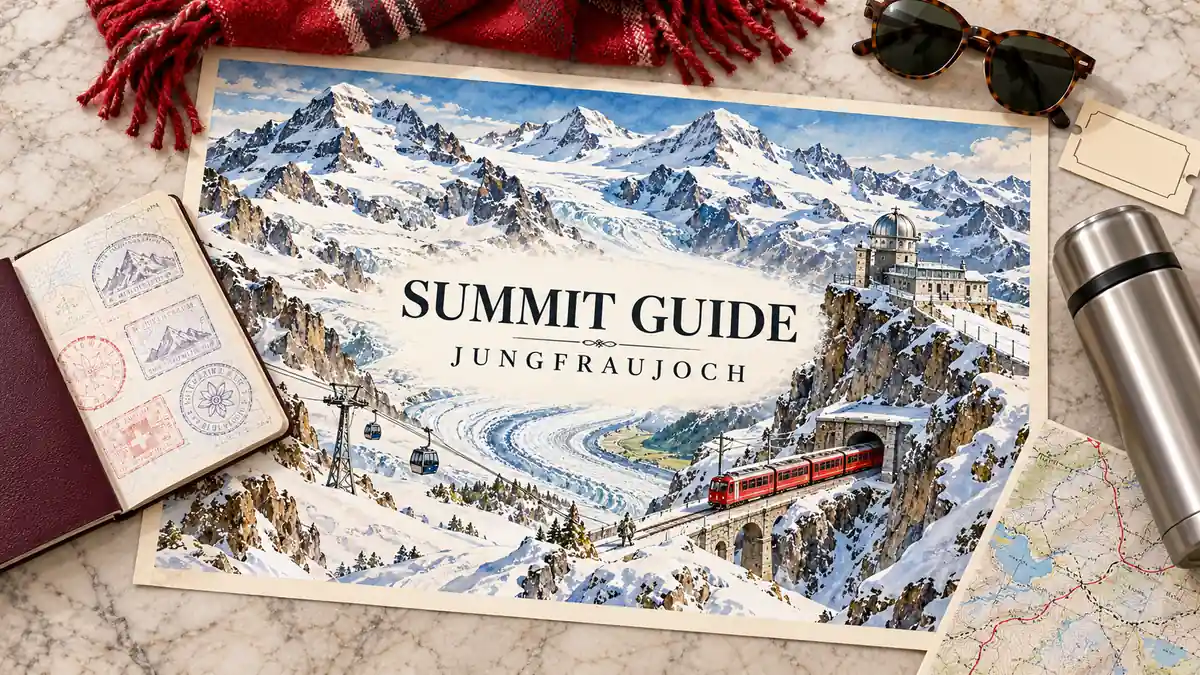
Jungfraujoch is the most famous day trip in Switzerland and one of the most expensive. The railway climbs to the Top of Europe, the highest railway station in Europe at 3,454 m, and the reward is ice, snow and the long sweep of the Aletsch Glacier. The same ride on a cloudy morning buys a white wall and a crowded corridor.
That gap is the whole decision. This guide gives the verdict first, then the honest case for skipping it. It sets out which ticket to buy and why a Swiss rail pass only cuts the fare. It covers the route that turns one ticket into a loop through two valleys, and the timing rule that matters more than the season. The last sections plan the hours at the top and the three things that catch visitors out on the day.
Quick Answer
Jungfraujoch is worth it on a clear day for a first high-Alpine experience, when the budget allows. The summit weather and the ticket path — first trains, a discount card or the Good Morning Ticket — decide whether the fare pays off. Check the webcam, ride the Eiger Express up early, and skip cloudy summit days.
Trust Layer
Tripstou attraction guide for travelers deciding whether an experience is worth doing and how to do it well. Covers value, booking versions, timing, access, and traveler fit.
Produced with AI assistance and reviewed by Alex Perrut, working in tourism since 2015, for the Tripstou editorial team. See our editorial process for details.
Last factual review: October 2, 2026.
Official sources consulted: Switzerland Tourism, State Secretariat for Economic Affairs (SECO), Jungfrau Railways: Jungfraujoch, Jungfrau Railways prices and tickets.
Key Takeaways
- Jungfraujoch pays off on a clear summit day for a first high-Alpine experience; under cloud, the fare buys tunnels and shops.
- Early risers should book the Good Morning Ticket from May to October; everyone else saves with a Swiss Travel Pass or Half Fare Card.
- Neither the Swiss Travel Pass nor the Half Fare Card makes Jungfraujoch free; both only discount the fare shown in the jungfrau.ch calculator.
- Ride the Eiger Express up from Grindelwald Terminal and the cogwheel train down via Kleine Scheidegg and Wengen to see both valleys.
- Hold Jungfraujoch for the clearest morning of your stay, check the official summit webcam before leaving, and take the first trains up.
- A paid seat reservation is mandatory on Jungfraujoch trains from May to October, on top of any ticket, pass or discount card.
Table of Contents
Is Jungfraujoch worth it?
Jungfraujoch is worth it on a clear day for travelers who want one high-mountain day and can absorb the fare. Two conditions decide it: a summit out of cloud, and a cost that does not squeeze the rest of the trip. Meet both and it is one of the easiest ways to stand on glacier snow in the Alps.
It suits first-time visitors to the Alps, families and non-hikers. Nobody has to climb anything. The train does the work, and the reward is snow, ice and a glacier view that would otherwise take a mountaineering day to reach.
The case rests on the setting. Jungfraujoch is the highest railway station in Europe, and the Sphinx Observation Deck looks straight down the Aletsch Glacier, the centrepiece of the Jungfrau-Aletsch UNESCO World Heritage area. Few places put that much high-mountain scenery within reach of a train seat.
The tradeoff is real. The fare is high, the complex is busy on clear days, and the summit is a built site of tunnels, shops and viewing halls. Travelers who expect solitude at the top usually come down disappointed.
The fare buys the Aletsch view, not the building. On a clouded summit the tunnels, the Ice Palace and the shops all keep running, but the reason you paid has gone.
Who Should Skip Jungfraujoch (and What to Do Instead)
Skip Jungfraujoch when the summit forecast is cloudy, the fare hurts, or you want a wild summit. The complex is a built site. Travelers who have already stood on a high Alpine summit gain little from a second. In each case a cheaper viewpoint in the region gives more value per franc.
The Schilthorn is the usual alternative. Its summit gives a 360-degree view, and the fare is lower. The region’s lower lifts are cheaper again and work well on days when the high summits sit in cloud.
Our Jungfrau region guide covers the Schilthorn, First and Männlichen in depth, along with the bases that serve them. For a day out away from the Jungfrau valleys, the wider list of things to do in Switzerland sets out the other excursions worth the time.
Skip it if:
- The summit webcam or forecast shows cloud on the only day you have.
- The fare would force cuts elsewhere in the trip.
- You want a quiet, natural summit with no shops or tunnels.
- You have already done a high Alpine summit on this or an earlier trip.
Which Jungfraujoch Ticket to Buy
Book the Good Morning Ticket if you can ride one of the first two trains; otherwise use a discount card. Most visitors pay the full fare cut by a Swiss Travel Pass or Half Fare Card. The Jungfrau Travel Pass special fare only pays off for travelers riding the region’s lifts on several days.
- Full fare with a discount card (Swiss Travel Pass or Half Fare Card): suits travelers who want any day and any departure. Tradeoff: it is the most expensive way up — discounted, but never free.
- Good Morning Ticket: suits early risers from May to October. It takes 20% off on one of the first two trains of the morning, with the descent by early afternoon and a mandatory seat reservation. Tradeoff: it cannot be combined with the Half Fare Card, GA, Swiss Travel Pass or Eurail/Interrail.
- Jungfrau Travel Pass special fare: suits travelers using the region’s lifts on several days. Tradeoff: it only pays with that multi-day use; for one summit day it is the wrong tool.
- Guided day tour: suits travelers who want zero logistics from a city base. Tradeoff: the date and timing are fixed, so a cloudy forecast cannot be dodged.
Jungfraujoch is one of the most expensive excursions in Switzerland. The price depends on where you start, the season and the discount card you hold. The official price calculator at jungfrau.ch gives the exact fare for your start point and date.
Half Fare Card holders should price both options before booking. The Good Morning Ticket replaces the card discount instead of adding to it, so the calculator decides which one is cheaper for your start point.
Whether the Jungfrau Travel Pass beats a national pass depends on the rest of the trip, which our guide on whether the Swiss Travel Pass pays off works through.
Tours and activities
Book skip-the-line tickets, day trips and local tours with free cancellation on most activities.
You can also browse everything on getyourguide.com.
Tripstou may earn a commission if you book through this link, at no extra cost to you.
Does the Swiss Travel Pass cover Jungfraujoch?
No. The Swiss Travel Pass discounts the Jungfraujoch fare but does not cover it. The Half Fare Card works the same way: both cut the price, neither makes the trip free. You still buy a Jungfraujoch ticket, and in season you still pay for a seat reservation on top.
That makes this ride a poor reason to buy a pass on its own. A pass earns its cost over the whole trip — intercity trains, lake boats and other mountain lines — and the Swiss Travel Pass guide runs that calculation.
Plan for the summit as one of the heaviest lines in the budget. Our breakdown of what a trip to Switzerland costs shows where it sits against daily spending.
Eiger Express or Cogwheel Train: Which Route Up
Take the Eiger Express up and the cogwheel train down: the loop is the best use of one ticket. The Eiger Express runs from Grindelwald Terminal to Eiger Glacier in about 15 minutes, putting the summit about 1 hour 30 minutes from Interlaken. The slower cogwheel descent via Kleine Scheidegg and Wengen shows the second valley.
The Eiger Express is the fast route. The gondola lifts you from Grindelwald Terminal to Eiger Glacier, where the Jungfrau Railway takes over for the final climb inside the mountain. It is the quickest way from Interlaken and the right choice for the morning.
The classic cogwheel route is longer. It runs from Lauterbrunnen through Wengen to Kleine Scheidegg, then joins the Jungfrau Railway. The scenery is the point — the Lauterbrunnen valley below, the Eiger, Mönch and Jungfrau above.
| Route | Start point | What it gives | Best use |
|---|---|---|---|
| Eiger Express | Grindelwald Terminal, gondola to Eiger Glacier | The fastest way up from Interlaken | The ascent, to reach the summit early |
| Cogwheel via Wengen | Lauterbrunnen, then Wengen and Kleine Scheidegg | Slower ride with views over two valleys | The descent, when time at the top is done |
| The loop | Up from Grindelwald, down to Lauterbrunnen | Both valleys on a single trip | First visits with one ticket and a day |
The loop works from any base. Interlaken, Grindelwald, Lauterbrunnen and Wengen all sit on one side of it or the other, and the bases and the other summits in the Jungfrau region are compared in the parent guide.
Run the loop in this direction, never the reverse. Going up fast spends the clear morning hours on the summit, and the slow scenic leg falls in the afternoon, when cloud at the top no longer costs you anything.
When is the best time to visit Jungfraujoch?
The best time is the first train on the clearest-forecast morning of your stay, in any season. Cloud tends to build over the summit as the day goes on, and crowds build with it. The sky decides the visit more than the month, because the site is open 365 days a year.
Early trains pay twice. The views are usually sharpest before midday, and the first two trains are also the Good Morning Ticket window from May to October.
Keep one flexible day in the region. Travelers who lock Jungfraujoch to a fixed date often ride up into cloud. Those who hold the summit back for the clearest day of the stay rarely do.
Check the official webcam on the morning of travel. If the summit is in cloud, switch days.
Summer and winter differ less than most expect. Below freezing is common at the top even in summer, and snow lies on the plateau all year. The Snow Fun Park is seasonal, open from late spring to mid-autumn. Winter brings quieter trains on many days, with the same rule: go when the sky is clear.
How long do you need at Jungfraujoch?
Allow at least about two hours at the top and treat the trip as most of a day. Two hours covers the main stops without rushing at altitude. Add time for the Mönchsjochhütte glacier walk. From Interlaken, the ride up, the visit and the loop down leave little room for another big plan that day.
Follow the complex in this order:
- Sphinx Observation Deck: the Aletsch Glacier view, first while the sky is clearest.
- Glacier Plateau: open snow underfoot and the summits close up.
- Ice Palace: corridors and halls carved into the glacier ice.
- Alpine Sensation: an indoor walkway on the railway and the region.
- Lindt Swiss Chocolate Heaven: a short, warm stop before the trains.
- Snow Fun Park: seasonal, late spring to mid-autumn, for travelers who want snow activities.
- Mönchsjochhütte path: the glacier walk to the hut, for those with time and energy.
The deck goes first for a reason. Cloud can close in while you are inside the tunnels. A missed glacier view is the one loss the rest of the complex cannot make up.
Seat Reservations, Clothing and Altitude: What Catches People Out
A paid seat reservation is mandatory from May to October, and many visitors discover the rule too late. The other two traps are the wrong clothes for a summit that is often below freezing, and rushing around at 3,454 m. All three are easy to fix before you leave.
- Seat reservation: mandatory from May to October, at CHF 10, on top of any ticket or pass. Outside that window it is strongly recommended on good-weather days, when trains fill.
- Clothing: warm layers, sunglasses, sun protection and sturdy shoes for the snow plateau. Below freezing is common even in summer, and the glare off snow is strong.
- Altitude: the station sits at 3,454 m. Move slowly, drink water and take breaks; mild symptoms such as a light headache are possible but usually brief on a short visit.
- Weather check: look at the official webcam before leaving the base. A clear valley does not guarantee a clear summit.
The reservation is tied to a train. Book it once the forecast is clear, which keeps the flexible-day plan intact.
Frequently Asked Questions
What should you wear to Jungfraujoch?
Wear warm layers you can add or remove, plus sunglasses, sun protection and sturdy shoes with grip. Below freezing is common at the summit even in summer, so pack a warm jacket, hat and gloves even when the valley feels hot. The snow on the Glacier Plateau reflects strong sunlight, which makes sunglasses essential.
Do you get altitude sickness at Jungfraujoch?
Mild altitude symptoms are possible at 3,454 m, such as a light headache, but they are usually brief on a short visit. Walk slowly, drink water and rest between stops. Anyone with a heart or breathing condition should ask a doctor before going, since the train climbs fast with little time to adjust.
Is Jungfraujoch open in winter?
Yes. Jungfraujoch is open 365 days a year, so the trains and the main complex run through winter. The Snow Fun Park runs from late spring to mid-autumn and closes outside its season. From November to April the seat reservation is not mandatory, but it is strongly recommended on good-weather days, when trains fill.
Should you go to Jungfraujoch from Interlaken or Grindelwald?
Both bases work. Staying in Grindelwald keeps you close to Grindelwald Terminal, where the Eiger Express starts, so the first trains of the morning are easier to catch. From Interlaken, the fastest route to the top takes about 1 hour 30 minutes. Either way the loop holds: up by the Eiger Express, down by the cogwheel through Wengen.
How do you check the weather at Jungfraujoch before going?
Look at the official Jungfrau Railways webcam on jungfrau.ch on the morning of travel, and before you book a seat reservation. The valley sky is a poor guide, because cloud can sit on the summit while Interlaken is in sunshine. If the webcam shows cloud at the top, move the trip to your flexible day.
Can you use the Good Morning Ticket with a Swiss Travel Pass?
No. The Good Morning Ticket cannot be combined with the Swiss Travel Pass, the Half Fare Card, the GA or Eurail and Interrail passes. Pass holders choose between the 20% Good Morning discount and their pass discount, not both. Price each option in the jungfrau.ch calculator for your start point, then book the cheaper one.
Related Guides
- Jungfrau region guide: bases, the other lifts and summits, and where to stay.
- Swiss Travel Pass guide: whether a pass pays off, and how it compares with the Jungfrau Travel Pass.
- Switzerland trip cost: where this excursion sits in a daily budget.
- Things to do in Switzerland: the other excursions worth a day.
Did this guide save you time or money? Tripstou is independent and reader-funded — if you'd like to give something back, you can support the site with a crypto contribution of any size.