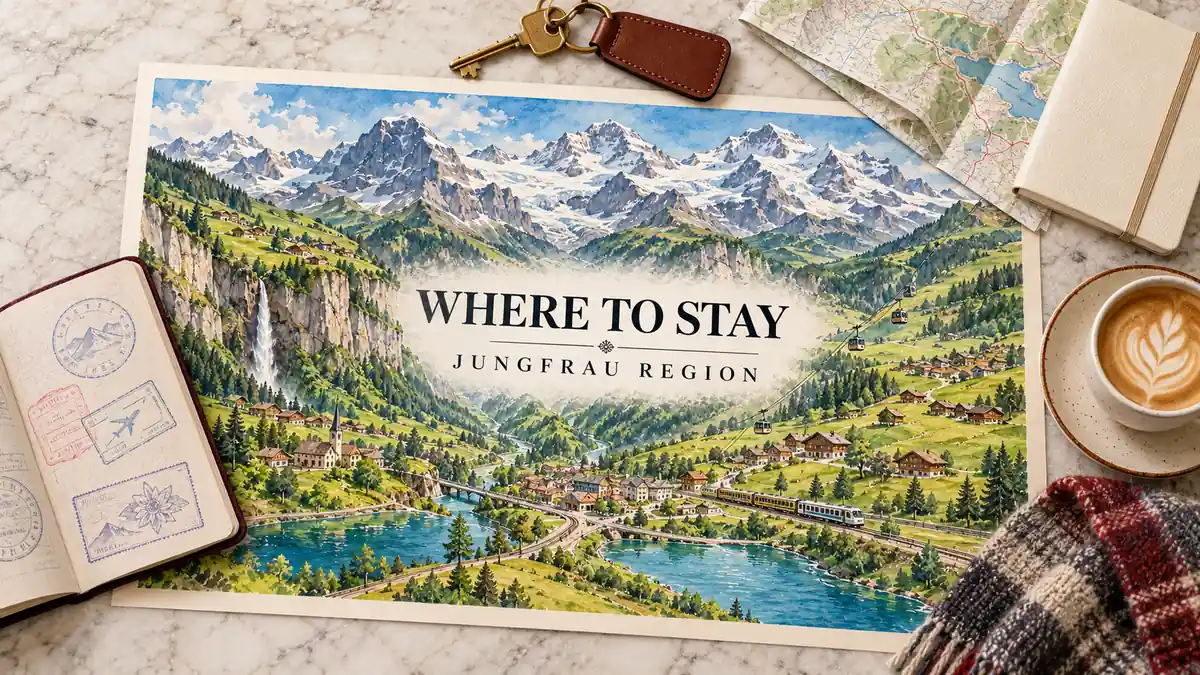
Most travelers arrive in the Jungfrau region with one question: which village to sleep in. The answer gets easy once the layout is clear. The region is two valleys with one gateway town, and each valley owns a different set of trains, lifts and views. Interlaken sits at the bottom as the rail hub. Lauterbrunnen fills one valley floor, with Wengen and Mürren on the terraces above it. Grindelwald anchors the other valley under the Eiger.
This guide covers how the region fits together, where to base yourself, how long to stay and when to come. It also shows how to move around without a car and which mountain excursions start from which side. Jungfraujoch, the headline summit trip, has its own dedicated guide; here it appears only as part of the base decision.
Quick Answer
The Jungfrau region is the strongest first-trip choice in the Swiss Alps: car-free villages and lifts in one compact area. The base decides the trip: Interlaken for price; Lauterbrunnen, Wengen or Mürren for valley calm; Grindelwald for lifts and Jungfraujoch. Three to four days from one base covers the highlights; hikers add a second base.
Trust Layer
Tripstou region guide for travelers planning a regional trip. Covers sub-areas, trip shape, base strategy, timing, and mobility tradeoffs.
Produced with AI assistance and reviewed by Alex Perrut, working in tourism since 2015, for the Tripstou editorial team. See our editorial process for details.
Last factual review: October 2, 2026.
Official sources consulted: Switzerland Tourism, State Secretariat for Economic Affairs (SECO).
Key Takeaways
- The region is two valleys above Interlaken (Lauterbrunnen and Grindelwald) joined by rail at Kleine Scheidegg, so your valley shapes every day.
- Base in Grindelwald for lifts and the fastest Jungfraujoch start, Lauterbrunnen for the valley, Wengen or Mürren for car-free calm, Interlaken for price.
- One base covers trips of up to four days; split between the two valleys only on longer, hiking-led stays.
- June to September opens the full lift network, September thins the crowds, and November is the month to avoid because many lifts close for maintenance.
- A car is useless above the valley floors: roads end at Grindelwald and at Lauterbrunnen or Stechelberg, and trains and lifts handle the rest.
- Keep the Jungfraujoch day unfixed and move it to the first clear morning, since cloud can hide the peaks for a day or more.
Table of Contents
Is the Jungfrau Region Worth Visiting?
The Jungfrau region is worth it for almost every first trip to Switzerland. Nowhere else in the country packs this much alpine access into one compact area: the Eiger, Mönch and Jungfrau wall, car-free villages and a dense network of mountain railways and lifts. The region is part of the Swiss Alps Jungfrau-Aletsch UNESCO World Heritage site.
The region suits first-timers who want big mountains without driving, walkers who want trails starting at the station, and anyone who enjoys mountain railways as much as the summits they reach. It rewards travelers who stay put and let the trains and lifts do the work.
It is a weaker fit for travelers chasing empty mountains or a low-cost alpine stay. The villages are pricier than the lowland towns, and peak summer brings heavy day-trip crowds. Travelers who want lakeside cities or a quieter corner of the Alps can compare the other Swiss regions before committing.
The crowds concentrate on one axis: Interlaken, the Lauterbrunnen valley floor, Grindelwald and the summit railway. Sleeping on a terrace like Wengen or Mürren takes you off that axis every evening without leaving the region. That is the cheapest crowd fix here.
How the Jungfrau Region Fits Together
The Jungfrau region is two parallel valleys above Interlaken, joined at Kleine Scheidegg, and that shape decides everything. Interlaken sits between Lake Thun and Lake Brienz as the gateway. The Lauterbrunnen valley carries Wengen and Mürren on its terraces. The Grindelwald valley lies beside it, opening out under the Eiger.
The Lauterbrunnen valley is narrow and steep-walled, marketed as the “valley of 72 waterfalls”. Staubbach falls drops beside Lauterbrunnen village, and Trümmelbach falls is further up the same valley. Wengen sits on the terrace on one side; Mürren sits on the other, with Gimmelwald just below it. Both Wengen and Mürren are car-free, and Gimmelwald is likewise reached only by public transport.
The Grindelwald valley feels different. It is an open, green bowl directly under the Eiger, with the village spread across the slope. It has more space and more lifts.
Roads end at Grindelwald on one side and at Lauterbrunnen and Stechelberg on the other. Beyond those points, the region runs on trains, cable cars and gondolas. Kleine Scheidegg is the high saddle where the rail lines from both valleys meet.
On the map the two valleys look like neighbours, but no road links their upper ends. Moving between Lauterbrunnen and Grindelwald means going either over Kleine Scheidegg by train or back down to the junction where the valleys split. That geography is why the base matters so much.
Where to Base Yourself in the Jungfrau Region
Pick Grindelwald or Lauterbrunnen for a first visit. Choose Interlaken only when price or onward travel matter more than waking up in the mountains. Grindelwald suits lift-led days and the fastest Jungfraujoch start. Lauterbrunnen sits central to both terraces. Wengen and Mürren trade convenience for car-free calm.
Each base below follows the same pattern: what the place is like, what it puts on your doorstep and who it suits. Stays are positioned broadly. Interlaken has the widest and cheapest supply, while the mountain villages are pricier and smaller.
Interlaken
Interlaken is the gateway town between Lake Thun and Lake Brienz, with the widest and cheapest range of places to stay in the region. Its two stations put the lakes, both valley rail lines and onward connections to the rest of Switzerland on the doorstep. Arrival and departure days are easy. The trade-off is the commute: every mountain day starts with a train up, and evenings feel like a town, not a village.
Best for: short stays, onward rail connections and tighter budgets.
Lauterbrunnen
Lauterbrunnen sits on the valley floor between sheer rock walls, with Staubbach falls dropping beside the village. It is the hinge of its valley: trains climb to Wengen on one side, and lifts reach Mürren on the other. Road access continues only as far as Stechelberg, further up the valley. The catch is a smaller supply than Interlaken and a valley floor that fills with day-trippers in peak summer.
Best for: first-timers who want the valley itself and easy reach of both terraces.
Grindelwald
Grindelwald is a larger resort spread across an open bowl under the Eiger. Grindelwald Terminal holds the Eiger Express cable car to Eigergletscher, which makes this the fastest starting point toward Jungfraujoch, and the First lift leaves from the village itself. Our Jungfraujoch guide covers the summit trip. The trade-off: Grindelwald feels busier and more developed than the car-free terraces.
Best for: lift-led days and the quickest route to the summit.
Wengen
Wengen is a car-free village on the terrace above Lauterbrunnen, on the rail line that continues up to Kleine Scheidegg. That line puts the Jungfraujoch side within direct reach, and a cable car connects the village to Männlichen. Evenings are quiet, with no through-traffic at all. What you give up is choice: stays are fewer and pricier, and every trip down to the valley means a train.
Best for: quiet evenings with a direct train toward the Jungfraujoch side.
Mürren
Mürren is a car-free village on the opposite terrace, facing the Eiger, Mönch and Jungfrau across the valley. It is the base for the Schilthorn, and Gimmelwald sits just below it, likewise reached only by public transport. Supply is small and the setting is the calmest of the mountain bases. Extra transfers are the price: Grindelwald and Jungfraujoch are the furthest from here.
Best for: travelers who want the view at the door and accept extra transfers.
| Base | Side of the region | Access | Best for | Trade-off |
|---|---|---|---|---|
| Interlaken | Gateway town between Lake Thun and Lake Brienz | Main rail hub where both valley lines start | Short stays, onward rail and tighter budgets | A train up for every mountain day |
| Lauterbrunnen | Valley floor of the Lauterbrunnen side | Road and rail; the road ends at Stechelberg | First-timers wanting the valley and both terraces | Smaller supply, busy valley floor in peak summer |
| Grindelwald | Centre of the Grindelwald valley under the Eiger | Road and rail; the road ends in Grindelwald | Lift-led days and the quickest summit start | Busiest, most developed feel of the mountain bases |
| Wengen | Terrace above Lauterbrunnen, toward Kleine Scheidegg | Car-free, reached by train from Lauterbrunnen | Quiet evenings with a direct Jungfraujoch-side train | Pricier stays and a train for every trip down |
| Mürren | Opposite terrace, facing the Eiger, Mönch and Jungfrau | Car-free, lifts from Lauterbrunnen or Stechelberg | View at the door and Schilthorn days | Extra transfers to Grindelwald and Jungfraujoch |
The common head-to-heads resolve quickly:
- Interlaken or Lauterbrunnen: Lauterbrunnen, unless budget or onward rail connections decide the trip.
- Grindelwald or Interlaken: Grindelwald for lift-led days in the mountains; Interlaken for the cheapest stays and the easiest arrival.
- Wengen or Grindelwald: Wengen for car-free quiet; Grindelwald for more choice, more lifts and the Eiger Express.
Wengen and Grindelwald look like rivals, but they sit on the same rail line over Kleine Scheidegg. Both reach the Jungfraujoch side directly. The real choice between them is the kind of evening you want, not access.
Hotels and places to stay
Compare hotels, apartments and stays for your dates in one search.
Search hotels and stays on hotels.com →
Tripstou may earn a commission if you book through this link, at no extra cost to you.
One Base or Two in the Jungfrau Region?
One base is right for most trips of up to four days. Every corner of the region is reachable in a day from any village, so moving costs more than it saves. Two bases, one per valley, only earn their packing day on longer, hiking-led stays.
A split buys two sets of doorstep lifts at the cost of a day lost to packing and transfers. For a short trip, that day is better spent on a mountain.
If you split, pair one Lauterbrunnen-side base (Lauterbrunnen, Wengen or Mürren) with Grindelwald. Two bases in the same valley gain you almost nothing.
Mürren plus Grindelwald is the split that pays most. The two sit at opposite ends of the lift network, so each base covers exactly what the other reaches worst.
How Many Days You Need in the Jungfrau Region
Plan three to four days in the Jungfrau region; two covers the highlights, and five or more is for hikers. Three to four days fits one summit day, one valley day, one lift-and-walk day and spare time for weather, because cloud can hide the peaks for a day or more.
- 2–3 days: the highlights from one base, with one summit trip and the Lauterbrunnen valley. Right as an add-on to a wider Swiss trip.
- 3–4 days: the sweet spot, with a summit day, a valley day, a lift-and-walk day and weather slack. Fits most first-time visitors.
- 5 days or more: hiking-led stays, possibly split across two bases. Fits travelers for whom walking is the point of the trip.
Keep the summit day flexible. Leave it unfixed and move it to the first clear morning; a cloudy day at the top wastes the region’s most expensive outing. Short stays feel this most.
For day-by-day plans and routes that combine the region with other parts of the country, see our Switzerland itinerary.
When to Visit the Jungfrau Region
June to September is the main window, with September the best balance of open lifts and thinner crowds. Summer brings the full lift network and the hiking season. Winter suits skiing. Late autumn, November above all, is the month to avoid for most trips.
Summer is the default for most travelers. Every lift runs, the trails are open, and the high villages are at their liveliest. Hiking is the strongest reason to pick these months; the best hikes in Switzerland guide covers the trails. Expect peak crowds and the highest demand for village stays.
September keeps most of summer’s access with fewer day-trippers. It is the strongest shoulder month.
Winter turns the region into a ski area, and the car-free villages work as well under snow as in summer. Travelers who come for hiking should not choose winter.
Plan around one hard limit: many lifts close for maintenance in the shoulder months; check the operator before booking. In this region the shoulder season is a lift-timetable question first. A mild week in late autumn is worth little if the lift you came for is down for service.
How to Get to the Jungfrau Region and Around It Without a Car
Arrive by train at Interlaken and leave the car behind; the villages above the valley floors are car-free or lift-only. Interlaken is the region’s rail gateway. From there, trains and lifts do everything, and a car stops being useful at Grindelwald and at Lauterbrunnen or Stechelberg, where the roads end.
Interlaken has direct or one-change trains from the main Swiss cities. From Interlaken Ost, the regional line runs up the valley and splits into two branches, one to Lauterbrunnen and one to Grindelwald. Country-level transport, money and arrival logistics are covered in our Switzerland travel guide.
The car-free villages are simple to reach:
- Wengen: by train from Lauterbrunnen, on the line that continues to Kleine Scheidegg.
- Mürren: by lift and train from Lauterbrunnen, or by cable car from Stechelberg via Gimmelwald.
Drivers park at Lauterbrunnen, Stechelberg or Grindelwald. Beyond those points, the car stays put.
The Swiss Travel Pass covers the valley trains, while most Jungfrau lifts are only discounted; a regional pass also exists for stays inside the region. Our Swiss Travel Pass guide works out when each option pays.
A car gains nothing past Interlaken here. It ends up parked in Lauterbrunnen or Grindelwald while every day out runs on rails and cables.
The Main Mountain Excursions by Base Side
Choose the base by the excursions you want at the door, because each side owns a different set of lifts. Jungfraujoch and Männlichen are reached from both valleys. Grindelwald First is Grindelwald’s own, the Schilthorn belongs to Mürren, and Schynige Platte and Harder Kulm start near Interlaken.
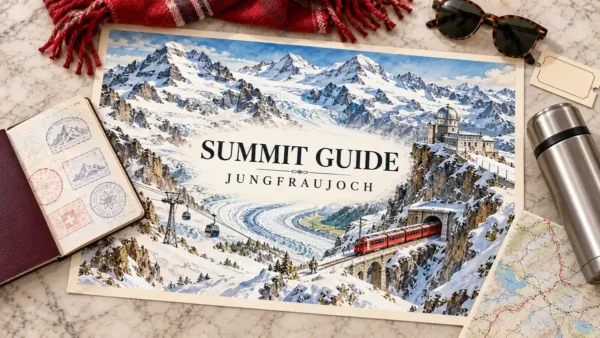
- Jungfraujoch (both sides): the headline excursion, to the highest railway station in the Alps at 3,454 m. The fastest start is Grindelwald Terminal, on the Eiger Express to Eigergletscher; the Wengen side reaches it by train via Kleine Scheidegg. Tickets, timing and the worth-it question live in our guide to visiting Jungfraujoch.
- Schilthorn (Mürren side): the summit above Mürren, easiest for travelers based on that terrace or in Lauterbrunnen. It is the major lift furthest from Grindelwald.
- Grindelwald First (Grindelwald side): the village’s own lift, the natural lift-and-walk day from a Grindelwald base. It is awkward to reach from the Lauterbrunnen terraces.
- Männlichen (between the valleys): a ridge reached by lift from both Wengen and Grindelwald. It suits either side equally, which makes it the easiest excursion to fit into any base.
- Schynige Platte (Interlaken side): starts from Wilderswil, just outside Interlaken. It suits a town base and is a detour from the upper villages.
- Harder Kulm (Interlaken): the viewpoint directly above Interlaken. It is a short outing that fits an arrival or departure day.
Several of these lifts link up with walking routes; the best hikes in Switzerland guide covers the trails.
Tours and activities
Book skip-the-line tickets, day trips and local tours with free cancellation on most activities.
You can also browse everything on getyourguide.com.
Tripstou may earn a commission if you book through this link, at no extra cost to you.
Frequently Asked Questions
Do you need a car in the Jungfrau region?
No, a car is not needed and adds little once you arrive. Roads end at Grindelwald and at Lauterbrunnen or Stechelberg, and Wengen, Mürren and Gimmelwald are reached only by train or lift. A car only helps if your trip continues to places off the rail network; otherwise it waits in a car park.
Which villages in the Jungfrau region are car-free?
Wengen and Mürren are the car-free villages, both on the terraces above the Lauterbrunnen valley. Gimmelwald, just below Mürren, is likewise reached only by public transport. Visitors arrive by train or cable car and walk from the station, which keeps evenings quiet. Grindelwald, Lauterbrunnen and Interlaken all have road access.
Is Mürren worth staying in?
Yes, Mürren is worth it for travelers who value the view and calm over convenience. The car-free village faces the Eiger, Mönch and Jungfrau and puts the Schilthorn on the doorstep. The cost is extra transfers: Grindelwald and Jungfraujoch take longest to reach, and the supply of stays is small and pricier.
What is closed in the Jungfrau region in November?
Many lifts close for maintenance in November and the other shoulder months, which can take a planned excursion off the table. Closure windows shift from year to year, so check the operator before booking. Travelers who come in late autumn should keep the mountain days flexible and plan a lakeside or town day as backup.
Does the Swiss Travel Pass cover the Jungfrau lifts?
Only partly: the Swiss Travel Pass covers the valley trains, while most Jungfrau lifts are only discounted. A regional pass also exists for travelers who stay inside the region and ride several lifts. The deciding factor is how many mountain excursions you plan; our Swiss Travel Pass guide works through the comparison.
Can you visit the Jungfrau region as a day trip from Lucerne or Bern?
Yes, a day trip from Lucerne or Bern is possible, since Interlaken has direct or one-change trains from the main Swiss cities. It suits one valley or one viewpoint, not the whole region. The mountain excursions start well above Interlaken, so a night or more in a base is the better plan, because it lets you wait out cloud.
Related Guides
- Jungfraujoch guide: tickets, timing and the route to the region’s headline summit.
- Swiss Travel Pass guide: what the national pass covers here and when a regional pass beats it.
- Best hikes in Switzerland: the trails that make a longer, hiking-led stay worth it.
- Switzerland itinerary: day-by-day routes that fit the region into a wider trip.
- Best places to visit in Switzerland: how the Jungfrau region compares with other Swiss regions.
- Switzerland travel guide: country-level transport, money and practical planning.
Did this guide save you time or money? Tripstou is independent and reader-funded — if you'd like to give something back, you can support the site with a crypto contribution of any size.