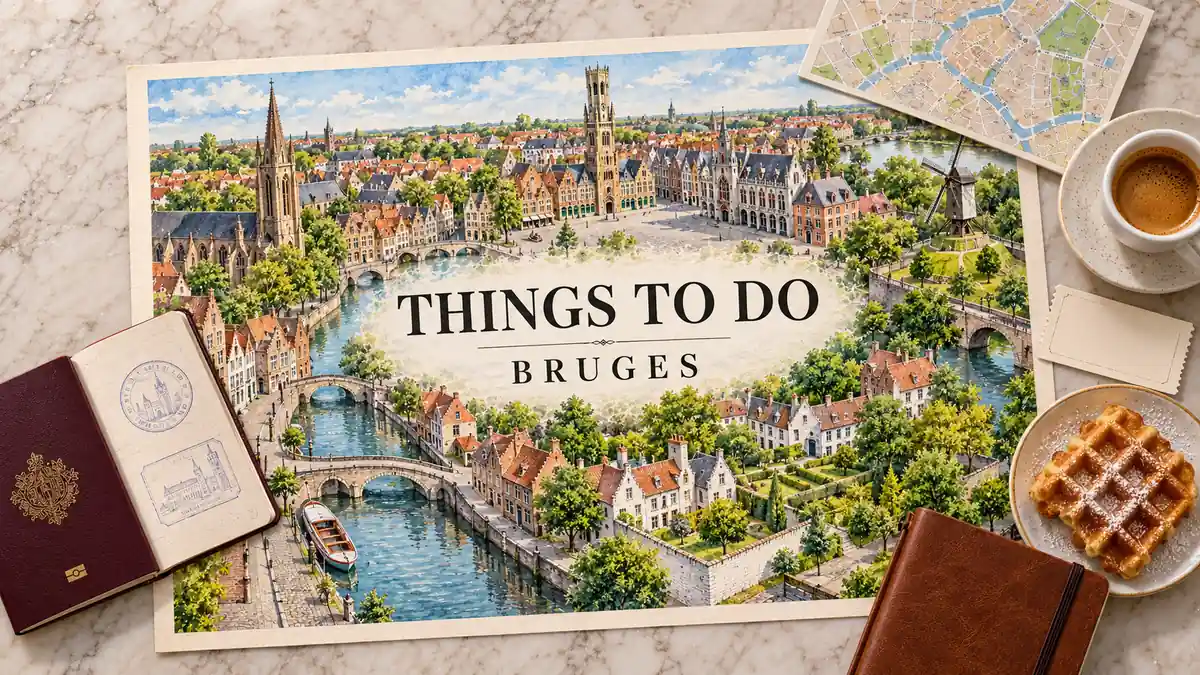
Bruges is small, compact and over-visited by day, so the real question is what earns a place on a short stay. Most visitors come for a day or a single night. In that window, the same few squares fill with tour groups by mid-morning, while the canal edges and the east side stay quiet.
This page resolves that trade-off. It weighs the crowd-timed core against the quiet edges, and the free walks against the paid interiors and the one sight you must book ahead. The picks sit in four groups: the medieval core, canals and quiet corners, art and churches, and beer and the evening. Each carries a verdict and a clear fit. A final section names what to skip when time is short, so the hours go to the sights that repay them.
Quick Answer
The best things to do in Bruges are the Belfry, the Burg, a canal boat, the Beguinage and Sint-Anna’s windmills. Visit the core early or late to miss day-trippers, and keep the east side for quiet hours. Art lovers add the Flemish Primitives and Michelangelo’s Madonna; on a half-day, skip the Historium and the carriage.
Trust Layer
Tripstou selection guide for travelers choosing between multiple places. Covers selection criteria, traveler fit, and trip value.
Produced with AI assistance and reviewed by Alex Perrut, working in tourism since 2015, for the Tripstou editorial team. See our editorial process for details.
Last factual review: September 30, 2026.
Official sources consulted: Belgium.be tourism portal, FPS Foreign Affairs: Travel to Belgium, Musea Brugge, Visit Bruges.
Key Takeaways
- Make the Belfry climb, a canal boat and the Beguinage your core trio, because together they cover the view, the water and the quiet.
- Book the Belfry as a timed slot online and arrive on time, since a late arrival means the ticket expires.
- Do not try to reserve a canal boat: individual visitors buy tickets only at the jetties, so pick the shortest queue.
- Art lovers should pay for the Flemish Primitives and Michelangelo’s Madonna, while travelers after quiet should walk east to the Sint-Anna windmills.
- Stay one night if you can, because the lit canals and near-empty squares after the day-trippers leave cost nothing.
- On a short stay, drop the Historium, the Torture Museum and the carriage ride, which repackage streets you can walk for free.
Table of Contents
The Medieval Core Is Where Every First Visit Starts
The Markt, the Belfry, the Burg and Rozenhoedkaai are the Bruges core, and they reward early or late visits. These stops sit a few minutes’ walk apart, so every first visit starts here. Timing changes everything: arrive before mid-morning or after the day-trippers leave, and the same squares feel far calmer.
The Belfry slot is the fixed point of a Bruges visit. Book it first, and let the free squares fit around it. This page chooses the stops; it does not order them. For how to order these stops in a single day, the one-day Bruges itinerary builds the route.
Markt and the Belfry climb
The Belfry is the tower on the Markt, and climbing it gives the highest view over Bruges. The climb runs 366 steps to 83 m (about 270 ft), passing the carillon on the way up. No other pick shows the whole red-roofed centre and the flat land beyond in one frame.
The trade-off is effort and planning. Entry is a paid, timed slot booked online; arrive on time or the ticket expires. The stairs are steep and narrow, so the tower is not suitable for wheelchair users. Take the first or the last slot of the day for a calmer staircase.
- Pick this if: you can manage steep stairs and want the highest view over the town.
The Burg: City Hall and the Basilica of the Holy Blood
The Burg is the second square of the core, and the Basilica of the Holy Blood is its reason to be on this list. The relic is shown for veneration at set times each day in the upper chapel. Entry to the basilica is free. It remains a working place of worship, so dress and behave accordingly.
Below sits the dim Romanesque lower chapel, a sharp contrast to the ornate chapel above. Next door, the City Hall’s Gothic Hall is the paid half of the square, worth a short visit for its vaulted ceiling and murals. Smaller and more enclosed than the Markt, the Burg is quieter at the edges of the day.
- Pick this if: you want a sacred relic and Gothic interiors within a single square.
Rozenhoedkaai
Rozenhoedkaai is the canal corner behind most Bruges photographs, where the water bends beneath the Belfry. It costs nothing and sits a couple of minutes from the Burg, so it slots in between the paid stops without planning. What makes it distinct is the view itself: water, brick facades and the tower lined up in one frame.
From mid-morning, tour groups fill the quay and the frame fills with selfie sticks. At dawn or after dark it empties. The light improves too. Walk past it twice, once early and once lit up.
- Pick this if: you care about the photograph and can be out before the groups arrive.
Tours and activities
Book skip-the-line tickets, day trips and local tours with free cancellation on most activities.
You can also browse everything on getyourguide.com.
Tripstou may earn a commission if you book through this link, at no extra cost to you.
Canals and Quiet Corners: The Bruges Most Day-Trippers Miss
A canal boat plus the free walk to the Beguinage and the Sint-Anna windmills covers Bruges’s calmest side. The boat is the one paid canal experience worth doing. The walk south to Minnewater and east to the ramparts costs nothing, and most tour groups never make it that far.
The quiet side of Bruges is no secret district. It is simply the half of the ring that tour groups have no reason to walk to, and it begins where the guided routes turn back.
Canal boat tour
A canal boat is the only way to see the facades that back straight onto the water, which is why it earns a place despite being the most touristy pick here. Individual visitors cannot reserve. Tickets are sold only at the jetties, so ignore any page that tells you to book ahead.
The trip takes about half an hour with no stops, and every company runs broadly the same inner-canal loop. That makes the choice easy: take the jetty with the shortest queue. The ride is paid, and queues are shortest early or late. Fewer boats run in winter.
- Pick this if: you want the canal-side view of the town and are happy to queue at a jetty.
Beguinage and Minnewater
The Beguinage is a walled court of whitewashed houses around a tree-filled lawn, and its grounds are free to walk. It earns the list for silence: visitors are asked to keep quiet, and the rule holds even when the town centre is loud. Just south, Minnewater is a tree-lined lake and the gentlest walk in Bruges.
The trade-off is position. Both sit at the south edge, so pair them with the boat jetties or treat them as the start of a walk out of the centre. Come early, before the groups loop through the gate. It works best as a pause between paid stops.
- Pick this if: you want the quietest free half-hour in the centre of Bruges.
Sint-Anna windmills and the ramparts walk (on foot or by bike)
Sint-Anna is the east side of Bruges, where the ring canal, the ramparts and the windmills sit away from the tour routes. It earns the list because it shows the residential town: cobbled lanes, quiet canals and almost no tour groups. The windmills line the old rampart on the edge of the ring, along a grassy bank with open sky.
Bruges is flat and compact. A bike is optional; walking covers it well, and cycling only adds speed on the ramparts loop. In the same quarter, the Jerusalem Chapel adds one odd sight: a family chapel modelled on the Holy Sepulchre.
- Pick this if: you want the residential side of Bruges and a walk along open ramparts.
Art and Churches Worth Paying For
The Flemish Primitives and Michelangelo’s Madonna are the two paid interiors worth a short-stay ticket. Both show work you cannot see elsewhere in this form. The Gruuthusemuseum is the third pick, for a full day or rain. For a free alternative, St Salvator’s Cathedral holds a serious church interior at no cost.
The Madonna and the Primitives answer different appetites. One is a single masterpiece seen in minutes; the other is a collection that needs an unhurried hour. St Salvator’s Cathedral suits travelers who want a large Gothic interior without a ticket, though it holds no single draw on the scale of the Madonna.
The Flemish Primitives (Groeningemuseum, at BRUSK during its refurbishment)
The Flemish Primitives are the strongest reason to pay for art in Bruges. Van Eyck and Memling worked in this city. Seeing their panels here, a short walk from the streets they knew, gives them a context no touring show can match.
The detail rewards slow looking: fabrics, reflections and faces that read as portraits. The trade-off is time. This is a sit-down, look-closely visit. For the length of the Groeningemuseum’s refurbishment, the core of the collection moves to BRUSK, so check which building shows it on your dates, and that venue’s closing day, before planning an art morning.
- Pick this if: you know the names Van Eyck and Memling and want to see them in their home city.
Church of Our Lady and Michelangelo’s Madonna
The Church of Our Lady holds Michelangelo’s Madonna and Child, the only Michelangelo sculpture that left Italy in his lifetime, and that is the reason to pay. The white marble figure is small, calm and quieter in person than its fame suggests.
The church nave is free. The Madonna and the tombs of Charles the Bold and Mary of Burgundy sit in the paid museum part. What sets it apart from the Primitives is scale: one masterpiece, seen properly in a short visit. The brick spire dominates this corner of town and frames the view from the Gruuthuse courtyard.
- Pick this if: you want one world-famous masterpiece without committing to a full museum visit.
Gruuthusemuseum
The Gruuthusemuseum is the former palace of the Gruuthuse lords, a family that grew rich on the herb mix used to brew beer. It ranks third because it shows how wealthy Bruges lived, through rooms of tapestries, silver and furniture.
Its distinct perk is the view. An oratory window looks straight into the Church of Our Lady next door, and the courtyard frames the church’s brick spire. The trade-off is priority. On a half-day it loses to the Primitives and the Madonna. On a full day, or in rain, it is the natural third ticket.
- Pick this if: you have a full day or a wet afternoon and want a lived-in palace.
Beer and the Evening After the Day-Trippers Leave
Bruges is best after the day-trippers leave: a brewery tour, one beer bar, then the lit canals. By evening the core squares empty and the town turns residential again. These three picks are activities, not a food lesson, and each one improves as the hour gets later.
Staying one night changes Bruges more than any ticket does. The evening town only exists once the last day groups head home.
De Halve Maan brewery tour
De Halve Maan is the only working brewery inside the ring, and its guided tour turns beer into a sight in its own right. The tour climbs through the brewhouse to the roof, which ends with a view across the rooftops of the old town.
It runs as a guided tour on set slots. Check the schedule, and book if you want a specific time. It differs from the bar pick because it explains the place and how the beer is made. A later slot leads naturally into the evening, and the brewery sits close to the Beguinage, so the two pair easily.
- Pick this if: you want a rooftop view and a working brewery in one visit.
An evening at a beer bar
An evening at a beer bar is the slowest pick on this page, and it needs no slot or ticket. Choose a bar with a long bottle list and staff who guide you through it; that conversation is the activity. The best ones fill with locals once the day groups leave.
The distinct value is pace. You sit, you ask, you taste slowly. The trade-off is strength: Belgian beers often run strong, so one or two glasses go further than expected. Ask the staff to choose. Tell them what you usually drink, and let them steer you toward something you would never have ordered alone.
- Pick this if: you want a slow, social evening guided by people who know the list.
The night walk
The night walk is free and shows Bruges at its emptiest: Rozenhoedkaai, the Burg and the Markt lit up and almost silent. It is the version of the town that day visitors never see, which makes it the strongest argument for staying overnight.
The facades glow and the canals reflect them. No ticket, no slot, no fixed route. Wander the core, then drift toward the quieter canals of the east side. The trade-off is simple: you need to be in town after dark, which rules it out for most day trips.
- Pick this if: you are staying the night and want the centre almost to yourself.
Free, Paid or Book Ahead: What Each Pick Costs You in Effort
Only the Belfry needs a booked slot; the canal boat cannot be reserved; most other picks are free. That split decides how you plan a short stay. Book one thing online, queue for the boat at a jetty, and spend the remaining hours on squares, quays and ramparts that cost nothing.
| Pick | Free or paid | Booking rule |
|---|---|---|
| Belfry climb | Paid ticket, stairs only | Book a timed slot online and arrive on time |
| Canal boat | Paid ticket bought at the jetty | No reservations for individuals; queue at any jetty |
| Basilica of the Holy Blood | Free entry to the working basilica | No booking; relic shown at set times daily |
| Flemish Primitives and Gruuthuse | Paid tickets, bought per museum | No slot needed; check closing days first |
| De Halve Maan tour | Paid guided tour on set slots | Book ahead only for a specific time |
| Squares, quays, Beguinage, ramparts | Free to walk at any hour | Nothing to book; timing matters most here |
The free list is longer than most visitors expect. It covers the Markt, the Burg square, Rozenhoedkaai, the Beguinage grounds, Minnewater, the windmills and ramparts, the basilica’s lower chapel and the night walk. Timing matters more than tickets.
A 72-hour museum card exists for the Musea Brugge venues, and it pays off only if you plan two or more paid museums. Museums close on some weekdays, so check the day before you plan an art morning. For arrival, cost and how long to stay, see the planning basics in our Bruges guide.
What to Skip When Time Is Short
On a short stay, skip the Historium and the Torture Museum, and treat the carriage ride as optional. None of them is bad, but each costs time that the Belfry slot, the canal boat or the quiet east side would repay better. In a town this small, time is the scarce resource.
- Historium: a staged, multimedia take on medieval Bruges. It works for a rainy hour with children, but it recreates what the real streets outside already show.
- Torture Museum: a novelty stop. It entertains some visitors, yet it adds little to understanding the town, and its paid time comes out of better picks.
- Carriage ride: pleasant and photogenic, but pricey for its length. It follows a loop through the centre that you can easily walk for free.
Anything that recreates medieval Bruges indoors has its original a few streets away, free. Walk there instead.
Frequently Asked Questions
Do you need to book the Bruges Belfry in advance?
Yes, book the Bruges Belfry online in advance. Entry works on timed slots, and the ticket expires if you arrive late, so plan the rest of the day around that fixed time. The first and last slots bring the calmest staircase. The climb is stairs only, with no lift, so it does not suit wheelchair users.
What is there to do in Bruges in the evening?
In the evening, walk the lit canals and the near-empty Markt and Burg, then settle into a beer bar with a long bottle list. A late De Halve Maan tour slot bridges the afternoon into the night. None of it needs a ticket except the brewery, and all of it rewards an overnight stay.
What can you do in Bruges when it rains?
On a rainy day in Bruges, head indoors to the Flemish Primitives, Michelangelo’s Madonna in the Church of Our Lady and the Gruuthusemuseum. The De Halve Maan brewery tour and St Salvator’s Cathedral are mostly indoors. With children, the Historium works for a wet hour. Check museum closing days first, because Musea Brugge venues close on some weekdays.
Is Bruges walkable, or do you need a bike?
Bruges is fully walkable: the historic centre is flat and compact, and every pick on this page sits within an easy walk. A bike is optional. It adds speed on the ramparts loop around the ring canal and suits a ride out to Damme, but inside the centre cobbles and crowds make walking the simpler choice.
Can you see the Holy Blood relic in Bruges?
Yes. The Holy Blood relic is shown for veneration in the upper chapel of the basilica at set times each day, and entry to the basilica is free. Check the day’s times before you go and keep the visit respectful, because it remains a working place of worship. The Romanesque lower chapel beneath is also free.
Is there a museum pass for Bruges?
Yes. A 72-hour Musea Brugge card gives access to the city museum group’s venues over three days. It pays off only if you plan two or more paid Musea Brugge museums in that window. For a single collection, buy that ticket alone. Private sights such as the canal boats and De Halve Maan are separate purchases.
Related Guides
- Bruges guide: arrival, cost and how long to stay in Bruges.
- One-day Bruges itinerary: the core stops in a sensible order for a single day.
Did this guide save you time or money? Tripstou is independent and reader-funded — if you'd like to give something back, you can support the site with a crypto contribution of any size.