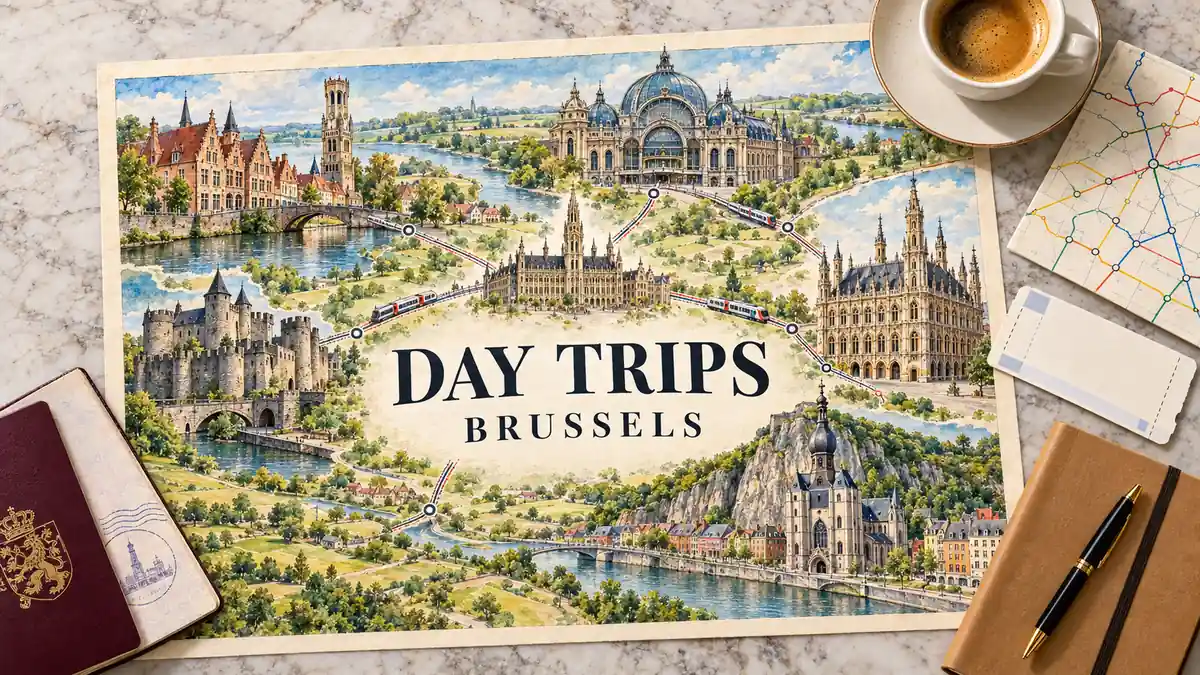
Brussels sits in the middle of a small, fast rail network, so the real question is not whether to leave the city for a day. It is which town, and how much of the day the train eats. This guide ranks the options by ride time, from the quickest hop to the longest haul, and sorts them into three groups: the Flemish art cities of Ghent, Bruges and Antwerp; the quick hops to Mechelen and Leuven; and the trips south into French-speaking Wallonia, to Dinant and Waterloo. Each pick gets a plain verdict on what it is, what sets it apart and who it suits. This page makes the choice. The Bruges, Ghent and Antwerp guides plan the day once you have picked, and the practical section at the end covers stations, tickets and whether a tour is worth paying for.
Quick Answer
Ghent is the best overall day trip from Brussels: about 36 minutes by direct train and less crowded than Bruges. Bruges, at 1h04, is the postcard pick for a first visit, and the shortlist runs by ride time from Mechelen, about 20 minutes away, to Dinant. Antwerp suits travelers who want a bigger city over a medieval centre.
Trust Layer
Tripstou selection guide for travelers choosing between multiple places. Covers selection criteria, traveler fit, and trip value.
Produced with AI assistance and reviewed by Alex Perrut, working in tourism since 2015, for the Tripstou editorial team. See our editorial process for details.
Last factual review: September 30, 2026.
Official sources consulted: Belgian Federal Government tourism portal, FPS Foreign Affairs: Travel to Belgium, Belgian national railway operator, Visit Mechelen.
Key Takeaways
- Ghent is the best overall day trip from Brussels, about 36 minutes by direct train, with a medieval centre and fewer crowds than Bruges.
- Bruges, 1h04 by train, is the postcard pick for a first visit, and it rewards the earliest train before the tour groups arrive.
- Mechelen, about 20 minutes away, is the quickest and calmest hop, while Leuven, under half an hour out, adds lively student evenings.
- Bruges and Ghent fit into one day because Bruges trains pass through Ghent, but each town gets half a day and no evening.
- Antwerp suits travelers tired of medieval squares, while Dinant swaps Flemish towns for Meuse valley cliffs and needs a full day.
- Domestic Belgian trains no longer sell tickets on board, so buy before boarding at whichever main Brussels station is nearest your stay.
Table of Contents
Which day trip from Brussels is best, and how long is the train?
Ghent is the best day trip from Brussels for most visitors, 36 minutes away on average by direct train. It has a full medieval centre, fewer crowds than Bruges and life after dark. Mechelen, about 20 minutes out, is the quickest hop, and the shortlist below runs by ride time from there to Dinant.
Only the Mechelen, Ghent and Bruges rides are given in minutes; the others are described by route.
| Town | Train from Brussels | Pick this for |
|---|---|---|
| Mechelen and Leuven | About 20 minutes to Mechelen, under half an hour to Leuven | A calm half day, or a lively student town |
| Ghent | 36 minutes on average, direct train | Best overall: medieval centre, fewer crowds, good evenings |
| Antwerp | Direct train, under an hour | Big-city energy, fashion, museums and the port |
| Bruges | 1h04, with trains running via Ghent | The classic medieval postcard on a first visit |
| Waterloo | Short local train to Braine-l’Alleud, then bus or taxi | The battlefield and Lion’s Mound for history readers |
| Dinant | Longest on this list, usually a change at Namur | Meuse valley cliffs, citadel and a change of scenery |
Ride time is the first filter because it decides how much of the day is left once you arrive. Crowds come second. Bruges is the busiest town on the list and Mechelen the calmest, and the Flemish picks in between trade a little of one for the other. Fit settles the rest. A medieval postcard, a big city, a river valley and a battlefield are four very different days out.
Bruges is the only Flemish pick where both the ride and the crowds argue for the first train out; for Ghent, Mechelen, Leuven and Antwerp you can leave after a proper breakfast and still have a full day.
If none of these beats another day in the capital, the guide to things to do in Brussels covers what to fill a spare day with without leaving the city.
The Flemish Art Cities: Ghent, Bruges or Antwerp
Ghent, Bruges and Antwerp are the day trips most visitors choose between, each a different kind of city. Ghent is the lived-in medieval city, Bruges the preserved postcard, and Antwerp the big port city with fashion and Rubens. All three sit on direct or simple train routes, so fit decides more than distance.
Ghent — the best overall day trip
Ghent is the best overall day trip from Brussels, about 36 minutes on average by direct train. It is a larger, working city with a big student population, so its medieval centre of canals, towers and guild houses feels lived-in. It also stays lively into the evening, after most day visitors have gone.
The difference from Bruges comes down to crowds and evenings. Ghent has the same gabled facades and canal views with more room to move, and restaurants full of locals at dinner. For the walking plan that sequences the day, see the one-day Ghent itinerary.
Pick this if: you want a full medieval centre without Bruges-level crowds.
Bruges — the postcard pick, go early
Bruges is the postcard pick, 1h04 from Brussels by train, with trains running via Ghent. Its medieval centre survives at an intact, walkable scale, with canals, brick gables and the Belfry above the Markt. That preservation is both the draw and the cost: Bruges is the busiest of the three art cities by a clear margin.
Crowds build through the late morning. The first trains out of Brussels earn their early alarm, because arriving early buys you the canals before the tour groups fill them. The Bruges travel guide covers where to walk and what to see once you arrive.
Pick this if: this is your first time in Belgium and the medieval postcard is the point.
Antwerp — the big-city alternative
Antwerp is the big-city alternative, reached by direct train in under an hour. It is a major port city with a serious fashion scene, Rubens altarpieces in the Cathedral of Our Lady and shopping streets that feel closer to a capital than a museum town. Even the arrival counts: Antwerp-Centraal is one of the grandest stations in Europe.
Antwerp is the only pick on this list that feels like a metropolis. One day works as a taster of the station, the old centre and the riverfront. The Antwerp itinerary shows what a longer stay adds.
Pick this if: you have seen enough medieval squares and want shops, museums and a city that moves.
Bruges or Ghent, or both in one day?
Pick Ghent for atmosphere and Bruges for the postcard; doing both in one day works but feels rushed. Bruges trains pass through Ghent, so the route itself is simple. The cost is time: an early start, roughly half a day in each town and no evening in either.
The mechanics favour combining. You ride to Bruges first, then stop in Ghent on the way back, because it sits on the same line. No backtracking is involved. What you lose is depth: each town gets a walk through its centre and a meal, with no slack for a museum, a boat trip or a long lunch.
- Combine them if you have one spare day, Bruges is non-negotiable and you are happy to walk more than you sit.
- Split them if you have two free days, or you want an evening in Ghent, where the city is at its best.
- Skip Bruges if crowds spoil a place for you; Ghent alone gives you the medieval centre with room to breathe.
Combining the two throws away Ghent’s main advantage, its evenings, so the pairing only makes sense when Bruges is the half you refuse to miss. Plan each half from its own page: the Bruges travel guide for the morning and the Ghent itinerary for the afternoon.
Tours and activities
Book skip-the-line tickets, day trips and local tours with free cancellation on most activities.
You can also browse everything on getyourguide.com.
Tripstou may earn a commission if you book through this link, at no extra cost to you.
Quick Hops Under Half an Hour: Mechelen and Leuven
Mechelen, about 20 minutes away, is the quickest day trip from Brussels. Leuven follows at under half an hour. Both suit a half day or an unhurried full one. Both have compact centres, little tour-group traffic and enough to fill a morning and lunch without advance planning.
Mechelen — the quickest hop
Mechelen is the quickest hop from Brussels, about 20 minutes by train. Its centre is compact and walkable, built around the Grote Markt and St Rumbold’s Cathedral, whose tower dominates the skyline and can be climbed for a view across the flat Flemish countryside.
The town sits between Brussels and Antwerp and is passed over by most visitors, which is exactly its appeal. Tour groups rarely stop here. The calm centre and short ride make it the easiest trip on this list to fit around a slow morning or a late night in Brussels, and the old beguinage quarter and riverside walk fill the rest of a half day.
Pick this if: you have half a day, or you want a Flemish town almost no tour group visits.
Leuven — the university town
Leuven is a university town under half an hour from Brussels by train. Its Gothic town hall is one of the most ornate in Belgium, and the Oude Markt nearby is lined almost wall to wall with bars and cafés, which gives the square its reputation as the longest bar in the country.
The university sets the rhythm. Students keep the squares busy from lunch into the night, which makes Leuven the liveliest small town on this list. By day, the climbable university library tower and the Groot Begijnhof, a walled former béguinage quarter of brick houses and quiet lanes, balance the bar-heavy centre.
Pick this if: you want a town that fills up at night as much as by day.
South into Wallonia: Dinant and Waterloo
Dinant and Waterloo are the Wallonia day trips worth the extra travel from Brussels, for scenery and history. Dinant offers river cliffs, a clifftop citadel and the Meuse; Waterloo offers the battlefield where Napoleon was defeated. Both involve a longer or two-leg journey, so each needs a clear reason to go.
Dinant — the Meuse valley scenery trip
Dinant is the Meuse valley scenery trip, the longest ride on this list and usually with a change at Namur. The town is squeezed between the river and a limestone cliff, with the onion-domed collegiate church at the foot of the rock and the citadel on top, reached by cable car or a long stair.
Nothing else on the list is a landscape trip, and the contrast with Flanders is the point: French-speaking, hilly, built along a river. The last leg follows the Meuse valley, so the ride is part of the trip. The journey rules out a half day. Give it a full one and a clear weather forecast.
Pick this if: you want scenery and a change from Flemish squares, and can give it a full day.
Waterloo — the battlefield day
Waterloo is the battlefield day, reached by a short local train to Braine-l’Alleud and then a bus or taxi to the site. The visit centres on the Lion’s Mound, an artificial hill topped by a lion statue, and the battlefield memorial museum at its foot, which explains the battle before you climb.
Everything here turns on one historic site. From the top of the mound you look out over the fields where the armies met. Most people need half a day. Readers with no interest in the Napoleonic story tend to find it the least rewarding trip here, since there is no old town to fall back on.
Pick this if: the Napoleonic story is the reason you came to Belgium.
How to Do These Day Trips by Train from Brussels
All three main Brussels stations serve these routes, so leave from the one nearest your stay and buy before boarding. Brussels-Central, Brussels-Midi and Brussels-Nord all sit on the main lines. Go early for Bruges, and take the train over a tour unless you want Bruges and Ghent handled for you.
The three stations sit on one north–south rail axis that tunnels under the city centre. Central is the closest to the old town and the Grand-Place. Midi is the international station, where the high-speed trains arrive. Nord serves the business district to the north. For visitors used to one terminus per route, this is the useful surprise: you rarely have to cross town to catch your train. The Brussels travel guide covers where to base yourself and how the stations fit the city.
Domestic Belgian trains no longer sell tickets on board, so buy through the SNCB app, website, a station machine or a ticket office before boarding. Walk-up tickets are the norm for domestic trains. There are no seat reservations to make, so a ticket bought on the platform a few minutes before departure is enough.
Going early matters most for Bruges, where the crowds build through the morning. For the quick hops and for Ghent, the timing is yours. Dinant is the other trip that rewards an early start, because the journey takes the biggest bite out of the day.
- Independent train: suits every pick on this list and anyone happy to read a departure board; the tradeoff is that you plan the day yourself.
- Guided combo tour: suits travelers who want Bruges and Ghent in one day with no planning at all; the tradeoff is a fixed schedule and group pace.
- Staying in Brussels: suits a short stay or a tired traveler; the tradeoff is missing the smaller towns, and the guide to things to do in Brussels covers that day.
A guided tour only earns its place on the Bruges-and-Ghent combination; for Mechelen, Leuven, Antwerp and Dinant the train is simpler and leaves the timing in your hands.
Train and bus tickets
Compare routes, schedules and prices across rail and bus operators in one search, with mobile tickets on your phone.
New to Omio? Code NEW10 takes 10% off your first booking — or APPNEW10 if you book inside the Omio app. Both apply to bookings up to €80.
Search routes and compare prices on Omio →
Tripstou may earn a commission if you book through this link, at no extra cost to you.
Frequently Asked Questions
Is Waterloo worth a day trip from Brussels?
Waterloo is worth it if the Napoleonic story interests you, and it fills about half a day. Take a short local train to Braine-l’Alleud, then a bus or taxi to the Lion’s Mound and the memorial museum. Without an interest in the battle, a town like Mechelen repays the time better.
Can you do a day trip from Brussels to Paris?
Yes, but it makes for a long day. High-speed trains from Brussels-Midi reach Paris in under an hour and a half, which leaves most of a day in the city. Treat it as a taster: Paris is far too large to see properly in one day, so pick one area and one museum at most.
Can you do a day trip from Brussels to Amsterdam?
You can, but Amsterdam works better as an overnight stop than a day trip from Brussels. Direct trains link the two cities, yet the round trip takes a real bite out of the day and leaves little slack for museums. If you want a day of canals from Brussels, Ghent or Bruges is the nearer choice.
Is a guided tour worth it for Bruges and Ghent from Brussels?
A guided tour is worth it only if you want Bruges and Ghent in one day with zero planning. It handles the transfer and the timing, but you move at group pace on a fixed schedule. For any single town on this list, the train is simpler and leaves the day in your hands.
Do you need to book Belgian train tickets in advance for a day trip?
No, domestic Belgian trains need no advance booking or seat reservation, so a ticket bought minutes before departure is enough. Domestic Belgian trains no longer sell tickets on board, so buy through the SNCB app, website, a station machine or a ticket office before boarding. The app is the quickest option on a busy platform.
Which day trip from Brussels has the fewest crowds?
Mechelen has the fewest crowds of any day trip from Brussels. Most tour groups pass it by on the way to Antwerp. Leuven comes next, busy with students rather than visitors. Bruges draws the heaviest crowds, especially from late morning, so an early train matters more there than anywhere else.
Related Guides
- Brussels travel guide: where to base yourself and how the city fits together before you head out for the day.
- Bruges travel guide: what to see and where to walk once you have picked the postcard trip.
- One day in Ghent: the full walking plan for the best overall day trip from Brussels.
- Antwerp itinerary: what a longer stay in the big-city alternative adds beyond a taster day.
- Things to do in Brussels: how to fill a spare day if you decide to stay in the capital.
Did this guide save you time or money? Tripstou is independent and reader-funded — if you'd like to give something back, you can support the site with a crypto contribution of any size.