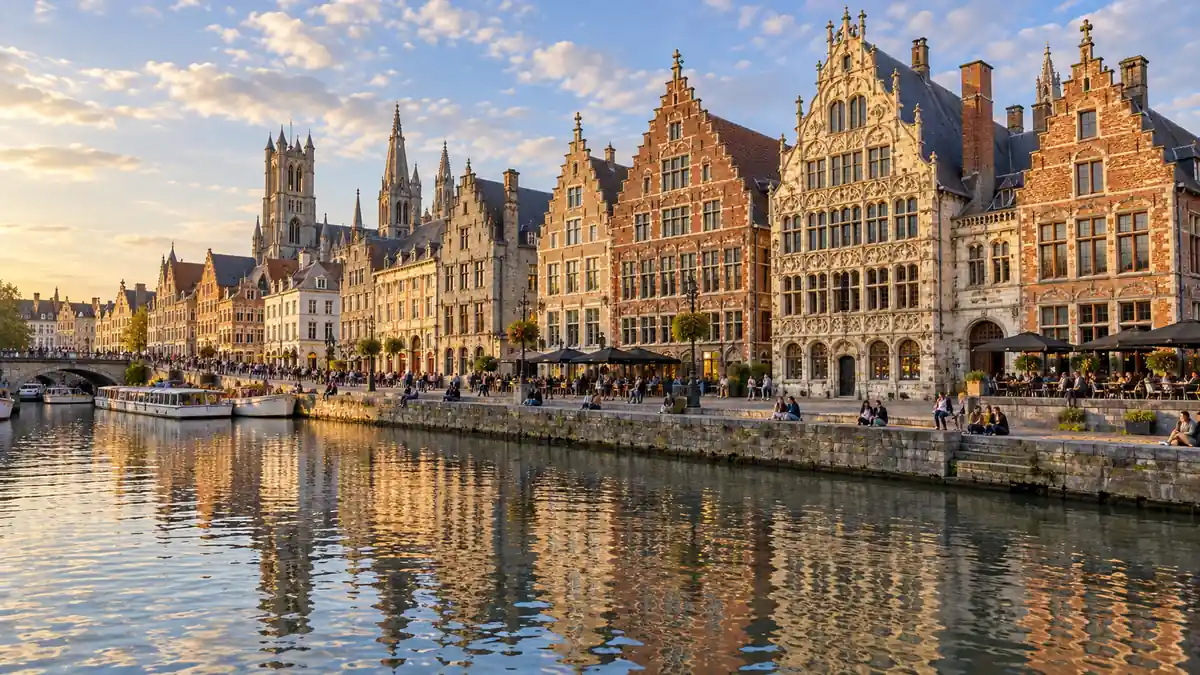
This Belgium itinerary takes six days by train and covers Brussels, Ghent, Bruges and Antwerp without rushing. Base in Brussels, then Ghent, with Bruges as a day trip from Ghent, and finish with two nights in Antwerp before the train back to Brussels to fly home; no car is needed. The route suits first-time visitors, and four days is the realistic minimum if you cut Antwerp.
You have picked Belgium, and now you need a length, an order and a base. The geography makes this easier than it looks. Brussels, Ghent, Bruges and Antwerp sit within about an hour of each other on direct trains, so the answer is a compact rail loop, not a road trip. The real questions are how many nights each city gets and which one you sleep in.
Every move is on a direct InterCity train, and the order runs west along one line, then swings north, so only the short Bruges return doubles back. Each leg below states its nights, its role in the route and the train that takes you onward. The last section sets the rules for bending the route: what to cut first with fewer days, and what to add first with more.
- Days 1–2: Brussels — arrival hub and capital core
- Days 3–4: Ghent — canal base with Bruges day trip
- Days 5–6: Antwerp — northern leg closing the loop
Sources and Review for This Route
This page plans one six-day rail loop through Brussels, Ghent, Bruges and Antwerp: leg order, nights per base and what changes with fewer or more days. It is not a Belgium destination guide, a things-to-do list, a hotel roundup or a general planning overview.
This six-day loop was written with AI assistance, then read leg by leg by Alex Perrut, working in tourism since 2015, for the Tripstou editorial team; what that reading involves is set out under our editorial process.
Official sources consulted: Belgian Federal Government Portal, Belgian Federal Public Service Foreign Affairs, SNCB Belgian Railways, Brussels Airport.
Days 1–2: Brussels, where the loop starts and ends
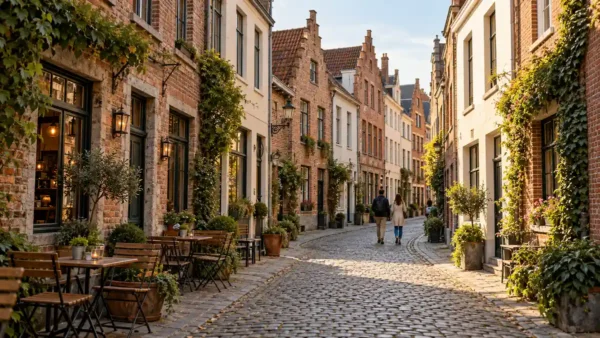
Brussels takes the first two nights. It is where you land, and its rail hub connects directly to every other stop on the route, which is why the trip starts here. Two days cover the capital core at an easy pace: the Grand-Place, the museum quarter around the Mont des Arts, and an evening in the old centre. That is the route purpose, not a sight list.
Start and end in Brussels: the airport’s own rail station puts you in the centre in about 18 minutes. The station sits beneath the terminal, and direct trains run to Brussels-Central. Every leg of the loop connects back to the capital, so the city you land in is also the easiest one to leave from.
The Brussels 2-day itinerary sets out the hours and the order. On the morning of day 3, take the train to Ghent. The ride takes just over half an hour, and trains run roughly every 15 minutes. No seat reservation is needed.
Days 3–4: Ghent, with Bruges as a day trip
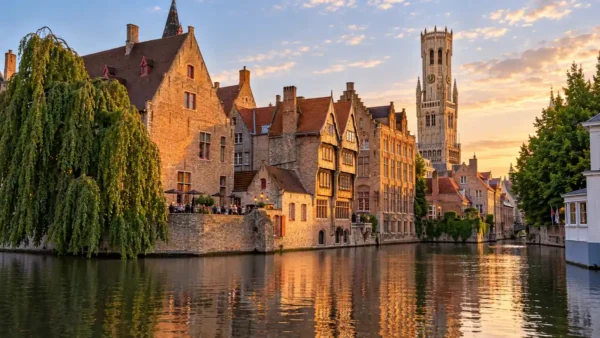
Ghent takes the next two nights and earns them by position. It sits between Brussels and Bruges on the same line, so one base covers both cities. Day 3 is Ghent itself: the Graslei quays, the Gravensteen castle, then the canals after dark. Day 4 is Bruges, a short direct train ride out and back.
The Bruges return is the only backtrack on this loop, and on so short a ride it costs less time than packing a bag for a night there would.
Follow one day in Ghent and the Bruges day trip plan for the detail. Sleeping in Bruges instead buys quiet evenings after the day-trippers leave, at the cost of an extra base. On day 5, take the train on to Antwerp.
Can you see Ghent and Bruges in one day?
You can, since the train ride between them is short, but both centres lose out. A single day leaves only a few hours in each and an evening in only one of them. Give each city its own day, as this route does, and combine them only when a short trip leaves no other choice.
Tours and activities
Book skip-the-line tickets, day trips and local tours with free cancellation on most activities.
You can also browse everything on getyourguide.com.
Tripstou may earn a commission if you book through this link, at no extra cost to you.
Days 5–6: Antwerp, then back to Brussels
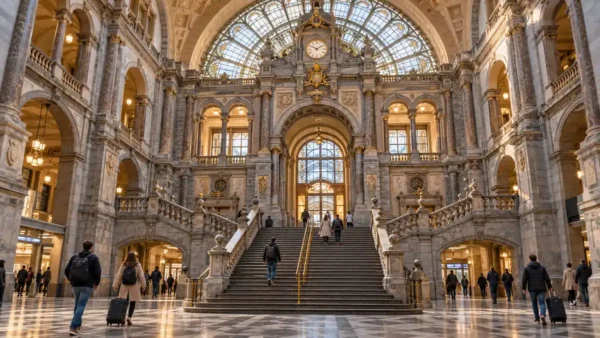
Antwerp takes the final two nights and closes the loop from the north. Its role is contrast. After the small medieval centres of Ghent and Bruges, it is a larger, busier port city with a different rhythm. The anchor moments are the arrival hall of Antwerp-Centraal station, the Cathedral of Our Lady, and an evening in the old town near the Scheldt.
The two days in Antwerp plan fills in the rest. On departure day, the train back to Brussels takes under an hour. From there, the airport’s own station is one more train away, so the trip ends as it began: on rails.
A loop beats a one-way line here. Ending in Antwerp adds only one short train back to Brussels on the last day, and it keeps your arrival and departure at the same airport. Travelers who fly in and out of Brussels lose nothing by closing the circle.
Can you do this Belgium route in reverse?
Yes. The loop starts and ends in Brussels either way, so you can run it as Brussels, Antwerp, Ghent with the Bruges day trip, then back to Brussels. Each leg is the same short ride in either direction. The one thing to keep fixed is Brussels as your arrival and departure city, because of its airport rail link.
Should you base in Ghent or Brussels, or move between cities?
Use two bases: Brussels for your first two nights, then Ghent, which puts Bruges a short train ride away. Antwerp becomes a third base on six days and a day trip on five. For four or five days, a single base in Ghent is the shortcut, since it reaches every other stop without a hotel change.
The reason is line geometry. Brussels is the better-connected city, but Ghent is the better base for this route. The one city you visit as a day trip — Bruges — sits on its doorstep. Ghent also keeps its evenings. It is a working university city, so its canal-side centre stays lively after the tour groups have gone.
- Single base in Ghent: suits four or five days and travelers hauling heavy bags. The tradeoff is day trips to Brussels and Antwerp on either side of the stay.
- Two bases, Brussels then Ghent: the five-day pattern. Antwerp becomes a day trip of about an hour each way from Ghent.
- Three bases (Brussels, Ghent and Antwerp): the six-day version, and the recommended route. It costs two hotel moves in under a week.
Bruges is the exception worth weighing. Its centre empties in the evening, and only travelers who sleep there see it that way. The price is a fourth base and a shorter stay somewhere else. On six days, move one Ghent night to Bruges so the total stays the same; the cost is one extra hotel move. For most first trips, the one day in Bruges plan from a Ghent base is enough.
Pick your bases by the city you would otherwise commute to twice. On this route that city is Ghent, never Bruges.
Do you need a car for a Belgium itinerary?
No. Brussels, Ghent, Bruges and Antwerp are linked by direct InterCity trains, and their old centres are compact enough to cover on foot, where a car mostly means hunting for parking. Hire one only if you extend the trip into Wallonia or the Ardennes, and only for those days.
The train is the mode for the whole circuit. Domestic tickets do not need advance booking, so a delayed morning or a slow breakfast never costs you a reserved seat. That flexibility is part of why the route works.
A car changes the picture only if you add Wallonia or the Ardennes. Those regions sit outside the four-city loop, and reaching their villages is easier by road. For the Flanders cities themselves, a car is a burden. Parking in the old centres is the problem, not the driving.
How long is the train from Brussels to Bruges?
About an hour on a direct train. Ghent sits on the same line, just over half an hour out of Brussels, so this route breaks the journey there and treats Bruges as a short hop from Ghent. From a Brussels base, the Bruges round trip costs about two hours of the day, against far less from Ghent.
Who This Belgium Route Suits, and Who Should Change It
This route suits first-time visitors who want Belgium’s four classic cities by train in under a week. It works because each city is a short direct ride from the next and no leg needs a car. It does not suit travelers whose priority is the Ardennes, First World War sites or a slow stay in one city.
The main limitation is geographic. This is a Flanders loop. Wallonia (the French-speaking south) sits outside it, and adding its castles and river towns turns a train trip into a trip that works better with a car or much longer train days.
- First-time visitors: keep the route as written. It covers the four cities most first trips are built around.
- Returners: swap a city you have already seen for a new one. The best places to visit in Belgium help you choose the replacement.
- Travelers widening the plan: timing, money, food and entry all sit outside a route page. The Belgium travel guide covers everything around the route.
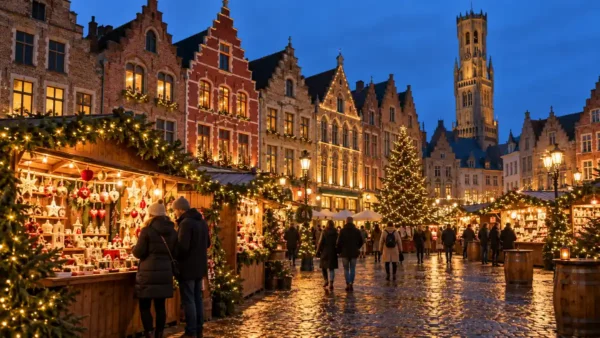
Pacing holds year-round. In winter, shorter daylight makes the Bruges day the one to start early.
The route asks more of your feet than your wallet. Four walkable old centres in six days is the whole trip, so travelers who dislike long days on foot should add a day before they add a city.
Six Days Is the Right Length for a First Belgium Itinerary
Six days is the right length for Belgium’s four core cities by train, sleeping in two or three of them. That span gives each city the time its own day plan needs: two days for Brussels, one each for Ghent and Bruges, two for Antwerp. Four days is the floor, and extra days go to a theme day first.
The split follows the city plans, not a formula. Brussels earns two days because it is both the arrival point and the largest city on the route. Ghent and Bruges are compact. One full day each covers their old centres at a walking pace. Antwerp gets two days because it closes the loop and rewards a slower second day after the medieval scale of the western cities.
- 4 days: Brussels, Ghent and Bruges from a single base, with Antwerp dropped, enough for a long weekend or a first taste of Flanders.
- 6 days: all four cities, two or three bases, no day rushed. It is the route this page recommends, built around first-time visitors.
- 7–8 days: the same four cities plus a Flanders Fields day or a short-hop city such as Leuven or Mechelen, a better match for slower travelers and returners.
Below four days the loop breaks, and the trip becomes a single-base stay with day trips. The adaptation rules at the end of this page say which city goes first.
Because every train leg on this route runs about an hour or less, a Belgium trip loses its time to checking out and repacking, not to travel. The length verdict is really a count of hotel moves: six days with two of them feels unhurried, while six days with four does not.
How to Adapt This Route with Fewer or More Days
With fewer days cut Antwerp first; with more days add a Flanders Fields day before any new city. Antwerp goes first because it is the one stop off the Brussels–Ghent–Bruges line. Flanders Fields comes first on the way up because it adds a theme, not another old town. The backbone keeps the same order at every length.
- 3 days: not enough for four cities. Stay in one base (Ghent or Brussels) and cover Brussels, Ghent and Bruges only. Antwerp is dropped.
- 4 days: Brussels, Ghent and Bruges from one or two bases. Antwerp works as a day trip only if you must see it.
- 5 days: the full loop with Antwerp shrunk to one day, visited from Ghent or with one night there.
- 7 days: add a First World War day at Ypres and the Flanders Fields battlefields first, staying for the evening Last Post ceremony at the Menin Gate.
- 8 days: then add a short-hop city: Leuven or Mechelen. After that comes Wallonia, with Dinant a longer train ride south, or a car for the Ardennes.
Make the Ypres day a full day out from your Ghent base, on the western side of the loop, and keep the next morning light, since the return runs late. None of these add-ons changes the backbone. They slot in after the core cities are covered. To choose between them, the best places to visit in Belgium weigh each option on its own terms.
| Trip length | Stops | Bases | What you lose or gain |
|---|---|---|---|
| 4 days | Brussels, Ghent and Bruges | One base in Ghent, or Brussels then Ghent | Lose Antwerp; gain a calmer pace with fewer moves |
| 6 days | Brussels, Ghent, Bruges and Antwerp | Brussels, Ghent and Antwerp, two nights each | The full four-city loop with no rushed day |
| 8 days | Four core cities plus Ypres and Leuven or Mechelen | Same three bases with longer stays | Gain a First World War day and one smaller city |
Cutting Antwerp saves a hotel move as well as a day. That is why a well-cut four-day trip often feels calmer than a five-day trip that tries to keep all four cities.
Did this guide save you time or money? Tripstou is independent and reader-funded — if you'd like to give something back, you can support the site with a crypto contribution of any size.