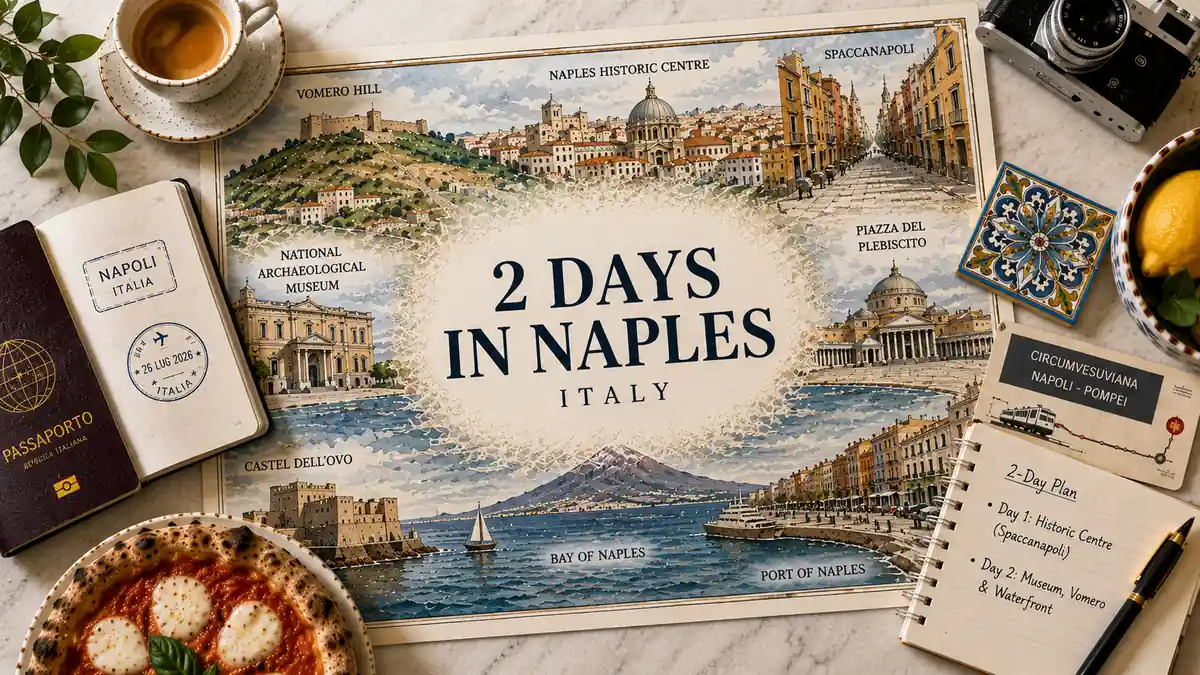
Forty-eight hours in Naples forces one real decision: how much of the city you trade for what surrounds it. Pompeii sits close enough to tempt every 2-day planner, yet the city itself rewards slow walking above almost anything you could commute to. This guide commits to a single route instead of offering a menu. Day 1 is one walking loop through the historic centre, built around Spaccanapoli. Day 2 climbs from the Archaeological Museum to Vomero and ends on the waterfront. Along the way you will find where each loop starts and ends, why the days run in this order, who 48 hours actually suits, and a straight answer to the day-trip question — including exactly what you give up whichever way you choose. It is built for a first visit that wants the real city, walked at the pace the city demands.
Quick Answer
Spend both days in the city — Day 1 the historic centre, Day 2 the museum, Vomero, and waterfront. A Pompeii day trip consumes half of a 2-day visit, so with 48 hours the city itself wins. This route suits a first visit focused on the historic core; add a third day if Pompeii is non-negotiable.
Trust Layer
Tripstou itinerary guide for travelers planning a route. Covers pacing, stop count, stop order, base logic, and trip length.
Produced with AI assistance and reviewed by Alex Perrut, working in tourism since 2015, for the Tripstou editorial team. See our editorial process for details.
Last factual review: July 26, 2026.
Official sources consulted: italia.it, enit.it.
Key Takeaways
- Spend both days in Naples itself: Day 1 is a historic-centre walking loop, Day 2 pairs the Archaeological Museum with Vomero and the waterfront.
- Two days is enough for Naples’ historic core and essential character; only add-ons like day trips threaten to overload the schedule.
- Skip the Pompeii day trip on a 48-hour visit, since it costs most of a day; save it for a third day instead.
- Book one central base near the historic centre and stay put, because both walking loops begin and end within reach of it.
- Build slack into the plan, since Naples rewards slow walking and long meals more than cramming every hour with ticketed attractions.
Table of Contents
Is 2 Days in Naples Enough?
Yes — 2 days in Naples is enough for the historic core and the city’s essential character. The pressure comes from add-ons like day trips, which eat time faster than the city does. Forty-eight hours covers the dense centre, one major museum, and a hilltop view without rushing.
Two days suits a first visit built around the old city: the historic centre walked slowly, the Archaeological Museum, the view from Vomero, and long meals in between. Unlike Rome or Florence, Naples’ headline attraction is the street fabric itself — the noise, the food, the laundry-strung alleys — so a plan that fills every hour with tickets misses the point. The schedule needs slack. That slack is the route’s real luxury.
Travelers who want the ancient sites, the islands, or the coast need more than 48 hours; those belong to a longer southern stay, and our Naples travel guide covers how the city anchors one. A short, walkable visit also keeps spending low — see the full Naples trip cost breakdown for what a compact trip runs.
The Recommended 2-Day Naples Route at a Glance
The route is simple: one walking loop per day, from a single central base. Day 1 covers the historic centre on foot; Day 2 pairs the Archaeological Museum with Vomero and the waterfront. Each day starts and ends within reach of your bed, so nothing depends on complicated transfers.
- Day 1: The historic centre — the city’s dense core
- Day 2: Archaeological Museum, Vomero, and the waterfront — context, height, and sea air
The two days run in this order for a reason: streets first, explanations second. Reverse them and the museum is a building full of objects; after a day on Spaccanapoli, it reads as the back-story of everything you just walked through.
Where to Start and End Each Day’s Loop
Start Day 1 at the western end of Spaccanapoli and finish in the same streets for the evening. The historic centre is where Naples eats and gathers after dark, so ending the loop there means dinner without a transfer. Day 2 starts at the Archaeological Museum while you are fresh, goes up to Vomero for the view, then comes down to the waterfront to close the trip — one climb, one descent, no backtracking.
One central base carries the whole plan. Both loops begin and end within walking distance of the historic centre, so sleeping in or beside it removes transport from the itinerary almost entirely. Choosing the exact area is its own decision — see where to stay in Naples for that. Check in once and never move.
Hotels and places to stay
Compare hotels, apartments and stays for your dates in one search.
Search hotels and stays on hotels.com →
Tripstou may earn a commission if you book through this link, at no extra cost to you.
Day 1: The Historic Centre Walking Route
Day 1 stays entirely in the historic centre, walked as one slow loop from morning to evening. This is the densest part of the city — churches, chapels, and street life stacked into a few hundred metres — and it explains Naples faster than anywhere else. Start here and everything after makes sense.
You spend the whole day in and around the old centre, the district your base should sit in or beside. Spaccanapoli is the day’s spine — the straight street that slices the old city end to end — and the loop simply follows it out and works back through the parallel alleys. Everything worth stopping for sits on or just off this line.
Keep the ticketed stops to two. The Sansevero Chapel, home of the Veiled Christ, is the day’s one fixed point — it is small and popular, so go early and build the loop around it. For the second interior, pick either the Duomo or Naples Underground, and leave the rest for a longer trip. Lunch is pizza in the neighbourhood that invented it; skip any queue that looks punishing, because the gap between the famous ovens and the merely excellent ones is small. This day could absorb a dozen more sights, and resisting them is the discipline that makes it work — the full menu lives in our guide to things to do in Naples.
The day ends where it started. Stay in the centre for dinner and let the evening run long — the historic core after dark is the half of Naples no museum can show you, and it costs nothing.
Tours and activities
Book skip-the-line tickets, day trips and local tours with free cancellation on most activities.
You can also browse everything on getyourguide.com.
Tripstou may earn a commission if you book through this link, at no extra cost to you.
Day 2: Archaeological Museum, Vomero, and the Waterfront
Day 2 goes deeper and higher: the Archaeological Museum in the morning, Vomero for the view, the waterfront to finish. After Day 1’s immersion in the streets, this day supplies context and perspective — the ancient world in glass cases, then the whole bay from above, then sea level for the last evening.
You work from the same base — nothing gets packed, nothing moves. The morning belongs to the Archaeological Museum, which holds much of what was excavated from Pompeii and Herculaneum; give it an unhurried visit while your attention is at its best, and skip the exhibit-by-exhibit completism. It is a museum that rewards choosing wings over conquering floors.
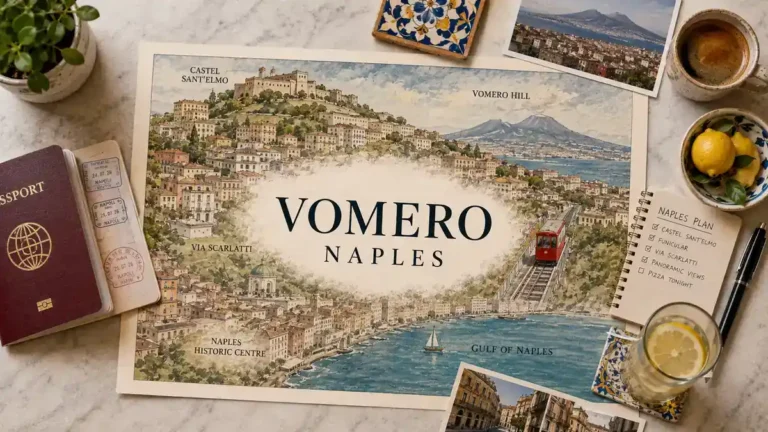
From the museum, ride the funicular up to Vomero — the ride is part of the experience — for Castel Sant’Elmo and the wide view over the bay, with the whole of yesterday’s loop laid out below you. Then descend toward the sea and finish on the waterfront, where the promenade faces Vesuvius across the water. It is the calmest stretch of the route, placed last on purpose.
The trip closes at sea level. Dinner near the water, or a slow walk back toward the centre — after two loops on foot, the flat final stretch is the right ending.
Should You Use One of Your 2 Days for Pompeii?
No — with only 2 days, keep both of them in the city. The journey, the queues, and the site’s sheer size consume most of a day, and Naples loses half your trip in exchange. Pompeii is a superb reason to stay longer — it is a poor reason to compress the city.
Be clear about what the trade costs. A Pompeii day removes Day 2 in full: the Archaeological Museum, the Vomero viewpoint, and the waterfront all go, and the city you came to see shrinks to a single loop plus two nights of dinners. The train ride out and back, plus entry queues and the walking the site demands, fills the daylight hours on its own. The same arithmetic applies to Herculaneum, even as the smaller site.
Much of Pompeii’s best material — the mosaics, frescoes, and everyday objects — no longer sits at Pompeii at all; it sits in the Naples Archaeological Museum, already on your Day 2 route. With 48 hours, the museum is the smarter way to meet the ancient world. If walking the excavated streets themselves is non-negotiable, the answer is a third day, and the plan for 3 days in Naples adds the day trip without sacrificing either city loop.
| Decision factor | Both days in the city | One day for Pompeii |
|---|---|---|
| What you gain | The complete route: centre, museum, hill, and waterfront | Walking the ancient streets of the site itself |
| What you lose | The excavated site stays unvisited on this trip | All of Day 2: museum, Vomero, and waterfront |
| Who should choose it | First visits focused on Naples itself | Travelers who truly cannot add a third day |
How to Adapt This Route with More or Fewer Days
The route flexes by two rules: cut Day 2 first, add Pompeii last. With less time, the historic centre survives everything; with more time, the day trip finally earns its place. Nothing about the Day 1 loop changes either way, which is what makes this itinerary easy to resize.
- With one day: keep the Day 1 historic-centre loop exactly as written and drop Day 2 — the centre is the non-negotiable half of the trip.
- With three days: keep both city days unchanged and add Pompeii or Herculaneum as day three, following the 3-day plan linked above.
- Inside a longer trip: Naples works as the southern anchor of a country route — see where it slots into a full Italy itinerary.
One route, resized by rules. This page deliberately avoids parallel alternative itineraries, because swapping the days or splitting the base breaks the walking logic both loops depend on.
Frequently Asked Questions
Is Naples worth two days?
Yes, Naples is worth two days for a first visit centred on the historic core. Forty-eight hours covers the dense old-town streets, one major museum, and a hilltop viewpoint at an unhurried pace. The city’s character lives in its street life and food, which reward slow walking rather than a packed sightseeing checklist.
Can you see Pompeii and Naples in 2 days?
Technically yes, but it is not recommended. A Pompeii day trip swallows most of a day between the train ride, entry queues, and walking the vast site, erasing your entire second day in the city. With only 48 hours, the smarter plan keeps both days in Naples and saves Pompeii for a three-day trip.
Do you need more than 2 days in Naples?
Only if you want more than the historic core. Two days covers the old city, the Archaeological Museum, and a hilltop view, but the ancient sites, the islands, and the Amalfi Coast each need extra time. Add a third day for Pompeii, or build Naples into a longer southern-Italy trip.
Is one day enough in Naples?
One day works only for the historic centre and nothing else. You can walk Spaccanapoli, see the Veiled Christ, and eat a proper Neapolitan pizza, but the museum, Vomero, and the waterfront all fall away. A single day gives you the city’s atmosphere without its depth or its wider views.
Should you stay in one base for 2 days in Naples?
Yes, one central base is the whole logic of this route. Both walking loops start and end near the historic centre, so a single well-placed room removes transfers almost entirely. Checking in once and never moving frees time and mental energy for the city itself instead of hotel logistics.
Can you do this Naples itinerary in reverse order?
It is better not to. The route deliberately puts the streets before the museum: after a day walking the historic centre, the Archaeological Museum reads as the backstory to everything you saw. Reverse the days and the museum becomes a room of objects without the city context that gives them meaning.
Related Guides
- Naples travel guide — the full planning hub for the city, beyond this route.
- 3 days in Naples — the extended plan that fits the Pompeii day trip in properly.
- Things to do in Naples — deeper sight and experience detail for every stop on this route.
- Where to stay in Naples — choosing the central base this walking itinerary depends on.
- Naples trip cost — what a short city trip actually costs to run.
- Italy itinerary — fitting Naples into a longer route through the country.
Did this guide save you time or money? Tripstou is independent and reader-funded — if you'd like to give something back, you can support the site with a crypto contribution of any size.