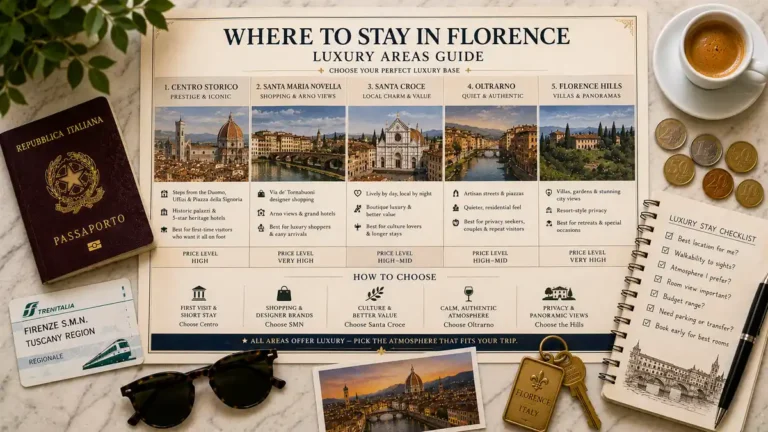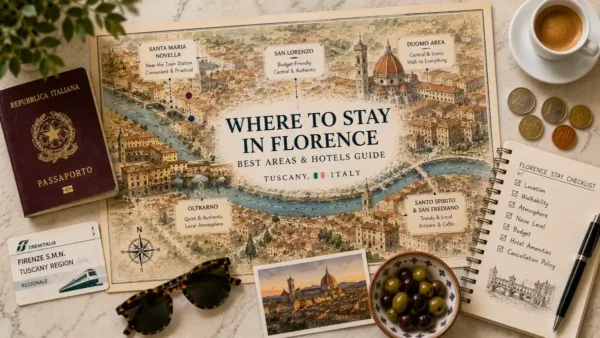
You have chosen Florence and set a budget — now you need the right base, not another hotel list. The good news: value in Florence is a question of which zone you pick, and the cheapest beds are not stuck out on the ring road. Cross the Arno or step a few blocks north of the Duomo and prices ease while the walk to the sights stays short. This guide ranks Florence’s budget zones by real value — price weighed against walkability, atmosphere, and noise — and matches each to a budget-travel style. It covers where to stay cheap and stay central, when the outskirts actually pay off, and which accommodation type fits your trip. The verdict, the trade-offs, and where to book next are all below.
Quick Answer
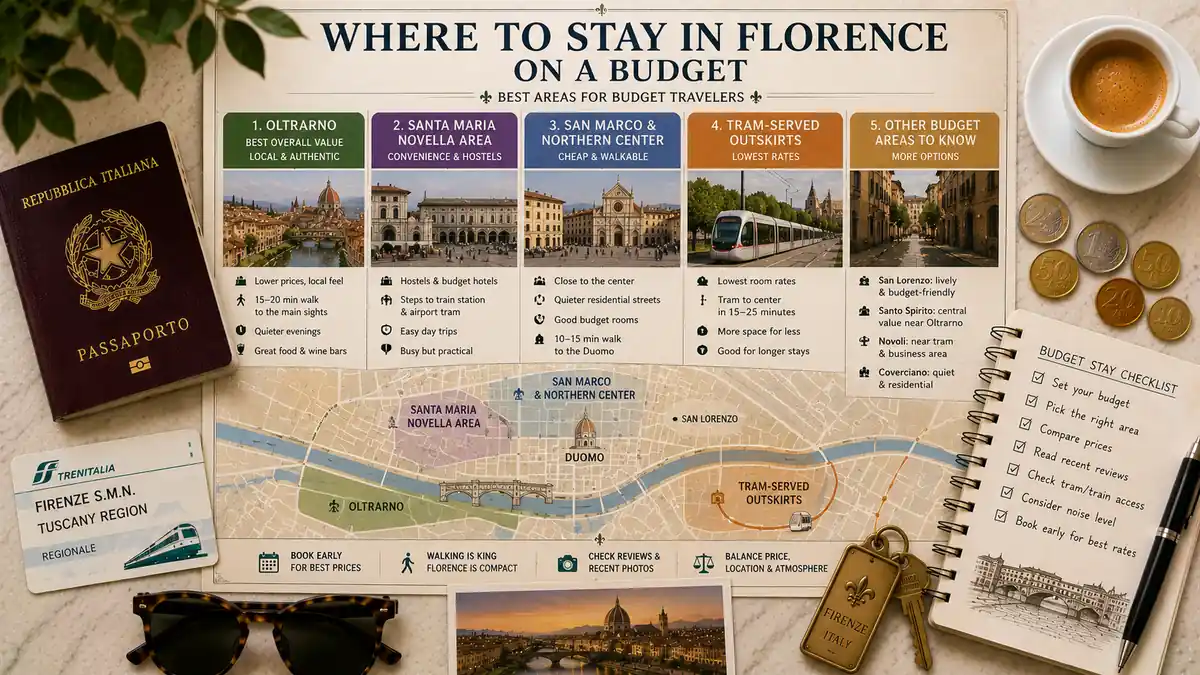
Oltrarno is Florence’s best-value base for budget travelers who want a local feel within walking distance. The cheapest beds sit just off the Duomo core, trading a short walk for lower prices and calmer streets. For convenience and hostels, choose the station area; for the lowest rates, the tram-served outskirts.
Trust Layer
Tripstou stay guide for travelers choosing where to base. Covers area atmosphere, budget, convenience, noise, and traveler fit.
Produced with AI assistance and reviewed by Alex Perrut, working in tourism since 2015, for the Tripstou editorial team. See our editorial process for details.
Last factual review: July 15, 2026.
Official sources consulted: Italia.it, ENIT — Italian National Tourism Agency.
Key Takeaways
- Oltrarno offers budget travelers the best overall value — local atmosphere and lower rates just a short bridge walk from the sights.
- You don’t have to sleep on the outskirts to save money; central zones off the Duomo core stay affordable and walkable.
- Location versus price is the core trade-off — cheaper beds mean more travel time, fewer crowds, or less atmosphere.
- Match the zone to your style: the station area for hostels, San Marco for quiet central rooms, the tram outskirts for the lowest rates.
- Chasing the absolute cheapest bed often backfires once you add daily tram fares and lost walking time near the center.
Table of Contents
Can you stay cheap and still be central in Florence?
Yes — budget travelers can sleep within walking distance of Florence’s center without paying Duomo prices. The best value sits just off the historic core, in Oltrarno, the station area, and the northern center around San Marco. You trade the busiest postcard streets for lower rates and a short walk.
Florence’s compact center is the whole reason this works. The historic core is small enough to cross on foot in well under half an hour, so “central” does not have to mean the blocks ringing the cathedral, where rates are highest. Step one zone out and the same walkable access comes at a lower price.
The price gap in Florence tracks distance from the Duomo, not distance from the center. Cross the Arno into Oltrarno and rates ease while your walk to the Uffizi barely changes — a lever that pure price tables miss. For the full, budget-agnostic tour of every zone, the full area breakdown for Florence covers the wider picture; this page keeps the budget lens.
| Zone | Relative price level | Walk to the historic core | Best for |
|---|---|---|---|
| Oltrarno | Below the Duomo core | About 10–15 minutes across the river | Local feel on a tight budget |
| Santa Maria Novella / station | Low, hostel-heavy market | Under 10 minutes on foot | Convenience and easy transport links |
| San Marco / northern center | Moderate, below the Duomo blocks | Roughly 10–15 minutes on foot | Quiet nights inside the center |
| Tram-served outskirts | The lowest rates in the city | A short ride plus a walk | The cheapest beds overall |
| Duomo core (for reference) | The highest rates in Florence | You are staying in the middle | Short splurge stays, not budgets |
Oltrarno: the best-value base for budget travelers
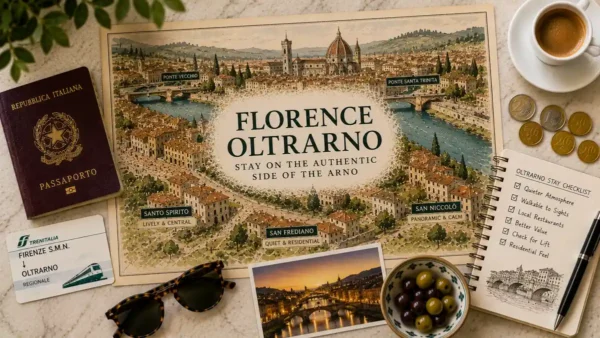
Oltrarno delivers the best balance of price, atmosphere, and walkability for budget travelers in Florence. The artisan quarter south of the Arno keeps rates below the Duomo core while sitting a short bridge-crossing from the main sights. It suits travelers who want a genuine local base, not a tourist bubble.
The atmosphere is the draw. Oltrarno is workshops, wine bars, and neighborhood squares like Santo Spirito, where the crowds thin and daily life still runs. You get a lived-in Florence at a budget price, which is a rare pairing this close to the center.
Convenience holds up. Crossing the Ponte Vecchio or Ponte alla Carraia puts you in the core in about ten to fifteen minutes on foot, so you sacrifice almost no access. Prices sit a clear tier under the cathedral blocks, and value hotels, guesthouses, and rooms are easy to find here.
Eating in Oltrarno usually costs less too, so the savings run past the room rate — something the central postcard streets cannot match. For the deep neighborhood detail, see the Oltrarno neighborhood profile, and if you are weighing it directly against the middle of town, the Oltrarno-versus-Centro comparison settles that duel.
- Best for: budget travelers who want local atmosphere and low rates without giving up a short walk to the sights.
Hotels and places to stay
Compare hotels, apartments and stays for your dates in one search.
Search hotels and stays on hotels.com →
Tripstou may earn a commission if you book through this link, at no extra cost to you.
Around Santa Maria Novella and the station: the convenient budget base
The Santa Maria Novella and station zone is Florence’s most convenient budget base. It packs hostels and value hotels beside the main transport hub. You can walk into the historic core in minutes and reach the airport tram, buses, and trains without a transfer. It suits arrivals-focused, transport-heavy trips.
This is the natural home for hostels and dorm beds. Backpackers and solo travelers get the widest cheap-bed choice in the city here, plus late-night and early-morning transport on the doorstep. If you arrive tired or leave before dawn, the location earns its keep.
The station area carries the usual big-transport-hub feel: busier, more transient, less charming than the artisan quarters. It is fine for most travelers who keep normal awareness after dark, and the blocks a little closer to the church tend to feel calmer than those pressed against the platforms. Choose your street and the trade-off softens.
- Best for: hostel-seekers, solo travelers, and anyone prioritizing transport and walk-in access over neighborhood character.
San Marco and the northern center: cheap but still walkable
San Marco and the northern center put budget travelers inside the historic core at gentler rates. Rooms here undercut the Duomo blocks. The area sits around the university, museums, and quiet residential streets, so nights stay calm and walks to the main sights stay short. It suits light sleepers who want a central base.
The trade you make is buzz for calm. This is student and museum territory — Accademia, the San Marco convent, leafy squares — so evenings are quieter than the cathedral crowds a few blocks south. Walks to the Duomo run about ten to fifteen minutes, which keeps everything in easy reach.
On price, the northern center sits a notch below the cathedral core while staying firmly inside the walkable center. For the full picture of the central neighborhoods and how they knit together, the central Florence neighborhood guide goes deeper.
- Best for: budget travelers who want to sleep inside the historic center but value quiet nights over nightlife.
Beyond the ring: tram-served outskirts for the lowest rates
The lowest nightly rates sit beyond the historic ring, in tram- and bus-served areas like Scandicci and Careggi. You trade a short daily commute for real savings, often the widest price gap on the map. This base suits disciplined budget travelers who plan to be out sightseeing most of the day anyway.
The tram is what makes this viable. Lines run from Scandicci and the Careggi area toward the center and the station in a short, predictable ride, so you are not stranded far from the sights. Bus links reach hilltop spots and other outer pockets where rates drop further.
Count the full cost before you book out here. The outskirts only win if you spend little time at your accommodation — add a couple of daily tram fares and the extra travel time, and the saving shrinks fast for travelers who like slow mornings or midday breaks back at the room.
- Best for: price-first travelers who sightsee all day and want the cheapest bed a short ride from the center.
Other budget areas worth knowing
A few more Florence areas can work on a budget without earning a full block above. These sit either just outside the prime walking core or a little further out, and they suit specific trade-offs — a touch more distance, a quieter scene, or a seasonal rate dip. Here is who each one fits.
- Santa Croce: a central-east option with a lively square and some value pockets away from the busiest cathedral blocks. Read the Santa Croce neighborhood profile for depth, or the Centro-versus-Santa Croce comparison if you are choosing between them.
- Fiesole: a hilltop town linked to Florence by bus, with lower rates and cooler summer air; best for travelers happy to ride in and out for a calmer, greener base.
- Campo di Marte: a residential eastern district near the stadium and rail links, quieter and cheaper, suiting travelers who want a local neighborhood over a tourist address.
Which budget accommodation type should you choose?
Match the accommodation type to your budget style, not just the nightly price. Hostels and dorms deliver the lowest cost for solo and social travelers; guesthouses and value two- to three-star hotels buy private comfort; apartments win for self-catering and groups splitting a rate. Each choice trades money for space, privacy, or flexibility.
- Hostels and dorm beds: the lowest per-night cost, and the easiest way to meet people. Best for solo and social travelers; the trade-off is shared rooms and less privacy.
- Guesthouses and value 2–3 star hotels: a private room and daily comfort at a modest step up in price. Best for couples and travelers who want their own space without paying for a full hotel.
- Apartments and self-catering rooms: a kitchen to cut food costs and room to spread out. Best for groups and longer stays; the trade-off is fewer hotel services and a per-night rate that only makes sense when shared.
Apartments usually only beat a guesthouse once three or more people share — below that, a value hotel tends to win on both price and location. If your budget flexes upward and you want to see the other end of the market, the top-end hotels in Florence mark the contrast.
Best budget areas by traveler type
Your best-value area depends on how you travel, not just how little you want to spend. Solo backpackers, value-hotel couples, cheap-but-central seekers, and self-catering groups each have a natural Florence base. The mapping below points each type to one area and the reason it fits.
- Solo backpacker or social traveler: the Santa Maria Novella and station zone — the widest hostel choice, on top of transport and walk-in access.
- Value-hotel couple: San Marco and the northern center — central and calm, at gentler rates than the cathedral blocks.
- Cheap-but-central seeker: Oltrarno — local atmosphere and low rates, a short bridge walk from the sights.
- Self-catering group or longer stay: the tram-served outskirts or an apartment — the most space and the lowest cost per person when shared.
Frequently Asked Questions
Is it cheaper to stay outside Florence and commute in?
Sometimes, but rarely worth it for short trips. Towns like Prato or Empoli offer lower room rates, yet daily train fares, longer journeys, and lost sightseeing time erode the saving. For most budget travelers, a tram-served Florence suburb like Scandicci beats commuting from another town on both cost and convenience.
Are Florence hostels safe and central?
Yes, Florence’s hostels are generally safe and many sit within walking distance of the center. The biggest cluster is around Santa Maria Novella station, which stays busy but is fine with normal night-time awareness. Choose a hostel a few blocks from the platforms for calmer streets, and check recent guest reviews before booking.
How much does a budget hotel in Florence cost per night?
Budget hotels in Florence generally fall into the lower nightly tiers, with hostel dorm beds cheapest, followed by guesthouses and value two- to three-star rooms. Rates climb in peak season and near the Duomo, and ease in the outskirts or off-season. Staying just outside the historic core keeps a budget stay at its lowest.
Do you pay a tourist tax on budget stays in Florence?
Yes, Florence charges a per-person, per-night tourist tax on almost all accommodation, including hostels and budget hotels. The amount scales with the property’s category, so cheaper stays pay less, and it is usually collected at check-out on top of your room rate. Confirm the current rate with your accommodation when you book.
How far in advance should you book budget accommodation in Florence?
Book budget accommodation in Florence as early as you can, especially for spring and autumn travel. The cheapest hostel beds, guesthouses, and value rooms near the center sell out first, so late bookers get pushed toward pricier or further-out options. Booking a few months ahead gives the widest choice and the best rates.
Related Guides
- Where to Stay in Florence — the full, budget-agnostic breakdown of every area.
- Florence Travel Guide — wider planning for your whole trip.
- Florence Centro — deep detail on the central neighborhoods.
- Oltrarno — the full profile of the best-value budget base.
- Santa Croce — the central-east neighborhood in depth.
- Luxury Hotels in Florence — the top-end contrast to the budget picture.
Did this guide save you time or money? Tripstou is independent and reader-funded — if you'd like to give something back, you can support the site with a crypto contribution of any size.