The best all-round day trip from Dublin is Glendalough in the Wicklow Mountains: one direct bus gets you there in about 80 minutes and leaves you about four hours among the lakes and the monastic ruins, with no car needed. With only half a day free, take the DART to Howth instead, about 25 minutes from Connolly. The Cliffs of Moher are the most famous name on the list and the most expensive in hours: from Dublin they cost a coach day of 12 to 13 hours.
The trips below are sorted by how long they take from a Dublin base and written for visitors without a car: the DART coast in under an hour, the heritage and mountain days one to two hours out, and the long days of 12 hours and more.
Glendalough Is the Best All-Round Day Trip from Dublin
Glendalough wins for a first-time visitor because the monastic valley and its lakes are about 80 minutes away on one direct bus, and that bus leaves you about four hours on the ground. The bigger names spend most of their day on a coach.
The shortlist is built for car-free first-timers. Every pick is grouped by the time it takes to reach, then judged on how much of the day you actually spend there. That second number is where the famous trips lose: the further the sight, the larger the share of the day that goes to the motorway.
| Day trip | Car-free route | Time each way | Suits |
|---|---|---|---|
| Howth | DART from Connolly | About 25 minutes | A free morning or afternoon |
| Glendalough | St Kevin’s Bus from St Stephen’s Green | About 80 minutes | Lakes, ruins and an easy walk |
| Kilkenny | Train from Heuston | About 1 hour 30 to 1 hour 45 minutes | A medieval town on foot |
| Belfast (Northern Ireland) | Enterprise train from Connolly | About 2 hours 10 minutes | A second country |
| Galway | Train from Heuston | About 2 hours 30 minutes | A west-coast city day |
| Cliffs of Moher | Coach day tour | 12 to 13 hour day, about 8 hours on the road | The one sight you cannot skip |
Newgrange and the Giant’s Causeway in Northern Ireland are missing from the table on purpose: neither works by public transport in a day, so both need a car or an organised tour.
Tours and activities
Book skip-the-line tickets, day trips and local tours with free cancellation on most activities.
You can also browse everything on getyourguide.com.
Tripstou may earn a commission if you book through this link, at no extra cost to you.
The DART Coast: Day Trips from Dublin in Under an Hour
The easiest trips out of Dublin are the coastal villages on the DART line, about 25 to 30 minutes from the city centre, with nothing to book and no timetable to plan around. Howth is the pick of them.
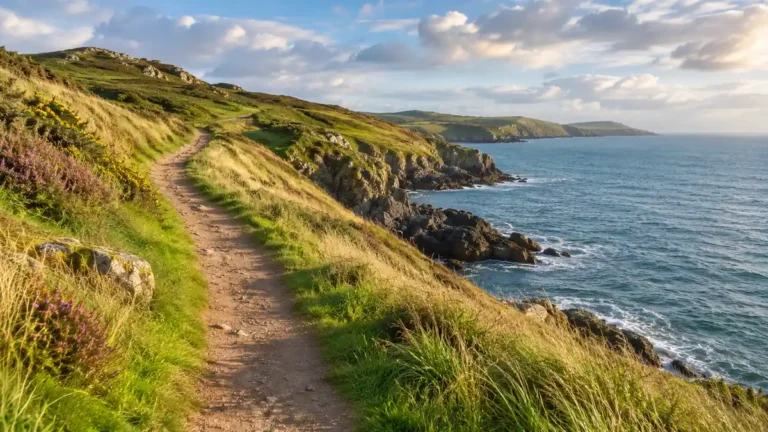
Howth: cliff walk and harbour
Howth is the best half-day trip from Dublin. This fishing harbour and headland on the north side of Dublin Bay gives you the Howth Cliff Walk above the sea, a working harbour, Howth Lighthouse and the grounds of Howth Castle.
The DART from Connolly takes about 25 minutes, and mid-morning weekday trains run about every 20 minutes, so you can simply turn up. Walkers get the most from it; so does anyone with a morning or an afternoon to fill. Back in town by lunch, you still have time for the things to do in Dublin itself.
Malahide: a castle at the end of the line
Malahide is the castle-and-gardens option on flat ground. Malahide Castle stands beside the village, and Portmarnock Beach is close by for a walk on the sand. Connolly to Malahide takes about 25–30 minutes. Families and anyone who would sooner skip a cliff path will find it the gentler day.
Dalkey, Killiney and Bray: the south side of the bay
The south side of Dublin Bay is the quieter, view-led alternative to Howth. Dalkey village is about 30 minutes from Tara Street; from there Killiney Hill gives the view over the bay, and the Vico Baths are the local sea-swimming spot. Dún Laoghaire and Bray are further stops on the same line. Repeat visitors, or anyone planning a second coast day, should come here after Howth.
Glendalough, Newgrange and Kilkenny: One to Two Hours from Dublin
The three full-day trips that give the most time on the ground are Glendalough for mountains and a monastic site, Newgrange for prehistory and Kilkenny for a medieval town. Glendalough and Kilkenny work by public transport alone; Newgrange needs a car or a tour.
Glendalough and the Wicklow Mountains
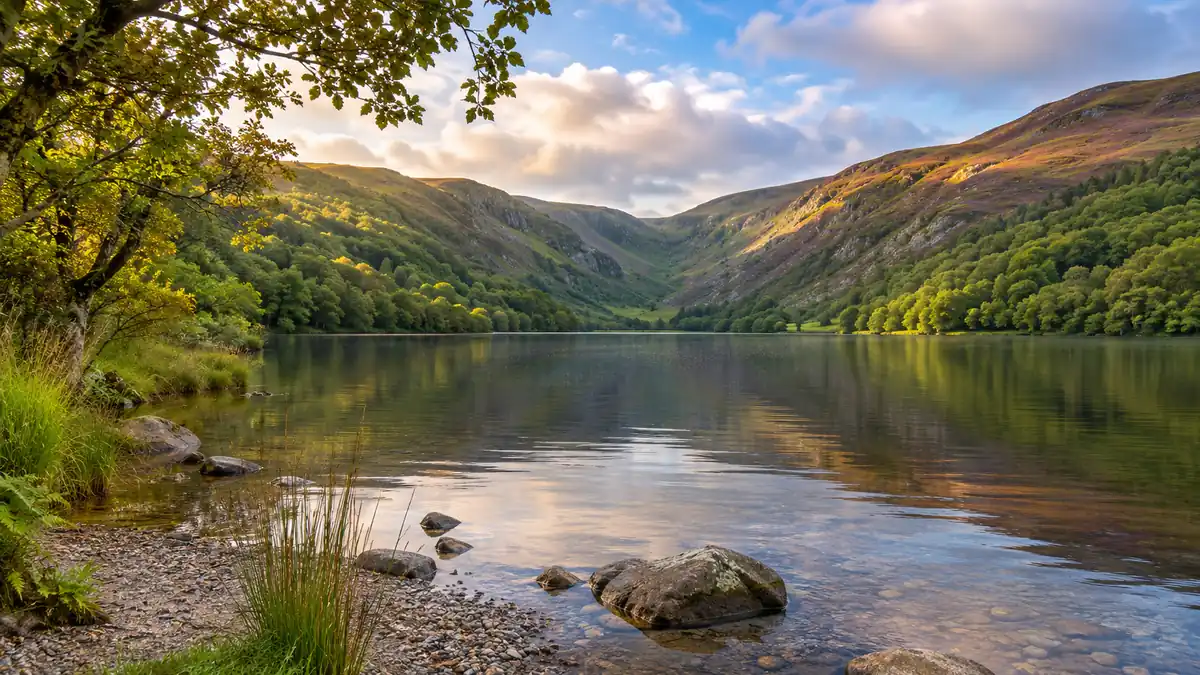
Glendalough is a monastic site and a pair of lakes inside Wicklow Mountains National Park, with a walk out to the Upper Lake as the centre of most visits. The Glendalough Visitor Centre at the valley entrance is where the bus stops.
The bus from Dublin to Glendalough takes about 80 minutes. St Kevin’s Bus, a private operator and not a Dublin Bus route, runs one day-trip departure at 11:00 from St Stephen’s Green North, arriving at Glendalough Visitor Centre at 12:20. The return leaves Glendalough at 16:30 and reaches St Stephen’s Green North at 18:00, which gives you about four hours on site. An extra evening service runs in July and August only. An adult return is EUR 23 and a single EUR 14, payable by card, cash or Leap. The service runs all year except Christmas Day.
Because the bus leaves at 11:00, there is no early alarm, unlike the coach days that pick up around 07:00.
The wider Wicklow Mountains are a different trip. Sally Gap, Lough Tay and Powerscourt Estate and Waterfall are not on the St Kevin’s route, so they need a car or a coach tour; the coach day that combines Kilkenny, the Wicklow Mountains and Glendalough runs about 10 hours, and you can reserve a seat if the mountain roads matter more than time at the lakes. Glendalough suits first-timers who want Irish landscape and a proper walk without committing to a 12-hour day.
Newgrange and the Boyne Valley
Newgrange, Knowth and Dowth are the passage tombs of Brú na Bóinne in the Boyne Valley, and Newgrange is the one most visitors come for. Nearby names fill out a longer day: the Hill of Tara, Trim Castle, Old Mellifont Abbey, Monasterboice and the Battle of the Boyne Visitor Centre.
You do need to book Newgrange in advance: pre-booking is essential, and the rules leave no room for turning up on the day.
- Every visit to Newgrange and Knowth starts at the Brú na Bóinne Visitor Centre, with a shuttle bus to the monuments and a guided tour only; arriving at the monuments themselves does not get you in.
- Tickets bought on third-party or resale platforms are not valid, and holders are refused entry.
- Tickets release about 30 days ahead in the main season and about 7 days ahead in winter; cancellations are released online daily.
- In winter only the Newgrange tour runs; Knowth joins it in the main season.
- Regular tours are suspended around the winter solstice, and the centre closes over Christmas.
- The visitor-centre exhibition on its own needs no pre-booking.
Inside, the limits are physical. There is no access to the chambers at Knowth, photography is not allowed in the Newgrange passage and chamber, and the passage itself is low and narrow. The way to get there from Dublin is by car or on a day tour.
Archaeology and history readers get the most from Brú na Bóinne, and it is the best wet-weather choice of the three, since the visit runs from the visitor centre on guided tours.
Kilkenny by train
Kilkenny is the medieval town of the shortlist, compact enough to walk end to end from the station at your own pace. The Medieval Mile links Kilkenny Castle and St Canice’s Cathedral, with the Smithwick’s Experience on the way; Jerpoint Abbey and Dunmore Cave lie outside town and need a car.
Dublin Heuston to Kilkenny (MacDonagh) takes about 1 hour 30 minutes to 1 hour 45 minutes. About eight trains a day run Monday to Saturday, the first at 07:20 from Heuston, with fewer on Sunday. The last Monday-to-Saturday arrival back into Heuston is at 22:52, so dinner in Kilkenny fits. Pick it over Glendalough when streets, pubs and a castle appeal more than mountain scenery.
Cliffs of Moher, Galway and Belfast: Are the Long Days Worth It?
The long days are doable and sold every day, but the famous names cost the most time. A Cliffs of Moher or Giant’s Causeway coach day runs about 12 to 13 hours, most of it on the road, so it is worth it only when that sight is the reason for your trip and a night outside Dublin is impossible. Otherwise, an overnight is the better plan.
Cliffs of Moher from Dublin
A Cliffs of Moher day from Dublin is a coach day of about 12 to 13 hours. Pick-up is around 07:00 and the return around 19:45, with about 2 hours at the cliffs and 2 hours in Galway, and roughly 8 hours on the road in between.
The route crosses the Burren on the way, and some tours add stops such as Bunratty Castle or Kinvara. Two hours at the cliffs is enough to walk a stretch of the clifftop; it leaves no slack to wait out bad weather on the west coast.
The Cliffs are fine as a bucket-list day and better with a night in the west. For how the site itself works and what to see once you are there, read the guide to visiting the Cliffs of Moher; for where a night in the west fits into a longer trip, see the Ireland itinerary. Take the coach day when the Cliffs are the one sight in Ireland you will not leave without.
Galway by train
Galway is worth a day trip from Dublin for a city day, and better with a night. The train from Heuston takes about two and a half hours each way, which means five hours of rail for an afternoon around Eyre Square, the Spanish Arch and Shop Street.
The day is long but fully independent: no coach, no pick-up point, your own pace in town. By train the Cliffs of Moher do not fit into the same day; the coach day above is the way to see both, with about two hours in each. If a train and a town beat a coach and a viewpoint for you, Galway is the day.
Belfast and the Giant’s Causeway (Northern Ireland)
Belfast and the Giant’s Causeway are in Northern Ireland, part of the United Kingdom, where UK entry rules and the pound sterling apply. Check the entry rules that apply to your passport before booking.
Belfast works as a day trip by train. The Enterprise from Dublin Connolly reaches Belfast Grand Central in about 2 hours 10 minutes, roughly hourly Monday to Saturday with fewer on Sunday, and trains back run hourly until about 21:00. That leaves a full day for Titanic Belfast, City Hall and St George’s Market.
The Causeway Coast is a coach-tour day, because the coast is not practical by public transport in a day from Dublin. The tours run about 12 to 13 hours, from around 07:00 to 20:00, with about 2 hours each way between Dublin and Belfast, and take in the Giant’s Causeway, Dunluce Castle and Carrick-a-Rede; if the Causeway itself is the goal, book the Causeway tour.
Game of Thrones fans should pick the coach day. The Dark Hedges in Northern Ireland, used as a filming location, is included on these Causeway tours, and a tour is the practical way to reach it.
Belfast and the Causeway suit travelers who want a second country on the trip and a city with a very different story from Dublin’s.
Rock of Cashel and Blarney Castle
The Rock of Cashel and Cahir Castle make up the southern heritage day, by car or on a coach tour. Blarney Castle in County Cork is further again: it is doable as a long coach day or a long drive, usually paired with Cashel, and it ranks among the longest days on this page. A route through the south over several days suits it better. Castle-focused travelers with a car or a tour seat are the ones who should attempt it.
Day Trips from Dublin Without a Car: Train, Bus or Coach Tour?
Most of this list works without a car. The coast, Kilkenny, Galway and Belfast are plain train trips, Glendalough has one bus out and one back, and only Newgrange, the Wicklow back roads and the Causeway Coast call for a tour or a rental.
- DART and Irish Rail give you control of the clock. Howth, Malahide and Dalkey on the DART, and Kilkenny, Galway and Belfast on intercity trains, are the day trips from Dublin you can do entirely by train; independent travelers who like to linger should build around them.
- St Kevin’s Bus is the only public route to Glendalough. It fixes your day to one departure and one return, which suits anyone happy to let the timetable set the shape of the visit.
- A coach day tour is the practical way to Newgrange, the Sally Gap and Lough Tay, the Cliffs of Moher and the Causeway Coast. You trade flexibility for a seat and a fixed clock, a good deal for first-timers who want the far sights without planning connections.
- Self-drive has the widest reach and is the only way to combine Boyne Valley or Wicklow stops freely. Driving is on the left, which is why this page leads with the other three; confident drivers after back roads and their own stops gain the most.
Three Dublin starting points cover every car-free trip here: Connolly for the northern coast and Belfast, Heuston for Kilkenny and Galway, and St Stephen’s Green for the Glendalough bus. For getting across the city to them and for the Leap card, see the Dublin travel guide.
Train and bus tickets
Compare routes, schedules and prices across rail and bus operators in one search, with mobile tickets on your phone.
New to Omio? Code NEW10 takes 10% off your first booking — or APPNEW10 if you book inside the Omio app. Both apply to bookings up to €80.
Search routes and compare prices on Omio →
Tripstou may earn a commission if you book through this link, at no extra cost to you.
Which Dublin Day Trip Fits Your Trip?
Glendalough is the default, and it is the wrong choice in three cases. With only half a day, take Howth. In bad weather, or with a taste for archaeology, take Newgrange. When the Cliffs of Moher are the reason you came to Ireland, give them a night in the west instead of a coach day.
The half-day visitor belongs on the DART: Howth for cliffs, Malahide for a castle and level paths if hiking is not your thing. History readers should go to Brú na Bóinne, booked well ahead. Kilkenny is the answer for anyone who would trade the mountains for a walkable town.
Second-country collectors should take the Enterprise to Belfast, and add the Causeway Coast only if they accept a long coach day. Bucket-list travelers who will only ever come to Ireland once can justify the Cliffs of Moher run from Dublin; everyone else gets more from a night out west.
The Ring of Kerry and Dingle in County Kerry are not day trips from Dublin at all. They belong on a longer route, and the guide to the best places to visit in Ireland shows where they fit.
How This Shortlist Was Put Together
This page selects day trips from a Dublin base and groups them by time each way and by whether they work without a car, with journey times read from the operators’ timetables; it is not a guide to Dublin’s own sights, a route around Ireland or a list of tours to book.
These journey times and access rules were checked by Alex Perrut, working in tourism since 2015, for the Tripstou editorial team, on a page drafted with AI assistance; our editorial process explains how we work.
Official sources consulted: Irish Rail, St Kevin’s Bus, Heritage Ireland (OPW), Wild Rover Tours.
Did this guide save you time or money? Tripstou is independent and reader-funded — if you'd like to give something back, you can support the site with a crypto contribution of any size.